1. Introduction
Electrochemical reduction of carbon dioxide offers a way to turn a waste gas and renewable electricity into chemicals, and of the many possible products formate has a particular appeal. Its formation needs only two electrons and two protons, it leaves the cell in the liquid phase, and it has existing markets as well as a proposed role as a carrier of hydrogen (Eppinger and Huang, 2017). Analyses of process cost have singled out formic acid and carbon monoxide as the products most likely to repay the electricity spent on them (Agarwal et al., 2011; Jouny et al., 2018).
Which metals give formate has been understood in outline for a long time. The surveys of Hori et al. (1994) sorted metal electrodes in aqueous bicarbonate into groups: lead, mercury, indium, tin and cadmium yield mainly formate, gold, silver and zinc yield carbon monoxide, copper alone gives hydrocarbons and alcohols in quantity, and metals such as nickel, iron and platinum evolve hydrogen (Hori, 2008). Bismuth was later added to the first group. The task for catalyst design has therefore been less to discover new elements than to present the known ones in forms that are active at low overpotential, stable, and free of toxic or scarce components.
Metal-organic frameworks entered this field as a means to that end. They are crystalline solids in which metal ions or clusters are joined by organic linkers into open networks (Furukawa et al., 2013), and they place the metal in a regular, atomically dispersed arrangement surrounded by carbon and often nitrogen. Heating or electrochemical reduction converts that arrangement into small metal-containing particles in intimate contact with a conducting support. This article reviews what has been published on such framework-derived catalysts for the formate reaction specifically.
2. Scope and Approach
This is a narrative review of the published literature. It draws on the foundational electrochemical studies, on reviews of framework-derived materials, and on primary reports that are widely cited in discussions of formate catalysts. It does not attempt an exhaustive catalogue of every material reported, and it does not tabulate performance figures, because values measured in different cells and electrolytes are not comparable on their face. The aim is to bring out the reasoning that links precursor, conversion route, working catalyst and measured selectivity, and to identify where that reasoning rests on firm evidence and where it does not.
3. Why Some Metals Give Formate
The reduction of carbon dioxide to formate and to carbon monoxide both transfer two electrons, and the branch between them is set early. Computational work has attributed the difference to the way the first intermediate binds. Where the surface holds the intermediate through its oxygen atoms, as a bidentate formate-like species written *OCHO, hydrogenation at carbon follows and formate is released. Where the intermediate binds through carbon, as *COOH, the path leads to carbon monoxide. Feaster et al. (2017) showed, by combining experiment on tin with calculations across several metals, that the binding energy of *OCHO describes formate activity well and that tin sits near the top of the resulting volcano. Theoretical screening by other groups has pointed the same way.
Two consequences follow for catalyst design. The first is that oxophilic post-transition metals are favoured, which accounts for the long-standing dominance of tin, indium, bismuth and lead. The second is that the state of the surface matters as much as the element. Chen and Kanan (2012) found that a tin electrode stripped of its native oxide produced mostly hydrogen, while tin deposited together with its oxide was selective for carbon dioxide reduction, and Zhang et al. (2014) obtained high formate selectivity from tin oxide nanocrystals on carbon supports. Oxide-derived, defect-rich and nanostructured surfaces recur throughout the later literature, and framework-derived catalysts belong to that line of work. A general account of the mechanistic picture and of its unresolved points is given by Birdja et al. (2019).
4. Frameworks as Catalyst Precursors
The idea of using a framework as a sacrificial template predates its application to carbon dioxide. Liu et al. (2008) carbonised a zinc carboxylate framework loaded with a carbon source and obtained a highly porous carbon, and the approach was soon generalised to give metals, oxides, carbides and nitrogen-doped carbons from many frameworks (Dang et al., 2018). What the template offers is control: the metal is dispersed at the atomic scale before conversion, the linker supplies carbon and heteroatoms in fixed proportion, and the morphology of the parent crystal often survives as the shape of the product.
For formate the relevant precursors fall into a few families, summarised in Table 1. Figure 1 sets out the general chain from precursor through conversion to the working catalyst, together with the observations needed to support a claim about each link.
| Precursor family | Usual conversion | Catalyst obtained | Principal question |
|---|---|---|---|
| Bismuth carboxylate frameworks | Reduction in the electrolyte; mild pyrolysis | Metallic bismuth sheets or particles | What the framework adds over simpler bismuth salts |
| Indium carboxylate frameworks | Pyrolysis or calcination | Indium or indium oxide in carbon | Scarcity and cost of indium |
| Tin introduced into a host framework | Pyrolysis under inert gas | Tin oxide or tin sites on doped carbon | Nature of the active tin species |
| Copper frameworks, intact or converted | Electrochemical reduction | Copper and copper oxide particles | Product mixture shifts as the solid restructures |
| Zinc imidazolate frameworks with a guest metal | High-temperature pyrolysis | Metal-nitrogen sites in carbon | These sites mostly favour carbon monoxide |
| Bimetallic frameworks | Any of the above | Alloy or oxide interface | Separating composition effects from morphology |
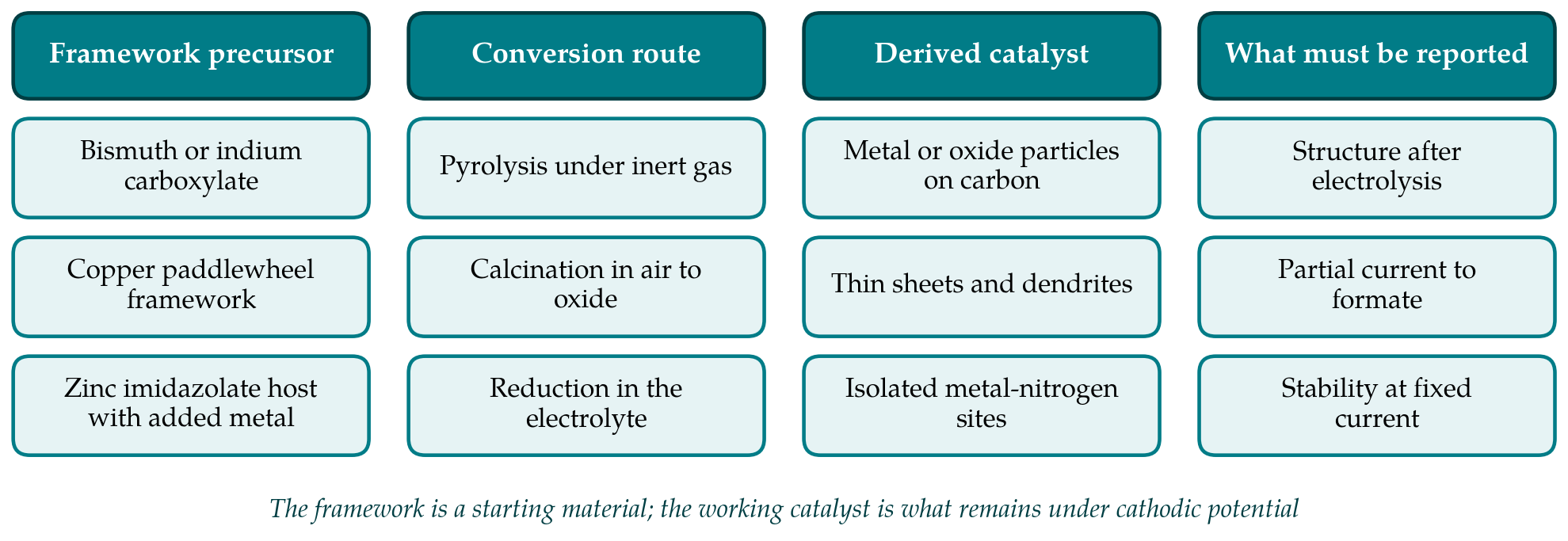
4.1. Thermal conversion
Pyrolysis under an inert atmosphere reduces the metal ions and carbonises the linker. With zinc imidazolate frameworks the zinc itself is largely lost as vapour at high temperature, since the metal boils at 907 °C, and what remains is a nitrogen-doped carbon that can hold a second metal as isolated sites. Zhao et al. (2017) used ion exchange followed by pyrolysis to place single nickel atoms in such a carbon. That catalyst, like most metal-nitrogen-carbon materials, reduces carbon dioxide to carbon monoxide, which is a reminder that the template alone does not decide the product. For formate the pyrolysed framework must retain tin, indium or bismuth, usually as oxide or metal particles some nanometres across, and the temperature has to be chosen to carbonise the linker without sintering or volatilising the metal.
Calcination in air takes the other course and burns the linker away, leaving an oxide that keeps something of the parent morphology. The oxide is then reduced in the cell. In either case the conducting carbon, the particle size and the residual nitrogen all change together with the conditions of heating, which makes it hard to attribute a gain in selectivity to any one of them.
4.2. Electrochemical conversion
Many frameworks are not stable at the potentials needed for carbon dioxide reduction. The metal nodes are reduced, the linkers are released or hydrolysed in bicarbonate, and the solid reorganises into metallic or oxidic nanostructures. Bismuth frameworks illustrate the case. Structurally well-defined bismuth carboxylates such as the trimesate characterised by Inge et al. (2016) are available, and Lamagni et al. (2020) reported that a bismuth framework restructures during electrolysis into nanoscale bismuth that is active and selective for formate. The outcome resembles the bismuth nanosheets obtained by Han et al. (2018) from a layered bismuth oxyiodide, a precursor that is not a framework at all. The comparison suggests that the decisive feature is the in situ formation of thin, defect-rich metallic bismuth, and that several kinds of precursor can deliver it.
5. Does the Framework Survive?
A distinction therefore runs through the literature between frameworks used as catalysts and frameworks used as precatalysts. Early demonstrations employed the intact solid. Hinogami et al. (2012) reduced carbon dioxide on a copper rubeanate framework and observed formic acid as the main product, and Kornienko et al. (2015) grew thin films of a cobalt porphyrin framework that produced carbon monoxide, with spectroelectrochemical evidence that the cobalt centres were the active sites. In such systems the linker and node are designed to be the catalyst, and stability under potential is the property that has to be proved.
For the carboxylate frameworks of copper, bismuth, indium and tin the weight of evidence points the other way. Copper frameworks built on the paddlewheel unit first described by Chui et al. (1999) are reduced to copper and copper oxide particles under cathodic bias, and their product distribution drifts as this happens. Zheng and Lee (2021) argued that for electrocatalysis in general the question of catalyst or precatalyst should be asked of every framework, and answered with characterisation after and during operation instead of before it. Diffraction, electron microscopy and X-ray absorption measurements on the used electrode are the minimum; operando Raman or absorption spectroscopy is better. A report that characterises only the as-made framework says little about what catalyses the reaction.
6. Measurement, Reporting and Comparison
Claims about formate catalysts rest on three numbers: the Faradaic efficiency, the partial current density and the potential at which they are obtained. Each is easy to misstate. Formate is quantified in the liquid, usually by nuclear magnetic resonance or ion chromatography, and must be reconciled with the gaseous products so that the efficiencies sum to about one hundred per cent. Potentials need correction for uncompensated resistance. Current should be referred both to geometric area and, where possible, to electrochemically active area, because a porous framework-derived electrode can show a large geometric current simply by having more surface. Clark et al. (2018) set out standards for these measurements that apply to derived catalysts as much as to metal foils.
Controls matter particularly for derived catalysts. The carbon produced from a linker may contain residual zinc or other metals; a nitrogen-doped carbon without the intended metal should be tested under identical conditions. Isotope labelling with 13CO2 confirms that formate arises from the gas and not from decomposing linker, which is a real possibility when the precursor contains carboxylate groups. Finally, the natural comparison for a framework-derived bismuth or tin catalyst is the same metal made by a simpler route, such as electrodeposition or reduction of a commercial oxide, measured in the same cell.
7. From H-Cells to Devices
Most framework-derived catalysts have been evaluated in two-compartment H-cells with the electrode immersed in carbon dioxide-saturated bicarbonate. The low solubility of the gas in water caps the attainable current, so results from such cells say little about behaviour at the current densities a process would require. Gas-diffusion electrodes remove that limit by bringing gas, electrolyte and catalyst together at a thin interface (Weekes et al., 2018). Burdyny and Smith (2019) argued that the local environment in such electrodes, notably the high pH near the catalyst, differs so much from that in an H-cell that performance must be assessed under the conditions of use.
Formate brings its own engineering problem. In neutral or alkaline electrolyte the product is the formate anion, since the pKa of formic acid is 3.75, and it is obtained as a dilute salt solution that must be separated and acidified. It can also cross an anion-exchange membrane and be oxidised at the anode. Cell designs with a centre compartment bounded by cation- and anion-exchange membranes were developed to deliver formic acid directly (Yang et al., 2017), and Xia et al. (2019) replaced the liquid in that compartment with a porous solid electrolyte to obtain concentrated acid free of dissolved salts, using a bismuth catalyst. Whether framework-derived materials keep their structure and selectivity in these configurations, over long periods at high current, has been examined far less often than their behaviour in an H-cell.
8. Gaps and Directions
Several gaps stand out. Durability is reported over hours far more often than over the much longer periods relevant to use, and the slow processes that degrade post-transition metal catalysts, such as particle coarsening, dissolution and redeposition, and flooding of the gas-diffusion layer, need longer tests to appear. The contribution of the carbon matrix is rarely isolated. Synthesis of the framework adds solvent, linker and time to the cost of the catalyst, and few studies ask whether the gain over a directly prepared oxide justifies it. Tin, which is cheap and abundant, has fewer well-defined framework precursors than bismuth or indium, and indium is too scarce to be an obvious choice at scale.
Progress is likely to come from treating reconstruction as something to be designed and not merely observed: choosing linkers and node geometries so that the solid collapses into a particular morphology, and verifying the result by operando methods. Agreement on test conditions would help as much as new materials. If framework-derived catalysts were routinely compared at fixed current in gas-fed cells, with the used electrode characterised, the literature would be far easier to read.
9. Conclusion
The published work on framework-derived catalysts for formate builds on a secure foundation: the metals that favour the reaction are known, and the oxygen-bound intermediate explains why. Frameworks have proved to be convenient and versatile precursors for nanostructured bismuth, tin and indium phases, and in the bismuth case the resulting catalysts are among the most selective described. The evidence also shows that the framework seldom persists under working conditions, so its merit lies in the structure it leaves behind. Longer tests in realistic cells, honest controls against simpler syntheses and characterisation of the used catalyst are what the field most needs before the approach can be judged on practical grounds.
Conflict of interest
To be declared by the author(s) before publication.
Funding
To be declared by the author(s) before publication.