1. Introduction
Climate change has a temporal structure that fits awkwardly with adjudication. Emissions released now produce their gravest effects decades later, and those who will bear them have no vote and no voice in the proceedings in which reduction targets are set. Gardiner (2011) called this the intergenerational storm: each generation has an incentive to take the benefits of emitting and pass the costs forward. The scientific assessments leave little doubt about the direction of travel, with every increment of warming bringing more severe and in some cases irreversible harm (IPCC, 2023).
Litigants have responded by asking courts to hold states to account on behalf of the young and the unborn. Surveys of the field record a steady rise in cases against governments and a marked turn towards arguments founded on constitutional and human rights (Peel and Osofsky, 2018; Savaresi and Setzer, 2022; Setzer and Higham, 2023). Within that turn, intergenerational equity has moved from rhetorical background to an operative part of the reasoning in several apex courts.
This review traces that movement. It asks which legal techniques courts have used to give the interests of later generations weight against the preferences of present majorities, how the academic literature has received those techniques, and what remains unsettled. The focus is on claims against states; litigation against corporations raises different questions of causation and attribution and is left aside.
2. Approach of the Review
The article is a narrative review of the published literature and of the decisions on which that literature concentrates. Sources were chosen for their influence on the debate, not through a systematic search, and the account is weighted towards jurisdictions whose judgments are available in English or have been closely analysed in English-language journals. That is a real limitation. Reviews of climate litigation scholarship have noted its concentration on a small number of high-profile cases from the Global North and the relative neglect of routine disputes and of courts elsewhere (Setzer and Vanhala, 2019).
3. Intellectual and Treaty Foundations
The modern legal concept owes most to Weiss (1989), who described each generation as both trustee and beneficiary of the planet and derived three duties from that position: to conserve the diversity of the resource base so that later generations keep their options, to pass on the environment in no worse condition than it was received, and to preserve access to the common legacy. She presented these as principles of international law in the making (Weiss, 1990). Philosophers had prepared the ground. Rawls (1971) included a just savings principle in his account of justice between generations, while Parfit (1984) raised the difficulty that policies affecting the distant future also determine who will exist, so that no identifiable future person is made worse off by them.
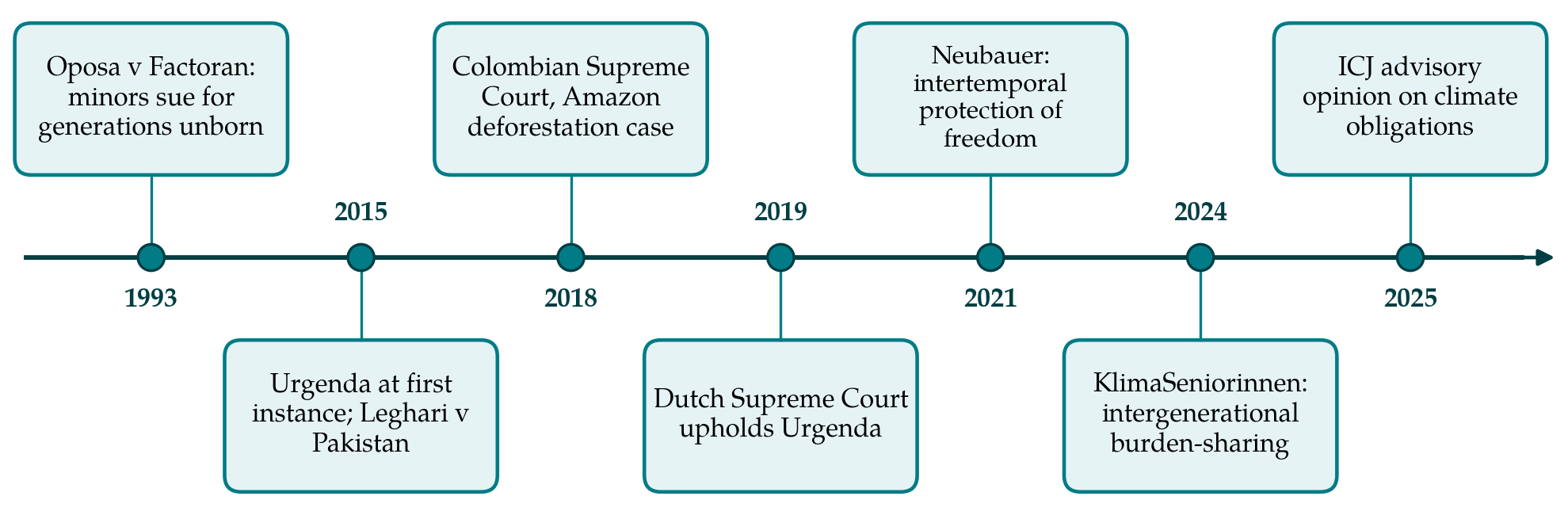
Treaty law adopted the vocabulary without giving it hard edges. The Stockholm and Rio Declarations refer to present and future generations. Article 3 of the United Nations Framework Convention on Climate Change directs the parties to protect the climate system for the benefit of present and future generations of humankind on the basis of equity (United Nations, 1992), and the preamble to the Paris Agreement lists intergenerational equity among the matters parties should respect when acting on climate change (United Nations, 2015). The International Court of Justice referred to generations unborn in its 1996 advisory opinion on nuclear weapons and again in Gabcikovo-Nagymaros in 1997. The standard treatise nonetheless treats the principle as one that informs interpretation and does not by itself generate enforceable obligations (Bodansky et al., 2017). Litigation has been the means of testing whether it can do more. Figure 1 places the main decisions in sequence.
4. Doctrinal Routes Taken by Courts
Courts have reached the future by different paths, and the differences matter for how far each doctrine can travel between legal systems. Table 1 summarises the five routes discussed below.
| Route | Core idea | Leading decision | Related scholarship |
|---|---|---|---|
| Representative standing | Living minors may sue for themselves and for generations to come | Oposa v Factoran (Philippines, 1993) | Weiss, 1990 |
| Positive human rights obligations | Rights to life and private life require adequate mitigation now | Urgenda (Netherlands, 2019) | Mayer, 2019 |
| Intertemporal freedom | Delay today forces drastic limits on liberty later | Neubauer (Germany, 2021) | Minnerop, 2022 |
| Public trust | The state holds the atmosphere on trust for successive generations | Juliana (USA, 2020); Held v Montana | Blumm and Wood, 2017 |
| Future generations as rights-holders | Those not yet born have enforceable environmental rights | Future Generations v Ministry of Environment (Colombia, 2018) | Rodríguez-Garavito, 2022 |
4.1. Representative standing
The earliest and still most quoted decision is Oposa v Factoran, in which the Supreme Court of the Philippines allowed a group of children to challenge timber licences on their own behalf and on behalf of generations yet unborn. The court grounded their standing in the constitutional right to a balanced and healthful ecology and in what it called intergenerational responsibility. The decision was about forests, not climate, and its practical outcome was modest, but it supplied a template that climate litigants adopted two decades later. Its weakness as doctrine is that it says little about how a court should identify the interests of the absent or who may speak for them.
4.2. Positive obligations under human rights law
The Urgenda litigation showed that a court could order deeper emission cuts without any novel theory of future rights. The Dutch Supreme Court held in 2019 that Articles 2 and 8 of the European Convention on Human Rights oblige the state to do its part against a real and immediate risk to the lives and welfare of residents, and it confirmed an order requiring a reduction of at least 25 per cent by the end of 2020 against 1990 levels. The claimant foundation had pleaded the interests of future generations, yet the judgment rested on risks to people already living (Mayer, 2019). The earlier argument that human rights law imposes duties to address climate change, developed by Knox (2009), was vindicated in its most conventional form. The Lahore High Court in Leghari v Federation of Pakistan and the Irish Supreme Court in Friends of the Irish Environment reached state accountability by related though distinct reasoning.
4.3. Intertemporal protection of freedom
The German Federal Constitutional Court's order of March 2021 in Neubauer is the most original contribution. The court declined to find that the legislature had breached its duty to protect life and health. It held instead that the Federal Climate Change Act, by permitting generous emissions until 2030 and leaving the path afterwards unspecified, pushed the burden of reduction into a period in which almost every exercise of liberty that involves emissions would have to be curtailed. Because the constitution's environmental clause, Article 20a of the Basic Law, commits the state to climate neutrality and thus to a finite budget, present leniency operates as an advance interference with future freedom (Minnerop, 2022). The complainants were young people alive today, so the court avoided attributing rights to the unborn while giving the future direct constitutional weight. Kotzé (2021) reads the decision as a step towards a planetary perspective, though one that stops short of protecting claimants outside Germany.
4.4. Public trust
In the United States youth plaintiffs have relied on the public trust doctrine, which Sax (1970) revived as a tool of judicial intervention in resource management and which Wood (2014) extended to the atmosphere. The theory treats government as a trustee obliged to preserve the trust assets for successive beneficiaries (Blumm and Wood, 2017). In Juliana v United States the federal Court of Appeals for the Ninth Circuit accepted in 2020 that the plaintiffs had shown injury and causation but dismissed the claim because an order requiring a national remedial plan lay beyond judicial power. State constitutions have proved more receptive. In Held v Montana the state courts held that a statutory bar on considering greenhouse gas emissions in environmental reviews violated the Montana constitution's guarantee of a clean and healthful environment for present and future generations.
4.5. Future generations as rights-holders
A smaller group of decisions speaks of future generations as subjects of rights in their own name. The Colombian Supreme Court, ruling in 2018 on a claim by young plaintiffs about deforestation in the Amazon, described the unborn as holders of environmental rights and ordered the preparation of an intergenerational pact for the forest. Contributors to Rodríguez-Garavito (2022) present the case as part of a distinct Latin American jurisprudence. At the international level the Maastricht Principles on the Human Rights of Future Generations, adopted by a group of experts in 2023, restate existing law on the same premise. The European Court of Human Rights took a more cautious line in Verein KlimaSeniorinnen Schweiz v Switzerland in 2024. It found a violation of Article 8 and spoke of intergenerational burden-sharing as a reason for binding targets and timetables, while keeping victim status tied to living applicants and to associations acting for them.
5. Recurring Objections
Four objections appear across the judgments and the commentary. The first is procedural. Standing rules built around individualised present injury sit uneasily with harm that is diffuse and deferred, and Juliana shows that a claim can fail on redressability even where the facts are accepted. The second is institutional: setting emission pathways involves distributive choices that many judges consider the business of legislatures. The courts that have granted relief have usually answered by ordering the state to meet a floor derived from its own commitments or from scientific consensus and leaving the means open (Peel and Osofsky, 2015).
The third objection is philosophical. If Parfit's non-identity problem holds, a rights claim made for specific future persons is hard to sustain, since different policies produce different people. Lawrence (2014) argues that the difficulty can be met by framing duties towards future generations as a class whose basic interests are foreseeable whoever its members turn out to be. The doctrines that have prevailed in court take a practical way around the problem by anchoring the claim in children and young adults who exist now and will live through the relevant decades.
The fourth objection comes from within progressive scholarship. Humphreys (2022) contends that talk of future generations displaces attention from those already suffering climate harm, most of them in poorer countries, and offers wealthy states a way of expressing concern without redistribution. Wewerinke-Singh et al. (2023) reply that intergenerational and intragenerational justice are complements, and that many of the communities at issue themselves frame their claims in terms of ancestors and descendants. The exchange has made clear that the concept carries political risks as well as legal promise.
6. Gaps and Future Directions
Three areas call for further work. Remedies are the first. Declaratory relief and orders to revise targets are now familiar, but there is little analysis of how courts supervise compliance over the long periods involved or of what follows when a state misses a judicially confirmed target. The second is the position of claimants beyond the forum state. Neubauer admitted complainants from Bangladesh and Nepal without granting them the same protection, the European Court declared Duarte Agostinho inadmissible against all but the home state on jurisdictional grounds, and the Committee on the Rights of the Child in Sacchi v Argentina accepted a broader view of jurisdiction before rejecting the communication for failure to exhaust domestic remedies. Intergenerational equity that stops at the border is an incomplete idea.
The third area is the effect of the advisory opinions delivered by international courts. The International Court of Justice, in its 2025 opinion on the obligations of states in respect of climate change, treated intergenerational equity as a consideration relevant to the interpretation of those obligations, and the Inter-American Court of Human Rights has addressed the climate emergency in an advisory opinion of its own. How far domestic courts will draw on these pronouncements, and whether they will harden a principle that treaty practice left soft, is a question for the next phase of research. Comparative work on legislative and institutional alternatives, such as commissioners for future generations, would also help to show what litigation can and cannot be expected to deliver.
7. Conclusion
Intergenerational equity has become justiciable by being made concrete. The decisions that have changed state policy did not rest on a general right of the unborn. They rested on the finite quantity of emissions compatible with agreed temperature limits and on the recognition that what one cohort uses is unavailable to the next. Seen in that light the German doctrine of intertemporal freedom and the Strasbourg language of burden-sharing are versions of one insight, and the public trust expresses it in the idiom of property. The literature is right to press on the limits of the idea, especially its territorial confinement and its uneasy relation to present inequality. Within those limits it has given courts a principled reason to insist that climate targets be set early, specified in advance and backed by law.
Conflict of interest
To be declared by the author(s) before publication.
Funding
To be declared by the author(s) before publication.