1. Introduction
Shrimp farming grew for decades by exchanging water. Ponds were flushed to dilute ammonia and phytoplankton, and the effluent carried nutrients, organic matter and, when disease struck, pathogens into the estuaries that neighbouring farms drew upon (Boyd and Tucker, 1998). The viral epidemics that swept through Asia and the Americas from the early 1990s made the weakness of that model plain (Lightner, 2011; Flegel, 2012). A farm that takes in large volumes of untreated water takes in whatever the water contains.
Biofloc technology is one response. The idea is to retain the water and to manage the microbial community within it so that waste nitrogen is converted into bacterial biomass or into nitrate without leaving the pond. The principle was formulated for pond aquaculture by Avnimelech (1999), who showed that the ratio of carbon to nitrogen in the inputs could be used as a control variable, and it was demonstrated at commercial scale in lined, heavily aerated shrimp ponds in Belize (Burford et al., 2004). The Pacific white shrimp, Litopenaeus vannamei, tolerates the turbid, crowded conditions that result and has become the principal species grown in this way.
Reviews of the technology have generally concentrated on one aspect, most often the microbiology and water chemistry (De Schryver et al., 2008; Crab et al., 2012; Emerenciano et al., 2013). A farmer deciding whether to adopt it faces all aspects at once. This review therefore considers water quality, disease and economics together, and asks how far the claims made in each area are supported.
2. Approach
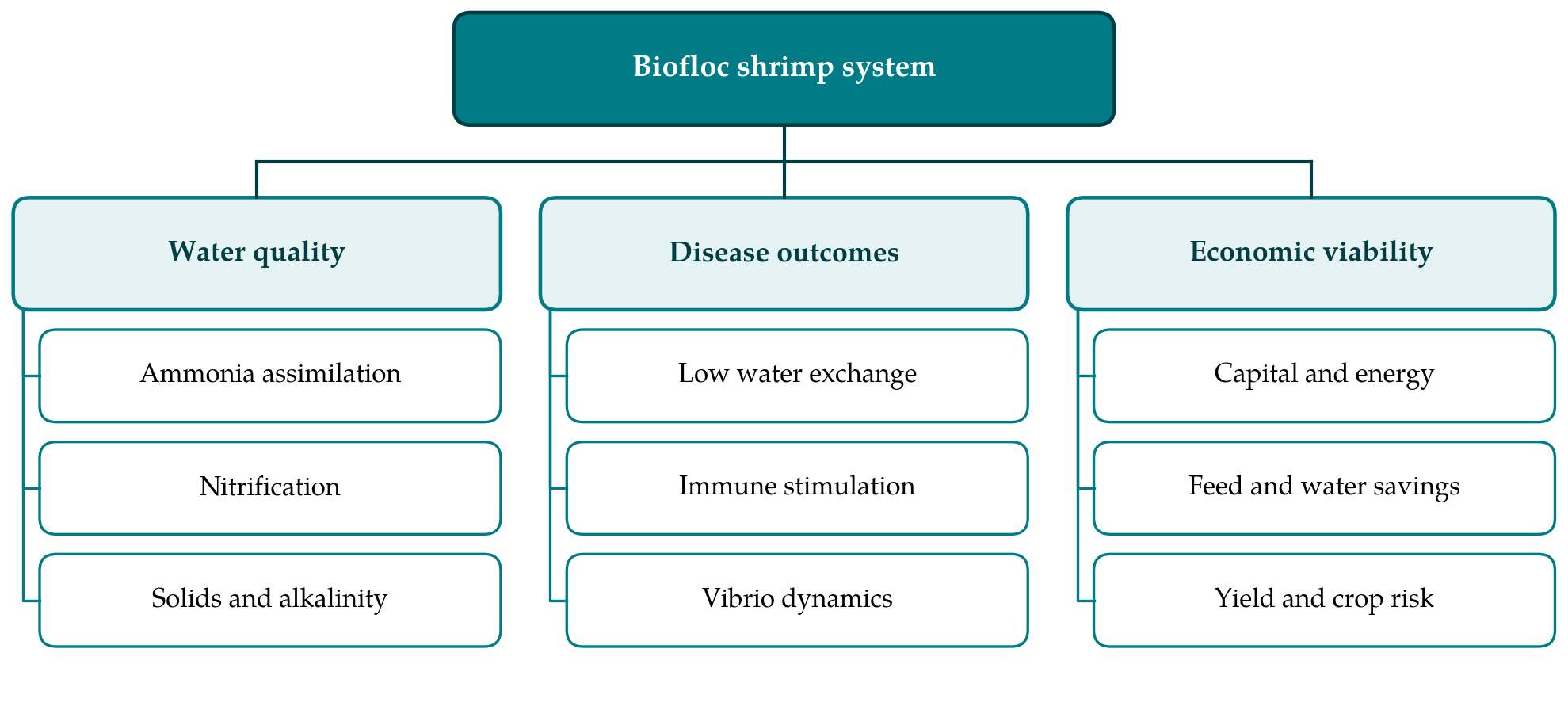
The article is a narrative review of the published literature on biofloc systems for penaeid shrimp, with emphasis on L. vannamei. It relies on the foundational papers that established the principles, on experimental studies that have been widely cited and repeated, and on the practical manuals written by groups with long operating experience (Avnimelech, 2009; Hargreaves, 2013; Samocha, 2019). It does not attempt an exhaustive or quantitative synthesis. Figure 1 sets out the three themes and the topics considered under each.
3. Water Quality Dynamics
Shrimp retain only a minor part of the nitrogen in their feed. Most of the remainder is excreted as ammonia or released as faeces and uneaten feed that decompose to ammonia. In a system without water exchange that ammonia must be removed biologically, and three pathways compete to do so.
3.1. Three pathways of nitrogen removal
The stoichiometry of the three pathways was set out by Ebeling et al. (2006) and their place in suspended-growth systems by Hargreaves (2006). Algae assimilate ammonia in the light, consuming carbon dioxide and producing oxygen. Nitrifying bacteria oxidise ammonia to nitrite and then to nitrate; they grow slowly, yield little biomass, and consume oxygen and a large amount of alkalinity. Heterotrophic bacteria, when supplied with organic carbon, assimilate ammonia directly into new cells. They grow fast and respond within hours, but they produce many times more biomass per unit of nitrogen than nitrifiers do, and they also consume oxygen and release carbon dioxide. Table 1 compares the pathways and the management response each calls for.
| Process | Effect on the water | Management response | Sources |
|---|---|---|---|
| Algal uptake | Removes ammonia in daylight; oxygen and pH swing between day and night | Dominant only at low feeding rates; limited by shading | Hargreaves, 2006 |
| Heterotrophic assimilation | Rapid ammonia removal; large production of bacterial solids | Add carbohydrate to raise the carbon to nitrogen ratio | Avnimelech, 1999 |
| Nitrification | Converts ammonia to nitrate; consumes alkalinity; slow to establish | Allow time to mature; correct alkalinity with lime or bicarbonate | Ebeling et al., 2006; Furtado et al., 2011 |
| Solids accumulation | Rising oxygen demand; gill fouling at high concentrations | Settle or filter part of the solids | Ray et al., 2010; Schveitzer et al., 2013 |
| Microbial respiration | Continuous oxygen demand from flocs as well as shrimp | Uninterrupted aeration and mixing with backup power | Hargreaves, 2013 |
| Nitrite build-up | Transient peak during start-up; more toxic at low salinity | Inoculate with mature water; limit feed until nitrifiers establish | Lin and Chen, 2003 |
Avnimelech (1999) reasoned that because bacteria build their cells with a fairly constant proportion of carbon to nitrogen, a supply of carbohydrate matched to the ammonia to be removed would drive heterotrophic uptake. Molasses, sugar, starch and cereal brans have all been used (Avnimelech, 2009). The same effect can be had by lowering the protein content of the feed, since protein is the source of the nitrogen.
In practice the pathways coexist and their balance shifts through a crop. Algae dominate a newly filled pond in sunlight. As feeding rises, bacteria overtake them and the water turns from green to brown. Nitrifiers establish over a period of weeks and, once present, take a growing share of the ammonia, so that mature systems accumulate nitrate and need less added carbon than the heterotrophic model implies (Hargreaves, 2013). Operators who continue to add carbohydrate at the initial rate produce more solids, and consume more oxygen, than the water chemistry requires.
3.2. Solids, oxygen and alkalinity
The price of converting nitrogen to biomass is that the biomass remains in the water. Suspended solids rise through the crop, and with them the oxygen demand of the water itself. Ray et al. (2010) showed that removing part of the solids with simple settling chambers improved shrimp production in superintensive raceways, and Schveitzer et al. (2013) found that performance was best at intermediate floc concentrations, with very high levels harming the animals. A biofloc system is therefore managed within a band of solids, monitored with settling cones or by total suspended solids, and not simply allowed to thicken.
Respiration and nitrification both acidify the water and deplete alkalinity, and in closed systems the loss is not made good by incoming water. Regular additions of bicarbonate, carbonate or hydrated lime are standard, and their relative merits were compared by Furtado et al. (2011). Start-up is the most hazardous period. Ammonia-oxidising bacteria usually establish before nitrite oxidisers, and nitrite can accumulate to harmful concentrations in the interval. The toxicity of both ammonia and nitrite to L. vannamei increases as salinity falls (Lin and Chen, 2001; Lin and Chen, 2003), which matters because much biofloc production takes place inland in low-salinity water.
3.3. Bioflocs as food
Flocs are eaten. Using nitrogen isotopes in the Belize ponds, Burford et al. (2004) showed that flocculated material contributed measurably to the nitrogen retained by the shrimp, and Wasielesky et al. (2006) found that juveniles grew better and converted feed more efficiently in floc-rich water than in clear water on the same diet. The nutritional value of flocs varies with the carbon source and the microbial community, and they supplement formulated feed without replacing it (Emerenciano et al., 2013). The practical gain is that feeds of somewhat lower protein content can be used, and that nitrogen is recycled once before it leaves the system.
4. Disease Outcomes
Claims that biofloc systems reduce disease rest on two distinct mechanisms, and the evidence for them is of different quality.
4.1. Exclusion
The first mechanism is exclusion. White spot syndrome virus and other major pathogens enter farms with water, with wild crustacean carriers and with infected postlarvae (Lightner, 2011; Flegel, 2012). A lined pond or tank that is filled once with disinfected water, stocked with postlarvae from tested broodstock and then closed has far fewer routes of entry than a pond exchanging water daily. This is a property of low exchange and good biosecurity, not of bioflocs as such, but biofloc management is what makes low exchange workable at high density. The argument is strong and follows from first principles of epidemiology. It also implies a corollary that is often overlooked: once a pathogen is inside a closed, densely stocked system, there is little to slow it.
4.2. Effects on the host and on pathogens
The second mechanism is an effect of the flocs on the shrimp or on the pathogens. Bacterial cell wall components are recognised by the innate immune system of crustaceans, and shrimp living in bioflocs are continuously exposed to them. Ekasari et al. (2014) reported higher values of several immune indicators and better survival after challenge with infectious myonecrosis virus in shrimp that had been fed bioflocs grown on different carbon sources, and Kim et al. (2014) found increased expression of immune-related genes in postlarvae reared in biofloc water. These are laboratory results over short periods. They show that an effect exists; they do not show how large or how lasting it is in a commercial crop.
Effects on bacterial pathogens have also been proposed. Floc bacteria may compete with vibrios for nutrients and attachment sites, some accumulate poly-β-hydroxybutyrate, which has shown protective activity against pathogenic vibrios in model organisms, and some interfere with the quorum sensing that regulates vibrio virulence (Defoirdt et al., 2007; De Schryver et al., 2008). Against this must be set the fact that bioflocs are an organically rich habitat in which vibrios also grow well. Acute hepatopancreatic necrosis disease, caused by particular strains of Vibrio parahaemolyticus (Tran et al., 2013), has prompted interest in biofloc and related mature-water systems as a control measure. The supporting evidence is largely from small-scale challenge tests and farm observation, and controlled field comparisons are lacking. The honest summary is that bioflocs probably help through biosecurity, may help through immune stimulation and microbial competition, and cannot be relied upon to protect a crop once a virulent pathogen has entered.
5. Economic Viability
The economic case is assembled from several components that pull in different directions, and it is best examined with the ordinary tools of farm management: an enterprise budget for the whole system and a partial budget for each change from current practice (Engle, 2010).
On the cost side, biofloc systems need lined ponds or tanks, an aeration capacity several times that of a conventional semi-intensive pond, a reliable electricity supply with standby generation, and equipment for solids control. Energy for continuous aeration and mixing is a major operating cost, and aeration cannot be interrupted for long without loss of the crop (Hargreaves, 2013). Carbohydrate and alkalinity supplements add to the bill. Skilled labour is needed, because the margin for error in a superintensive system is narrow and mistakes are expensive.
On the benefit side are higher yield per unit area, made possible by stocking densities far above those of conventional ponds (Krummenauer et al., 2011), better feed conversion through consumption of flocs, lower pumping and water treatment costs, a smaller land requirement, and the possibility of siting farms inland, near markets or under cover in temperate climates. Reduced effluent may also lower the cost of compliance where discharge is regulated. None of these gains is automatic: each has to be realised crop after crop, and the published budgets are sensitive above all to survival and to the sale price of shrimp (Samocha, 2019).
Two general points emerge from the practical literature. Fixed costs are high, so profitability depends on running many crops a year at high survival, and a single failed crop removes the margin of several good ones. And the advantage is greatest where land, water or biosecurity are the binding constraints, and least where land is cheap, water is abundant and conventional ponds are still producing. Whether the environmental advantages claimed for the technology are realised depends in turn on the source of the electricity and on what becomes of the sludge removed from the system.
6. Gaps and Future Work
Three gaps stand out. The microbial community of bioflocs is still managed by indirect indicators, such as settleable solids and the ratio of carbon to nitrogen in the inputs, and the relation between community composition and system performance is poorly understood. Disease outcomes need farm-scale studies with proper comparison groups, recording pathogen status at stocking and during the crop, because laboratory immune indicators are not a substitute for survival data from production. Economic studies should report full enterprise budgets with stated prices, so that results can be recalculated for other settings, and should include the risk of crop loss explicitly. Work on the fate and possible use of the solids removed, and on lowering the energy cost of aeration, would address the two weakest points of the environmental case.
7. Conclusion
Biofloc technology rests on sound and well-described water chemistry. Ammonia can be controlled without water exchange by a mixed community of heterotrophic and nitrifying bacteria, at the cost of continuous aeration, alkalinity correction and the management of solids. The disease benefits attributed to it are of two kinds. Exclusion of pathogens through reduced water exchange is well founded. Direct protection through immune stimulation or microbial antagonism is supported by experiments but not yet by convincing field evidence. Economically, the system exchanges low-cost land and water for capital, energy and skill, and it pays where the former are scarce and the latter are available.
Conflict of interest
To be declared by the author(s) before publication.
Funding
To be declared by the author(s) before publication.