1. Introduction
Walk into a teaching hospital and the machinery of antimicrobial stewardship is visible. There is a named pharmacist, a consultant with sessions allocated to the work, a restricted list, a prospective audit of certain agents, and a report that goes to a committee. The structure follows guidelines that specify its components and the evidence for them (Barlam et al., 2016), and in many countries it is a condition of accreditation. Walk into a general practice or an urgent care clinic and almost none of this exists, although this is where most antibiotics are prescribed.
The argument of this article is that the imbalance cannot be justified by where the problem lies. It arose because hospitals had the organisational apparatus to act and the ambulatory sector did not, and it has persisted because the mechanisms of accountability in outpatient care are weaker. Resistance is driven by total use, and total use is dominated by the clinic. The article reviews what the ambulatory evidence shows, why the response has lagged, what an outpatient programme would involve, and what can be said for the contrary view.
2. Where the Antibiotics Are Prescribed
The distribution of human antibiotic use is not seriously disputed: the large majority is dispensed outside hospital, mostly in primary care and in urgent care, and mostly for respiratory complaints. An analysis of national ambulatory visit data in the United States estimated that about a third of antibiotic prescriptions were for conditions in which an antibiotic was not indicated at all, with acute respiratory conditions accounting for most of the excess (Fleming-Dutra et al., 2016). Prescribing rates also vary widely between regions and between individual clinicians in ways that case mix does not explain (Hicks et al., 2015). Variation of that kind is the signature of a decision influenced by habit and circumstance rather than by the patient in front of the prescriber.
The consequences are not confined to the population. A systematic review of primary care studies found that a patient prescribed an antibiotic for a respiratory or urinary infection carried organisms with reduced susceptibility for months afterwards, with the effect greatest in the first month and still detectable at a year (Costelloe et al., 2010). That finding matters for the consultation, because it converts a diffuse public health externality into a direct statement about the person being treated. Antibiotics also cause harm of the ordinary kind. They are among the commonest drug classes implicated in emergency department visits for adverse drug events, particularly in children (Shehab et al., 2016), and the risk of Clostridioides difficile infection does not begin at the hospital door.
3. Why the Response Has Lagged
Four features of ambulatory care explain the slower progress. The first is the absence of a natural locus of accountability. A hospital formulary committee can restrict an agent across an institution; a region of independent practices has no equivalent authority, and a patient refused an antibiotic in one clinic may obtain it at another. The second is measurement. Hospital stewardship reports days of therapy per thousand patient days, a denominator that has no ambulatory meaning. Clinics need measures such as prescriptions per visit for conditions in which antibiotics are rarely indicated, and the agreement on such measures has come slowly.
The third is the consultation itself. A primary care appointment is short, the diagnosis is often uncertain at the time of the decision, and the clinician carries the risk of the rare serious illness alone. Prescribing resolves the encounter. Patient expectation contributes, although the relationship is not as simple as it is often stated: clinicians frequently act on an expectation they have inferred rather than one the patient has voiced. The fourth is money. Hospital programmes can be justified by drug budgets and by lengths of stay; a clinic that reduces prescribing sees no corresponding return, and in most systems no one is paid to run the programme.
4. What Has Been Shown to Work
The evidence base for outpatient intervention is better than the level of implementation would suggest. A randomised trial in primary care practices tested three behavioural interventions and found that peer comparison, in which clinicians were told how their prescribing compared with that of the lowest prescribers, and accountable justification, in which a free-text reason was required in the record for a prescription that did not fit guidance, both reduced inappropriate prescribing for acute respiratory infections (Meeker et al., 2016). A simpler intervention, a poster in the examination room displaying the clinician's signed commitment to avoid unnecessary antibiotics, also reduced prescribing (Meeker et al., 2014). In England, a letter from the Chief Medical Officer telling high-prescribing practices that they prescribed more than most practices in their area produced a measurable reduction over the following months (Hallsworth et al., 2016).
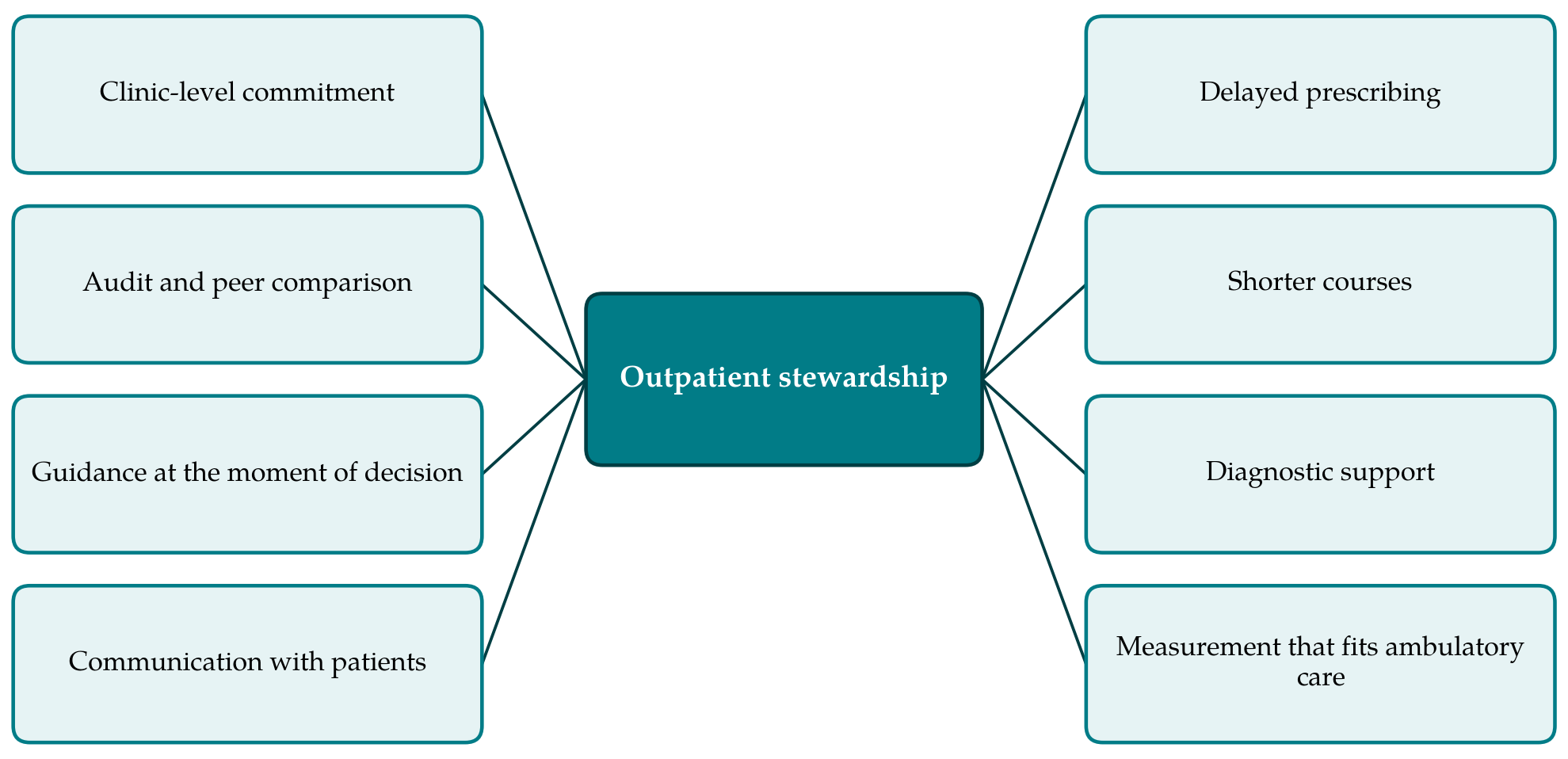
Interventions aimed at the consultation have also been tested. A multinational cluster randomised trial found that internet-based training in communication skills, and the use of a point-of-care C-reactive protein test, each reduced antibiotic prescribing for respiratory tract infection, with the largest effect when the two were combined (Little et al., 2013). Delayed or back-up prescribing, in which the patient is given a prescription to use only if symptoms persist or worsen, reduces antibiotic consumption while leaving a safety net, and has been examined in a Cochrane review (Spurling et al., 2017). Reassurance about safety is relevant here: a large cohort analysis of English general practices found that practices prescribing fewer antibiotics for self-limiting respiratory infections had slightly higher rates of pneumonia and peritonsillar abscess, but that the absolute increases were small (Gulliford et al., 2016). Figure 1 shows the components that a programme would combine, and Table 1 summarises the main intervention types with their evidence and their demands.
| Intervention | Evidence | What it requires |
|---|---|---|
| Peer comparison feedback | Randomised reduction in prescribing (Meeker et al., 2016) | Prescribing data by clinician |
| Social norm letters | National trial in general practice (Hallsworth et al., 2016) | A central body able to write |
| Commitment display | Randomised reduction (Meeker et al., 2014) | Almost nothing beyond willingness |
| Communication training | Cluster randomised effect (Little et al., 2013) | Clinician time for training |
| Point-of-care C-reactive protein | Reduced prescribing in the same trial (Little et al., 2013) | Device, consumables, quality control |
| Delayed prescribing | Cochrane review of trials (Spurling et al., 2017) | Clear patient instructions |
| Shorter courses | Evidence of equivalence for several infections (Spellberg, 2016) | Guideline and formulary alignment |
5. What an Outpatient Programme Would Involve
The core elements have been set out by public health agencies: commitment from the practice, action towards better prescribing, tracking and reporting, and education of clinicians and patients (Sanchez et al., 2016). Translating them into practice means attaching the work to a unit that can act, which in most systems is the group practice, the network or the commissioning body rather than the individual clinician. It means a small number of measures that clinicians accept as fair, which usually requires restricting them to conditions where the right rate is close to zero. It means feedback that arrives often enough to be noticed and is framed as comparison with peers rather than as a target.
Duration deserves separate attention, because it is the least contentious change available. For several common infections, shorter courses have been found equivalent to longer ones, and the habit of prescribing a week or ten days has little empirical foundation (Spellberg, 2016). The associated claim that patients must finish the course to prevent resistance has been challenged on the ground that it is unsupported for most infections and that longer exposure increases selection (Llewelyn et al., 2017). Shortening default durations in prescribing software changes total exposure without requiring any clinician to refuse anyone anything, which makes it unusually easy to implement.
Finally, outpatient stewardship needs to be funded and counted. National action plans commit governments to reducing inappropriate use across all settings (WHO, 2015), and the economic case for acting on resistance has been argued at length (O'Neill, 2016). Neither translates into a stewardship pharmacist for a group of clinics unless a payer decides that it should. Where quality payments have been attached to prescribing measures, prescribing has moved. The sums involved are small beside the cost of a hospital programme, since much of the work consists of preparing comparative data that prescribing systems already hold and circulating it to clinicians who have agreed in advance to receive it. What is missing is not capacity but a decision about who owns the task.
6. The Case Against, and What It Is Worth
Three objections are worth taking seriously. The first is that the effects of behavioural interventions fade when the intervention stops, which has been observed in follow-up of trial practices. That is an argument for building the measures into routine systems rather than running campaigns, not an argument against acting, and the same is true of most quality improvement in ambulatory care. The second is safety: if outpatient prescribing falls, some infections that would have been treated early will declare themselves late. The cohort evidence suggests the absolute risk is small but not zero (Gulliford et al., 2016), and the honest response is to pair reduced prescribing with safety-netting, delayed prescriptions and clear advice about when to return. Safety also depends on who is in front of the clinician, and a programme that applies the same expectation to a frail older patient as to a healthy adult will deserve the resistance it meets.
The third objection is about proportion. Antibiotic use in food animals is large, and some argue that human outpatient prescribing is the wrong target. The two are not in competition. Agricultural use requires regulation and is being addressed through different instruments; outpatient prescribing is under the direct control of the health system and affects the patient in the room. A fourth concern, that stewardship signals distrust of clinicians, is best met by designing programmes that clinicians run themselves, with data they can interrogate.
7. Conclusion
Hospital stewardship was built because hospitals could build it, not because that is where most antibiotics are given. The ambulatory sector now has the evidence it lacked twenty years ago: a measured estimate of unnecessary prescribing, documented variation between prescribers, demonstration that exposure selects for resistance in the individual patient, and randomised trials of interventions that work. What it lacks is the infrastructure, which is a matter of accountability, measurement and money rather than of science. Extending to clinics the attention that hospitals already receive is the clearest remaining opportunity to reduce unnecessary antibiotic use.
Conflict of interest
To be declared by the author(s) before publication.
Funding
To be declared by the author(s) before publication.