1. Introduction
A farmer in rural Tanzania, Ghana or Mozambique typically holds land because a family, a lineage or a village accepts that it is hers to use, and that acceptance rests on descent, marriage, long occupation or allocation by a recognised authority. No document is needed and often none exists. A statutory system of registration works on a different logic. It identifies a parcel on a map, names an owner in a register and treats the entry as proof, or at least as strong evidence, against the world. When a state extends the second system over land held under the first, each parcel acquires two possible sources of legitimacy, and the people living on it may be unsure which will prevail.
This situation is a standard example of legal pluralism, the presence in one social field of more than one legal order (Griffiths, 1986). It is also a matter of policy. Registration has been promoted as a route to investment, credit and efficient land markets, and resisted as a means by which the well-connected convert shared rights into private ones. This review examines what the published literature says about the points at which customary tenure and statutory registration pull against each other and about the legal devices used to reconcile them.
2. Scope and Approach
The article is a narrative review of the published literature. It draws on legal scholarship, on anthropology and agrarian studies, on development economics and on the texts of land statutes and international guidelines. Sub-Saharan Africa supplies most of the material, because that is where the debate has been most intense and the statutory experiments most varied; decisions from Australia and the Americas are mentioned where they clarify a point of principle. The sources were chosen as the works around which the debate has turned, and the review does not claim to be exhaustive or to weigh studies by formal criteria. "Customary tenure" is used for land rights whose source is the practice of a community, without implying that the practice is ancient or fixed.
3. Custom and Its Colonial Inheritance
The customary law that statutes now recognise is not a survival from before the colonial period. Chanock (1985) showed for Malawi and Zambia that what courts and administrators recorded as custom was produced in the colonial encounter, as elders and chiefs advanced versions of the rules that suited them and officials wrote those versions down. Mamdani (1996) argued that indirect rule fused powers over land, labour and justice in the office of the chief and so made rural people subjects of a local despotism instead of citizens. On both accounts the question of who speaks for custom is political from the start.
Anthropological work describes the living practice differently from the codified version. Moore (1973) used the Chagga of Kilimanjaro to show that a community generates and enforces its own rules while remaining open to rules from outside, so that state law enters a field already occupied. Berry (1993) found that access to land in several African countries depended on membership of social networks and was continually renegotiated, which is why people invested in relationships as well as in soil. Shipton (2009), writing on the Luo of western Kenya, described land as bound up with ancestry and burial in ways that make its use as security for a loan morally fraught. A register has no column for any of this.
4. The Case for Registration and Its Critics
The argument for registration is usually put in economic terms. A secure, documented and transferable right is said to encourage long-term investment, allow land to move to those who use it best, and serve as collateral. de Soto (2000) gave the argument its most widely read form by describing undocumented assets as dead capital. Behind it stands what Platteau (1996) called the evolutionary theory of land rights: as population grows and agriculture commercialises, people demand more individual rights, and the state should respond by supplying titles.
The first sustained test was in Kenya, where systematic consolidation and registration of African holdings began under the Swynnerton Plan of 1954 and continued after independence. Later studies found that registers went out of date as inheritances and sales were not recorded, that title was seldom used to obtain credit, and that customary expectations continued to govern land that was nominally individual freehold (Shipton, 2009). Survey work in Ghana, Kenya and Rwanda found no clear evidence that indigenous tenure held back productivity (Migot-Adholla et al., 1991). Sjaastad and Bromley (1997) pointed out that under customary rules investment, such as planting trees, is often a way of strengthening a claim, so that the causal arrow may run from investment to security and not only the other way. Platteau (1996) concluded that titling in African conditions tends to create new uncertainty for those whose rights are not the ones written down.
Economists have since reported more favourable results from low-cost programmes that certify existing holdings without attempting to remake them. Studies of land certification in Ethiopia and of tenure regularisation in Rwanda associate the programmes with greater investment in soil conservation, with mixed effects on women depending on their marital status (Deininger et al., 2011; Ali et al., 2014). A systematic review of the quantitative studies found gains from formal recognition that were clearer in Latin America and Asia than in Africa, and suggested that pre-existing customary security is one reason (Lawry et al., 2017). World Bank thinking moved in the same direction, accepting that customary systems can provide secure tenure at low cost and that recognition may be preferable to replacement (Deininger, 2003).
5. Four Recurring Tensions
Across this literature the same points of friction appear repeatedly. They are grouped here under four heads.
5.1. Layered rights and the single owner
Customary holdings commonly carry several rights in different hands: a household cultivates, kin retain a say in transfer, neighbours graze stubble after harvest, others gather wood or draw water. Cousins (2007) describes such rights in South Africa as nested within households, kinship groups and wider communities. A register built around one owner per parcel must either ignore the lesser rights or convert them into something else. Experience suggests that it is the holders of those lesser rights who lose when a title is issued in one name (Toulmin and Quan, 2000).
5.2. Whose authority
Registration relocates the power to say who holds what. If the state recognises custom by confirming the authority of chiefs, it may entrench the unaccountable power that Mamdani (1996) described; if it transfers the function to elected or bureaucratic bodies, it displaces institutions that people actually use. Lund (2008) shows for northern Ghana how chiefs, earth priests, district assemblies and land agencies compete to be the body whose validation counts, each claim to land being at the same time a claim to authority. Boone (2014) argues that the choice between chief-centred and state-centred land regimes shapes the form that land conflict takes in national politics. Where several bodies can validate a claim, disputants take their case to whichever forum is likely to favour them, and a certificate issued by one authority may be answered by a ruling from another. Plural authority of this kind gives the weaker party some room for manoeuvre, but it also rewards those with the money and contacts to pursue a claim in every forum. South Africa's Communal Land Rights Act of 2004, which would have vested land in traditional councils, was challenged by rural communities on these grounds and was struck down by the Constitutional Court in 2010 on a point of legislative procedure.
5.3. A fixed record and a changing tenure
A register is accurate on the day it is made. Customary rights shift with births, deaths, marriages and migration, and a register is of use only if later dealings are entered in it. Where the land office is distant, fees are high or the transaction is one the statute does not contemplate, people continue to deal with land locally and the record drifts away from the facts. The Kenyan experience is the example most often given. The practical lesson drawn in the literature is that the cost of maintaining a register matters as much as the cost of creating it (Deininger, 2003).
5.4. Recognition and equality
Recognising custom can mean recognising its inequalities. Whitehead and Tsikata (2003) warned that the policy turn toward the customary risked weakening women's claims, since women commonly hold land through husbands or male kin and local forums are dominated by men; they also doubted that titling alone was the remedy. Peters (2004) criticised the tendency to celebrate the flexibility of custom and showed that negotiation takes place between unequal parties, with growing competition producing exclusion along lines of gender, generation and origin. Statutes have responded with provisions for joint registration of spouses and for the representation of women on land bodies. How far these provisions change practice is one of the less well documented questions.
6. Statutory Accommodations
From the 1990s a generation of land laws abandoned replacement in favour of recognition. Fitzpatrick (2005) classified the legal options: a minimalist approach that records only the outer boundary of a group's land, vesting of land in an agent such as a chief or trustee, incorporation of the group as a legal person, and administration by a land board. Table 1 sets out the main techniques with an example of each and the difficulty most often reported, and Figure 1 arranges them by how much documentation they require and how much authority they leave with the community.
| Technique | Illustration | How custom is treated | Recurrent difficulty |
|---|---|---|---|
| Replacement by individual title | Kenya, registration programme from the 1950s | Extinguished on first registration | Registers fall out of date; secondary rights lost |
| Recognition by occupation | Mozambique, Land Law of 1997 | Use right arises from customary occupation itself | Unmapped rights hard to assert against investors |
| Village administration | Tanzania, Village Land Act 1999 | Village council manages land and issues certificates | Capacity and funding of village bodies |
| Land boards | Botswana, Tribal Land Act 1968 | Allocation moved from chiefs to statutory boards | Distance from users; informal dealings persist |
| Customary certificates | Uganda, Land Act 1998 | Customary owner may obtain a certificate | Low uptake where machinery is not funded |
| Community title | Kenya, Community Land Act 2016 | Registered community holds land for its members | Defining the community and its governance |
| Low-cost household certification | Ethiopia and Rwanda (Ali et al., 2014) | Existing holdings recorded, spouses named | Updating after inheritance and transfer |
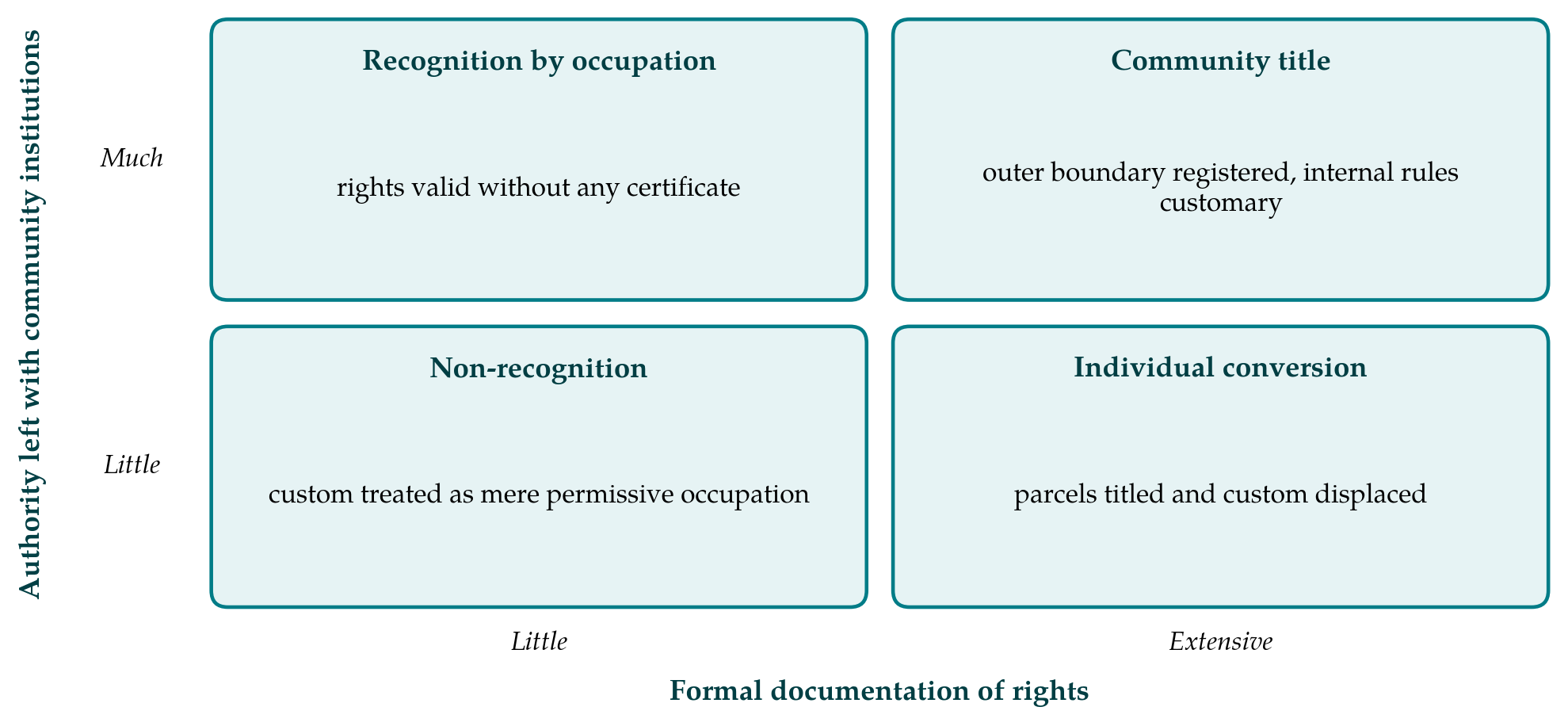
The statutes differ most in whether a right depends on paper. Mozambique's law treats occupation according to customary norms as itself conferring a right of use, admits oral evidence, and makes the delimitation of community land optional; Tanzania's declares customary rights of occupancy equal in status to granted rights and gives village councils the task of managing village land (Knight, 2010). Botswana took a different course much earlier by transferring the allocating powers of chiefs to land boards. Comparative assessments credit these laws with removing the old presumption that unregistered land belongs to the state, and report that implementation has lagged wherever the local bodies on which the schemes rely were left without resources (Knight, 2010).
Common lands are the weak point of most schemes. Forests, pastures and wetlands used collectively have often been classed as vacant or public land and allocated to outside interests, a result that Alden Wily (2011) attributes to the law itself and not to its poor enforcement. Community title is the response, but it requires the law to say who belongs to the community and how it decides. Courts outside Africa have faced the same problem from another direction: the High Court of Australia in Mabo v Queensland (No 2) in 1992 held that the common law recognises native title whose content is given by the traditional laws and customs of the people concerned, which leaves a national legal system to give effect to rights that it does not itself define.
Regional human rights bodies have reasoned in a similar way. The Inter-American Court of Human Rights held in 2001, in the case of the Awas Tingni community against Nicaragua, that the right to property in the American Convention protects the communal property of indigenous peoples and that possession under custom should be enough to obtain official recognition and registration. The African Commission on Human and Peoples' Rights applied comparable reasoning in 2010 to the Endorois community of Kenya. These decisions concern indigenous peoples and not rural communities at large, but they establish a principle of wider interest: that the absence of a registered title is a failure of the state to record a right and not evidence that no right exists.
International soft law now reflects the recognition approach. The Voluntary Guidelines on the Responsible Governance of Tenure call on states to recognise and respect legitimate tenure rights, including customary rights that are not currently protected by law, and to provide accessible means of recording them (FAO, 2012). The Guidelines also state that customary systems should not be shielded from requirements of non-discrimination. They leave open how a state is to honour both commitments where they conflict.
7. Gaps and Directions for Future Work
Three gaps are evident. Evidence on outcomes is concentrated in a few countries with large certification programmes, and comparatively little is known about how recognition statutes operate where implementation has been partial. Studies measure investment and perceived security more often than they examine what happens in disputes, where the relative weight of a certificate and a customary claim is actually tested. Work on common lands and on pastoral tenure remains sparse beside work on arable holdings. Legal scholarship could contribute by studying how courts and local tribunals treat documents issued under the newer laws, and how registries handle rights that do not fit their forms.
8. Conclusion
The literature records a change of approach from replacing customary tenure to recognising it, and that change has removed the starkest conflict of principle. The practical tensions persist in altered form. Recognition still requires a decision about whose version of custom counts, a record still has to be kept current, and rights that are layered or shared still fit awkwardly into a register. The statutes that have fared best in the assessments reviewed here are those that ask least of the record and most of accountable local institutions, and they depend on those institutions being given the means to do the work.
Conflict of interest
To be declared by the author(s) before publication.
Funding
To be declared by the author(s) before publication.