1. Introduction
For most of the history of cochlear implantation, a normal contralateral ear was a reason not to operate. Implants were developed for people who gained nothing from hearing aids in either ear, and the signal they deliver, a coarse electrical code of the sound envelope spread across a limited number of electrodes, was assumed to be of little use beside natural hearing and possibly a distraction from it. Unilateral deafness was managed with reassurance or with devices that pick up sound on the deaf side and present it to the good ear.
That view changed after Van de Heyning et al. (2008) implanted adults with single sided deafness (SSD) whose principal complaint was severe tinnitus in the deaf ear and observed a marked and lasting reduction in its loudness. Reports that the same patients heard better in some listening situations followed (Vermeire and Van de Heyning, 2009), and within a few years groups in Europe, Australia and North America were studying implantation for SSD as a hearing intervention in its own right. In 2019 the United States Food and Drug Administration approved a cochlear implant system for SSD and asymmetric hearing loss in adults and in children aged five years and older. This review considers who is regarded as a candidate, what benefits have been shown, and what remains uncertain.
2. Approach
The article is a narrative review of the published literature. It is organised around the three themes of its title and relies on the early clinical series, the prospective trials, the systematic reviews and the consensus papers that have shaped practice. No formal search protocol was applied and no pooled estimates are offered. Where studies are cited for a finding, the intention is to indicate the direction and quality of the evidence, and readers who need effect sizes are referred to the original reports.
3. Hearing With One Ear
Two ears give the auditory system three advantages when speech and noise come from different directions. The head casts an acoustic shadow, so that one ear always has the more favourable signal-to-noise ratio. The brain can compare the inputs at the two ears and partly cancel the noise, an effect known as binaural squelch. And the same signal presented to both ears is perceived as louder and clearer, which is binaural summation. Localisation in the horizontal plane depends on differences between the ears in the time of arrival and the level of a sound. A person with SSD has none of these, apart from the head shadow when the talker happens to be on the better side.
The practical effects are well described. Adults report difficulty in groups, in traffic and in open offices, and questionnaires such as the Speech, Spatial and Qualities of Hearing Scale were designed in part to capture disabilities of this kind that a pure-tone audiogram does not show (Gatehouse and Noble, 2004). In children, unilateral loss is associated with delays in speech and language and with poorer progress at school (Lieu, 2004). Experimental work adds a developmental concern: when one ear is deaf during an early sensitive period, the auditory cortex reorganises in favour of the hearing ear, and the representation of the deaf ear weakens (Kral et al., 2013). Gordon et al. (2015) have called the result an aural preference syndrome and argue that it sets a time limit on effective treatment.
4. Rerouting Devices and Their Limits
The established alternatives are the contralateral routing of signal (CROS) hearing aid, which transmits sound from a microphone on the deaf side to a receiver in the hearing ear, and the bone conduction device, which sends vibration through the skull to the hearing cochlea. Both lift the head shadow for sounds on the deaf side. A systematic review by Kitterick et al. (2016) found that they improve speech perception when the talker is on the deaf side, can make matters worse when noise is on that side, and do not restore localisation, as would be expected of devices that deliver everything to one cochlea. Table 1 compares the options.
| Option | How it works | What it offers | Main limits |
|---|---|---|---|
| No device | Positioning, communication tactics | No surgery or cost | All binaural deficits remain |
| CROS hearing aid | Microphone on deaf side, receiver in hearing ear | Awareness of sound from deaf side | No localisation; noise on deaf side is also routed |
| Bone conduction device | Vibration through skull to hearing cochlea | As CROS, with open ear canal | No localisation; surgery for implanted types |
| Cochlear implant | Electrical stimulation of the deaf ear | Two-sided input; tinnitus relief in many users | Surgery, cost, rehabilitation, variable outcome |
| Hearing aid in poorer ear | Amplification, only if usable residual hearing | Acoustic two-sided input | Not applicable to profound loss |
Comparative data are limited but point in a consistent direction. Arndt et al. (2011) tested patients with a CROS aid and a bone conduction device before implantation and with the implant afterwards, and found localisation and speech perception in several configurations to be better with the implant. A randomised trial from Utrecht assigned adults with SSD to implantation or to an initial trial of the two rerouting devices and reported short-term advantages for the implant group in speech perception in noise and in localisation (Peters et al., 2021).
5. Candidacy
Agreement on who counts as having SSD came late. A consensus group proposed that the term be reserved for a pure-tone average of 70 dB HL or worse in the poorer ear with 30 dB HL or better in the other, and that asymmetric hearing loss describe the same poorer ear paired with a better ear between 30 and 55 dB HL (Vincent et al., 2015). The distinction matters because a patient with asymmetric loss already depends on a hearing aid in the better ear and stands to lose more if that ear deteriorates.
5.1. Adults
Most adult candidates have acquired deafness: sudden sensorineural loss, labyrinthitis, Ménière's disease, temporal bone fracture, or surgery for vestibular schwannoma. Assessment includes audiometry, speech testing of each ear, imaging of the cochlea and the cochlear nerve, and a frank discussion of what the implant sounds like. Many centres ask patients to try a CROS aid or a bone conduction device on a headband first, partly because some are satisfied with it and partly because the experience clarifies what they hope an implant will add. Duration of deafness is weighed, since long auditory deprivation predicts poorer results in conventional implant recipients, but no upper limit has been established for SSD. In the pilot series of Firszt et al. (2012), adults whose deafness began after language was acquired did well, while those deaf in one ear since early childhood gained little speech understanding through the implant.
Two causes call for separate comment. After bacterial meningitis or labyrinthitis the cochlea may ossify within weeks to months, and where implantation is contemplated it should not be put off until the lumen is obliterated. In deafness due to vestibular schwannoma or its treatment, the result depends on whether the cochlear nerve remains intact in function as well as in appearance, which imaging cannot always establish, and reports in this group are fewer and more variable than for other causes. The compatibility of the implant magnet with the magnetic resonance surveillance such patients need is a further consideration.
5.2. Children
In children the cause is more often congenital, and the first question is anatomical. Absence or hypoplasia of the cochlear nerve is a recognised cause of congenital unilateral deafness and leaves nothing for an implant to stimulate, so magnetic resonance imaging is essential. Where the nerve is present, age at implantation appears to be the decisive factor. Arndt et al. (2015) reported that children with congenital SSD implanted early used their devices and showed binaural benefit, whereas results after years of unilateral deafness were poor and some of those children stopped wearing the processor. Children with acquired loss behaved more like adults. A meta-analysis of paediatric studies reached similar conclusions and drew attention to how few children had been followed for long (Benchetrit et al., 2021).
6. Benefits
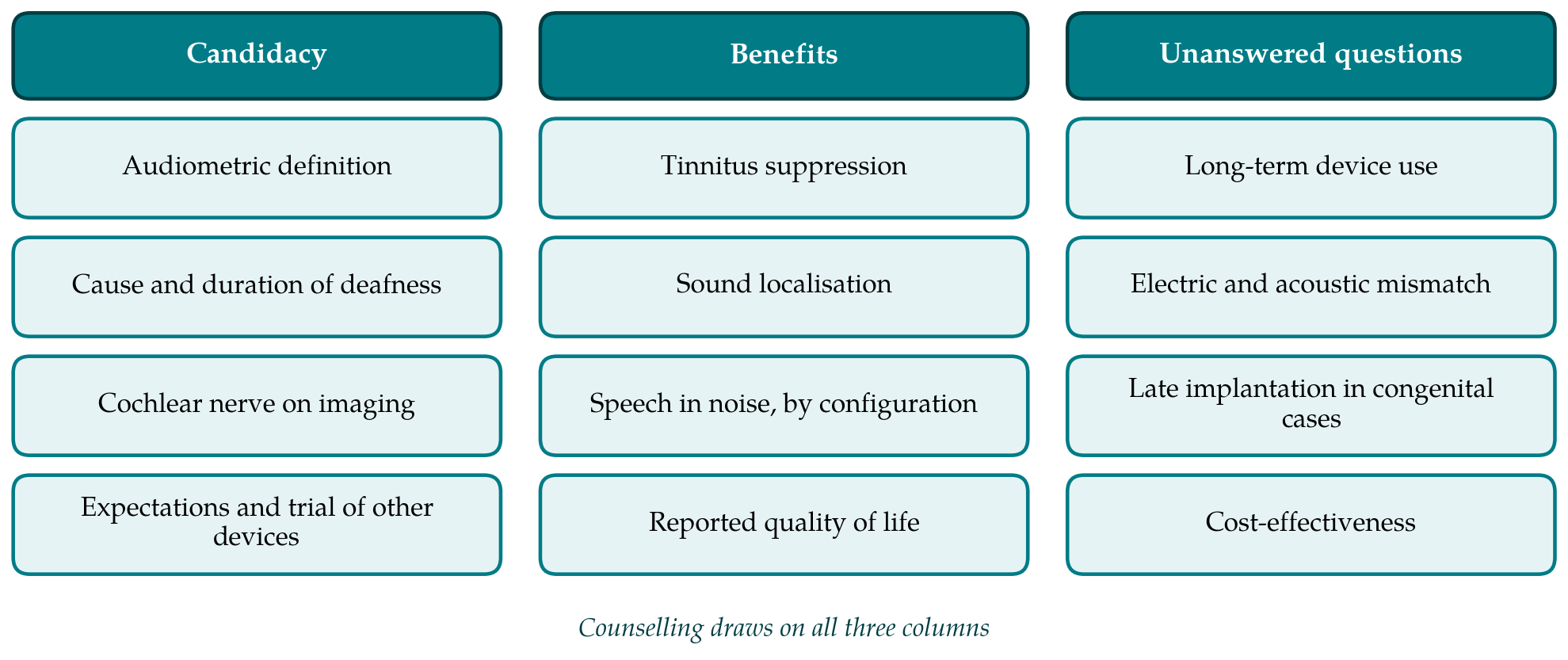
The reported benefits fall under four headings. They are not equally well supported, and Figure 1 sets them beside the elements of candidacy and the questions discussed later in this review.
6.1. Tinnitus
Relief of tinnitus is the most consistent finding. It was the original indication (Van de Heyning et al., 2008), and later series and a meta-analysis of patients implanted after sudden unilateral deafness report reduction in the great majority (Blasco and Redleaf, 2014; Távora-Vieira et al., 2015). The effect depends on stimulation: tinnitus typically returns when the processor is removed. These were open studies of a subjective symptom, with no placebo condition, and should be read accordingly.
6.2. Localisation
Localisation improves in most adult recipients, from near-chance performance to errors that are clearly smaller though still larger than normal (Zeitler et al., 2015; Buss et al., 2018). The mechanism is informative. Implant processors do not preserve the fine timing of the acoustic waveform, and Dorman et al. (2015) showed that SSD recipients localise by comparing sound level between the ears and make little use of interaural time differences. This explains why low-frequency sounds, for which level differences are small, remain hard to place.
6.3. Speech in noise
Results for speech in noise depend on where the speech and the noise are. The largest gain appears when speech is on the implanted side and noise on the hearing side, which is the head-shadow effect that rerouting devices also provide. Summation and squelch effects are smaller and less consistent (Vermeire and Van de Heyning, 2009; Buss et al., 2018). Bernstein et al. (2016) demonstrated that SSD recipients can use the implant to help separate competing talkers, evidence of true binaural processing of an electric and an acoustic input. An implant should not degrade performance when noise is on the implanted side, an advantage over rerouting.
6.4. Quality of life
Patient-reported outcomes generally favour implantation. Prospective trials in the United States recorded improved scores on spatial hearing and hearing-related quality of life questionnaires (Dillon et al., 2017; Galvin et al., 2019). Systematic reviews of the earlier literature agree on the direction of effect and are equally agreed on its weaknesses: small samples, few controlled comparisons, varied test set-ups and short follow-up (Vlastarakos et al., 2014; van Zon et al., 2015). Questionnaire results call for the same reserve as tinnitus scores. Recipients have chosen surgery, have invested months in rehabilitation and cannot be blinded to the device, all of which favour a positive report. A more persuasive sign, where studies record it, is behavioural: whether recipients are still wearing the processor through the day some years later.
7. Unanswered Questions
The first open question is how the brain combines a degraded electric signal with normal acoustic hearing. Electrode arrays do not reach the apex of the cochlea, so a given sound may excite a place on the implanted side that corresponds to a higher pitch than on the acoustic side, and the two signals also arrive with different delays. Whether fitting the processor to reduce these mismatches improves binaural benefit, and how much the listener adapts unaided, are active areas of research with no settled clinical protocol.
Rehabilitation is a related and practical uncertainty. Because the normal ear dominates everyday listening, the implanted ear gets little practice on its own, and many programmes ask recipients to train it in isolation, by streaming audio directly to the processor or by plugging and masking the hearing ear. Whether such training hastens or enlarges the eventual benefit, and how much of it is needed, has not been established in controlled studies, and practice differs from centre to centre.
The second concerns selection. Duration of deafness, cause, age and tinnitus are all thought to influence outcome, yet no study has been large enough to weigh them against one another, and the adult who has been unilaterally deaf for decades cannot be given a reliable estimate of benefit. In children the corresponding question is how late is too late for congenital SSD. Animal and developmental data imply a narrow window (Kral et al., 2013; Gordon et al., 2015), but a threshold age has not been defined from clinical outcomes.
Third, comparison between studies is hampered by their methods. Loudspeaker arrangements, noise types and the way the hearing ear is masked when the implant is tested alone differ from centre to centre. A consensus paper has proposed a common framework of tests for SSD studies (Van de Heyning et al., 2016), and its adoption would make future pooling of data more meaningful. Fourth, long-term use is poorly documented. An implant that is worn for two years and then left in a drawer has not succeeded, and non-use has been reported, particularly in late-implanted children (Arndt et al., 2015). Finally, the device and its lifelong maintenance are costly, the benefit is an improvement in hearing that is already serviceable, and economic evaluations specific to SSD are few. Funding bodies in many countries have yet to decide the matter.
8. Conclusions
Cochlear implantation is the only treatment that returns sound to the deaf ear in SSD, and the studies published since 2008 show with reasonable consistency that it suppresses tinnitus in most recipients, improves localisation and helps with speech in noise in configurations where two-sided input matters. Adults with acquired, recent deafness and young children with a normal cochlear nerve are the candidates for whom the case is strongest. The uncertainties are substantial: the evidence base is small and largely uncontrolled, predictors of individual outcome are weak, the integration of electric and acoustic hearing is imperfectly understood, and long-term use and cost-effectiveness have barely been examined. Candidates deserve counselling that conveys both the promise and these limits.
Conflict of interest
To be declared by the author(s) before publication.
Funding
To be declared by the author(s) before publication.