1. Introduction
Few animal groups have contributed as much to cytogenetics as the short-horned grasshoppers. Their meiotic chromosomes can be read in a simple squash of the testis, and the classical accounts of chiasma formation, sex chromosome behavior and chromosomal polymorphism rest heavily on them (White, 1973; Hewitt, 1979). Two features of the group stand in apparent tension. The basic karyotype is highly conserved across hundreds of species, yet individual populations often carry visible variants: fused chromosomes, inversions, extra heterochromatic segments and supernumerary chromosomes. This communication considers what that tension implies about how karyotypes evolve, with particular attention to B chromosomes. It is a commentary on published work and presents no new observations.
2. A Conserved Karyotype and Its Departures
The standard complement of the Acrididae consists of eleven pairs of rod-shaped autosomes and an X chromosome, giving 2n = 23 in males, which are X0, and 24 in females. Most departures from this arrangement are centric fusions, which join two rod chromosomes into one two-armed element and lower the count without changing the number of major arms. The gomphocerine grasshoppers of the genus Chorthippus and their allies, with three pairs of large metacentric chromosomes and seventeen chromosomes in the male, are the familiar case (Hewitt, 1979). When the X chromosome is the fusion partner the unfused autosome becomes a neo-Y, and neo-XY systems have arisen in this way many times across the Orthoptera (Castillo et al., 2010).
Fusions are not only fixed differences between species. In the South American grasshopper Dichroplus pratensis several autosomal fusions are polymorphic within and between populations, and their distribution has been read as support for the theory that asymmetries of female meiosis favor one chromosome form over another (Bidau and Martí, 2004). That theory, formulated for mammals by Pardo-Manuel de Villena and Sapienza (2001), holds that the egg pole of the spindle captures centromeres of differing strength unequally, so that the direction of karyotypic change is set by drive and not by the fitness of carriers. Whether a new rearrangement spreads, persists as a polymorphism or is lost also depends on its effects on fertility in heterozygotes, a question long central to chromosomal models of speciation (White, 1973). Figure 1 groups the forms of variation met in natural populations.
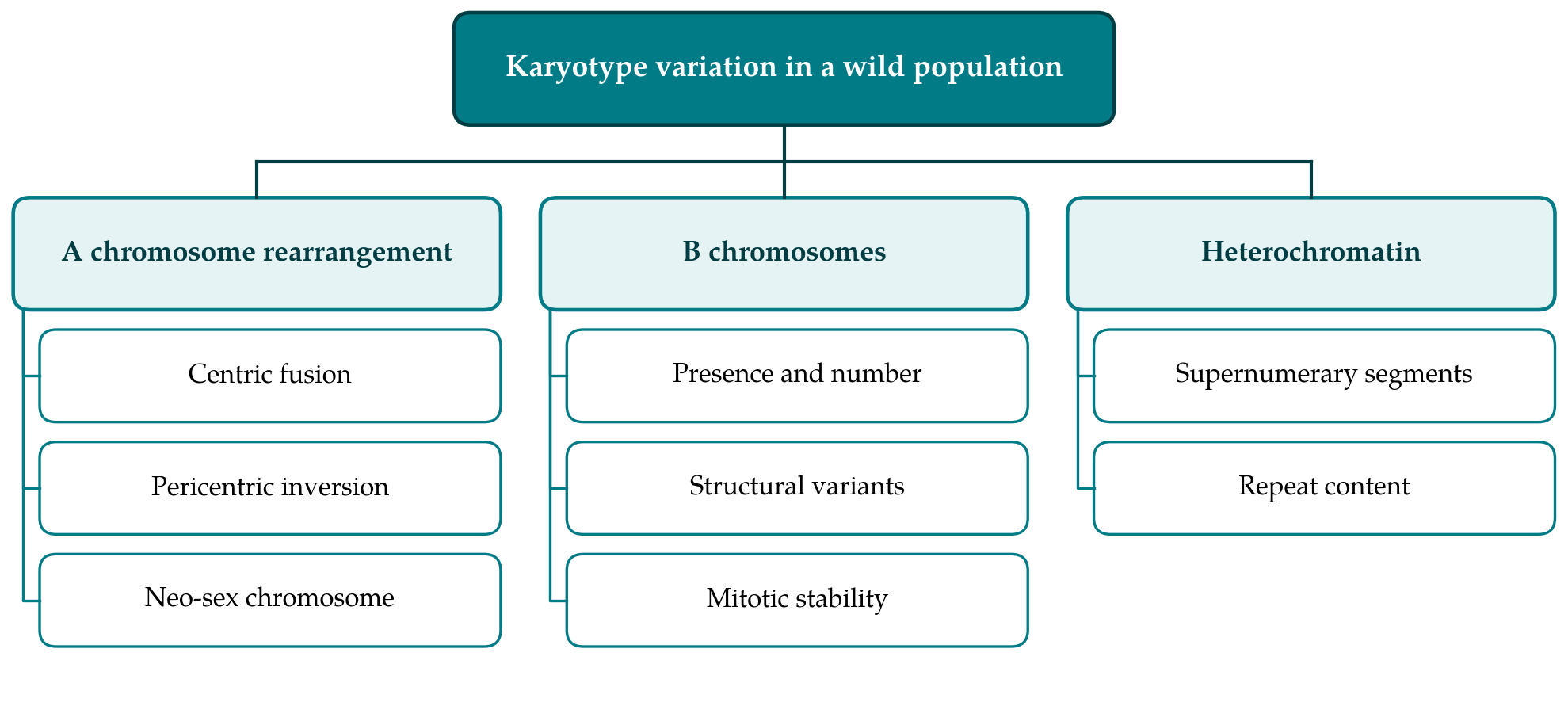
3. B Chromosomes as a Population Polymorphism
B chromosomes are additional to the standard set, are absent from some individuals of a species, do not pair with A chromosomes at meiosis and are inherited in a non-Mendelian way. First noticed as supernumeraries in hemipteran insects early in the twentieth century, they are now known from a great range of plants and animals (Jones and Rees, 1982). Östergren (1945) proposed that they are parasitic, maintained by mechanisms of accumulation in spite of harm to the carrier, and that interpretation, set against the alternative that they confer some benefit, has framed the subject since (Camacho et al., 2000). Table 1 summarizes the features by which B chromosomes and A chromosome rearrangements are compared in this note.
| Aspect | A chromosome rearrangement | B chromosome |
|---|---|---|
| Cytological sign | Altered shape or number with arm number conserved | Extra element, often heterochromatic, unpaired with A set |
| Inheritance | Mendelian unless distorted in female meiosis | Non-Mendelian; accumulation or loss |
| Proposed driver | Centromere drive (Pardo-Manuel de Villena and Sapienza, 2001) | Transmission advantage (Östergren, 1945) |
| Cost to carrier | Reduced fertility of some heterozygotes | Reduced fertility at high B numbers |
| Typical fate | Fixation, loss or stable cline | Suppression of drive, decay, replacement by new variant |
| Model system | Dichroplus pratensis | Eyprepocnemis plorans |
Grasshoppers supplied two of the best studied systems. In Myrmeleotettix maculatus the frequency of B chromosomes varies geographically within Britain, and classical work related their mechanics in meiosis to their distribution (John and Hewitt, 1965). In Eyprepocnemis plorans, around the western Mediterranean, the B chromosome occurs in many structural variants, and long-term study led to a model in which a B invades through drive, is neutralized as the A genome evolves suppression of that drive, and then drifts toward loss unless a new variant that has recovered drive replaces it (Camacho et al., 1997). On this view a population sampled at one moment shows a single frame of a long contest, and the apparent neutrality of a B in a given locality says little about its past.
Molecular work has since altered the picture of what a B is. B chromosomes were long regarded as inert blocks of repetitive DNA, and in grasshoppers they are indeed rich in satellite and ribosomal sequences. They are not empty, however. Reviews across kingdoms show that they originate from the A chromosomes of the same or a related species and accumulate sequences from several sources (Houben et al., 2014), and the B of E. plorans carries protein-coding genes, some of them transcribed (Navarro-Domínguez et al., 2017). A selfish element with active genes has, at least in principle, the means to influence its own transmission.
4. What Wild Populations Still Offer
The two strands share a logic. A centromere that wins at female meiosis and a B chromosome that accumulates in the germ line both spread because of how they are transmitted, and both provoke a response from the rest of the genome. Laboratory crosses can measure transmission in a single generation. Only natural populations show the frequencies, clines and replacements that result over many generations, and the theoretical treatment of B chromosomes has depended on such field data from the start (Camacho et al., 2000).
Scoring these polymorphisms is straightforward but has known pitfalls. Males are examined at diplotene or first metaphase in testis squashes, where B chromosomes can be told from the X by size and by their behavior, though both may be heteropycnotic; females require embryos or somatic tissue. Where Bs are mitotically unstable, the number varies among follicles of one testis and a single count misleads. C-banding and fluorescence in situ hybridization with ribosomal and satellite probes distinguish B variants that look alike in plain stain. Combining such cytology with sequencing of the same individuals would allow drive, suppression and gene content to be studied together, which has so far been achieved for very few populations.
5. Conclusion
Wild grasshopper populations preserve a conserved chromosome set while continually generating variants of it. Centric fusions, neo-sex chromosomes and B chromosomes differ in structure but share a dependence on meiotic transmission, and each is better explained by conflict within the genome than by adaptation of the organism alone. Long-term sampling of natural populations, joined to molecular characterization of the variants found, remains the most direct way to test that interpretation.
Conflict of interest
To be declared by the author(s) before publication.
Funding
To be declared by the author(s) before publication.