1. Introduction
After a cross is made, a self-pollinating crop must pass through several generations of selfing before lines are uniform enough to test. In the field that takes one generation a season, and the years so spent add nothing to the breeder's knowledge of the material. Shortening them is among the cheapest ways to raise genetic gain per year, an argument made forcefully for crops in general by Hickey et al. (2019). The single seed descent method, which advances each plant by one seed and so needs very little space per line (Brim, 1966), made rapid advance under cover practical long before the phrase speed breeding was coined.
The protocols that popularised the term used prolonged illumination. Watson et al. (2018) grew spring wheat, barley, chickpea and pea under a photoperiod of twenty-two hours and obtained up to six generations a year, and the companion protocol paper gave designs ranging from walk-in chambers to a benchtop cabinet (Ghosh et al., 2018). All of those crops flower sooner as days lengthen. Short-day plants do the opposite, and a long-day recipe applied to them produces tall vegetative plants and no seed.
This article is concerned with the short-day pulses of the tropics and subtropics: pigeonpea, cowpea, mungbean, black gram, horse gram and the photoperiod-sensitive types of common bean. Soybean, although classed as an oilseed, is included as a reference point because most of the relevant physiology was worked out on it. The aim is to propose a protocol that a small programme can set up with retail LED lamps and without a growth chamber. No experiment is reported. The protocol is derived from the literature, and its performance remains to be demonstrated.
2. Background
Three bodies of work inform the design: the control of flowering by night length and temperature, the experience gained with rapid generation advance in legumes, and the characteristics of LED lamps as a light source for plants.
2.1. Flowering in short-day legumes
Photoperiodism was described a century ago by Garner and Allard (1920), who showed with soybean and tobacco that some plants flower only when days are shorter than a critical length. It is the unbroken dark period that the plant measures, and a brief exposure to light in the middle of the night can cancel the inductive effect of a short day. For breeders the response is quantitative more often than absolute. In soybean and in several other annual crops the rate of progress towards flowering can be described as a function of mean temperature and photoperiod, with a base phase that responds to temperature alone and a photoperiod-sensitive phase after it (Hadley et al., 1984; Summerfield et al., 1991). Two practical points follow: short days must be accompanied by warm conditions to be effective, and genotypes differ, so that a schedule tuned on one variety may be slow for another.
2.2. Earlier work on rapid generation advance
The study closest to the present purpose is that of Jähne et al. (2020), who used LED-controlled light schemes for the short-day crops soybean, rice and amaranth. With a ten-hour photoperiod and a spectrum enriched in blue and deprived of far-red light they obtained short, sturdy soybean plants and estimated that up to five generations a year were achievable. Other groups have reached fast turnover by different means. Nagatoshi and Fujita (2019) combined carbon dioxide supplementation with germination of immature seed in soybean. In pigeonpea, germination of immature seed together with single seed descent was shown to shorten the cycle substantially (Saxena et al., 2017), and in peanut a commercial programme adopted continuous light under controlled temperature (O'Connor et al., 2013). For chickpea, a long-day species, Samineni et al. (2020) reported up to seven generations a year using extended photoperiod and early seed harvest without any tissue culture step. A recent review of the field stresses that protocols remain crop-specific and that the cost of facilities limits adoption in the regions where these legumes are bred (Wanga et al., 2021).
2.3. LED lamps as a light source
Light-emitting diodes convert electricity to light efficiently, emit little radiant heat towards the canopy and can be made in narrow or broad spectra (Morrow, 2008; Massa et al., 2008). They can therefore be hung close to the plants, which is what makes a shelf-based system possible. Spectrum affects plant form as well as photosynthesis. Blue light restrains stem elongation, while a low ratio of red to far-red light is read by phytochrome as shade and promotes stretching (Franklin and Whitelam, 2005). In temperate long-day pulses far-red enrichment has been used deliberately to hasten flowering (Croser et al., 2016), but for short-day crops grown at high density the compact habit produced by a far-red-poor spectrum is the more useful property. Bugbee (2016) cautions that total light captured by the canopy generally matters more to growth than fine adjustment of spectral ratios, a helpful principle when the lamps on offer are ordinary white ones.
3. The Proposed Protocol
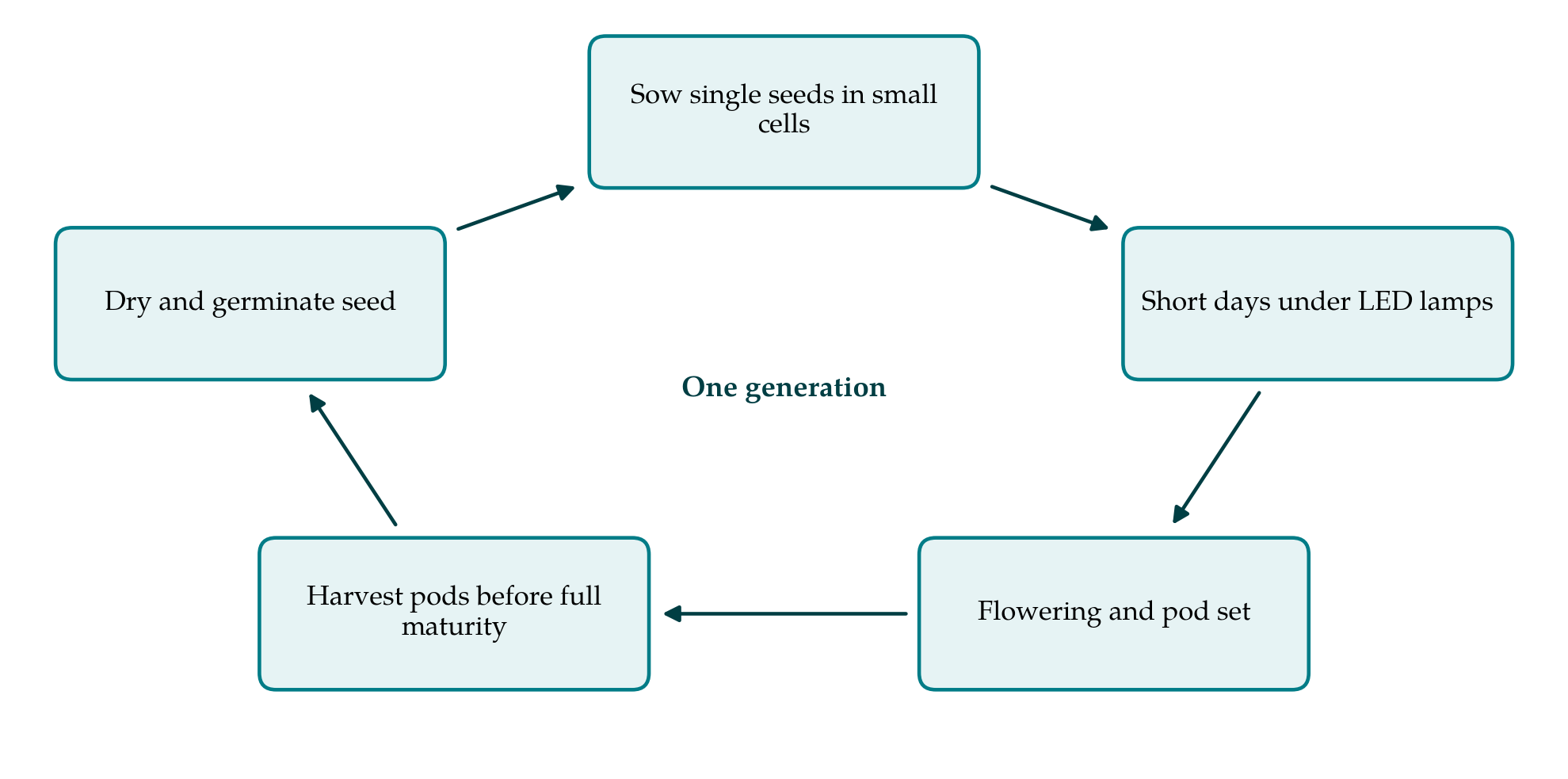
The protocol has five components. Table 1 sets out the proposed starting point for each and the reason for it, and Figure 1 shows the generation cycle they are meant to produce. The settings are starting points for local testing and not tested optima.
| Component | Proposed starting point | Reasoning |
|---|---|---|
| Growth space | Light-tight room or shed with shelving and ventilation | Darkness must be complete for short-day induction |
| Lamps | White LED tubes or panels, cool white preferred, close above the canopy | Low heat output; blue-rich light limits stretching (Massa et al., 2008) |
| Photoperiod | About ten hours of light and an unbroken night, on a timer | Schedule used for soybean by Jähne et al. (2020) |
| Temperature | Warm days and nights within the normal range of the crop | Development rate depends on temperature and day length together |
| Containers | Small cells, one plant each, restricted nutrition after flowering | Few pods per plant are needed under single seed descent |
| Harvest | Pick pods at physiological maturity, dry gently, sow at once | Saves the weeks otherwise spent on drying down in the pod |
3.1. Component 1: Growth space and lamps
Any room that can be made fully dark will serve: a store room, a shipping container or a screened shed lined with blackout fabric. Darkness is the non-negotiable requirement, because stray light from a corridor or a street lamp during the night may be enough to delay flowering. Shelving of the kind used in warehouses carries the plants in tiers, each tier lit by lamps fixed to the underside of the shelf above. Reflective sheeting on the walls and around the shelves returns light that would otherwise be lost. Lamps should be chosen for their output per unit of electricity and for a cool white colour; purpose-made horticultural fixtures are better but are not required. Light at canopy height should be measured with a quantum sensor if one can be borrowed, since the eye is a poor judge of intensity, and a simple lux meter calibrated once against such a sensor is adequate for routine checks afterwards.
3.2. Component 2: Light schedule
A mechanical or digital timer switches the lamps to give a short day, with ten hours as the proposed starting value on the evidence from soybean. Short-day crops bring an unexpected economy here: the lamps run for less than half the hours needed in a long-day protocol, so the electricity bill for lighting is correspondingly lower. The night must not be interrupted. Watering, scoring and crossing are done during the light period, and a dim green torch should not be assumed to be safe without testing. Where mains supply is unreliable, an outage during the day merely costs growth, whereas a timer that resets and lights the room at night can undo induction, so timers with battery backup are worth their small extra cost.
3.3. Component 3: Temperature and plant management
Temperature should be kept warm and steady within the range the crop meets in its normal season. In hot climates the difficulty is cooling a closed room, and an extraction fan running during the light period, with a light-trap baffle so that it does not admit daylight, is usually the first measure. Plants are grown singly in small cells of a free-draining medium. Root restriction and close spacing reduce plant size and seed number, which is acceptable because single seed descent needs only one or two good seeds from each plant. Feeding is generous until flowering and then reduced so that the plant matures its first pods instead of continuing to branch.
3.4. Component 4: Early harvest
In the field, several weeks pass between the point at which a legume seed can germinate and the point at which the pod is dry. The protocol recovers that time by harvesting pods once the seeds have filled and begun to lose their green colour, drying them in moving air at room temperature for a few days, and sowing immediately. Hard-seeded types may need the seed coat nicked. This step avoids embryo rescue, which demands sterile facilities and skilled staff, and follows the approach taken in pigeonpea and chickpea (Saxena et al., 2017; Samineni et al., 2020). How early pods can be picked without loss of germination has to be established for each crop.
3.5. Component 5: Records and single seed descent
Each cell carries a label that traces back to its cross and its plant in the previous generation. One seed from each plant is sown for the next generation and a second is kept as a reserve (Brim, 1966). No selection is practised during rapid advance, apart from the unavoidable loss of plants that fail to flower, and the proportion of each population lost in this way is recorded. That record matters, because a protocol that silently discards late genotypes will shift the population towards earliness without the breeder having chosen it.
4. Adapting the Protocol to Individual Crops
The pulses in question differ in ways that bear on the settings. Pigeonpea is a perennial shrub with a long juvenile phase in traditional types, and it is likely to need the strongest root restriction and the earliest harvest to give worthwhile turnover. Cowpea and mungbean include many genotypes that are nearly insensitive to day length; for these a short day does no harm, and populations segregating for sensitivity can be handled in the same room. Climbing types of common bean and cowpea will need support and more headroom than a shelf allows. Within each crop the photothermal models cited above imply that the critical day length varies among genotypes, so a programme should place its most sensitive parents in the first test and set the schedule to suit them.
5. Cost and Safety
The capital items are shelving, lamps, timers, blackout material and a fan, all available from general hardware suppliers. Running costs are electricity and labour. A programme can estimate its own figures from the rated wattage of the lamps and the daily hours of use, and no general figure is offered here because prices differ widely between countries. Electrical safety deserves attention in a humid room where plants are watered beneath mains lamps: fittings should be rated for damp locations, wiring kept off the floor and a residual current device fitted to the circuit. Staff should not look directly into dense LED arrays at close range.
6. Limitations and What Remains to Be Shown
The protocol is proposed and has not been validated in this article. Its central setting, a ten-hour day under blue-rich white light, is transferred from published results on soybean to crops on which it has not, to the author's knowledge, been systematically tested with retail lamps. Before adoption a programme should run a small comparison for each crop: the proposed schedule against one or two alternative day lengths and against its current practice, with days to flowering, days to harvestable seed, seeds per plant and germination of early-harvested seed recorded on a set of contrasting genotypes.
Three further questions are open. White LED lamps vary in spectrum between manufacturers, and whether ordinary lamps give plants compact enough for shelf culture is uncertain. Light intensity from inexpensive lamps may be too low for adequate pod set in some species, in which case fewer tiers and more lamps per tier would be needed. And the consequences of repeated generations in an artificial environment for seed quality and for unintended selection have not been studied in most of these crops. The number of generations a year that the protocol can deliver is therefore not stated here; it is the quantity that validation trials must measure.
7. Conclusion
Short-day pulses have been left at the margin of speed breeding because the standard recipe relies on long days. The physiology of these crops points to a different and cheaper route: a dark room, a short day supplied by white LED lamps, warm conditions, crowded plants and early harvest. The protocol set out here turns that reasoning into five components that a modest programme can assemble from local materials. It is offered as a starting point for testing, with the trials needed to confirm or correct it described alongside.
Conflict of interest
To be declared by the author(s) before publication.
Funding
To be declared by the author(s) before publication.