1. Introduction
Options have always been available to individuals, but for most of their history on organised exchanges they were a minority pursuit. That changed quickly. In the United States the removal of commissions by the main retail brokers, the growth of mobile trading and the confinement of households during 2020 coincided with a surge in retail option volume, and the events surrounding a handful of heavily traded stocks in early 2021 drew official attention to it (SEC, 2021). In India, individual participation in index options grew to the point where the securities regulator published its own analysis of the profits and losses of individual traders (SEBI, 2023).
Booms in retail trading are not new, and regulators have generally responded to them within an established framework: tell investors about the risks, check that the customer is the kind of person for whom the product is appropriate, and hold intermediaries to a standard of conduct when they give advice. This article takes the view that the framework is poorly matched to what self-directed options trading has become. It sets out why, proposes a different emphasis, and considers the objections. It is an argument from the published literature and from the content of existing rules, and offers no new data.
2. What Is Different About the Present Boom
Three features distinguish recent retail options activity. The first is cost structure. Commissions have fallen to zero at many brokers, which are paid instead by wholesalers for routing customer orders. The investor still pays through the bid-ask spread, and for cheap, short-dated options the spread is large relative to the price. Bryzgalova et al. (2023) documented the rise of retail trading in such contracts, its concentration among a few wholesalers, and the extent to which retail investors' losses are attributable to these implicit costs.
The second feature is the product mix. Contracts that expire within days or on the same day offer large percentage payoffs for a small outlay and lose their value quickly. A preference for assets with a small chance of a large gain is well documented among individual investors (Kumar, 2009). The third feature is the interface. Trading applications make an option purchase a matter of a few taps, and notifications and lists of popular securities direct attention in ways that have been shown to affect what retail investors buy and how they fare (Barber et al., 2022).
None of this would matter if retail option traders did well. The evidence is that on average they do not. The classic finding that individuals who trade more earn less (Barber and Odean, 2000) has been confirmed with complete market data, which also showed that the aggregate losses of individual traders are economically large (Barber et al., 2009). For options specifically, Bauer et al. (2009) found that individual investors at a Dutch discount broker lost substantially on their option trades, and attributed the result to poor timing and to motives of entertainment and gambling. The Indian regulator reported that roughly nine in ten individual traders in equity derivatives lost money in the year it examined (SEBI, 2023).
3. Why the Existing Rulebook Fits Poorly
Investor protection in options rests on several layers, which Figure 1 arranges from the least to the most intrusive. Most jurisdictions rely chiefly on the upper layers. Each has a specific weakness in the present market.
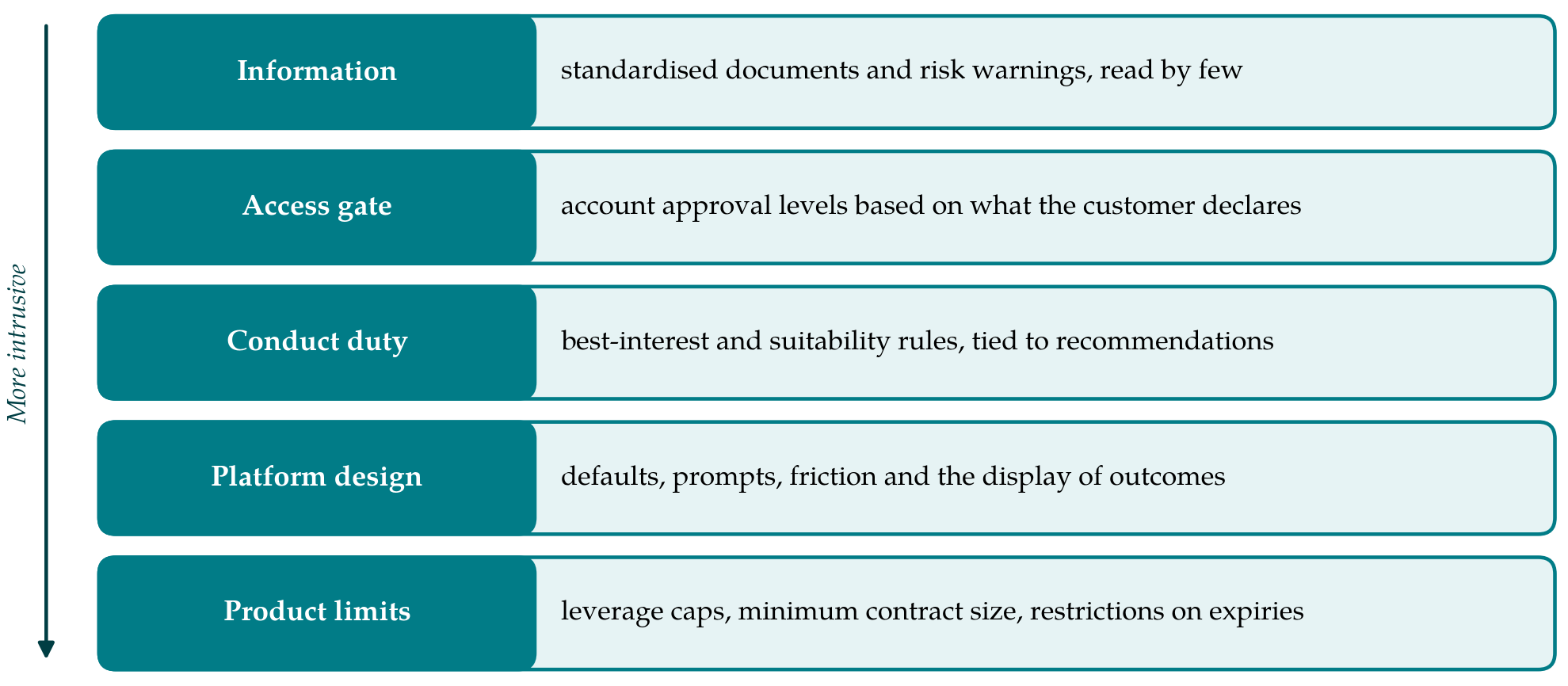
Disclosure comes first. A customer opening an options account receives a standard document describing the characteristics and risks of options. The document is accurate and long. A large body of work shows that mandated disclosure of this kind seldom changes behaviour: people do not read it, cannot relate it to their own decision, or discount it at the moment of choice (Ben-Shahar and Schneider, 2014; Loewenstein et al., 2014). Options also make heavier demands on financial literacy than almost any other retail product.
The second layer is the access gate. In the United States a broker must approve a customer for options trading and may grant different levels of approval for different strategies. The decision is based on information the customer supplies about income, net worth, experience and objectives, and the same customer can usually revise the answers and apply again. The industry regulator has reminded firms of their obligations in this area and asked whether the rules remain adequate (FINRA, 2022). In the European Union an appropriateness assessment is required before a client may trade complex instruments without advice, but a client who fails it may still proceed after a warning (European Union, 2014).
The third layer is the conduct duty. Rules requiring a broker to act in the customer's best interest apply to recommendations (SEC, 2019). A customer who chooses a trade unprompted on an application receives no recommendation in the legal sense, even though the design of the application may shape the choice as effectively as a salesperson would. The duty thus falls away exactly where the new activity is concentrated. Table 1 summarises the tools, the assumption each makes about the investor, and where that assumption fails.
| Tool | Assumption about the investor | Weakness in self-directed options trading |
|---|---|---|
| Disclosure document | Reads, understands and applies the information | Rarely read; does not address costs or typical outcomes |
| Account approval | Reports experience and means truthfully | Self-declared; answers can be revised until approval is granted |
| Appropriateness test | Heeds a warning that the product may not suit | Client may proceed regardless of the result |
| Best-interest duty | Trades on a broker's recommendation | Does not reach unsolicited trades on an application |
| Platform design rules | Is influenced by defaults and prompts | Little developed; hard to specify in advance |
| Product limits | Cannot be protected by information alone | Blunt; restrict informed investors along with the rest |
4. The Argument: Protection Should Follow the Product and the Platform
If losses came from ignorance, better information would be the remedy. The literature reviewed above points instead to overconfidence, attention effects, a taste for lottery-like payoffs and costs that are not visible at the point of sale. Regulation that takes these seriously looks different. As Campbell et al. (2011) argued for consumer finance generally, where consumers make predictable mistakes and firms profit from them, disclosure alone is unlikely to suffice and the regulator must consider the terms of the product and the way it is offered.
Three proposals follow. The first is that requirements should tighten with the riskiness of the contract and not only with the declared sophistication of the customer. Buying a three-month option on a broad index is a different act from buying an option that expires within hours, and the rules can recognise this through minimum contract sizes or limits on the shortest expiries offered to new accounts. European regulators have used powers of this kind for related products, prohibiting binary options for retail clients and capping leverage on contracts for differences (ESMA, 2018), and the Indian regulator moved in 2024 to raise contract sizes and reduce the number of weekly expiries.
The second proposal is to treat the design of the trading interface as conduct. Default order sizes, the prominence given to options relative to the underlying shares, celebratory animations, and prompts to trade are choices made by the firm, and they can be made subject to a requirement that they do not work against the customer's interest. The third is transparency about outcomes. The European restrictions on contracts for differences require a standard warning that states the share of the provider's retail accounts that lose money (ESMA, 2018). An equivalent figure for options, and a statement to each customer of realised results net of all costs, would tell investors something the general disclosure document cannot.
5. Counter-Arguments
The first objection is that such measures are paternalistic. Adults are entitled to take risks with their own money, and some trade for enjoyment knowing the odds. The objection has force against prohibition. It has less against measures that leave the choice open while changing its presentation, or against outcome reporting, which adds to the information on which an autonomous choice is made. It also assumes that current choices reflect settled preferences, which is doubtful where interfaces are built to encourage frequent trading.
The second objection is that options have legitimate uses. An investor holding shares may wish to buy protection or to earn income by writing calls against the holding, and limits designed for speculation would catch these uses too. This is a reason for graduation, since limits can be aimed at the shortest expiries and at new accounts, which leaves covered strategies largely untouched. The third objection is displacement. Restrict listed options, and some customers will move to offshore brokers, to leveraged products on cryptoassets or to outright gambling, where protection is weaker still. The concern is real, and it argues for calibrating restrictions and watching where activity goes, not for inaction.
A fourth objection concerns evidence. Direct evaluation of restrictions on retail derivatives is limited. The best-known study, by Heimer and Simsek (2019), examined a cap on leverage in retail foreign exchange trading in the United States and found that it reduced the losses of the most leveraged traders without harming market quality. Whether similar results would hold for options is not known, and a regulator acting now does so under uncertainty. The proper response is to build evaluation into any new rule, for instance by phasing it in and requiring brokers to report customer outcomes before and after.
6. Implications for Regulators
The position taken here does not require new legal theories. Product intervention powers exist in the European Union, margin and contract specifications are set by regulators and exchanges everywhere, and conduct rules can be interpreted to cover digital engagement practices. What it requires is a shift in the question regulators ask, from whether the investor was told to whether the investor was placed in a position where loss was the likely result. It also requires data. Regulators can obtain account-level outcomes from brokers at modest cost, as the Indian analysis shows (SEBI, 2023), and regular publication of such figures would discipline both the industry and the debate.
7. Conclusion
Retail options trading has outgrown rules built on disclosure, self-declared eligibility and duties that apply only to advice. The losses that individuals incur in these markets are better explained by behaviour and hidden costs than by lack of information, and protection should therefore attach to the riskiest contracts and to the design of the platforms that sell them, supported by public data on how customers fare. The objections from autonomy, legitimate use and displacement are serious. They counsel graduated and evaluated measures, and they leave intact the argument that the present framework is aimed at a problem other than the one regulators now face.
Conflict of interest
To be declared by the author(s) before publication.
Funding
To be declared by the author(s) before publication.