1. Introduction
Thermal management has become one of the constraints on electronic design. As power density rises, the heat generated in a small volume must be conducted to a heat sink through a stack of materials, and the weakest link in that stack is often the soft, filled polymer that fills the microscopic gaps between a chip and its cooler. The challenges of removing heat from modern electronics, and the central role of the interface materials, have been reviewed by Moore and Shi, 2014 and, for thermal interface materials specifically, by Prasher, 2006. Unfilled polymers conduct heat poorly because they lack the ordered lattice through which phonons travel in a crystal.
The standard remedy is to disperse a conductive filler in the polymer. Where the application also demands electrical insulation, as in most encapsulation and many interface uses, the choice of filler narrows sharply. Highly conductive carbon fillers such as graphene (Balandin, 2011) are excluded because they are electrically conductive. Ceramic fillers such as alumina and aluminium nitride are insulating but less conductive and are used at high loadings, which raises viscosity during processing and can make the cured material brittle. Against this background hexagonal boron nitride has drawn sustained attention (Huang et al., 2011).
It is worth stating plainly what a good interface material must do at once, because the requirements pull in different directions. It must conduct heat through its thickness, remain soft enough to fill microscopic gaps and accommodate thermal expansion, insulate electrically, and survive repeated heating and cooling without drying out or cracking. A filler improves the first of these but tends to work against the second and the fourth, so the design problem is not simply to maximise conductivity but to gain it without losing the compliance and durability that made the polymer useful in the first place.
2. Why Boron Nitride Nanosheets
Hexagonal boron nitride is a layered crystal with the same honeycomb arrangement as graphite but with boron and nitrogen on alternating sites, which opens a wide electronic band gap and makes it an electrical insulator while leaving it a good conductor of heat. It can be reduced to one or a few atomic layers, among the first two-dimensional crystals isolated alongside graphene (Novoselov et al., 2005), and its structure and properties as nanosheets and nanotubes are surveyed by Golberg et al. (2010). The in-plane thermal conductivity of high-quality single and few-layer sheets is high, as shown by calculation (Lindsay and Broido, 2011) and by measurement on suspended flakes (Jo et al., 2013). Table 1 places boron nitride nanosheets among the common filler options.
| Filler | Heat transport | Electrically insulating | Note |
|---|---|---|---|
| Graphene | Very high | No | Excellent conductor but electrically conductive Balandin, 2011 |
| Boron nitride nanosheet | High, in-plane | Yes | Wide band gap; anisotropic Golberg et al., 2010 |
| Aluminium nitride | High | Yes | Used at high loading; moisture sensitive |
| Alumina | Moderate | Yes | Inexpensive; needs very high loading |
The combination that no carbon filler offers, high thermal conductivity together with electrical insulation, is what makes boron nitride distinctive for this use. The promise was shown early, when boron nitride nanosheets improved both the thermal and the mechanical behaviour of polymers at achievable loadings (Zhi et al., 2009), and later work pursued higher composite conductivities by control of the filler network (Song et al., 2012).
3. Why Films Fall Short of the Sheet
The gap between the conductivity of an isolated sheet and that of a finished film is wide, and several distinct obstacles contribute to it. Figure 1 gathers them around the central object, the filled film.
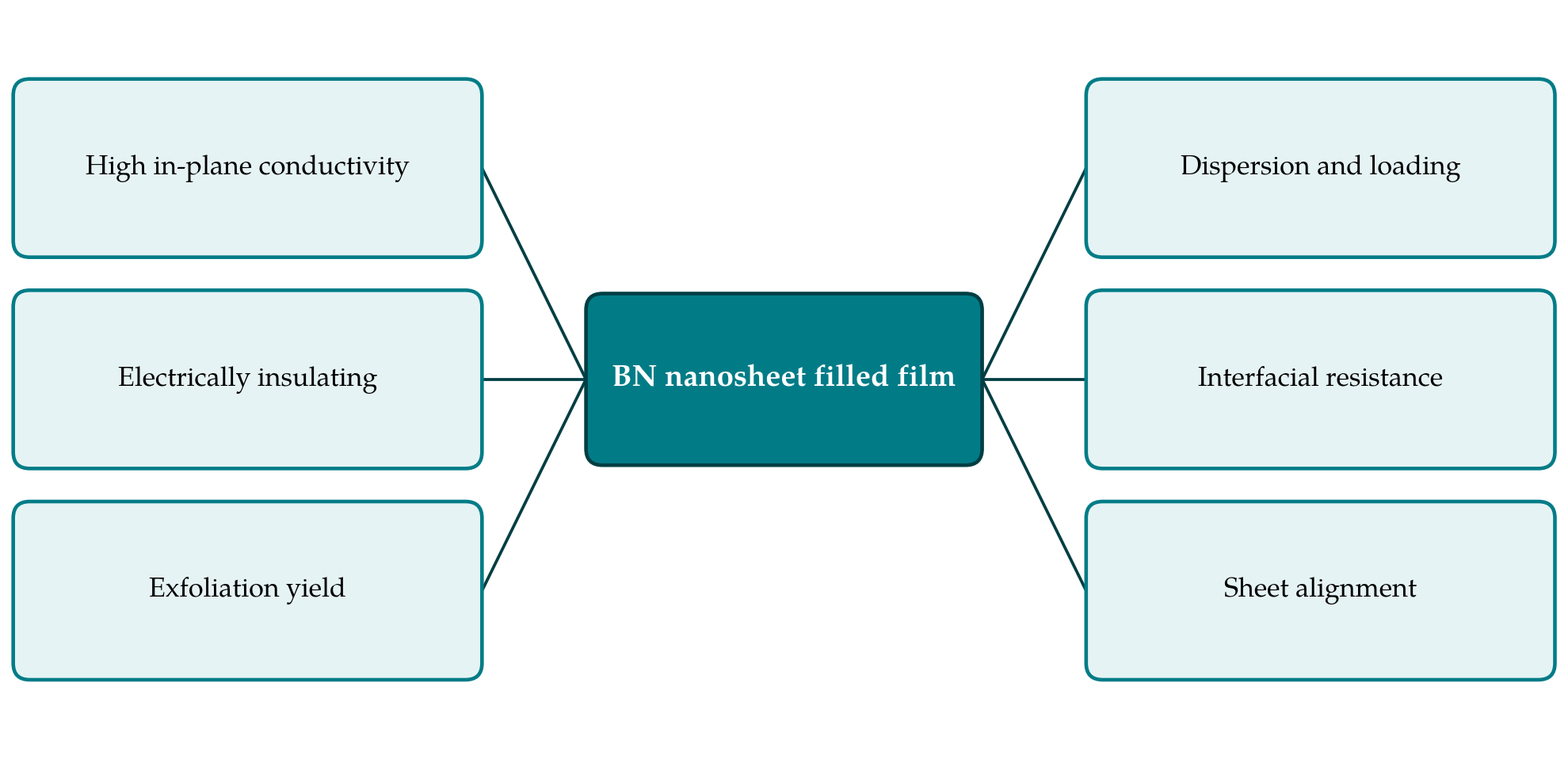
The first is exfoliation. Bulk boron nitride must be separated into thin sheets without breaking them into small fragments, and the chemically mild liquid-phase route that made this practical for many layered materials (Coleman et al., 2011) trades yield against sheet size and quality. Small or damaged sheets present more edges and defects, which scatter phonons.
The second is dispersion and loading. The filler helps only where sheets are close enough for heat to pass between them, so conductivity rises steeply only above a percolation-like threshold, yet high loadings make the composite stiff and hard to process and can leave voids that trap heat. The third, and often the dominant, obstacle is interfacial thermal resistance: at every boundary between polymer and filler, phonons are scattered by the mismatch in vibrational properties, a resistance understood since the work on thermal boundary resistance reviewed by Swartz and Pohl (1989). Because a filled film contains an enormous internal area of such boundaries, this resistance can dominate the result and is the main reason composite conductivities remain far below a simple average of the components.
The fourth obstacle is anisotropy. A boron nitride sheet conducts heat well in its plane and poorly across it, so a film in which the sheets lie flat conducts well in the plane of the film but may conduct little through its thickness, which is the direction that matters for a thermal interface material. Aligning the sheets to favour through-plane transport, rather than the in-plane alignment that casting naturally produces, is an active and unresolved part of the problem.
These obstacles are not independent. A route that raises exfoliation yield may produce smaller sheets with more edges, adding interfacial area; a surface treatment that improves dispersion and lowers interfacial resistance may also change how the sheets pack and orient. This coupling is why composite conductivity has advanced in steps rather than leaps, and why a fair comparison between reports requires knowing not just the loading but the sheet size, the surface chemistry and the direction in which the conductivity was measured. A number quoted without those details says little.
4. Conclusion
Boron nitride nanosheets are the leading candidate for a filler that makes a polymer conduct heat while keeping it electrically insulating, a combination that carbon fillers cannot provide. The intrinsic properties of the sheet are not in doubt. What limits a real film is the chain of losses between the sheet and the composite: imperfect exfoliation, the difficulty of dispersing enough filler to form a connected path, the thermal resistance of the many internal interfaces, and the mismatch between the in-plane conductivity of the sheet and the through-plane direction a device needs. Progress reported in the literature has come from attacking these in turn rather than from the sheet itself, and the interfaces and the alignment are where the largest gains most plausibly remain. This note is intended to orient work on such films; it draws no new conclusion of its own.
Conflict of interest
To be declared by the author(s) before publication.
Funding
To be declared by the author(s) before publication.