1. Introduction
For every kilogram of cheese a dairy makes, it is left with roughly nine litres of whey. The liquid is dilute, about 93 to 94 per cent water, but it holds most of the lactose of the milk, the whey proteins and a large share of the minerals (Walstra et al., 2006). Its organic load is high enough that discharge to a watercourse or an undersized treatment works causes serious pollution, and regulators treat it accordingly (Prazeres et al., 2012; Carvalho et al., 2013). The same composition makes whey a raw material. Smithers (2008) traced how whey moved, in his phrase, from gutter to gold as the nutritional and functional value of its proteins was recognised and as the means to recover them became available.
Those means were chiefly membranes. Ultrafiltration made it possible to concentrate whey proteins without heat or a change of phase, and the other pressure-driven processes followed for clarification, demineralisation and water removal (Pouliot, 2008). The plants that adopted them were large, because protein powders require evaporators and spray dryers that are costly and energy-hungry. Small and medium cheesemakers mostly continued to give whey to farmers for pig feed, spread it on land or pay for its treatment.
This review considers what membrane filtration can do for the smaller plant. The question is practical: which processes, in which combination, turn a liability into something saleable or at least cheaper to move, with equipment that a small team can run and clean.
2. Scope and Approach
The article is a narrative review of the published literature: textbooks and handbooks of dairy and membrane technology, review articles on whey use and on membrane processes in the dairy industry, and primary studies of whey ultrafiltration, nanofiltration and fouling. It was not conducted as a systematic search and reports no counts of records. "Small and medium" is used loosely for plants that cannot justify their own evaporator and dryer and that lack specialist membrane staff. Sweet whey from rennet cheeses is the main case; acid whey from fresh cheeses and strained yoghurt is noted where its behaviour differs. Electrodialysis, ion exchange and chromatography, which large processors combine with membranes, lie outside the scope.
3. Whey as a Raw Material and a Waste
Whey composition sets the terms for every separation. Lactose is by far the largest component of the solids, followed by minerals and by protein, of which β-lactoglobulin and α-lactalbumin are the principal fractions. Sweet whey also contains fine casein particles and residual fat from the vat, and it carries starter bacteria that continue to produce acid unless the whey is cooled or pasteurised promptly. Acid whey has more calcium and lactic acid and less lactose, which makes it harder to concentrate and dry (Bylund, 2015).
The range of products that can be made from whey is wide: whey powder, protein concentrates and isolates, lactose, permeate powder, fermented beverages, and feedstocks for ethanol, organic acids or biogas (Siso, 1996; Yadav et al., 2015). Most of these routes begin with a membrane step, either to separate protein from lactose or simply to remove water. Fermentation routes for the lactose fraction have been reviewed by Guimarães et al. (2010), who stress that they make economic sense only as part of an integrated scheme in which the protein has already been recovered.
4. The Four Pressure-Driven Membrane Processes
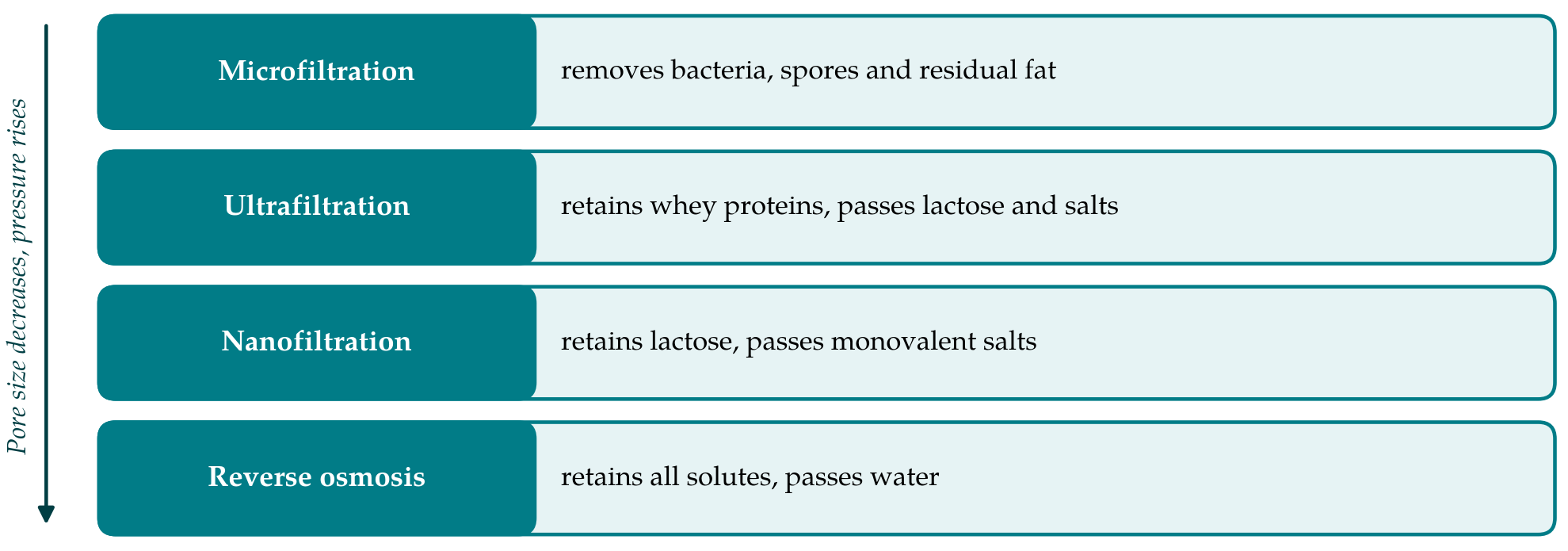
Pressure-driven membrane processes form a series distinguished by pore size and by the pressure needed to drive liquid through the membrane (Cheryan, 1998). Figure 1 shows the series as applied to whey, and Table 1 compares the four processes on the points that matter to a small operator. In each case the feed flows tangentially across the membrane surface, the material that passes through is the permeate, and the material held back is the retentate.
| Process | What it retains | Typical product or purpose | Main difficulty at small scale |
|---|---|---|---|
| Microfiltration | Bacteria, spores, fat, casein fines | Clarified, defatted whey before ultrafiltration | Ceramic membranes are costly; fouling by fat |
| Ultrafiltration | Whey proteins | Liquid protein concentrate; protein-enriched retentate | Large volume of lactose-rich permeate remains |
| Diafiltration (with ultrafiltration) | Whey proteins, as lactose is washed out | Higher protein-to-solids ratio | Water use and more dilute permeate |
| Nanofiltration | Lactose, proteins, divalent ions | Concentrated, partly demineralised whey or permeate | Higher pressure; mineral scaling |
| Reverse osmosis | Essentially all solutes | Pre-concentrated whey for transport; reusable water | High pressure; concentration limited by osmotic pressure |
4.1. Microfiltration
Microfiltration membranes have pores in the range of tenths of a micrometre to a few micrometres. Applied to whey they remove bacteria, spores, casein fines and the residual fat, much of which is phospholipid-rich membrane material that passes through a centrifugal separator. Saboya and Maubois (2000) describe how this defatting step improves the flux of a later ultrafiltration stage and the foaming properties of the protein concentrate obtained from it. Microfiltration can also split casein micelles from serum proteins when applied to skim milk before cheesemaking, which yields a "native" whey free of rennet and starter residues (Brans et al., 2004). For a small plant the drawback is cost: the ceramic membranes preferred for this duty are expensive, and a good clarifier and separator will often be the realistic pretreatment.
4.2. Ultrafiltration and diafiltration
Ultrafiltration is the central process. Its membranes are rated by molecular weight cut-off and, for whey, are chosen to retain the proteins while letting lactose, minerals and water pass. Concentrating whey in this way raises the protein share of the solids from roughly an eighth to a third or more, and adding water during filtration, known as diafiltration, washes out more lactose and salts and takes the protein share higher still (Morr and Ha, 1993; Baldasso et al., 2011). The products are the familiar whey protein concentrates, graded by protein content in the dry matter. Isolates, at ninety per cent protein or more, require microfiltration or ion exchange in addition and are beyond the reach of most small plants.
Operating conditions have been studied in detail. Whey is ultrafiltered either cold, to restrain bacterial growth, or at about fifty degrees Celsius, where viscosity is lower and flux higher; the range in between favours microbial growth and is avoided (Bylund, 2015). Continuous multi-stage plants behave differently from batch units, and Yee et al. (2007) showed how fouling in a continuous whey protein concentrate plant constrains operation over a production run. A small dairy is more likely to run a single-stage batch or feed-and-bleed unit on spiral-wound polymeric membranes, which are the cheapest per unit area and the most widely used in the dairy industry (Kumar et al., 2013).
4.3. Nanofiltration and reverse osmosis
Nanofiltration membranes retain lactose and multivalent ions but allow a good part of the monovalent ions, sodium, potassium and chloride, to pass with the water. The process therefore concentrates whey or ultrafiltration permeate and partly demineralises it in one step. Pilot-scale work has confirmed the effect on whey and on permeate (Suárez et al., 2006), and studies of lactose recovery report high lactose retention with suitable membranes (Atra et al., 2005; Cuartas-Uribe et al., 2009). Reverse osmosis membranes retain essentially all solutes and remove only water. Because the osmotic pressure of the concentrate rises as water is removed, the concentration that can be reached is limited, and whey is commonly taken to only a few times its original solids content before the pressure required becomes impractical (Cheryan, 1998).
For the smaller plant these two processes matter less as routes to refined products than as ways to reduce volume. Whey that has lost half or two-thirds of its water costs correspondingly less to chill, store and haul to a larger processor, and the permeate from reverse osmosis, after polishing, can serve as rinse water in the plant (Daufin et al., 2001).
5. What Decides Feasibility at Small Scale
The separations themselves are well understood. Whether a small plant can make them pay depends on a set of operating matters that receive less attention in the literature than membrane selectivity does.
5.1. Fouling and flux decline
Flux through a membrane falls during a run as material accumulates at and in the surface. With whey the foulants are proteins, which adsorb and form a gel layer, calcium phosphate, which precipitates as the retentate is concentrated or warmed, and residual fat. The classic review by Marshall et al. (1993) set out how protein fouling affects not only flux but also retention and selectivity, so that a fouled membrane is in effect a different membrane. Field et al. (1995) introduced the idea of a critical flux, below which fouling is slight, and the practical lesson for a small operator is that running gently, at moderate transmembrane pressure and adequate cross-flow velocity, sustains output better over a shift than pushing for a high initial flux. Opportunities to exploit selectivity between individual whey proteins exist in principle (Zydney, 1998) but demand a degree of control that small plants rarely have.
5.2. Cleaning, hygiene and membrane life
Membranes in dairy service are cleaned at least daily, typically with an alkaline detergent to remove protein and fat, an acid to dissolve mineral deposits and, where the membrane tolerates it, an enzyme or sanitising step. D'Souza and Mawson (2005) review the chemistry and point out that cleaning accounts for a large part of the running cost and downtime of a membrane plant and is the main determinant of membrane life. Polymeric membranes have limits of pH, temperature and chlorine exposure that must be respected. For a small dairy this means that membrane filtration adds a cleaning-in-place circuit, chemicals, water and effluent of its own, and that staff need training in procedures whose errors are expensive.
5.3. Pretreatment and whey handling
Whey quality at the membrane inlet governs everything downstream. Fines should be removed by screening or clarification and fat by separation, and the whey should be pasteurised or chilled soon after drawing so that acid development and bacterial numbers stay low (Bylund, 2015). Plants that make several cheeses produce wheys of different pH and salt content, and salty whey from dry-salted varieties is best kept apart. A buffer tank sized for a day's production is usually needed because cheese is made in batches while membranes run best continuously.
5.4. The permeate problem
Ultrafiltration recovers the protein, but most of the volume and most of the polluting load leave in the permeate as lactose. A plant that installs ultrafiltration alone has a valuable retentate and a waste stream almost as large as before. Options for the permeate include concentration by nanofiltration or reverse osmosis for sale to a lactose processor, use in animal feed, fermentation to ethanol or lactic acid, and anaerobic digestion to biogas for the plant's own boiler (Prazeres et al., 2012; Guimarães et al., 2010). The options are surveyed in general accounts of whey utilisation (Macwan et al., 2016). None is free of cost, and for a small plant the outlet for permeate, more than the protein step, is likely to decide whether a scheme is viable.
6. Configurations That Suit Smaller Plants
Three configurations emerge from the literature as realistic. The simplest is reverse osmosis or nanofiltration alone, used to pre-concentrate whey before it is collected by a larger processor. It creates no new product, but it cuts transport and chilling costs and returns water to the plant. The second is ultrafiltration to produce a liquid protein concentrate for use on site, in the plant's own yoghurt, ricotta-type cheese, ice cream or beverages, where it replaces purchased milk solids and needs no drying. The third adds a volume-reduction step on the permeate so that the lactose stream too can be transported economically.
Shared facilities are a further possibility. Several small cheesemakers in one district can pre-concentrate their whey individually and send it to a common plant with drying capacity, or can jointly own a mobile or central membrane unit. The technical literature has little to say about such arrangements, although the logic of concentrating before transport is well established (Daufin et al., 2001; Pouliot, 2008).
7. Gaps and Future Work
Published performance data come mostly from laboratory rigs and from large plants. Information on how small installations fare over years of use, including membrane replacement intervals, cleaning costs, labour and downtime, is scarce in the open literature, and that information is what an investment decision needs. Techno-economic studies framed for plants of modest throughput, with realistic assumptions about seasonal milk supply and product prices, would be more useful to this sector than further refinement of separation performance.
Acid whey is a second gap. Its volume has grown with the market for strained yoghurt and fresh cheeses, many of them made by smaller firms, and its high mineral and lactic acid content makes both membrane concentration and drying harder. Work on nanofiltration and diafiltration strategies tailored to acid whey, and on low-cost uses for the resulting streams, would address a need that is increasingly felt.
8. Conclusion
Membrane filtration offers small and medium dairies more than one way to deal with whey, and the most refined product is seldom the right target. Reverse osmosis or nanofiltration for volume reduction, and ultrafiltration to make a liquid protein concentrate for the plant's own products, are within the technical reach of a modest operation. Success depends less on the membrane than on what surrounds it: clean, cool, clarified whey at the inlet, disciplined cleaning, gentle operation that limits fouling, and a definite outlet for the lactose-rich permeate. Where those conditions can be met, whey ceases to be only a cost. Where they cannot, a shared facility or simple pre-concentration for collection is the more prudent course.
Conflict of interest
To be declared by the author(s) before publication.
Funding
To be declared by the author(s) before publication.