1. Introduction
Nitrate is the form in which most nitrogen is lost from cropped soil to groundwater. It is highly soluble, it is repelled by the negatively charged surfaces that dominate most soils, and it moves wherever water moves (Addiscott et al., 1991). Loss by leaching is therefore governed by two conditions that must hold at once: nitrate present in the profile, and water draining through it (Di and Cameron, 2002). The health significance of the loss is reflected in the guideline value of 50 mg/L for nitrate in drinking water set by the World Health Organization (WHO, 2017), which shallow wells beneath intensively farmed land can exceed.
In temperate agriculture the two conditions coincide mainly in autumn and winter, and much of the classic research concerns that season. In monsoon and other seasonally dry climates the calendar is different. The risk is concentrated at the start of the rains, when the soil holds the most nitrate it will hold all year and the crop is least able to use it. This short communication sets out the reasoning, with fertilised maize as the case in point, and comments on what it implies for field studies and for advice to growers.
2. Why the First Rains Release Nitrogen
The flush of mineral nitrogen that follows the wetting of dry soil is among the oldest observations in tropical soil science. Birch (1958) showed that drying followed by rewetting stimulates the decomposition of soil organic matter and the release of mineral nitrogen, and that the effect grows with the length and severity of the preceding dry period. Field measurements in East Africa documented the same seasonal flush across arable soils and climates (Semb and Robinson, 1969). Later work attributes the effect to two sources of substrate: microbial cells killed by desiccation or ruptured by sudden rewetting, and organic matter exposed when aggregates slake (Fierer and Schimel, 2002; Borken and Matzner, 2009).
The flush adds to nitrate that is already there. Mineralisation and nitrification continue slowly into the dry season after the previous harvest, with no crop to take up the product and no drainage to remove it, and evaporation draws some nitrate toward the surface. The first rains therefore meet a topsoil that is enriched before the microbial response begins.
3. Why Fertilised Maize Is Exposed
Maize is sown at or just before the onset of the rains so that the crop can use the full season, and a basal dressing of nitrogen fertiliser is commonly applied at sowing. The crop's demand for nitrogen in the first weeks after emergence is small. Uptake accelerates only as the canopy closes and the stem elongates. Efficient nitrogen management depends on matching supply to that demand in time (Cassman et al., 2002), and at the onset of the rains the match is at its worst. Table 1 lists the factors that combine during this period and the response each suggests.
| Factor | How it contributes | Management response |
|---|---|---|
| Carry-over nitrate | Residual nitrate accumulates in topsoil through the dry season | Test soil before sowing; credit it in the recommendation |
| Rewetting flush | Rapid mineralisation in the first days after rain | Allow for it when setting the basal rate |
| Basal fertiliser | Soluble nitrogen applied before the crop can use it | Reduce the basal share; split the remainder |
| Low early uptake | Small root system and low demand for several weeks | Place fertiliser near the row |
| Intense early storms | Drainage begins once the profile wets through | Keep residue or cover to slow infiltration fronts |
| Coarse or cracked soil | Fast or preferential flow past the matrix | Give most weight to splitting on these soils |
Soil type modifies the outcome. Sandy soils wet through quickly and hold little water, so that drainage, and nitrate with it, begins after relatively little rain; mineral nitrogen dynamics and leaching of this kind have been described for maize on a sandy loam in Zimbabwe (Chikowo et al., 2004). In cracking clays the first storms may run down shrinkage cracks before the soil swells. Some strongly weathered subsoils carry positive charge and retard nitrate, which delays the loss without preventing it (Cameron et al., 2013).
4. Observing the Pulse
A pulse that lasts days is poorly captured by sampling designed for seasonal totals. Soil cores taken monthly can miss it altogether, and they cannot separate nitrate leached from nitrate immobilised or denitrified. Suction cups sample the soil solution at a point and may be bypassed by water moving in macropores, while lysimeters collect drainage directly but are costly and disturb the soil; the strengths and weaknesses of each are reviewed by Weihermüller et al. (2007). Figure 1 places the pulse in the sequence of events from the dry season to mid-season, which indicates when sampling effort should be concentrated.
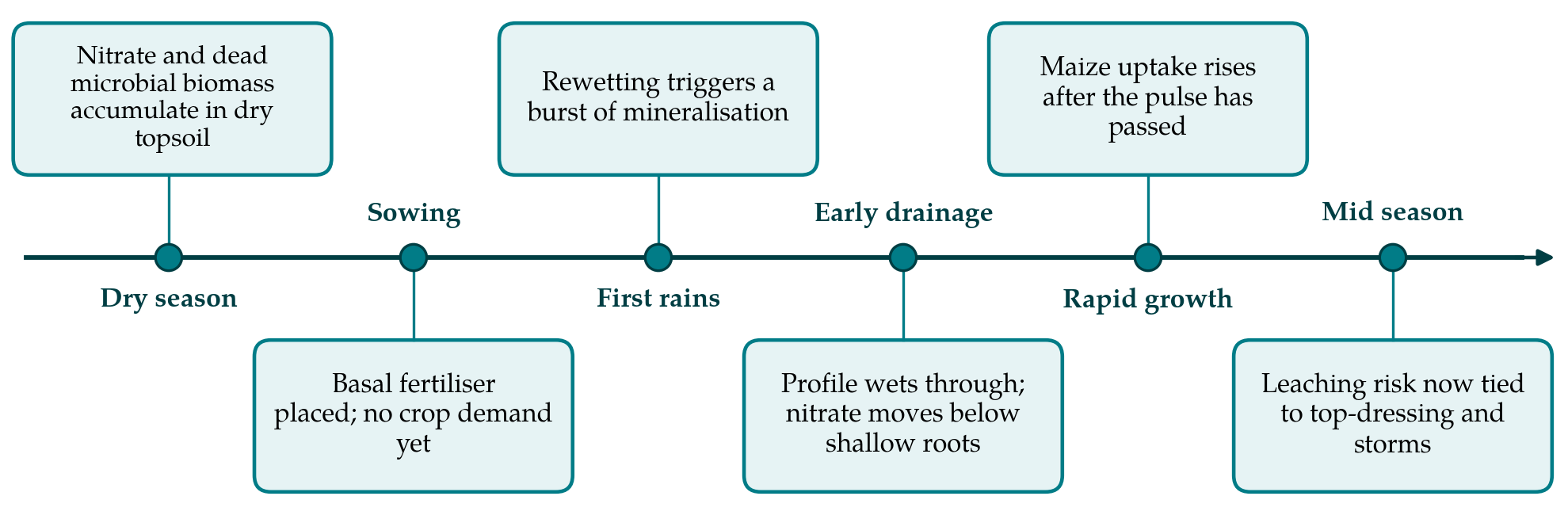
Three practical points follow for study design. Instruments should be installed and settled before the dry season ends, since installation after the first rain is already too late. Sampling should be triggered by rainfall events and not by the calendar, with frequent collection through the first drainage events. And mineral nitrogen in the profile should be measured immediately before the rains, because without that baseline the fertiliser contribution cannot be distinguished from the carry-over and the flush. An unfertilised reference plot serves the same purpose.
5. Implications for Nitrogen Management
If a substantial share of the season's leaching risk falls before the crop enters rapid growth, the most direct response is to have less soluble nitrogen in the soil at that time. Splitting the application, with a modest basal dose and the bulk applied when uptake is accelerating, is standard advice for this reason (Cameron et al., 2013). The reasoning here adds that the size of the basal dose should take account of the nitrogen the soil itself supplies at the onset of the rains, which in soils with a long dry season and reasonable organic matter may meet much of the seedling's early requirement. A pre-season soil nitrate test, where laboratories are accessible, puts a number on that supply.
These suggestions are inferences from established process knowledge. Their size and their reliability will differ between soils and rainfall regimes, and they need to be checked by event-based measurement in the systems concerned before they are written into recommendations.
6. Conclusion
The onset of the monsoon brings together stored nitrate, a mineralisation flush, freshly applied fertiliser and a crop too small to use them, at the moment drainage resumes. The resulting leaching pulse is brief, and routine sampling tends to overlook it. Treating the first rains as a distinct period, in the design of leaching studies and in the timing of nitrogen for maize, would direct attention to where the loss is most likely to occur.
Conflict of interest
To be declared by the author(s) before publication.
Funding
To be declared by the author(s) before publication.