1. Introduction
Hospitals never close, and a considerable share of nurses, junior doctors, laboratory staff and porters work through the night for part or all of their careers. These workers sleep when the sun is up. Since most vitamin D in the human body is made in skin exposed to ultraviolet B radiation, and comparatively little comes from unfortified food (Holick, 2007), it is reasonable to ask whether night work lowers vitamin D status. A systematic review of occupational groups found shift workers and indoor workers, with healthcare staff prominent among the latter, to have lower serum 25-hydroxyvitamin D concentrations and more deficiency than outdoor workers (Sowah et al., 2017).
Most of the studies behind that conclusion come from temperate countries. In a tropical city the question takes a different form. Sunlight strong enough for vitamin D synthesis is available throughout the year, so a day-sleeping worker forgoes a resource that is, in principle, plentiful. This communication does not present new measurements. It sets out why low vitamin D status is plausible in night-shift hospital workers even at low latitude, what makes the existing evidence hard to interpret, and what a hospital occupational health service can reasonably conclude.
2. Sunshine Without Sufficiency
Cutaneous synthesis depends on ultraviolet B photons, of wavelengths roughly between 290 and 315 nm, reaching 7-dehydrocholesterol in the epidermis. At high latitudes the winter sun is too low for this to happen at all (Webb et al., 1988); in the tropics the limiting factors are behavioural and biological. Melanin competes for the same photons, so darker skin needs longer exposure for the same yield (Clemens et al., 1982). Sunscreen, clothing that covers the limbs, and window glass all block ultraviolet B (Matsuoka et al., 1987; Holick, 2007). Urban air pollution attenuates it further, and in hot climates people sensibly avoid the midday sun, which is exactly when synthesis is most efficient.
The result is that low vitamin D status is common in sunny countries. Surveys across South Asia, the Middle East and other low-latitude regions have repeatedly found widespread hypovitaminosis D (Mithal et al., 2009), and even young adults in Hawaii with ample sun exposure showed a wide spread of concentrations, some of them low (Binkley et al., 2007). A tropical address therefore says little about an individual's status. The proper comparison for night workers is not an idealised sun-exposed population but their own day-working colleagues, most of whom also spend the daylight hours indoors.
3. What Night Work Changes
Figure 1 gathers the factors that bear on vitamin D status in a night-shift hospital worker. Some are common to all hospital staff in a hot city; others are specific to working nights.
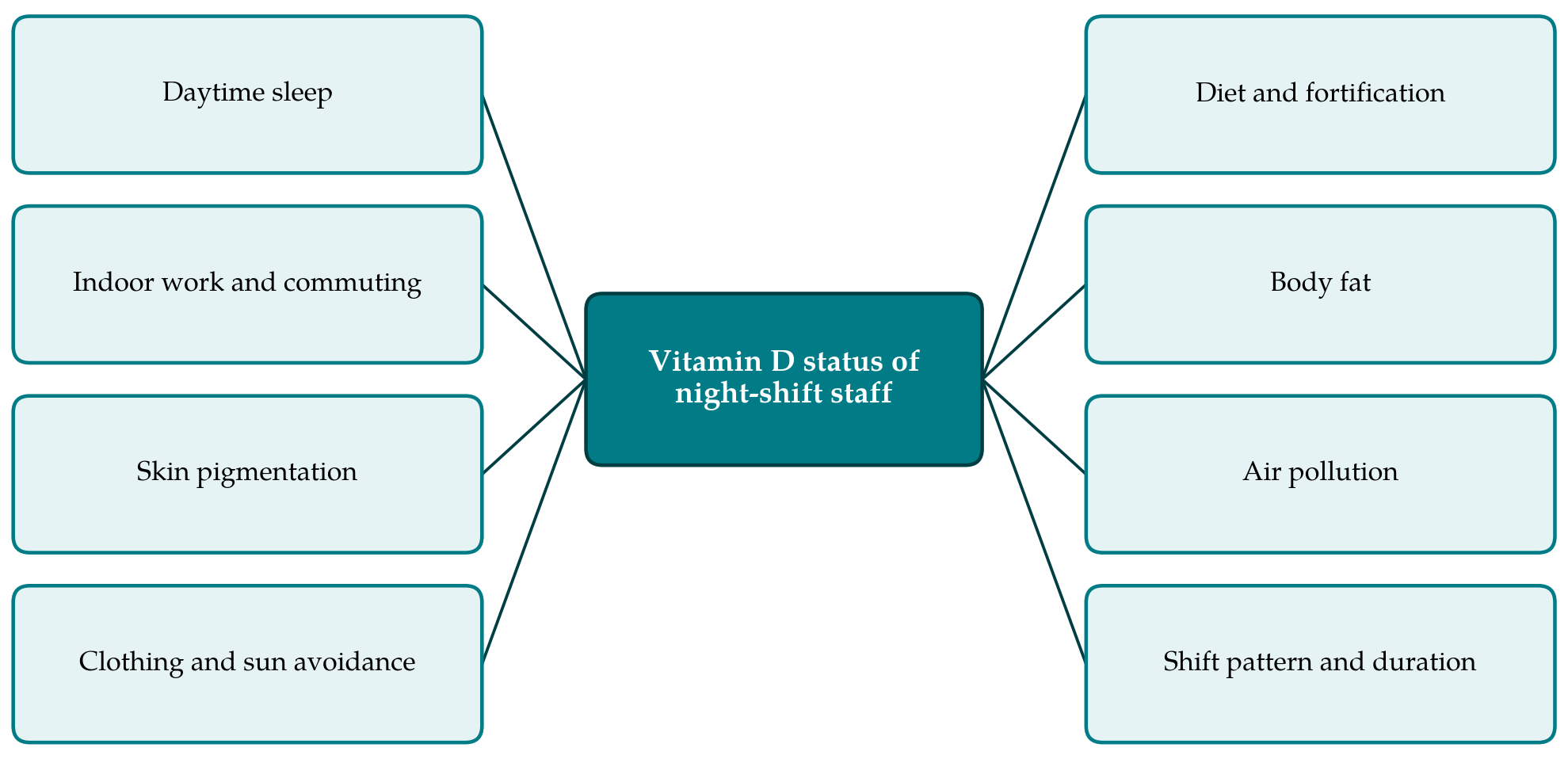
The specific contribution of night work is the displacement of waking hours away from solar noon. A worker on permanent nights who sleeps from morning to mid-afternoon may see direct sun only on the journey home, when the sun is low and ultraviolet B weak. Rotating schedules are less extreme but disrupt any routine of outdoor activity, and recovery days are often spent catching up on sleep. Against this, the difference from day staff may be smaller than it first appears, since a nurse on a day shift is inside the building from early morning until evening. Night work has other recognised correlates, weight gain and irregular meals among them, and because vitamin D is sequestered in adipose tissue, body composition could account for part of any association (Holick et al., 2011).
4. Reading the Evidence
Reports of vitamin D status in shift workers vary widely, and much of the variation arises from definition and measurement, not biology. Table 1 lists the main issues. The most consequential is the threshold. The Institute of Medicine concluded that a serum 25-hydroxyvitamin D concentration of 50 nmol/L (20 ng/mL) meets the needs of nearly all of the population (Institute of Medicine, 2011), while the Endocrine Society guideline of the same year defined deficiency as below 50 nmol/L and regarded concentrations up to 75 nmol/L (30 ng/mL) as insufficient (Holick et al., 2011). The same group of workers can thus be described as mostly adequate or mostly inadequate according to the standard chosen.
| Issue | Why it matters | What a careful report states |
|---|---|---|
| Threshold | Cut-offs of 50 and 75 nmol/L give very different prevalences | The cut-off used, with results at both |
| Assay | Immunoassays and mass spectrometry can disagree (Sempos et al., 2012) | Method and standardisation status |
| Season of sampling | Rainy and dry seasons differ in sun exposure | Month of blood collection |
| Comparison group | Day staff also work indoors | Day-shift colleagues from the same hospital |
| Sun exposure | Recall of time outdoors is imprecise | How exposure was measured |
| Confounders | Skin type, body mass, supplements and dress all affect status | Variables recorded and adjusted for |
Assay differences matter nearly as much. Immunoassays from different manufacturers, and liquid chromatography with tandem mass spectrometry, have historically given different values on the same serum, which is why an international standardisation programme was set up (Sempos et al., 2012). Cross-sectional designs add the usual difficulties. People are not assigned to night work at random; those who choose it or remain in it may differ in age, body mass, family responsibilities and outdoor habits. Without a comparison group drawn from the same hospital and measured in the same season by the same method, a finding of low status in night staff cannot be attributed to the nights.
5. Implications for Occupational Health
Three things can be said with reasonable confidence. Night-shift staff in a tropical city cannot be assumed to be replete because the city is sunny. Severe deficiency causes osteomalacia and is worth preventing (Holick, 2007). And the general measures that protect vitamin D status, namely dietary sources, fortified foods where available and sensible brief sun exposure on days off, carry little risk.
Beyond that the evidence thins. Low 25-hydroxyvitamin D is associated in observational studies with many disorders, but a systematic review concluded that the associations were largely not confirmed by randomised trials and may reflect ill health lowering vitamin D instead of the reverse (Autier et al., 2014). A large trial of supplementation in generally healthy adults did not reduce cancer or cardiovascular events (Manson et al., 2019). Routine screening of all night workers, or blanket high-dose supplementation, is therefore not supported by current evidence, and decisions about testing or supplementing an individual are properly made with a clinician under national guidance. What would help is better local data: a comparison of night and day staff within one hospital, sampled in the same season with a standardised assay, with sun exposure measured by dosimeter or diary and with adjustment for skin type and body mass.
6. Conclusion
Low vitamin D status among night-shift hospital workers in a tropical city is biologically plausible and consistent with what is known of indoor and shift workers elsewhere, but its size, and how much of it is owed to night work as distinct from indoor work in general, remain uncertain. Abundant sunshine is no guarantee of sufficiency. Hospitals should neither ignore the question nor medicalise it. The sound course is to encourage ordinary preventive habits and to support well-designed local studies that state their thresholds and assays clearly.
Conflict of interest
To be declared by the author(s) before publication.
Funding
To be declared by the author(s) before publication.