1. Introduction
Sequencing a human exome returns many missense changes whose consequences are unknown. Most are never seen again in a clinical database and most have no functional measurement, so interpretation falls back on computation. For two decades the computational contribution came from conservation: a position that has not changed across evolution is assumed to matter, an idea implemented in tools such as SIFT (Ng and Henikoff, 2003) and PolyPhen-2 (Adzhubei et al., 2010) and placed in the supporting evidence tier of the interpretation guidelines issued by Richards et al. (2015).
Protein language models have changed the computational input. Trained with a masked or autoregressive objective on tens or hundreds of millions of sequences, they learn a distribution over amino acids at each position conditioned on the rest of the sequence. Rives et al. (2021) showed that representations learned this way encode secondary structure, contacts and remote homology without ever being told about them, and the later ESM-2 models of Lin et al. (2023) extended the scale. Meier et al. (2021) made the step that concerns this review: scoring a substitution by the model likelihood of the mutant residue relative to the wild type, with no task-specific training at all.
That proposal has been taken up quickly in both research and clinical settings, and the claims made for it range from a useful prior to something close to a pathogenicity predictor. This article reviews the published evidence. It is a narrative review of the modelling, benchmarking and clinical interpretation literature, written to separate what these models reliably provide from what is assumed of them, and it does not report a systematic search or any new evaluation.
2. Scope and Approach
The review covers models trained on protein sequence alone and used to score single amino acid substitutions, together with the alignment-based generative models they are usually compared against and the assay data used to judge them. Structure prediction is discussed only where structural output is used as a variant signal. Regulatory, splicing and copy number variation lie outside the scope, as do protein design applications. Work is grouped by the question it answers rather than by date, and preference is given to papers that report evaluation against experimental measurements rather than against curated clinical labels alone.
3. How a Language Model Scores a Variant
Three scoring schemes dominate. The masked marginal score replaces the position of interest with a mask token, reads off the model distribution over the twenty amino acids, and takes the difference in log probability between mutant and wild type. The wild-type marginal score skips the masking and reads the distribution from the unmodified sequence, which is cheaper and usually slightly worse. The pseudo likelihood score mutates the sequence and sums log probabilities across all positions, capturing the effect of the substitution on the rest of the sequence. Meier et al. (2021) compared these schemes and reported the masked marginal to be the most reliable of the simple options.
The comparison class matters as much as the scoring rule. Alignment-based generative models fit a distribution to the homologous family rather than to all known protein sequence. Couplings models of the kind described by Hopf et al. (2017) capture pairwise epistasis within a family, the variational model of Riesselman et al. (2018) captures higher-order dependence, and the clinically oriented model of Frazer et al. (2021) adds a calibrated two-component mixture to turn the continuous score into a class. Hybrid approaches retrieve alignment statistics at inference time and combine them with an autoregressive language model, as in the method of Notin et al. (2022). Table 1 sets out the families and their characteristic weaknesses.
| Class | Signal used | Known weakness |
|---|---|---|
| Position conservation | Column entropy in an alignment | Ignores epistasis; weak at tolerated but rare substitutions (Ng and Henikoff, 2003) |
| Supervised classifier on features | Curated labels plus structural features | Type 1 and type 2 circularity in evaluation (Grimm et al., 2015) |
| Family generative model | Dependencies within one alignment | Fails when the family is shallow (Riesselman et al., 2018) |
| Protein language model, zero shot | Likelihood under a global sequence model | Confuses rarity with damage; no cellular context (Meier et al., 2021) |
| Retrieval-augmented language model | Global model plus family statistics | Inherits both failure modes (Notin et al., 2022) |
| Structure-informed ensemble | Predicted structure plus sequence likelihood | Calibration depends on the training labels (Cheng et al., 2023) |
4. What the Models Do Well
The strongest and best replicated result is that a language model likelihood correlates with measured functional effect across a wide range of proteins without any protein-specific fitting. Deep mutational scanning, introduced as a general technique by Fowler and Fields (2014), produces thousands of measured substitutions for a single protein, and collections of such experiments have become the standard yardstick. Livesey and Marsh (2020) used them to compare predictors on a footing independent of clinical labels, and the assembled benchmark of Notin et al. (2023) extended that comparison across many assays and model families.
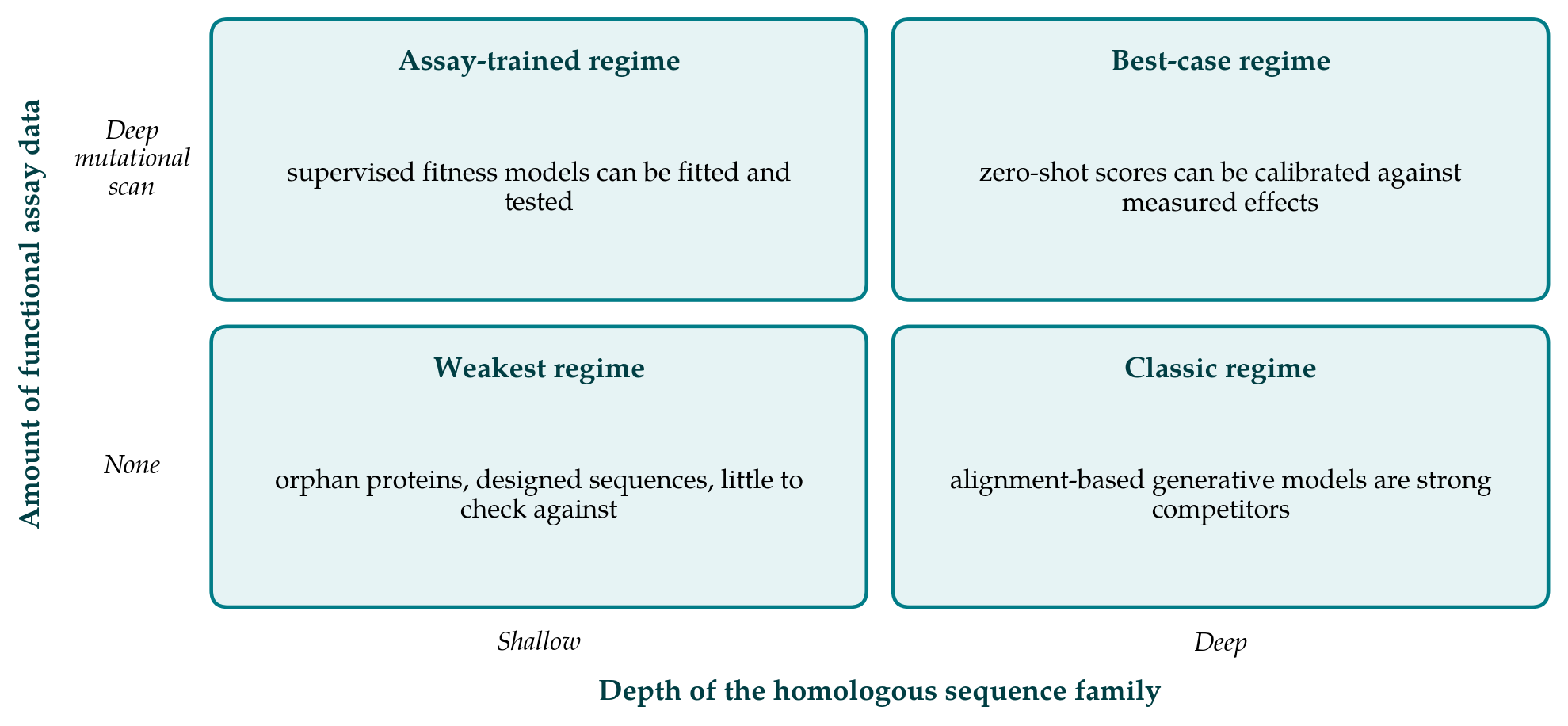
Generality is the practical strength. A conservation tool needs an alignment assembled for the protein at hand, and a supervised model needs labels; a language model needs only the sequence. For proteins with deep, diverse families the advantage over alignment-based generative models is modest, which several comparisons report, but the language model loses less ground when the family is shallow because it has learned general constraints on protein sequence from everything else it saw. Figure 1 shows the two axes, family depth and assay availability, that together determine which approach is likely to help.
A second strength is that the scores are cheap and exhaustive. A full substitution matrix for every position in a protein can be produced in one pass, which supports triage at proteome scale. The proteome-wide resource described by Cheng et al. (2023) combines this with structural context from the folding model of Jumper et al. (2021), and the structure database assembled by Varadi et al. (2022) makes such combinations routine.
5. Failure Modes
Four failure modes recur in the literature, and they are not simply matters of accuracy.
5.1. Rarity is not damage
A language model scores how expected a residue is given the sequence context, which is a statement about the sequences in the training set and not about molecular function. Residues that are rare because of phylogenetic sampling, codon usage or gene duplication history receive low likelihood whether or not they impair the protein. The converse also holds: a substitution common in a bacterial orthologue may be scored as acceptable in a human protein where the surrounding network differs. The underlying constraint learned is tolerance across evolution, which is correlated with function and not identical to it.
5.2. Family depth and bias
Performance degrades for proteins with few homologues, for fast-evolving families and for regions that are intrinsically disordered. Sequence databases are also unevenly sampled across the tree of life, so some human proteins sit in families dominated by a narrow set of lineages. Retrieval-based hybrids (Notin et al., 2022) and the constraint information in population datasets such as the one described by Karczewski et al. (2020) can partly compensate, but neither creates evolutionary signal where none exists.
5.3. Missing cellular context
A substitution can be benign for the folded enzyme and still cause disease through reduced expression, mislocalisation, altered degradation or disrupted interaction with a partner. Nothing in a sequence likelihood addresses dosage, tissue-specific expression or haploinsufficiency. Equally, a substitution that abolishes catalysis in vitro may be tolerated in vivo for a protein with redundancy. Functional assays have the same limitation, which is why the guidance of Brnich et al. (2020) insists that an assay be shown to model the disease mechanism before its output is used as evidence.
5.4. Circular evaluation
Evaluating any predictor on clinical labels invites circularity. Grimm et al. (2015) described two forms: training and test variants drawn from the same genes, and datasets in which almost all variants in a gene share one label, so that a predictor can score well by learning the gene rather than the variant. Labels in public archives such as the one maintained by Landrum et al. (2018) were themselves assigned with computational support, which compounds the problem. Assay-based evaluation avoids it, at the cost of covering few proteins.
6. Benchmarks and What They Can Settle
Benchmarking in this area has improved considerably. Early comparisons used heterogeneous clinical sets; current practice favours collections of deep mutational scans with standardised processing, of which the resource described by Notin et al. (2023) is the most widely used, alongside earlier protein transfer learning benchmarks (Rao et al., 2019) that established the format. These allow a ranking question to be answered: given two predictors, which orders substitutions within a protein more faithfully against measurement.
Several questions remain outside what such benchmarks settle. They say little about calibration, since a rank correlation is unchanged by any monotone transformation of the score, yet a clinical user needs a threshold with known error rates. They weight proteins by which ones happen to have been assayed, and those tend to be small, soluble and of established interest. And because each assay measures one property in one system, aggregate performance across assays conflates fitness, stability, binding and abundance. Reporting per-assay results with the measured property named is more informative than a single averaged figure.
For clinical use the framework of Richards et al. (2015) assigns computational predictions supporting weight only, and subsequent calibration work has examined how much weight a well-validated predictor can carry. Starita et al. (2017) set out the case for functional assays as the stronger evidence type, and the recommendations of Brnich et al. (2020) describe how an assay is validated for that purpose. A language model score is best understood as input to that process rather than as a substitute for it.
7. Gaps and Future Work
Three gaps stand out. The first is calibration to interpretable quantities. Converting a log odds ratio into a likelihood ratio with stated performance, as attempted by the mixture formulation of Frazer et al. (2021), is more useful than another increment in rank correlation. The second is coverage beyond the single substitution: insertions, deletions, multi-residue changes and frame-preserving rearrangements are common in patients and poorly handled.
The third is the integration of modalities that sequence cannot carry. Predicted structure, binding interfaces, post-translational modification sites, expression and population constraint all inform tolerance, and the current practice of concatenating them into an ensemble is pragmatic rather than principled. Representation learning across sequence and structure jointly, of the kind the models of Lin et al. (2023) and Elnaggar et al. (2022) begin to approach, is a natural direction, provided that evaluation keeps pace and stays independent of clinical labels.
8. Conclusion
Protein language models supply a general, inexpensive and genuinely zero-shot prior on which amino acid substitutions a protein will tolerate, and on assay-based benchmarks they match or exceed alignment-based methods across a wide range of proteins. Their weaknesses follow from what they are. They score how expected a residue is, not how damaging it is; they lose power where sequence families are shallow; they know nothing of expression, dosage or cellular context; and evaluation against clinical labels remains vulnerable to circularity. Treating these scores as a well-characterised prior, reported with calibration and with an explicit statement of the regime in which they were validated, is the use the evidence supports.
Conflict of interest
To be declared by the author(s) before publication.
Funding
To be declared by the author(s) before publication.