1. Introduction
The distinction between explanatory and pragmatic trials goes back to Schwartz and Lellouch (1967). An explanatory trial asks whether a treatment works under controlled conditions and seeks to isolate its specific action. A pragmatic trial asks whether choosing that treatment leads to better outcomes in ordinary practice, with all the variation ordinary practice brings. Most real trials sit somewhere between the two, and tools now exist for locating a design on that continuum (Loudon et al., 2015).
In homeopathy the two attitudes have often been set against each other. Some researchers in the field have argued that the placebo-controlled trial distorts individualised practice, because uncertainty about whether the patient is receiving an active remedy interferes with the practitioner's reading of the response and with the sequence of prescriptions that follows (Weatherley-Jones et al., 2004). They favour pragmatic comparisons of homeopathic care with usual care. Critics reply that such comparisons, being unblinded, measure the consultation and the patient's hopes along with the remedy, and so cannot answer the question that is actually in dispute.
Both points are sound, and they are not incompatible. This article proposes a trial design in which remedy selection is left wholly to the practitioner and blinding of the remedy is preserved. The design is a proposal built from published precedents and guidance. It has not been run or validated here, and no results are reported.
2. Background
The case for blinding rests on empirical work. Trials without adequate allocation concealment or double-blinding have been found to yield larger estimates of treatment effect than trials with them, and the exaggeration is concentrated in trials with subjective outcomes (Wood et al., 2008). Homeopathic trials rely almost entirely on such outcomes: symptom scores, global ratings, quality of life. Blinding protects against several distinct biases, among them differential expectation in patients, differential care by clinicians and differential assessment of outcomes (Schulz and Grimes, 2002).
The case for separating remedy from consultation is equally empirical. In a factorial trial in rheumatoid arthritis, patients were randomised both to consultation or no consultation and to remedy or placebo; benefit followed the consultation and not the remedy (Brien et al., 2011). The most rigorous comparative analysis of placebo-controlled trials concluded that the evidence for specific effects of homeopathic remedies was weak (Shang et al., 2005), and a meta-analysis of individualised trials found few that qualified as reliable evidence (Mathie et al., 2014). An open-label pragmatic trial that showed patients doing better with homeopathic care than without it would therefore be uninterpretable on the central question.
Published trials show that individualisation and blinding can coexist. In a trial of acute childhood diarrhoea in Nicaragua, each child was assessed and prescribed an individual remedy, after which the child received either that remedy or placebo under double-blind conditions (Jacobs et al., 1994). A British trial of individualised homeopathy as an adjunct in childhood asthma used the same principle, with prescriptions filled as remedy or placebo by a pharmacy according to a concealed code, and allowed the prescription to be changed during follow-up (White et al., 2003). The proposal below generalises this arrangement and adds pragmatic features that those early trials lacked.
3. The Proposed Design
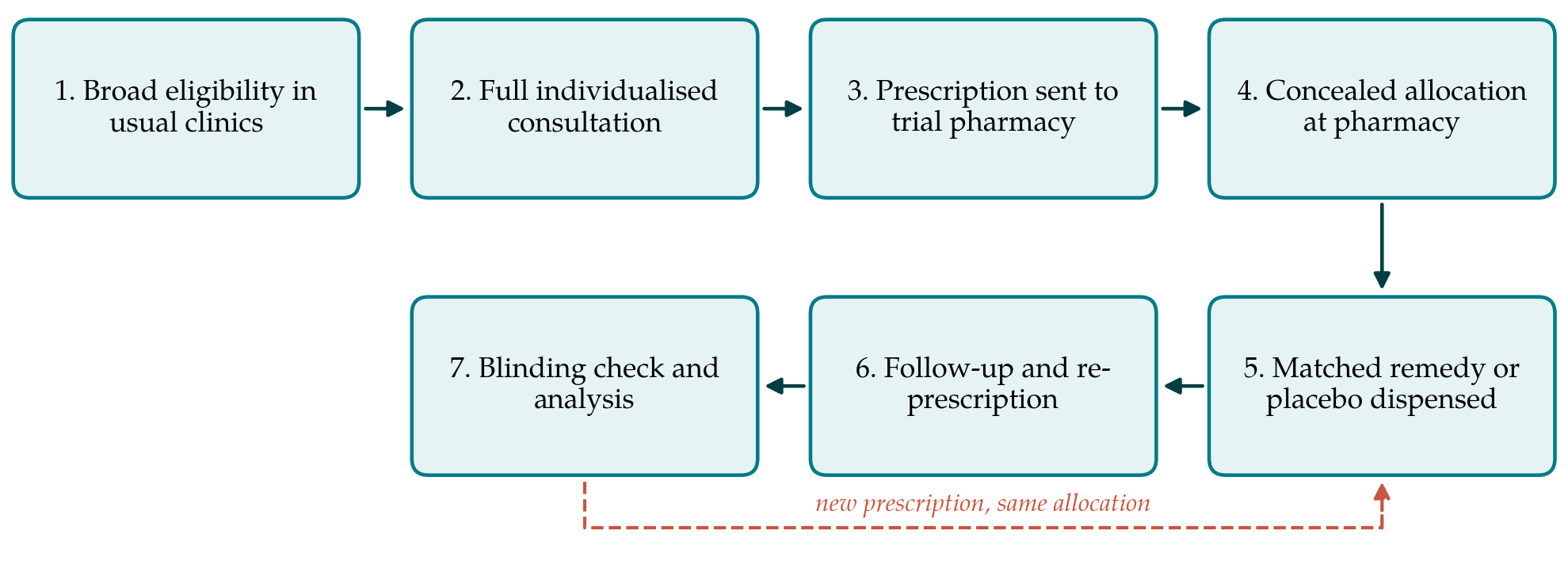
The design is described in seven steps, shown in Figure 1. The governing idea is simple: everything the practitioner does is real and unconstrained, and the only point at which the trial intervenes is the pharmacy shelf.
3.1. Steps 1 and 2: recruitment and consultation
Patients are recruited from the clinics where they would ordinarily be seen, with eligibility criteria kept as wide as safety allows: a clinical diagnosis made in the usual way, few exclusions for age or comorbidity, and no run-in period to select good compliers. Practitioners are those who normally provide the service, with their usual training. Each patient then has the standard first consultation, of normal length and conducted exactly as in practice. The practitioner selects a remedy, potency and schedule and writes a prescription, in the knowledge that the patient has an equal chance of receiving it or a placebo. The practitioner's reasoning is recorded so that the prescribing can later be described as the RedHot supplement asks (Dean et al., 2007).
3.2. Steps 3 to 5: allocation and dispensing
The prescription goes to a single trial pharmacy, independent of the clinics. Randomisation is generated by a statistician with no patient contact, and the allocation list is held only by the pharmacy. For a patient allocated to active treatment, the pharmacy dispenses the prescribed remedy. For a patient allocated to placebo, it dispenses carrier material prepared in the same form, by the same manufacturer, in identical packaging, and labelled with the name and potency the practitioner prescribed. Neither patient nor practitioner nor outcome assessor can tell the two apart. Because homeopathic medicines in high dilution are indistinguishable from unmedicated carrier by appearance or taste, the technical problem of matching, which is hard for many drugs, is here almost trivial.
3.3. Step 6: follow-up and changes of prescription
At each follow-up visit the practitioner assesses the response and is free to repeat, change the potency or choose a different remedy. Every new prescription is sent to the pharmacy and filled according to the patient's original allocation, so a patient in the placebo arm receives placebo labelled with each successive remedy name. The number and timing of visits are left to the practitioner within a broad ceiling. Conventional treatment continues as the patient's own doctor sees fit, and changes in it are recorded as outcomes or co-interventions and not prohibited. Table 1 sets out how each design decision is resolved in the pragmatic direction and what protects blinding at that point.
| Decision | Pragmatic choice | Safeguard for blinding |
|---|---|---|
| Eligibility | Usual clinic patients, few exclusions | None needed at this stage |
| Remedy selection | Any remedy, potency and schedule the practitioner chooses | Prescription written before allocation is applied |
| Dispensing | One central pharmacy supplies all clinics | Allocation held only by pharmacy; identical product and label |
| Re-prescription | Unlimited changes at follow-up | Each change filled under the original allocation |
| Co-interventions | Usual care continues unrestricted | Recorded by staff unaware of allocation |
| Outcomes | Patient-important, few, collected by questionnaire | Patients and assessors blind; guesses recorded |
| Analysis | Intention to treat, all randomised patients | Code broken only after database lock |
3.4. Step 7: testing the blind and analysing
A claim of double-blinding should be checked. At the end of follow-up, and ideally once earlier, patients and practitioners are asked which treatment they believe was given, with the option of saying they do not know. The answers can be summarised with the blinding index of Bang et al. (2004), which distinguishes random guessing from correct identification and from systematic wrong guessing in each arm. The primary analysis follows the intention-to-treat principle and a statistical analysis plan fixed in the registered protocol, written to the SPIRIT standard (Chan et al., 2013). The report should follow the CONSORT extension for pragmatic trials (Zwarenstein et al., 2008).
4. Adding a Usual-Care Arm
The two-arm design estimates the effect of the remedy within a setting of full homeopathic care. It says nothing about the value of the package as a whole. Where that question matters to a funder, a third arm receiving usual care alone can be added. The comparison between the two blinded arms then estimates the specific effect of the remedy, and the comparison between the placebo arm and usual care estimates the effect of the consultation and its context. The second comparison is unblinded and should be read with the caution that applies to any open-label contrast.
An alternative for the unblinded comparison is the cohort multiple randomised controlled trial, in which a large observational cohort is followed with regular outcome measurement and a random selection is offered the intervention, the remainder serving as controls without being told (Relton et al., 2010). This avoids the disappointment of patients who consent to a trial and are allocated to nothing. It raises questions about consent that each ethics committee will need to consider, and it does not remove the need for the blinded comparison.
5. How Pragmatic the Design Really Is
Trials described as pragmatic by their authors are frequently less so on inspection, particularly when they are placebo-controlled and conducted in a single specialised centre (Dal-Ré et al., 2018). The proposed design should be scored honestly against the nine domains of PRECIS-2: eligibility, recruitment, setting, organisation, flexibility of delivery, flexibility of adherence, follow-up, primary outcome and primary analysis (Loudon et al., 2015). It can be fully pragmatic on eligibility, recruitment, setting, delivery and analysis. It is less so on organisation, because a central pharmacy and mailed medicines are not how most patients obtain remedies. It is also less so on follow-up if questionnaires are added that would not be used in practice. The use of placebo is itself a departure from routine care, a point made in general discussions of pragmatic design (Ford and Norrie, 2016). These departures should be reported as such.
6. Limitations and What Remains to Be Shown
The objection that blinding alters prescribing is not answered by the design; it is only reduced. A practitioner who sees no change at follow-up cannot know whether the remedy was wrong or the patient is taking placebo, and may change prescriptions more often than usual. This can be examined by comparing the pattern of re-prescription in the two arms and with routine practice, but whether it matters for outcomes is unknown. Practitioners who believe they can detect an active remedy from the patient's response may also unblind themselves, correctly or not, which is one reason the blinding check is necessary.
Other limits are practical or interpretive. Homeopathic care as a whole is a complex intervention in the sense of the Medical Research Council guidance (Craig et al., 2008), and no single trial captures all its components. A central pharmacy adds cost and delay. Above all, the accumulated placebo-controlled evidence gives little reason to expect a specific effect, so a trial built on this design should be powered and interpreted with that prior in mind, and a null result should be reported as plainly as a positive one would be. None of the steps has been tested together here; feasibility, recruitment rates and the integrity of the blind would need to be established in a pilot.
7. Conclusion
Respect for individualised prescribing and protection of the blind are compatible when the trial intervenes only at the point of dispensing. The design proposed here lets practitioners work as they normally do, keeps patients, practitioners and assessors unaware of allocation, checks that the blind held, and can be extended with a usual-care arm to estimate the contribution of the consultation. It removes the main methodological excuse for unblinded trials in this field. Whether it also removes the practical obstacles is a matter for a pilot study to determine.
Conflict of interest
To be declared by the author(s) before publication.
Funding
To be declared by the author(s) before publication.