1. Introduction
Electricity in most of Southern Africa is supplied by a vertically integrated utility owned by the state. Such a utility answers to a shareholder ministry, a finance ministry that guarantees its debt, an energy ministry that plans the sector and, in most countries, an independent regulator that sets its tariff. When governance of the utility fails, the consequences reach well beyond the company: supply is interrupted, public debt rises and the regulator is asked to approve prices that reflect past errors. Regional reviews of the power sector have long identified the governance of incumbent utilities as a constraint on investment and reform (Besant-Jones, 2006; Eberhard et al., 2016).
South Africa's national utility, Eskom, is the most thoroughly documented instance. A report of the Public Protector in 2016 (Public Protector South Africa, 2016) and the report of a judicial commission of inquiry delivered in 2022 (State Capture Commission, 2022) placed a large body of testimony and documents in the public domain. A record of that size is an opportunity for research and a hazard. It invites the researcher to retell what the inquiries concluded, and it can hide the fact that an inquiry asks who was responsible while a social scientist asks why controls that existed on paper did not work.
This article proposes a case study design aimed at the second question. It is written for researchers in governance, public administration and energy policy who intend to study one utility in depth. The article describes a procedure and the reasoning behind it. It does not apply the procedure, and it makes no findings about Eskom or any other entity.
2. Background
Three bodies of work inform the design: the theory of state ownership, the formal governance framework that applies to a state-owned utility, and the literature on how organisational failures develop.
2.1. Why state ownership strains governance
The economic theory of state enterprise locates the problem in the objectives of those who control the firm. Shleifer and Vishny (1994) model politicians who use public firms to pursue political ends, such as employment or favours to supporters, at the expense of efficiency. Kornai (1986) described the soft budget constraint: a firm that expects to be rescued has weak reasons to control costs. A state-owned utility has several principals with different aims, which blurs accountability. The guidelines of the OECD respond to these problems by asking the state to separate its role as owner from its roles as policy maker and regulator, to act as an informed and active owner, and to leave boards with real authority (OECD, 2015).
2.2. The formal framework
A design must start from the rules that were meant to prevent failure. In South Africa these include the Public Finance Management Act, which makes the board of a public entity its accounting authority with fiduciary duties and responsibility for preventing irregular expenditure (Republic of South Africa, 1999); the King IV code on corporate governance, which applies to state-owned entities through a sector supplement (Institute of Directors in Southern Africa, 2016); and the statutes that establish the energy regulator and give it power to license and to set tariffs. Other countries in the region have their own equivalents. The first analytical task in any case is to establish which rule assigned which control to which body.
2.3. How failures develop
Studies of organisational failure suggest that breakdowns are seldom sudden. Turner (1976) described an incubation period in which warning signs accumulate and are discounted because they do not fit accepted beliefs. That idea directs attention to the years before a crisis becomes visible, and to the treatment of early warnings by auditors, board committees and the regulator. On the regulatory side, Ayres and Braithwaite (1992) proposed that regulators escalate from persuasion to sanction as cooperation fails. Their enforcement pyramid offers a yardstick against which the actual sequence of regulatory responses can be compared.
3. The Proposed Design
The design is a single-case study with embedded units of analysis, in the sense used by Yin (2018): the case is the utility over a defined period, and the embedded units are the board, the executive, the shareholder ministry and the regulator. A single case is appropriate where it is unusually revealing or well documented, and depth is the purpose of the method (Flyvbjerg, 2006). Figure 1 shows the first five steps with the main evidence for each; the sixth, testing rival explanations, runs across all of them. Table 1, placed with the second step, lists the types of source.
| Source type | What it can show | Main weakness |
|---|---|---|
| Annual and integrated reports | Board composition, committee structure, reported irregular expenditure | Written by the entity itself |
| External audit reports and opinions | Control deficiencies and qualified findings by year | Limited to matters within audit scope |
| Regulator decisions and reasons | Costs allowed or disallowed, and the stated grounds | Reflect the information the utility supplied |
| Parliamentary and judicial inquiry records | Sworn testimony and documents obtained by compulsion | Shaped by terms of reference; findings may be contested |
| Court judgments | Facts established to a legal standard | Cover only matters litigated |
| Interviews with former officials | Reasons and context absent from documents | Recall, self-justification, restricted access |
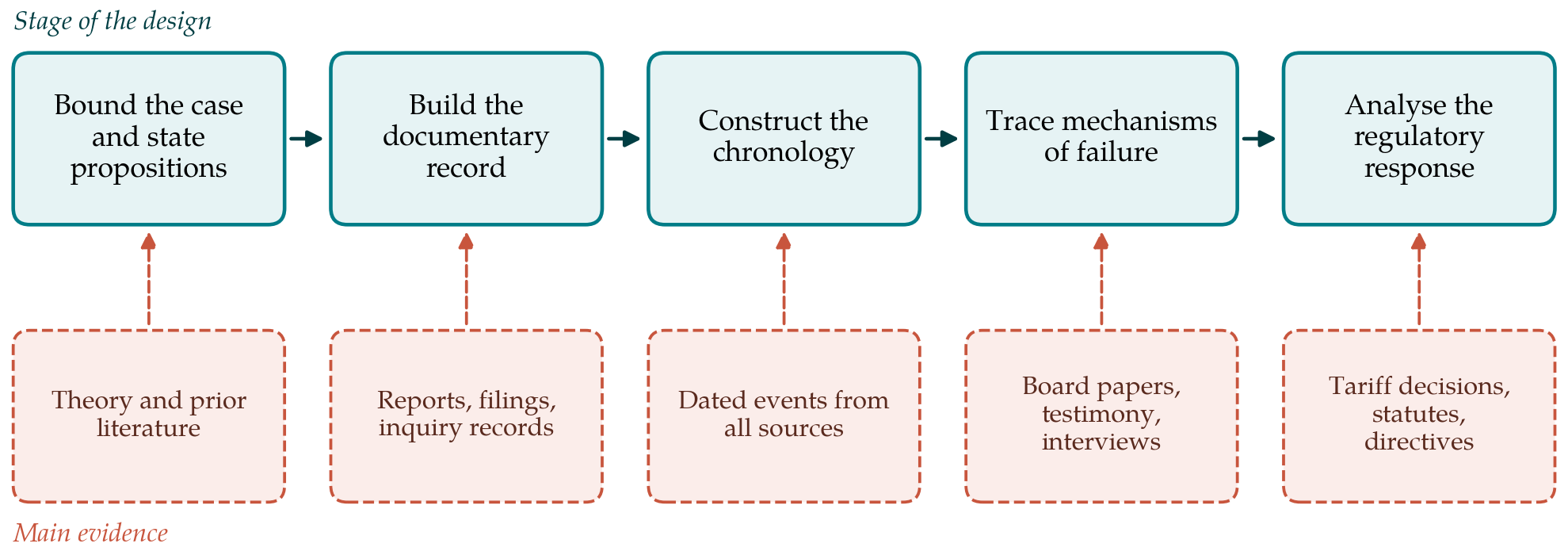
3.1. Step 1: Bound the case and state propositions
The researcher fixes the period, the entity and the decisions of interest before reading the record in detail. Procurement of fuel, the appointment and removal of directors and executives, and the financing of new generating plant are natural candidates, because each is governed by identifiable rules. Propositions are then written down from theory. One might hold that failures followed changes in board composition initiated by the shareholder; another, that the soft budget constraint weakened cost control regardless of who sat on the board. Stating propositions in advance is what separates a case study from a chronicle (Eisenhardt, 1989).
3.2. Step 2: Build the documentary record
Documents are the core of the evidence, and they should be collected systematically and logged with their origin, date and purpose. Table 1 lists the main types and what each can and cannot show. Document analysis has known weaknesses: documents are written for a purpose, survive selectively and may be incomplete (Bowen, 2009). An inquiry transcript records what witnesses chose to say under legal advice. An annual report is drafted by the entity under study. The log should therefore record who produced each document and why.
3.3. Step 3: Construct the chronology
Every dated event relevant to the bounded decisions is entered in a single chronology with its source: appointments, resolutions, contract awards, audit findings, regulatory applications and decisions, ministerial directives. The chronology is the main analytical instrument for process data (Langley, 1999). It exposes sequence, which narrative sources often obscure, and it shows where the record is silent. Gaps are themselves recorded, since an absence of board minutes on a large decision is evidence of a kind.
3.4. Step 4: Trace the mechanisms of failure
With the chronology in place, the researcher asks, for each decision, which control should have operated and what happened at that point. Process tracing provides the logic. Each proposition implies observable traces: if board changes drove the failure, the chronology should show contested decisions clustering after those changes, and committee records should show dissent ending. The researcher states in advance what evidence would count for and against each proposition and how strongly (George and Bennett, 2005; Beach and Pedersen, 2013). A trace that would be expected under every explanation proves little, while one that only a single explanation predicts carries weight.
3.5. Step 5: Analyse the regulatory response
The response is treated as a second sequence running alongside the first. For each warning that reached a body with power to act, the researcher records what that body knew, what it could lawfully do, and what it did. The bodies include the energy regulator, the shareholder ministry, the treasury, the auditor and the legislature. Comparing the observed sequence with the escalation that responsive regulation would predict shows where responses stalled, and the formal framework from the background section shows whether the cause was a lack of power or a failure to use it.
3.6. Step 6: Test rival explanations and report
Before conclusions are drawn, at least three rival accounts should be tested against the chronology: that the failure was mainly one of technical and financial circumstance, such as ageing plant or tariffs held below cost; that it was a failure of individuals; and that it was a failure of institutional design that would have occurred with different people. The report should present the chronology, the evidence for and against each account, and the points on which the record does not allow a conclusion.
4. Fitting the Design to Practice
Three practical matters need attention from the outset. The first is law. Many of the people named in the public record are or may be parties to criminal, civil or review proceedings, and findings of an inquiry can be challenged in court. The researcher should distinguish at every point between what a source alleges, what an inquiry found and what a court has decided, and should take advice on defamation before publication. The second is ethics. Interviews require approval from the researcher's institution, informed consent and a clear agreement on attribution, and some participants will speak only without attribution, which limits how their evidence can be used.
The third is volume. A commission record can run to many thousands of pages, more than one person can read closely. The bounding done in step 1 is the main protection. Qualitative analysis software helps with retrieval, and coding should follow a written scheme tied to the propositions so that a second researcher could check a sample of it.
5. Limitations and What Remains to Be Shown
The design has not been applied, and its workability is untested. Its dependence on public documents means that it sees best what inquiries chose to examine, and decisions that attracted no investigation may be invisible to it. A single case cannot establish how common a mechanism is. Conclusions can be generalised to theory, by showing that a proposed mechanism did or did not operate under stated conditions, and not to the population of utilities. A natural extension is a second case from another country in the region, chosen to differ on one condition of interest, such as the independence of the regulator. Whether the six steps can be completed within the resources of a doctoral project or a small research team is a question that only an application can answer.
6. Conclusion
The public record on state-owned power utilities in Southern Africa supports more rigorous research than it has so far received. The design proposed here asks the researcher to state propositions before reading, to organise the evidence as a sourced chronology, to trace failure and response as two linked sequences, and to test rival accounts before concluding. Its aim is an explanation of why formal controls failed that can be checked by others against the same record. The design is offered for use and criticism, and its value will be known only when it has been tried.
Conflict of interest
To be declared by the author(s) before publication.
Funding
To be declared by the author(s) before publication.