1. Introduction
A laboratory report of estimated glomerular filtration rate looks like a measurement. It is in fact the output of a regression equation that converts a serum creatinine concentration into a likely filtration rate using the patient's age and sex and, until recently in many countries, a term for race. The Modification of Diet in Renal Disease study equation multiplied the estimate by about 1.21 for patients identified as Black (Levey et al., 1999), and the 2009 Chronic Kidney Disease Epidemiology Collaboration (CKD-EPI) equation by about 1.16 (Levey et al., 2009). The same creatinine result thus yielded a filtration rate roughly a sixth to a fifth higher in a Black patient than in anyone else.
In transplantation that difference had a specific consequence. Kidney allocation in the United States lets a candidate who is not yet on dialysis begin to accrue waiting time once filtration rate falls to 20 mL/min or below. A higher estimate for the same creatinine meant that a Black patient crossed that line later. This Perspective considers what the move to race-free equations has and has not fixed in waitlisting, and argues that the threshold itself deserves as much scrutiny as the equation.
2. How Race Entered the Equations and Why It Was Removed
The coefficient was empirical. In the cohorts used to develop the equations, Black participants had on average higher serum creatinine than others at the same measured filtration rate, and adding a race term improved the statistical fit. The usual explanation offered was greater average muscle mass, although the evidence for that explanation was thin, and the developers presented the term as a way of reducing bias in the estimate (Levey et al., 2020).
Criticism gathered on several grounds. Race is a social classification with no fixed biological meaning, it is recorded inconsistently, and it cannot be assigned sensibly to people of mixed ancestry. A term derived from United States cohorts was being applied to populations elsewhere in which it had never been tested. And a correction that raises estimated kidney function systematically delays every decision that depends on a low value: referral to a nephrologist, preparation for dialysis, and listing for transplantation (Eneanya et al., 2019; Vyas et al., 2020). Defenders of the term replied that discarding it without a replacement would make estimates less accurate for Black patients and could cause other harms, such as withholding drugs cleared by the kidney (Powe, 2020). An analysis of a large United States cohort gave the transplant concern substance: recalculating without the coefficient shortened the time at which Black participants reached the listing threshold (Zelnick et al., 2021).
The task force convened by the National Kidney Foundation and the American Society of Nephrology recommended immediate adoption of a refitted creatinine equation that contains no race term, together with wider use of cystatin C (Delgado et al., 2021). The refitted CKD-EPI equations were published at the same time (Inker et al., 2021).
3. What the 2021 Equations Changed, and What They Did Not
The 2021 creatinine equation was fitted to the pooled development data without regard to race. Its authors were candid about the result. Compared with measured filtration rate, the new equation underestimates somewhat in Black individuals and overestimates somewhat in others, so that bias is shared between groups instead of being removed. The equation that combines creatinine with cystatin C was more accurate than either marker alone and showed smaller differences between race groups (Inker et al., 2021). A parallel analysis from the Chronic Renal Insufficiency Cohort reached a compatible conclusion: creatinine-based estimation without race or ancestry misestimated filtration rate in Black participants, whereas estimation from cystatin C did not need either (Hsu et al., 2021).
Transplant policy followed. The Organ Procurement and Transplantation Network required programmes to use race-neutral estimates when registering waiting time (OPTN, 2022), and then required them to review Black candidates already listed and to restore waiting time lost to the old calculation (OPTN, 2023). These were significant corrective acts. What they left untouched is the form of the rule: a single number, usually from creatinine alone, compared with a fixed cut-off.
4. The Argument: A Threshold Needs More Than One Number
Every estimating equation carries random error for the individual, whatever its average accuracy. In validation studies a meaningful share of creatinine-based estimates differ from measured filtration rate by more than thirty per cent (Levey et al., 2009). Around a cut-off of 20 mL/min, an error of that size spans the whole range in which the decision is made. Creatinine generation depends on muscle mass and meat intake, and its tubular secretion rises as filtration falls, so the error is largest in exactly the people being assessed: those with advanced disease, the frail, amputees, the very muscular, and those on restricted diets.
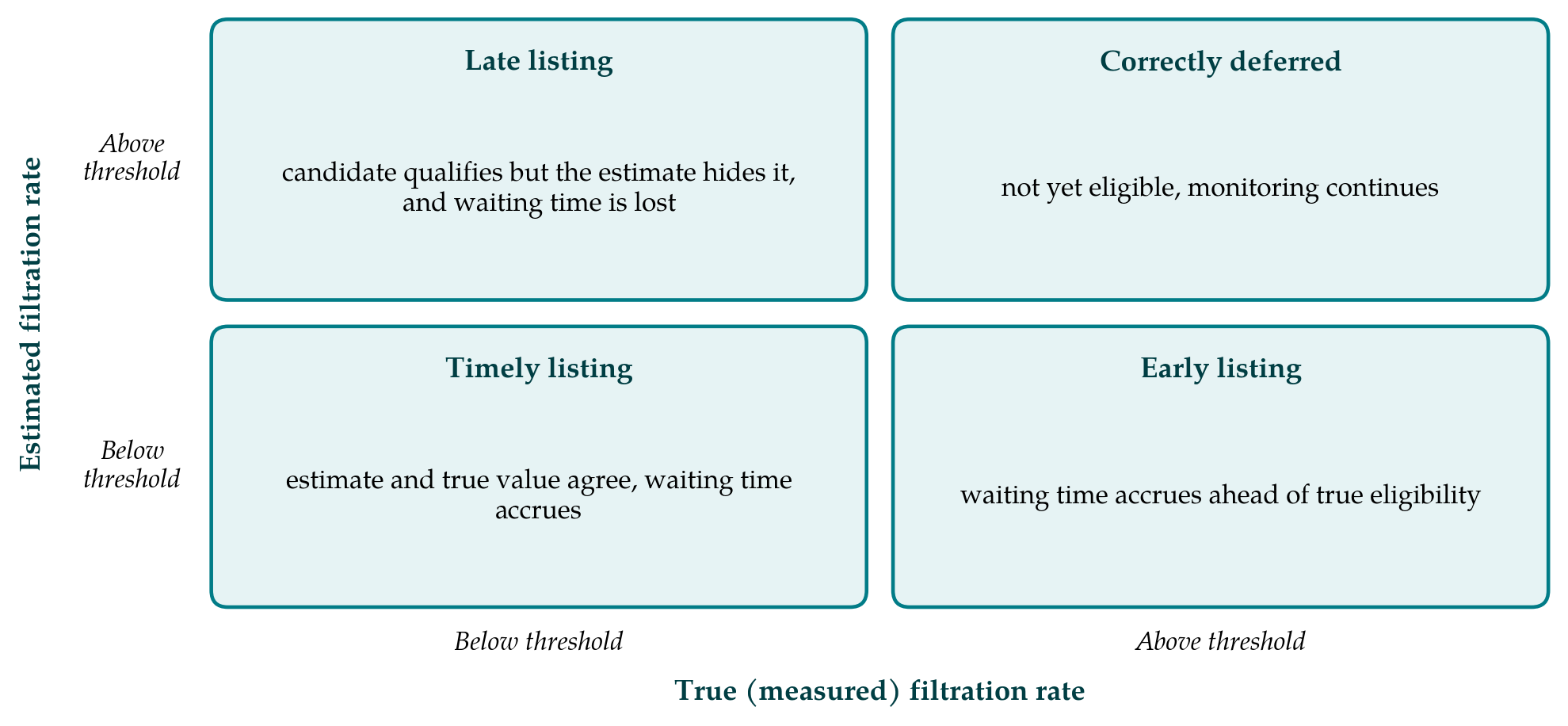
Figure 1 sets out the four possible relations between an estimate and the true filtration rate at a listing threshold. Two are correct. One, early listing, gives a candidate waiting time before strict eligibility. The fourth, late listing, is the costly error, because time on the list largely determines when a deceased donor kidney is offered, and longer exposure to dialysis before transplantation is associated with poorer outcomes afterwards (Meier-Kriesche and Kaplan, 2002). The race coefficient pushed Black candidates systematically towards the late-listing cell. Its removal ends that systematic push. It does not empty the cell.
The proposal here is modest. A creatinine-based estimate should be treated as a screening value for waitlisting. When it falls within a band above the threshold, a confirmatory test should be obtained and the more favourable valid result should count for the start of waiting time. Table 1 compares the available options. Cystatin C is the obvious first confirmatory test: it is a routine immunoassay and it does not depend on muscle mass. The combined creatinine and cystatin C equation has been available for more than a decade (Inker et al., 2012). Measured clearance, by an exogenous marker or a timed urine collection averaging urea and creatinine clearance, remains the reference where the two markers disagree. Guidance on candidate evaluation already accepts measured or estimated values (Chadban et al., 2020); the suggestion is to make confirmation routine near the line instead of optional.
| Method | Main strength | Main limitation near a threshold |
|---|---|---|
| Creatinine equation without race (Inker et al., 2021) | Universal, cheap, automatic reporting | Sensitive to muscle mass and diet; residual bias between groups |
| Creatinine and cystatin C combined (Inker et al., 2012) | Most accurate estimate; small differences by race | Cystatin C not offered by all laboratories |
| Cystatin C alone (Pottel et al., 2023) | Independent of muscle mass; no race or sex term needed | Affected by inflammation, steroids, thyroid disease |
| European Kidney Function Consortium equation (Pottel et al., 2021) | Scaled to population-specific normal creatinine | Requires a reference creatinine value for each population |
| Measured clearance | Direct measurement; reference standard | Time, cost and limited availability |
Disagreement between the two markers is itself informative. When the creatinine estimate sits well above the cystatin C estimate, low muscle mass is a likely reason and the creatinine value probably flatters kidney function; when the reverse holds, a non-renal influence on cystatin C should be sought. Neither pattern can be detected from creatinine alone. A programme that measures both in borderline candidates therefore learns which estimates to trust, and can reserve measured clearance for the smaller number in whom the markers diverge widely.
5. Counter-Arguments
The first objection is cost and access. Cystatin C costs more than creatinine and many laboratories still send it away. This is true, but the test would be needed only for candidates near the threshold, a small group, and the expense is trivial beside the cost of a single month of dialysis. The task force itself called for cystatin C to become routinely and promptly available (Delgado et al., 2021). A transplant programme is better placed than most services to insist on it.
A second objection is that confirmatory testing which only ever moves listing earlier is a one-way ratchet that will lengthen the list. That is a fair description, and it is intended. Allocation systems already tolerate early listing in other ways, and waiting time credited before a candidate is ready does not oblige anyone to transplant too soon. The alternative, to accept late listing as the price of a simple rule, places the cost on individuals who cannot know that their creatinine misrepresents them.
A third objection comes from those who think the 2021 equation went too far or not far enough. Outside the United States, groups such as the European Kidney Function Consortium have developed equations that scale creatinine to a population-specific reference value instead of using race, and a cystatin C equation with neither race nor sex terms (Pottel et al., 2021; Pottel et al., 2023). The debate over which equation is best is real, and it reinforces the present argument: if experts disagree about the estimate, a consequential threshold should not hang on one version of it.
The last objection is the most serious. The equation may be a minor contributor to inequity in transplantation. Work on the steps that precede listing has found that race and poverty are both associated with a lower chance of progressing from referral through evaluation to the waiting list (Patzer et al., 2012). A candidate who is never referred gains nothing from a better estimate. This is correct, and it is a reason to pursue both. The equation was a visible, codified source of delay that could be changed by a single policy decision; referral practice requires slower work with dialysis units, primary care and communities.
6. Implications for Programmes and Policy
For a transplant programme the practical steps are few. Laboratories should report the race-free estimate by default. Referral criteria should invite assessment well before the threshold is reached. Candidates whose creatinine-based estimate is approaching the listing value should have cystatin C measured, and a measured clearance where the two markers conflict or where body composition is unusual. The basis for the listing date should be recorded so that it can be audited. Programmes should also confirm that the review of previously listed Black candidates has been completed and that affected patients were told the outcome.
For policy makers the wider lesson concerns fixed thresholds applied to estimates. The same reasoning applies to cut-offs for living donor acceptance and for simultaneous organ listing. Countries that never used a race term still face the underlying problem, since their equations too were developed in particular populations and misfit others. Allocation rules could specify acceptable confirmatory methods and state that any one of them qualifies, which would turn a point of fragility into a documented margin of safety.
7. Conclusion
Removing race from kidney function equations ended a practice that delayed transplant listing for Black patients on the strength of a poorly understood statistical adjustment. It was necessary. It has not made a creatinine-based estimate precise enough to serve alone as the gate to the waiting list. The fairest reading of the past few years is that the profession has corrected a bias and should now address the imprecision behind it, by confirming borderline estimates with cystatin C or a measured clearance and by giving equal attention to the referral steps that come before any equation is applied.
Conflict of interest
To be declared by the author(s) before publication.
Funding
To be declared by the author(s) before publication.