1. Introduction
Pomegranate (Punica granatum L.) has moved in a few decades from a minor fruit of dry-land gardens to a commercial orchard crop. Demand for the fresh fruit, for ready-to-eat arils and for juice grew with interest in the phenolic compounds of the fruit (Gil et al., 2000), and plantings expanded in Spain, Iran, India, Turkey, Israel and California (Stover and Mercure, 2007). Nearly all of these production areas are semi-arid. The tree suits them: it is deciduous, withstands high summer temperatures, grows on shallow and calcareous soils and is more tolerant of salinity than most fruit species (Holland et al., 2009).
Tolerance of drought is not the same as indifference to it. A pomegranate tree survives a dry summer, but a commercial crop of large, well-coloured, uncracked fruit needs irrigation through a long season, and in the regions where the crop is concentrated the water for it is contested. Deficit irrigation, the deliberate application of less water than the crop would transpire if unrestricted, is the usual response. For annual crops its logic is one of water productivity (Geerts and Raes, 2009). For fruit trees the argument is stronger, because yield is only part of the return: size grade, colour, sugar content and storage life decide the price, and some of these improve under mild stress (Fereres and Soriano, 2007).
This review asks what the published evidence says about that balance in drip-irrigated pomegranate. It considers how the tree responds to water deficit, what the main deficit strategies have been found to do to yield and to fruit quality, how irrigation can be scheduled to apply them, and where the evidence is thin.
2. Scope and Approach
The article is a narrative review of the published literature. It draws on field experiments reported in peer-reviewed journals, on reviews of deficit irrigation in fruit trees, and on standard references for crop water requirements. No formal search protocol was applied and no quantitative pooling is attempted, since the trials differ in cultivar, tree age, soil, climate and the way deficits were imposed. Most of the controlled work comes from south-eastern Spain on the cultivar Mollar de Elche, with further studies from Iran, Israel and California, and that imbalance is itself a finding to which the review returns. Results are reported in qualitative terms, as directions and relative sizes of effect, so that they are not read as transferable numbers.
3. Water Relations of the Pomegranate Tree
The seasonal cycle shapes every deficit strategy. Leaves emerge in spring, flowering extends over several weeks in successive flushes, and fruit from the early flowers ripens five to seven months later, in late summer or autumn (Holland et al., 2009). Vegetative growth, flowering and fruit growth therefore overlap for much of the season, unlike in peach, where the stone-hardening pause that made regulated deficit irrigation attractive in the first place separates shoot growth from fruit growth (Chalmers et al., 1981).
Physiological studies describe a species that both avoids and tolerates stress. Under restricted irrigation, pomegranate leaves close stomata early and adjust their tissue water relations so that turgor is held as the soil dries (Rodríguez et al., 2012). Midday stem water potential separates irrigation treatments more clearly than leaf gas exchange and follows evaporative demand as well as soil water (Intrigliolo et al., 2011). Young trees grown in lysimeters reduce their evapotranspiration and crop coefficient as the salinity of the irrigation water rises (Bhantana and Lazarovitch, 2010), which matters because deficit irrigation with marginal water concentrates salts in the wetted bulb beneath the emitter.
4. Deficit Strategies Under Drip Irrigation
Three strategies have been tested in pomegranate, each developed first in other species (Behboudian and Mills, 1997; Ruiz-Sanchez et al., 2010). Table 1 summarises how they differ and what the pomegranate trials report. Drip systems make all three practicable, since they allow small, frequent and measured applications to each tree row.
| Strategy | How water is withheld | Yield and fruit size | Fruit quality |
|---|---|---|---|
| Sustained deficit | A fixed fraction of crop demand all season | Smaller fruit; yield falls as the deficit deepens | Higher soluble solids; juice colour and phenolics may decline |
| Regulated deficit, early | Restriction during flowering and fruit set | Little or no yield penalty reported | Few effects at harvest |
| Regulated deficit, mid-season | Restriction during linear fruit growth | Clear loss of fruit size | More small and sunburnt fruit |
| Regulated deficit, late | Restriction in the weeks before harvest | Small penalty if brief | Earlier harvest, more sugar and colour; cracking risk |
| Partial root-zone drying | Half the root zone irrigated, sides alternated | Similar to a deficit of equal volume in most trials | Few consistent differences from sustained deficit |
| Full irrigation | Demand replaced in full | Largest fruit | Reference; latest harvest |
4.1. Sustained deficit irrigation
The simplest approach applies a constant fraction of crop evapotranspiration throughout the season. In the Spanish trials, trees given about half of full demand yielded less, mainly through lower fruit weight (Intrigliolo et al., 2013; Mellisho et al., 2012). Work on the Iranian cultivar Rabab likewise found that yield and water productivity depended on the irrigation level and its interaction with fertiliser supply (Parvizi et al., 2014). Sustained deficit saves the most water for the least management effort, which explains its appeal to growers on fixed allocations, but it also stresses the tree in its most sensitive phases.
4.2. Regulated deficit irrigation
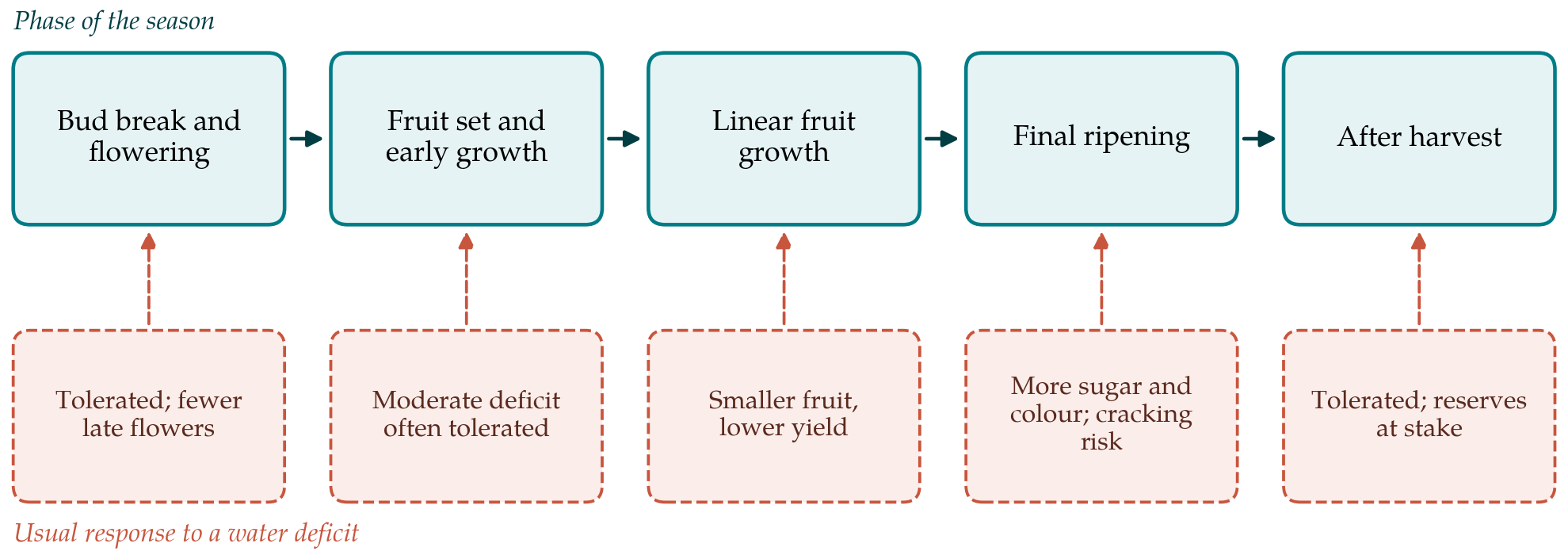
Regulated deficit irrigation withholds water only in phases when the crop is thought to be insensitive. Intrigliolo et al. (2013) compared restrictions placed at flowering and fruit set, during fruit growth, and during final ripening against a sustained deficit and a fully irrigated control. Their central result was that timing mattered more than the seasonal volume: restriction early in the season cost little, while restriction during the summer period of rapid fruit enlargement reduced fruit size. A later study that confined stress to the end of ripening reported an earlier harvest and better fruit composition (Galindo et al., 2017). Figure 1 sets the phases of the season against the response usually reported for a deficit in each.
4.3. Partial root-zone drying
Partial root-zone drying irrigates one side of the root system while the other dries, and alternates the sides. The idea, developed in grapevine, is that roots in drying soil send chemical signals that reduce stomatal opening and vigour while the wet side maintains plant water status (Dry and Loveys, 1998). In pomegranate the technique has been compared with conventional deficit irrigation at equal volumes (Parvizi et al., 2016). The trials do not show a consistent advantage large enough to justify the second drip line and the extra valves that the method needs, a conclusion in line with experience in other fruit species (Fereres and Soriano, 2007).
5. Fruit Quality Responses
Quality in pomegranate has several dimensions that do not move together. Packers grade on fruit weight and on freedom from cracks, sunburn and blemish. Consumers and processors care about aril and juice colour, the balance of sugars and acids, and, increasingly, the content of anthocyanins and hydrolysable tannins such as punicalagin (Gil et al., 2000).
5.1. Size, sugars and colour
Fruit size is the attribute most reliably reduced by deficit, and it is the one that most affects returns in the fresh market. Against that loss, fruit from deficit treatments generally carries more soluble solids, in part through simple concentration in a smaller fruit. Peel and aril colour often intensify when stress falls late in the season, and the changes resemble those of advancing maturity (Mellisho et al., 2012; Laribi et al., 2013). Fruit from deficit-irrigated trees of Mollar de Elche stored in the cold at least as well as fruit from fully irrigated trees (Laribi et al., 2013).
The picture for bioactive compounds is less tidy. A mild late stress has been associated with higher concentrations of phenolic compounds (Galindo et al., 2017), yet a sustained deficit through the season produced juice with poorer colour and lower contents of anthocyanins and punicalagin (Mena et al., 2013). The two results are compatible if the response depends on how severe the stress is and when it falls, but they warn against the general claim that water stress improves the functional value of the fruit.
5.2. Peel cracking
Cracking is the main quality risk of deficit irrigation in this crop. The leathery peel loses elasticity as the fruit matures, and when a dry spell is followed by rain or a large irrigation the arils take up water and expand faster than the peel can accommodate. Galindo et al. (2014) showed that rain falling on water-stressed trees intensified cracking and traced it to the different turgor responses of arils and peel. A late-season deficit that improves colour and sugar therefore needs to be released gradually, and it is hazardous where autumn rain is likely before harvest.
6. Scheduling Deficit Irrigation in Practice
To apply any of these strategies a grower needs an estimate of full demand and a way to check tree status. The standard estimate multiplies reference evapotranspiration by a crop coefficient (Allen et al., 1998). Coefficients for pomegranate were long borrowed from other deciduous trees; lysimeter measurements in California under surface and subsurface drip have since supplied crop-specific values across the season (Ayars et al., 2017). Coefficients measured on mature trees at one spacing still need adjustment for canopy cover in young or widely spaced orchards.
Plant-based indicators complement the water balance. Midday stem water potential, measured with a pressure chamber on bagged leaves, is the reference method in deciduous orchards (Naor, 2006) and has been shown to be sensitive in pomegranate (Intrigliolo et al., 2011). Its drawbacks are labour and the absence of agreed threshold values for each phase, without which a reading cannot be turned into a decision (Jones, 2004). Reviews of deficit irrigation in emerging fruit crops place pomegranate among the species for which such thresholds are still being worked out (Galindo et al., 2018).
7. Gaps and Future Work
Four gaps stand out. The first is geographic. Controlled trials are concentrated on a few cultivars in Mediterranean climates with dry summers, whereas much of the world crop is grown under monsoon climates, on different soils and with cultivars of different fruit type; results on cracking in particular cannot be carried across rainfall regimes. The second is duration. Most experiments run for two or three seasons, too short to show whether repeated deficits deplete reserves, reduce flowering in later years or shorten orchard life. The third concerns salinity: deficit irrigation reduces leaching, and its interaction with saline water in drip-irrigated orchards has been studied mainly in young trees.
The fourth gap is economic. Few studies carry their results through to grade-out and price, so the trade-off that matters to the grower, water saved against revenue per hectare, is usually left to inference. Crop response functions of the kind assembled for other species would need to include size distribution and cracking losses to be useful here.
8. Conclusion
The evidence supports a qualified case for deficit irrigation in pomegranate. Water can be saved with limited loss when restriction is kept away from the period of rapid fruit growth, and a brief deficit before harvest can advance maturity and improve sugar and colour. Sustained restriction through the season reliably reduces fruit size and may lower juice quality, and any late deficit carries a cracking risk that depends on weather the grower does not control. Whether the trade is worth making depends on the market the fruit is grown for, and on evidence from cultivars and climates that the literature has so far barely sampled.
Conflict of interest
To be declared by the author(s) before publication.
Funding
To be declared by the author(s) before publication.