1. Introduction
Fatty liver disease linked to metabolic dysfunction is the most common chronic liver disorder in the world, affecting roughly a quarter of adults according to a widely cited meta-analysis (Younossi et al., 2016). Its usual clinical picture is that of a person with obesity, type 2 diabetes or both. The picture is accurate for most patients and misleading for the rest. Pooled data suggest that around two fifths of people with the condition are not obese and that nearly one fifth are lean (Ye et al., 2020).
Lean patients present a double difficulty. They are easily missed, because neither they nor their doctors expect liver fat in someone of normal weight, and abnormal liver enzymes may be attributed to something else. Once found, they are hard to advise, because the central recommendation for this disease is to lose weight, and the drugs now reaching the clinic were tested mostly in people with a high body mass index. This review describes the present understanding of why steatosis develops in lean people and sets out the places where management rests on extrapolation.
2. Approach to the Literature
The article is a narrative review. It draws on consensus statements about nomenclature, published meta-analyses and cohort studies of prevalence and outcome, genetic and physiological studies of mechanism, clinical trials, and the practice guidance of the American and European liver and gastroenterology societies. It was not based on a systematic search, and it does not pool data. Much of the literature predates the 2023 change in terminology and uses the older term non-alcoholic fatty liver disease; findings are reported here under the name used by the original authors where the distinction matters.
3. Definitions and the Question of Who Counts as Lean
Leanness in this field is defined by body mass index: below 25 kg/m2 in most populations and below 23 kg/m2 in Asian populations, following the lower action points proposed for Asia by a World Health Organization expert consultation (WHO Expert Consultation, 2004). The term non-obese is wider and takes in people who are overweight. The two are often mixed in the literature, which complicates comparison between studies.
The current name, metabolic dysfunction-associated steatotic liver disease, was introduced by a multisociety Delphi process (Rinella et al., 2023a). The diagnosis requires hepatic steatosis together with at least one of five cardiometabolic criteria covering body mass index or waist circumference, glycaemia, blood pressure, triglycerides and high-density lipoprotein cholesterol. A lean person therefore qualifies only through a criterion other than weight. Those with steatosis, no cardiometabolic criterion and no other identifiable cause fall into a separate category of cryptogenic steatotic liver disease. The earlier proposal of metabolic dysfunction-associated fatty liver disease was stricter still and asked lean individuals to show at least two metabolic abnormalities (Eslam et al., 2020). Under either scheme some lean people with fatty liver sit outside the main diagnosis, and it is not yet clear how their outlook compares.
4. Epidemiology and Natural History
Lean fatty liver was first described in detail in Asian populations, where metabolic disease appears at a lower body mass index than in Europeans (Fan et al., 2017), but it is now recognised on every continent. Meta-analyses agree that it is common, although estimates vary with the method used to detect steatosis and with the threshold for leanness (Ye et al., 2020; Young et al., 2020). Compared with obese patients, lean patients are on average less insulin resistant and have less diabetes and hypertension. Compared with lean people without steatosis, they are clearly less healthy metabolically.
An early assumption that lean disease is benign has not survived longer follow-up. In a Swedish biopsy cohort, lean patients had less fibrosis at baseline than those who were overweight but were more likely to develop severe liver disease later (Hagström et al., 2018). A multicentre European study found that lean and non-lean patients had a similar long-term prognosis (Younes et al., 2022). In fatty liver disease generally, the stage of fibrosis is the histological feature that predicts outcome (Angulo et al., 2015), and nothing suggests that the rule is different in lean patients. A normal body mass index should therefore lower the suspicion of advanced disease only slightly, and should never exclude it.
5. Mechanisms
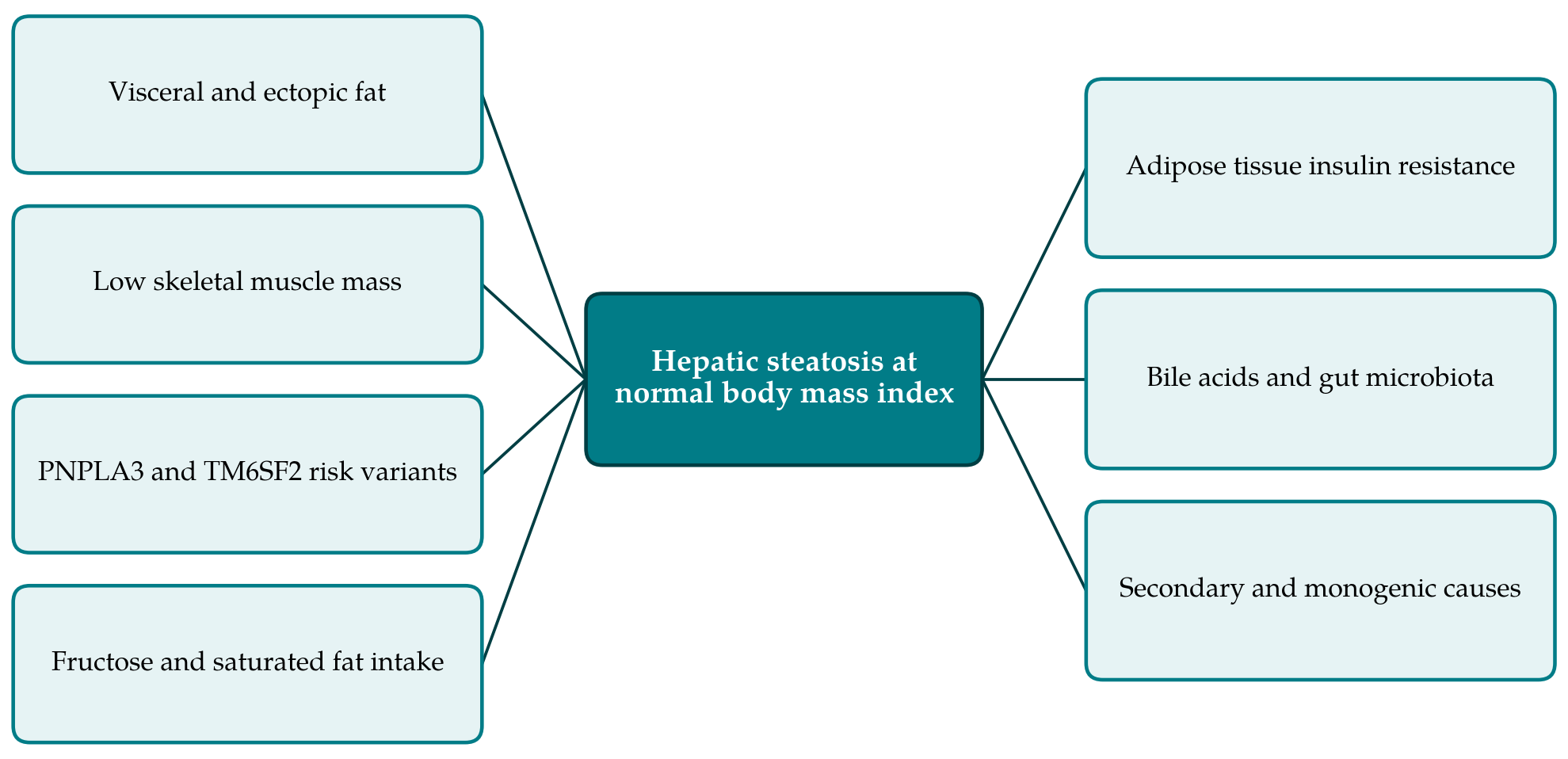
Several explanations have been offered for steatosis in the absence of general obesity. They are not alternatives. Figure 1 groups the contributors discussed in the following paragraphs, and most patients are likely to have more than one.
5.1. Body composition hidden by a normal body mass index
Body mass index does not describe where fat is stored. A person of normal weight may carry excess visceral fat and little muscle, a combination sometimes called metabolic obesity at normal weight. Visceral and dysfunctional subcutaneous adipose tissue release fatty acids into the portal and systemic circulation, and fatty acids from adipose tissue are the largest single source of the triglyceride that accumulates in the liver (Donnelly et al., 2005). Ethnic differences are marked. Young, lean Asian-Indian men were found to have more hepatic fat and more insulin resistance than men of other backgrounds matched for body mass index (Petersen et al., 2006). Low skeletal muscle mass adds to the problem by reducing the main site of insulin-mediated glucose disposal.
5.2. Genetic susceptibility
The I148M variant of PNPLA3 was the first common genetic determinant of liver fat to be identified (Romeo et al., 2008). It impairs the mobilisation of triglyceride from lipid droplets and raises the risk of steatohepatitis, fibrosis and hepatocellular carcinoma independently of body weight. The E167K variant of TM6SF2 reduces the export of very-low-density lipoprotein, so that carriers retain fat in the liver while having lower circulating lipids (Kozlitina et al., 2014). A loss-of-function variant of HSD17B13, by contrast, protects against progression (Abul-Husn et al., 2018). Several studies have reported that risk alleles are more frequent among lean than among obese patients, which is what would be expected if genes account for a larger share of risk when adiposity accounts for less. The finding has not been uniform, and genotyping has no agreed place in routine care.
5.3. Diet, bile acids and the microbiota
Dietary composition may matter as much as quantity. Fructose is a potent substrate for hepatic de novo lipogenesis, and higher fructose intake has been associated with more severe fibrosis in patients with fatty liver (Abdelmalek et al., 2010). Diets high in saturated fat and cholesterol have also been implicated, though the evidence in lean patients specifically is mostly cross-sectional.
Chen et al. (2020) proposed that lean fatty liver is a distinct entity marked by a different bile acid profile and gut microbial composition, and by an adaptive metabolic response that keeps patients lean in the early stages and is lost as disease advances. The hypothesis is attractive because it would explain why lean patients look metabolically favourable at first and yet progress. It awaits confirmation in independent cohorts.
5.4. Secondary and monogenic causes
Steatosis in a lean person should prompt a wider differential diagnosis than in an obese one. Unreported alcohol use, steatogenic drugs such as amiodarone, methotrexate, tamoxifen and corticosteroids, hepatitis C of genotype 3, coeliac disease, lipodystrophy, familial hypobetalipoproteinaemia, lysosomal acid lipase deficiency and Wilson disease can all produce the same appearance on imaging. The clinical practice update of the American Gastroenterological Association advises that these be considered before a lean patient is labelled as having metabolic disease (Long et al., 2022).
6. Diagnosis and Risk Stratification
Most lean patients come to attention through incidental imaging or unexplained liver enzymes. Screening of the general lean population is not recommended, but testing is reasonable in lean people with type 2 diabetes or other features of metabolic dysfunction (Long et al., 2022). Once steatosis is established, the task is the same as in any patient: to find those with significant fibrosis. Guidelines recommend a two-step approach with a simple blood-based score, usually the Fibrosis-4 index, followed by elastography or a proprietary serum test when the first result is indeterminate or high (Rinella et al., 2023b; EASL et al., 2024).
The weak point is that these tools were not developed in lean populations. The Fibrosis-4 index was derived in patients with viral coinfection (Sterling et al., 2006) and later adopted for fatty liver, and its thresholds have been checked mainly in cohorts where most participants were overweight. Elastography is technically easier in a lean abdomen, which is an advantage, but whether the same stiffness thresholds apply is not well studied. Table 1 sets this and the other management gaps beside the current guidance.
| Area | Current position | Gap for lean patients |
|---|---|---|
| Case finding | Test lean adults with diabetes or other metabolic risk Long et al., 2022 | No validated strategy for those without metabolic features |
| Exclusion of other causes | Consider alcohol, drugs, viral, genetic and endocrine causes | Extent and order of testing not standardised |
| Fibrosis assessment | Fibrosis-4 index, then elastography Rinella et al., 2023b | Thresholds derived mainly in overweight cohorts |
| Lifestyle | Modest weight loss, diet quality and exercise Wong et al., 2018 | Durable targets and the role of muscle gain are undefined |
| Drug treatment | Resmetirom approved for steatohepatitis with fibrosis Harrison et al., 2024 | Few lean participants in registration trials |
| Genetic testing | Not part of routine care | Whether genotype should alter follow-up is unknown |
| Follow-up | Interval guided by fibrosis stage | Natural history after lifestyle change poorly described |
7. Management and Its Evidence Base
Lifestyle change remains the first measure. In patients with steatohepatitis, the degree of histological improvement tracks the amount of weight lost (Vilar-Gomez et al., 2015), but that evidence came from a largely overweight population. The most relevant trial for lean patients is that of Wong et al. (2018), in which a lifestyle programme led to remission of fatty liver in non-obese as well as obese participants, and non-obese participants achieved it with a smaller proportional weight loss. On this basis the American Gastroenterological Association suggests a modest weight reduction of three to five per cent for lean patients (Long et al., 2022). What cannot be said from existing trials is how long the benefit lasts, whether a change in diet quality without weight loss is enough, or how much resistance exercise contributes by building muscle.
Drug treatment is less certain. Vitamin E and pioglitazone improved histology in the PIVENS trial of non-diabetic adults with steatohepatitis (Sanyal et al., 2010), and expert guidance allows their consideration in selected lean patients with biopsy-proven disease (Long et al., 2022), but the trial did not set out to study lean participants. Resmetirom, a thyroid hormone receptor beta agonist, became the first drug approved in the United States for steatohepatitis with fibrosis after a phase 3 trial (Harrison et al., 2024); its participants had, on average, a body mass index well within the obese range. Incretin-based agents act in large part through weight loss, which is not an aim in a patient who is already lean and may be undesirable in one with low muscle mass. Recommendations for lean patients in the current American and European guidelines are accordingly brief and are graded as expert opinion (Rinella et al., 2023b; EASL et al., 2024).
8. Gaps and Future Work
Four needs stand out. The first is consistent classification: studies should report lean, overweight and obese groups separately, state the ethnicity-specific thresholds used, and say whether lean participants met cardiometabolic criteria. The second is measurement of body composition. Waist circumference, imaging of visceral fat and an estimate of muscle mass would show how much of lean disease is simply adiposity that body mass index fails to register.
The third need is for trials that either enrol lean patients in sufficient numbers or report them as a prespecified subgroup, with endpoints that do not depend on weight loss. The fourth is prospective follow-up of lean patients with steatosis who meet no cardiometabolic criterion, since their classification as cryptogenic leaves both patient and clinician without guidance. Genetic studies could add to each of these by testing whether carriers of risk variants respond differently to diet or drugs.
9. Conclusion
Steatotic liver disease in lean people is common, is not benign, and has several overlapping causes, of which concealed visceral adiposity and inherited susceptibility are the best supported. Its management is guided by studies carried out mostly in heavier patients. Clinicians can reasonably exclude alternative causes, stage fibrosis as they would in anyone else and advise modest weight loss with attention to diet quality and physical activity. Beyond that, practice outruns evidence, and the questions listed in this review are ones that trials and cohorts designed with lean patients in mind could answer.
Conflict of interest
To be declared by the author(s) before publication.
Funding
To be declared by the author(s) before publication.