1. Introduction
The case for microalgae as an industrial crop has been made many times: high areal productivity, no need for arable land, and the ability to use saline water and waste carbon dioxide. Chisti (2007) set out the argument for biodiesel, and it prompted a wave of investment. Within a few years it was clear that a low-value product could not pay for an expensive culture. Wijffels and Barbosa (2010) concluded that production costs would have to fall by about an order of magnitude and that fuel would be feasible only if the proteins, carbohydrates and pigments in the same biomass were sold as well.
That conclusion redirected the field towards biorefining, the separation of biomass into several marketable fractions (Vanthoor-Koopmans et al., 2013; Chew et al., 2017). The products that microalgae companies actually sell have always been the valuable ones: β-carotene, astaxanthin, phycocyanin, whole dried biomass as a food supplement, and oils rich in long-chain fatty acids (Spolaore et al., 2006; Borowitzka, 2013). The biorefinery question is whether the material left after one of these has been extracted can earn anything.
This review takes up a specific and practical form of that question. It considers schemes in which one cultivation, with no fuel product at all, supplies a pigment, a protein ingredient and an agricultural input. The combination is attractive because the three products go to different markets and draw on different parts of the cell. It is also harder than it looks, because the conditions and processes that suit one product tend to damage another.
2. Approach
The article is a narrative review of the published literature. It relies on widely cited reviews and analyses of microalgal products, cultivation, downstream processing, economics and agricultural use, and on the primary studies those reviews rest on. It does not attempt an exhaustive survey of species or patents, and it reports no new data. Costs are discussed in relative terms, since published estimates depend heavily on location, scale and year.
3. Choosing the Organism and the Product Slate
Only a handful of microalgae are grown at commercial scale, and each is associated with a pigment. The cyanobacterium Arthrospira, sold as spirulina, contains the blue phycobiliprotein C-phycocyanin, which is used as a food colourant and a fluorescent label (Eriksen, 2008). Haematococcus pluvialis accumulates the red ketocarotenoid astaxanthin (Lorenz and Cysewski, 2000), and the halophile Dunaliella salina accumulates β-carotene. Chlorella species are rich in chlorophyll and lutein and are grown both photosynthetically and on sugars in fermenters (Safi et al., 2014).
Protein content varies as much as pigment content. Arthrospira and Chlorella grown with ample nitrogen contain protein at levels comparable to or above soybean, with amino acid profiles that compare well with conventional food proteins, although digestibility of whole cells is limited by the cell wall in the green algae (Becker, 2007). This makes them the obvious candidates for a protein co-product, and there is active interest in algal proteins as food ingredients (Draaisma et al., 2013; Caporgno and Mathys, 2018).
3.1. The growth and stress conflict
The phrase "a single cultivation" hides the main biological difficulty. Secondary carotenoids are stress products. Haematococcus makes astaxanthin when growth stops under high light and nitrogen deprivation, as the motile green cell turns into a thick-walled red cyst, and Dunaliella makes β-carotene under high salinity and light. Commercial producers therefore use two stages, a growth stage and an induction stage (Lorenz and Cysewski, 2000). Nitrogen starvation is exactly the condition under which cells stop making protein and divert carbon to lipid and carbohydrate. A culture pushed to its highest astaxanthin content is a poor protein source, and a culture harvested for protein has little astaxanthin.
Primary pigments do not have this problem. Phycocyanin, chlorophyll and lutein are components of the photosynthetic apparatus and are most abundant in fast-growing, nitrogen-replete, light-limited cells, which are also the cells richest in protein. For a pigment and protein cascade from one harvest, the better-matched systems are therefore Arthrospira for phycocyanin and Chlorella for lutein, with the caveat that phycocyanin is itself a protein and its removal lowers the protein yield of what remains. Table 1 summarises the principal product fractions and the constraint attached to each.
| Fraction | Typical source | Usual recovery route | Main constraint |
|---|---|---|---|
| C-phycocyanin | Arthrospira | Aqueous extraction, then precipitation or membrane filtration | Sensitive to heat and light; purity sets the price Eriksen, 2008 |
| Astaxanthin | Haematococcus pluvialis | Cyst disruption, then solvent or supercritical CO extraction 2 | Induced by nitrogen stress, which lowers protein Lorenz and Cysewski, 2000 |
| β-carotene | Dunaliella salina | Harvest from brine, oil or solvent extraction | Dilute cultures and high-salt residue |
| Lutein and chlorophyll | Chlorella | Solvent extraction of disrupted cells | Solvent and heat can denature co-extracted protein |
| Soluble protein | Chlorella, Arthrospira | Mild disruption, clarification, membrane concentration | Rigid walls, green colour and off-flavours Becker, 2007 |
| Residual solids and liquor | Any of the above | Drying, hydrolysis or anaerobic digestion | Variable composition; product rules Renuka et al., 2018 |
4. Cultivation and Harvesting
Cultivation systems fall into open raceway ponds and closed photobioreactors of tubular or flat-panel design. Ponds are cheap to build and suit organisms that tolerate selective conditions, such as Arthrospira at high alkalinity and Dunaliella at high salinity. Closed reactors give higher biomass concentrations and better control, at higher capital and energy cost, and the engineering limits are light distribution, mixing and gas exchange (Posten, 2009). Cost analyses based on design models (Norsker et al., 2011) and on an operating plant (Acién et al., 2012) both show production costs well above those of agricultural commodities, with labour, energy for mixing and the cost of carbon dioxide and nutrients as the main items that could be reduced.
Cultures are dilute, so harvesting means removing a very large volume of water. Filamentous Arthrospira can be screened, but unicellular species need flocculation, centrifugation or membrane filtration, and recovery of the biomass accounts for a substantial share of total cost (Molina Grima et al., 2003). For a multi-product scheme the harvesting method matters beyond cost. Chemical flocculants end up in the paste and may be unacceptable in a food ingredient, and drying, the conventional next step, is the single most energy-demanding operation in life-cycle studies of algal processes (Lardon et al., 2009). Processing the wet paste directly avoids that penalty and is gentler on proteins.
5. Disruption and Fractionation
Most products are intracellular, and the cell has to be opened. Bead milling and high-pressure homogenisation are the established mechanical methods; pulsed electric fields, ultrasound and enzymatic lysis are milder and less complete. Günerken et al. (2015) reviewed these options with the biorefinery in mind and stressed that the aim is not maximum breakage but release of the target molecules in a functional state with the least energy. The thick sporopollenin-like wall of the Haematococcus cyst and the rigid wall of Chlorella demand intensive treatment, whereas Arthrospira releases phycocyanin after freeze-thaw cycles or simple soaking in buffer.
After disruption the fractions part along lines of solubility, as Figure 1 shows. Phycobiliproteins and the soluble enzymes, of which Rubisco is the most abundant, go into the aqueous phase. Carotenoids, chlorophylls and lipids stay with the membranes and need a non-polar solvent or supercritical carbon dioxide. Cell-wall polysaccharides, insoluble protein and minerals remain as solids.
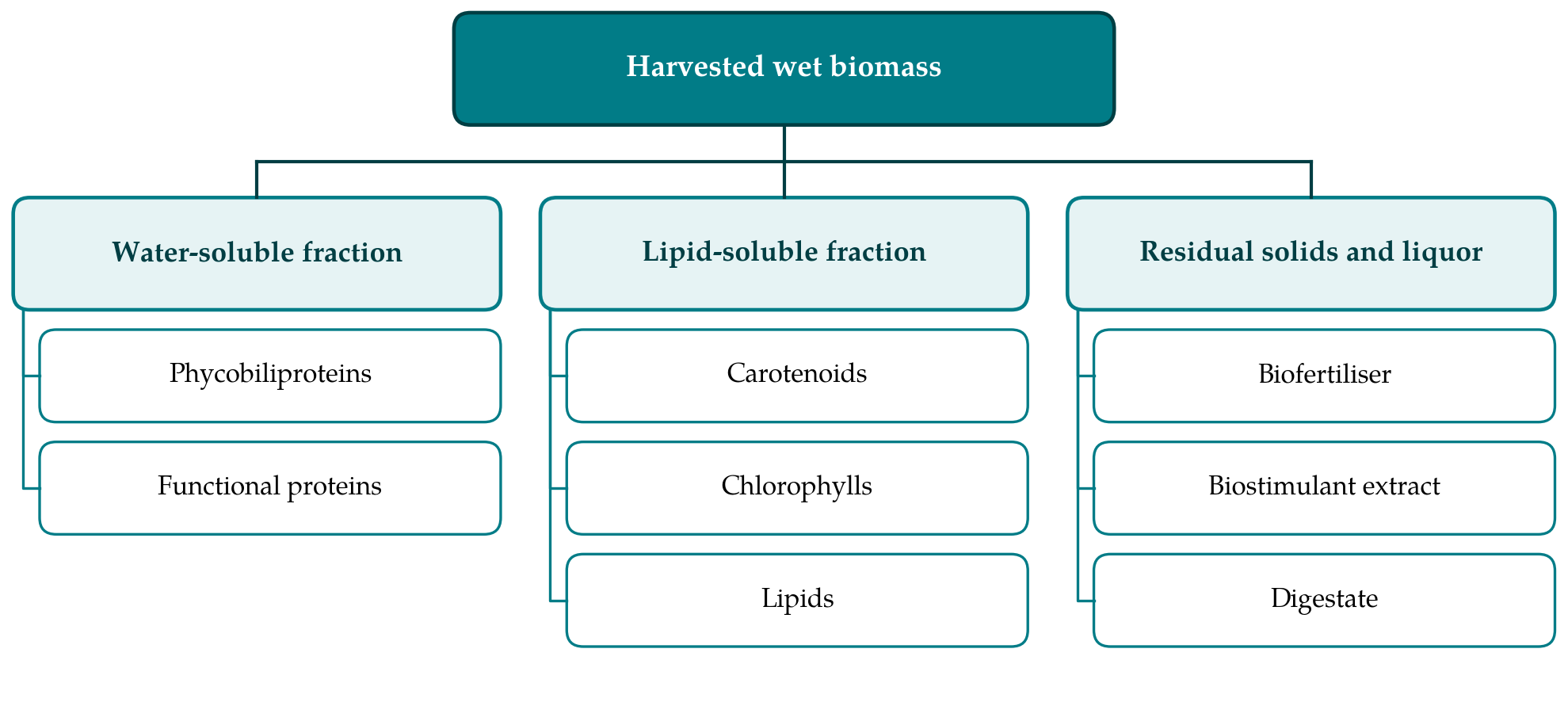
The order of operations decides what survives. Extracting the hydrophobic pigment first with hot ethanol or acetone denatures the proteins, which may still be acceptable for feed but removes the solubility, foaming and gelling properties that give a food protein its value. Extracting the aqueous fraction first protects the protein but leaves the pigment in a wet, partly depleted solid from which recovery is less efficient. Reviews of multi-product processing have pointed out that each added separation step brings losses and cost, and that a short process with two or three products can outperform a long one that tries to recover everything ('t Lam et al., 2018; Ruiz et al., 2016).
6. The Residue as Biofertiliser and Biostimulant
Two distinct agricultural uses are discussed in the literature, and they should not be confused. As a fertiliser, algal biomass or residue supplies nitrogen, phosphorus and potassium that are released as the organic matter mineralises in soil. Mulbry et al. (2005) showed with algae grown on dairy manure effluent that dried biomass behaved as a slow-release fertiliser for seedlings. Living nitrogen-fixing cyanobacteria such as Anabaena and Nostoc have a long history as inoculants in rice paddies, though that is a different practice from applying processing residue.
As a biostimulant, an algal extract is applied in small amounts and is claimed to improve growth or stress tolerance through polysaccharides, amino acids, phytohormone-like compounds and other metabolites. Reviews of this literature report positive effects on germination, root development and yield in many crops, while also noting that studies differ widely in species, extract preparation and dose and that the active principles are seldom identified (Renuka et al., 2018; Ronga et al., 2019). After pigment and protein have been removed, the residue is depleted in nitrogen and enriched in cell-wall carbohydrate, so its fertiliser value is lower than that of whole biomass and its biostimulant activity has to be shown, not assumed.
7. Economics, Environment and Regulation
Techno-economic studies agree on the ranking of the three streams. Pigments command prices far above those of food proteins, which in turn exceed those of fertilisers, and Ruiz et al. (2016) found that with current technology only the higher-value markets cover production costs. In a cascade the pigment therefore pays for the cultivation. The protein fraction contributes meaningfully only if it is sold as a functional food ingredient and not as bulk feed. The agricultural stream contributes little revenue, but it turns a disposal cost into a product and returns nutrients to land, which improves the life-cycle profile where fertiliser manufacture is a significant burden (Lardon et al., 2009).
Each product meets a different regulator. Colourants and food proteins fall under food law, which in many jurisdictions distinguishes species with a history of consumption from novel ones. Fertilising products and plant biostimulants placed on the European Union market are governed by Regulation (EU) 2019/1009, which sets limits for contaminants and defines biostimulants by their function (European Union, 2019). A biorefinery that grows algae on wastewater to save nutrient costs may find its food products excluded, and one that uses solvents for pigment extraction must show that residues in the co-products are acceptable.
8. Gaps and Future Work
The literature is rich in studies of one product at a time and thin on integrated processes carried through at a meaningful scale with mass balances for every stream. Three needs stand out. Product compatibility should be tested directly, by measuring protein functionality after pigment recovery and pigment stability after aqueous extraction, on the same batch. Wet processing routes that avoid drying need development for the hydrophobic pigments in particular. And the residue should be characterised as a product in its own right, with its nutrient content, contaminant levels and agronomic effect measured across batches, since farmers and regulators both require consistency.
9. Conclusion
A single microalgal cultivation can in principle supply a pigment, a protein ingredient and an agricultural input, and the published evidence indicates where the idea is sound and where it is strained. Combinations built on primary pigments, such as phycocyanin from Arthrospira or lutein from Chlorella, fit the biology better than those built on stress-induced carotenoids. Mild, wet fractionation that takes the soluble fraction first protects the protein. The residue is a useful outlet whose agronomic value needs proper measurement. In every published analysis the pigment bears most of the cost, so a multi-product plant remains, in economic terms, a pigment plant that wastes less.
Conflict of interest
To be declared by the author(s) before publication.
Funding
To be declared by the author(s) before publication.