1. Introduction
Three decades separate the report that gave sustainable development its standard definition (WCED, 1987) from the point at which destination managers began to say that sustainability was no longer enough. In the interval, sustainable tourism acquired a journal, a set of indicators, numerous certification schemes and a place in almost every national tourism plan. It did not acquire a record of having bent the curve. Global tourism emissions kept rising (Lenzen et al., 2018), and the destinations most often cited as models of sustainable management were frequently those under the heaviest pressure.
Regenerative tourism entered this situation as both a critique and a proposal. Its advocates hold that aiming to do less harm accepts harm as the baseline, and that tourism should instead leave places in better condition than it found them. Its critics reply that the industry has renamed its ambitions before without changing its practice. This Perspective takes a position between the two. The label is being used loosely, and often opportunistically. The idea underneath it is distinct from sustainability as tourism has practised it, and islands are the destinations where the distinction has the most practical force.
2. Where the Idea Comes From
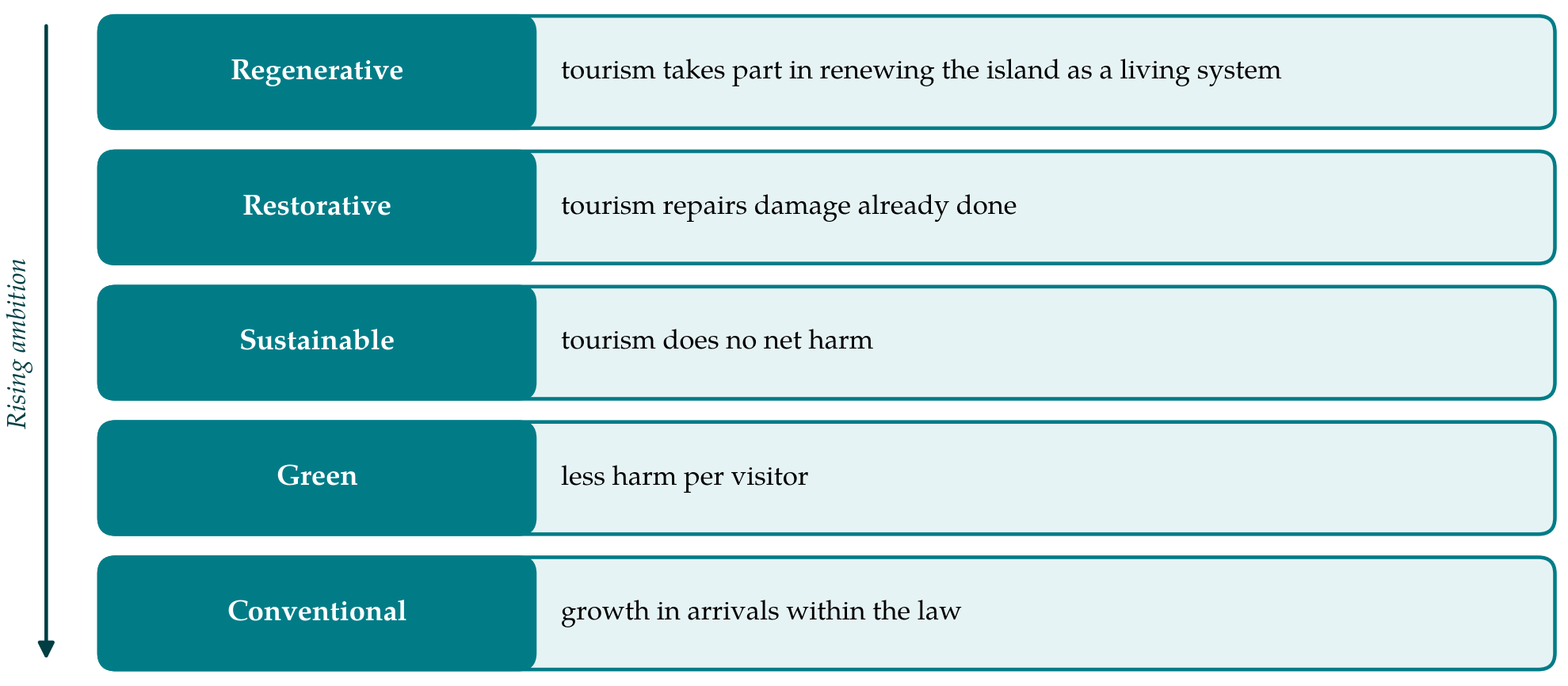
The concept did not originate in tourism. It comes from regenerative design and development, a field concerned with buildings and settlements. Reed (2007) described a trajectory running from conventional practice through green and sustainable design to restorative and finally regenerative work, in which human activity takes part in the continuing evolution of the living system it belongs to. Mang and Reed (2012) set out the accompanying method, which begins with the story of a particular place, its ecology, history and culture, and asks what role a project can take within it. Indigenous knowledge systems that treat people as kin to land and sea are an acknowledged source.
Tourism scholars took up the idea in earnest around the pandemic, when the suspension of travel prompted calls to rebuild the sector on different terms (Ateljevic, 2020). Cave and Dredge (2020) linked regeneration to diverse economic practices beyond the growth model. Dredge (2022) presented it as a change of mindset, system and practice, and Bellato et al. (2023) offered a conceptual framework drawn from both theory and practitioners. Policy followed quickly in some places: Becken and Kaur (2022) examined how the government of New Zealand sought to anchor a broader notion of tourism value within a regenerative paradigm.
3. The Case That It Is Only a New Label
The sceptical case deserves a full statement. First, sustainable tourism was never as narrow as its regenerative critics suggest. The definition in the Brundtland report concerns the needs of future generations, and the early tourism literature already spoke of host community wellbeing and of conservation as a positive aim. Butler (1999) showed long ago that the term had been stretched to cover almost any tourism that someone wished to see continue. If sustainability failed, the failure lay in implementation, and a new word does nothing for implementation.
Second, the tourism industry has a record of absorbing critical vocabulary. Ecotourism, responsible tourism and sustainable tourism each began as a challenge and became a market segment. Higgins-Desbiolles (2018) argued that sustainable tourism had come to mean sustaining tourism, and there is no obvious reason why regeneration should be immune. A resort that plants mangroves while expanding its room count can describe itself as regenerative at little cost. Third, the language of living systems and co-evolution is hard to translate into commitments that anyone can check, and Sharpley (2020) has made the wider point that tourism's relation to sustainable development remains unresolved in theory after decades of discussion.
4. What Is Different
These objections describe a risk. They do not show that the two ideas are the same. Table 1 sets sustainable tourism as it is usually practised beside regenerative tourism as its proponents define it. The contrast is between practice and proposal, which is unfair to sustainability in one sense and is the comparison that matters to a destination deciding what to do next.
| Dimension | Sustainable tourism in practice | Regenerative tourism as proposed |
|---|---|---|
| Aim | Reduce negative impacts to an acceptable level | Net improvement in ecological and social condition |
| Starting point | General standards, indicators and certification criteria | The particular place, its ecology, history and people Mang and Reed, 2012 |
| Measure of success | Efficiency per visitor; compliance with criteria | Health of reefs, soils, water, culture and community over time |
| View of growth | Growth accepted if impacts are managed | Volume is one variable among several and may need to fall |
| Role of visitor | Consumer asked to behave responsibly | Guest who contributes to the place |
| Role of residents | Stakeholders to be consulted | Hosts who define what the place needs Bellato et al., 2023 |
Three of the rows carry most of the weight. The aim changes the question asked of any project from how much damage is tolerable to what the project gives back. The starting point reverses the usual direction of planning, which begins with a market and looks for a product. And the view of growth connects regeneration to the degrowth argument that tourism volumes in some places must fall (Hall, 2009; Higgins-Desbiolles et al., 2019), a conclusion that mainstream sustainable tourism policy has consistently avoided.
5. Why Islands Make the Difference Visible
On a continent the effects of tourism diffuse. Waste is trucked elsewhere, water is piped in, workers commute from another district, and it is seldom clear where the destination ends. An island has an edge. Its freshwater lens, reef, landfill and housing stock are finite and in plain view, and the link between the state of the reef and the livelihood of the fishing and diving community is direct. Small island economies are also structurally exposed, through remoteness, narrow export bases and proneness to natural hazards (Briguglio, 1995), and many have followed a path of rising tourism density with little alternative to fall back on (McElroy, 2006).
This combination is what gives regeneration its meaning for islands. Reducing harm per visitor is of limited use where the reef is already degraded and the aquifer already saline; the practical need is repair. Figure 1 places the regenerative aim at the top of the ladder that Reed (2007) described, restated for an island destination. Most island tourism policy sits on the second and third rungs from the bottom.
Islands also offer what regeneration requires and large destinations lack: a community small enough to deliberate about what the place should become, and in many cases customary systems of stewardship that predate tourism. The Palau Pledge, introduced in 2017, which asks every arriving visitor to sign a promise to the children of the islands, is a modest instance of recasting the visitor as a guest with obligations. Tourism can serve the development aims of small island states when local control and linkages are strong (Scheyvens and Momsen, 2008), and regeneration extends that argument from income to the condition of the place itself.
6. Objections That Remain
The strongest objection is aviation. Nearly every visitor to an island arrives by air, and long-haul flights dominate the footprint of a remote island holiday. An ecological footprint analysis of the Seychelles made the point two decades ago: a destination can protect its own environment well and still depend on a form of travel with a large global cost (Gössling et al., 2002). No amount of reef restoration offsets this in any accounting that would survive scrutiny. An honest regenerative strategy for an island therefore has to say something about how many visitors come, from how far and for how long, and cannot confine itself to what happens after landing.
Measurement is the second difficulty. Sustainability lends itself to indicators because it sets thresholds. Regeneration describes a direction of change in a system, and its advocates are wary of reducing it to a scorecard. Without some agreed evidence, however, the term is open to exactly the appropriation that sceptics predict. The third difficulty is political. To regenerate a place is to hold a view of what it ought to be, and on islands with colonial histories, absentee resort owners and contested land tenure, the answer depends on who is asked.
7. Implications for Island Destinations
If the term is to mean more than sustainability with a fresh coat of paint, island governments and operators would need to accept several commitments. The first is to state baselines: the present condition of reefs, forests, water, waste systems, housing and cultural practice, against which improvement can be judged by residents and outsiders alike. The second is to let those baselines, and not arrival targets, set the terms of tourism policy, including limits on volume where repair requires them. The third is to place decisions about what is to be regenerated with resident and customary institutions, and to fund them from tourism revenue.
The fourth commitment is candour about air travel. A destination that favours longer stays, nearer markets and fewer arrivals is acting consistently with the idea; one that pursues regeneration on the ground while seeking ever more long-haul capacity is not. None of this is beyond what a small island administration can decide. All of it runs against the way success in island tourism has been counted for half a century.
8. Conclusion
Regenerative tourism is a distinct proposition that is being widely used as a slogan. Its claim on attention rests on a change of aim, from limiting damage to improving the condition of a place, and on a method that starts from the place instead of the market. Islands, with their visible limits, tight coupling of ecology and livelihood and traditions of stewardship, are where that claim can be tested and where failure to honour it will be easiest to see. Whether the word survives as more than a rebranding will be decided less by scholars than by island destinations that are willing to publish baselines, share authority with residents and count their success in something other than arrivals.
Conflict of interest
To be declared by the author(s) before publication.
Funding
To be declared by the author(s) before publication.