1. Introduction
A packing line for apples, tomatoes or stone fruit ends with a task that people do well and machines do poorly: taking an item from a moving belt and placing it, the right way up, in a tray or punnet. The sorting and grading stages upstream have been automated for decades. The final placement has resisted automation mainly because of the end-effector. Reviews of grippers for fresh produce have reached the same verdict more than once: the grasping device, more than the arm or the vision system, limits what can be handled without loss of quality (Blanes et al., 2011; Zhang et al., 2020).
Compliance is the accepted remedy. A finger that deforms around the fruit turns a point or line contact into an area contact, lowers the peak pressure for a given holding force, and tolerates the item-to-item variation that would defeat a rigid jaw set for one diameter. Soft robotics has produced a large family of such devices over the past fifteen years, catalogued in detail by Shintake et al. (2018) and by Hughes et al. (2016). The difficulty for a designer is no longer a shortage of concepts. It is the absence of a route from the properties of a particular crop to the dimensions of a particular finger.
This article proposes that route as a seven-step design procedure. It draws on three bodies of published work: the mechanics of fruit tissue and bruising, the theory of compliant mechanisms, and the modelling of soft fluidic actuators. It reports no prototype and no test results. The procedure is offered as a structured proposal that has yet to be applied, and its limitations are stated in a separate section near the end.
2. Background
Two questions frame the design: what load the produce can bear, and which physical principle should deliver the grasp.
2.1. Produce as a mechanical object
Fruit tissue is a cellular, water-filled, viscoelastic material. Under slow compression it shows a roughly linear region followed by a bioyield point at which cells begin to rupture, and the classical treatment of these properties, including the use of Hertz contact theory for convex bodies pressed against a plate or indenter, is that of Mohsenin (1986). A bruise is the visible consequence of that rupture: cell contents oxidise and the tissue browns beneath skin that may itself be unbroken. Opara and Pathare (2014) review how bruises are measured and note that susceptibility changes with ripeness, temperature, turgor and cultivar, so a limit established for one batch does not carry over automatically to the next. Li and Thomas (2014) distinguish damage from impact, compression, abrasion and vibration, a distinction that matters here because a gripper can cause the first three in a single cycle.
2.2. Principles of compliant gripping
Shintake et al. (2018) sort soft grippers into those that grasp by actuation, those that grasp by controlled stiffness and those that grasp by controlled adhesion. For packing work five practical families follow from that scheme, and Table 1 compares them. Passive structures such as the Fin Ray finger bend towards an applied load and wrap the object without any internal actuator (Crooks et al., 2016). Pneumatic network actuators are elastomer fingers with internal chambers that curl when pressurised (Ilievski et al., 2011; Mosadegh et al., 2014), and fibre-reinforced variants constrain the swelling so that more of the input pressure becomes bending (Polygerinos et al., 2015). Granular jamming grippers press a loose membrane onto the object and then harden it by evacuating the air (Brown et al., 2010). Tendon-driven underactuated fingers adapt through their kinematics (Manti et al., 2015). Suction cups, the oldest of the group, remain the default wherever the surface allows a seal (Monkman et al., 2007).
| Family | How the grasp is formed | Strength for packing | Main limit |
|---|---|---|---|
| Passive adaptive finger (Fin Ray) | Ribbed structure bends towards the load and wraps the item | No air supply to the finger; simple to mould or print | Contact force follows jaw travel, not a set pressure |
| Pneumatic network finger | Chambers in an elastomer inflate and curl the finger | Force is set by supply pressure; very gentle | Fatigue of thin walls; slower at large strokes |
| Fibre-reinforced finger | Inextensible winding turns inflation into bending | Higher force for the same size | More fabrication steps; harder to clean |
| Granular jamming pad | Membrane conforms, then stiffens under vacuum | Handles irregular shapes with one tool | Must press onto the item; membrane wear |
| Tendon-driven soft finger | Cable pulls an underactuated compliant finger closed | Compact drive; easy force sensing at the motor | Cable routing and seals complicate washdown |
| Suction cup | Seal on the surface and pressure difference | Fast, cheap, needs access to one side only | Fails on rough, wet or very soft skins |
For the fingers themselves two modelling traditions are available. Flexure-based and ribbed designs in stiffer polymers can be analysed with the pseudo-rigid-body method, which replaces a flexible segment with rigid links and torsional springs (Howell, 2001). Elastomer fingers undergo strains far beyond the linear range and need a hyperelastic material law; the reduced polynomial form of Yeoh (1993) is widely used because it can be fitted from a uniaxial test alone.
3. The Proposed Procedure
The procedure has seven steps, shown in Figure 1. The order is deliberate: the produce sets the limit, the line sets the envelope, and only then is a gripping principle chosen. A single return loop takes the designer back to finger sizing whenever the estimated contact pressure exceeds the limit set in the first step.
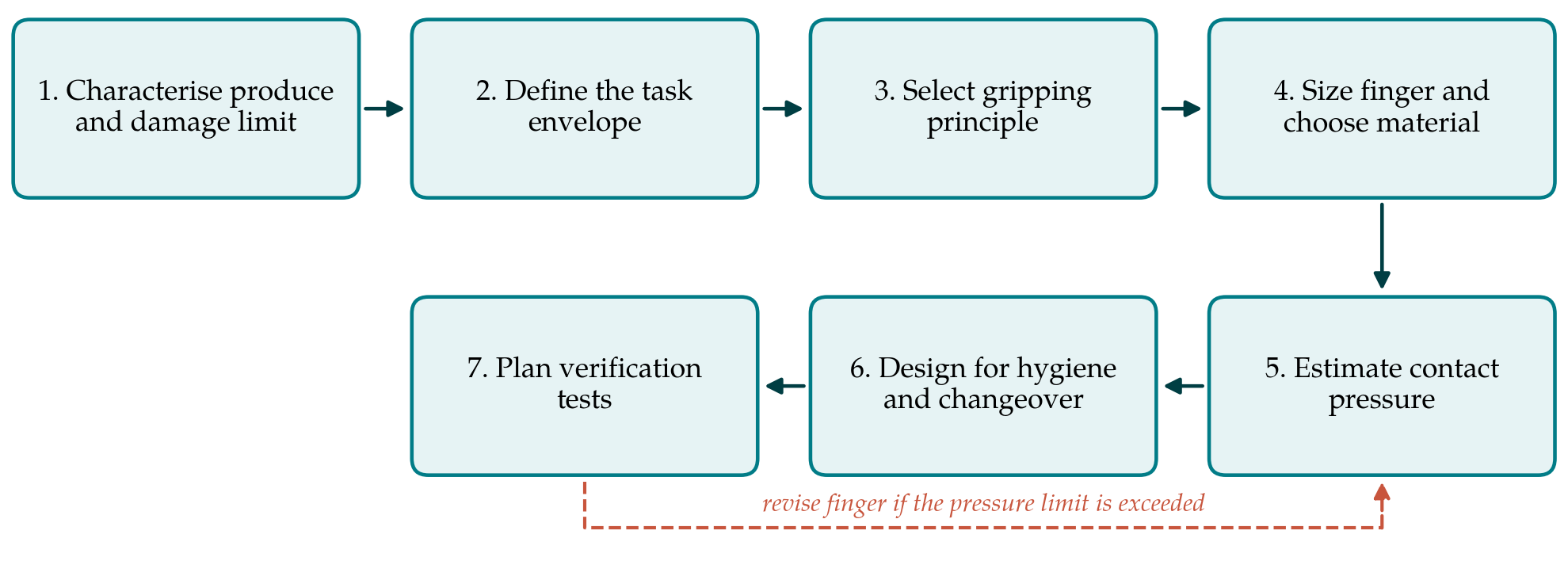
3.1. Step 1: Characterise the produce and set a damage limit
The first output is a number the gripper must not exceed. Following the practice described by Mohsenin (1986), samples spanning the ripeness range handled on the line are compressed between a flat plate and a curved indenter, and the force and deformation at bioyield are recorded. Hertz theory converts these into an allowable contact pressure for the radii of curvature involved. Because bruising may appear only after storage, the limit should be confirmed by holding loaded samples for the usual shelf period and inspecting them, using one of the bruise measures reviewed by Opara and Pathare (2014). A margin is then applied for the softest fruit expected, not the average.
3.2. Step 2: Define the task envelope
The second step fixes what the line demands: the range of item sizes and masses, the cycle time, the accelerations of the arm, the approach direction, the spacing of neighbouring items and the geometry of the tray. The peak acceleration matters most, since the holding force must resist inertial load as well as weight, and a fast pick-and-place robot can impose accelerations several times that of gravity. The envelope also records whether the item must be reoriented, which separates tasks that need an enclosing grasp from those a single-sided grip can serve, in the sense of the power and precision grasps classified by Cutkosky (1989).
3.3. Step 3: Select the gripping principle
With a pressure limit and an envelope in hand, the families in Table 1 can be screened. Suction is tried first because it is fastest and cheapest, and rejected if the skin is rough, wet, hairy or too weak to carry the item by a patch of its surface. Passive adaptive fingers suit lines where a servo or pneumatic jaw is already present. Fluidic fingers are preferred where the pressure limit is low, since the grasp force is governed by supply pressure and not by jaw position. Jamming pads are reserved for mixed or irregular items. The choice and the reasons for rejecting the alternatives are written down, because a later change of crop will reopen the question.
3.4. Step 4: Size the finger and choose the material
Finger length follows from the largest item, which the fingers must reach around past its widest section, and finger width from the room between neighbouring items. Wall and rib thicknesses are first estimates at this stage. The material is chosen from grades cleared for food contact, which in the European Union means compliance with the framework regulation on food contact materials (European Parliament and Council, 2004) and in practice points to platinum-cured silicones and certain thermoplastic polyurethanes. A softer grade lowers contact pressure and raises the stroke for a given input, at the cost of tear strength and fatigue life.
3.5. Step 5: Estimate contact pressure
The trial geometry is now checked against the limit from Step 1. For a ribbed passive finger a pseudo-rigid-body model gives the deflected shape and the reaction at each contact (Howell, 2001). For a fluidic finger the analytical model of Polygerinos et al. (2015) relates input pressure to bending angle and tip force, and a finite element model with a Yeoh material law refines the result where the geometry is unusual. The quantity of interest is the peak pressure on the fruit at the holding force required by the envelope, with the fruit represented by its measured stiffness and not as a rigid body. If the peak exceeds the limit, the designer returns to Step 4 and lengthens the contact, softens the material or adds a finger.
3.6. Step 6: Design for hygiene and changeover
A gripper that touches food must be cleanable. Crevices, exposed threads, open cable runs and porous printed surfaces harbour residue and should be designed out; moulded one-piece fingers with a smooth skin are preferable to assemblies. Fingers are consumables, so they should release from the base without tools, and the air or vacuum connection should seal on its own when a finger is fitted. Where the line runs several crops, the base is kept common and only the fingers change.
3.7. Step 7: Plan the verification tests
The last step produces a test plan, not a result. It should specify a holding test under the peak acceleration of the envelope, a damage test in which gripped and ungripped fruit from the same batch are stored and compared after the shelf period, a cycle test to the service life expected of a finger, and a cleaning test. Pass criteria are fixed before any test is run.
4. Fitting the Procedure to a Packing Line
Packhouses differ from laboratories in ways that bear on each step. Fruit arrives in batches whose firmness shifts through the season, so the damage limit from Step 1 is a schedule of values, and a gripper whose force is set by regulated air pressure can follow that schedule from the line controller where a fixed-travel jaw cannot. Ambient conditions are cold and wet, which stiffens some elastomers and defeats suction on condensing surfaces. Maintenance staff are few, which favours passive fingers and common bases over elaborate actuators. And the economics are those of a consumable: a design that performs slightly worse but can be moulded cheaply and swapped in seconds may be the better engineering answer.
5. Limitations and What Remains to Be Shown
The procedure has been assembled from published methods and has not been tested as a whole. Several of its links are weaker than the tidy sequence suggests. Hertz theory assumes small strains in a homogeneous elastic body, and ripe fruit is neither homogeneous nor elastic; the pressure limit it yields is an engineering estimate. Quasi-static compression says little about the brief impact when a finger closes at speed, and the procedure handles that only through the storage test in Step 7. Models of soft fingers are sensitive to material parameters that drift with temperature, ageing and batch.
What a validation would need to establish is therefore specific. It should show, for at least two crops of contrasting firmness, that a gripper sized by the procedure holds the item under the stated accelerations, that stored fruit shows no more bruising than hand-packed controls, and that the predicted contact pressures agree acceptably with pressures measured by a thin-film sensor at the interface. It should also report finger life in cycles. Until such work is done the procedure should be read as a design aid.
6. Conclusion
Choosing a compliant gripper for produce is usually done by trial, with a catalogue in one hand and a crate of fruit in the other. The procedure proposed here puts the steps in an order that starts from the fruit: a damage limit first, then the demands of the line, then the gripping principle, the finger, a pressure check, hygiene and a test plan. Its claim is modest. It organises existing knowledge so that the reasons for a design are recorded and can be revisited when the crop changes, and it leaves the question of how well the resulting grippers perform to the trials it describes.
Conflict of interest
To be declared by the author(s) before publication.
Funding
To be declared by the author(s) before publication.