1. Introduction
The forested uplands of Madhya Pradesh, Chhattisgarh and the adjoining districts of Maharashtra and Odisha are home to Gond, Baiga, Bhil, Korku, Bharia and other Scheduled Tribe communities, among whom herbal specialists continue to treat a large share of everyday illness. Indian folk medicine as a whole has been catalogued for decades (Jain, 1991), and the pharmacological literature on Indian plants with glucose-lowering activity is extensive (Grover et al., 2002). Diabetes has meanwhile become common in rural India, so that healers who once saw few such patients are now asked for remedies regularly.
Plant-derived leads have a respectable history in this disease. The biguanide class, to which metformin belongs, traces back to guanidine compounds in Galega officinalis, and several hundred species have been recorded worldwide as traditional treatments (Bailey and Day, 1989; Marles and Farnsworth, 1995). Field surveys are the first link in the chain that leads from a healer's practice to a tested preparation, and the quality of everything downstream depends on them.
That quality is uneven. Critical assessments of ethnopharmacological field studies have found recurring faults: no stated research question, no account of how informants were chosen, plant names that cannot be verified, and indices used as decoration (Heinrich et al., 2009). A consensus statement now sets out minimum standards for conducting and reporting such work (Weckerle et al., 2018). This article translates those standards into a concrete protocol for one question in one region: which plants tribal healers of central India use for diabetes, and how. The protocol is proposed, not reported; no survey was carried out for this article.
2. Background to the Design
Three matters shape the protocol before any step is taken: the illness category, the informants and the legal setting.
2.1. The illness category
Diabetes mellitus is a biomedical diagnosis that rests on blood glucose measurement. A healer without a glucometer recognises something else: a cluster of signs such as frequent urination, thirst, loss of weight, wounds that heal slowly, or urine that attracts ants. Hindi and regional terms such as madhumeh and the borrowed word "sugar" circulate alongside older local categories. A survey that simply asks for "plants for diabetes" therefore records a mixture of answers to different questions. The distinction between the informant's own category and the researcher's is basic to field method (Martin, 1995), and for this topic it decides whether the results mean anything.
2.2. Healers as informants
Specialist knowledge is unevenly held. Village herbalists, known by titles that vary with community and district, treat patients from several settlements and often guard their formulas. General household surveys underrepresent what they know, while a study confined to two or three famous healers cannot show which uses are shared. The design proposed here follows the healers' consensus approach, in which agreement among independent specialists is taken as a sign that a use is culturally established and worth closer study (Trotter and Logan, 1986; Heinrich et al., 1998).
2.3. Law and ethics
India's Biological Diversity Act regulates access to biological resources and associated knowledge through the National Biodiversity Authority, State Biodiversity Boards and local Biodiversity Management Committees (Government of India, 2003). It gives domestic effect to the principles of prior informed consent and benefit sharing later elaborated in the Nagoya Protocol (Secretariat of the CBD, 2011). The Code of Ethics of the International Society of Ethnobiology adds obligations that law does not cover, among them educated prior informed consent, confidentiality where requested, and the return of results in usable form (International Society of Ethnobiology, 2006). These are treated below as design constraints, not as paperwork to be completed afterwards.
3. The Proposed Protocol
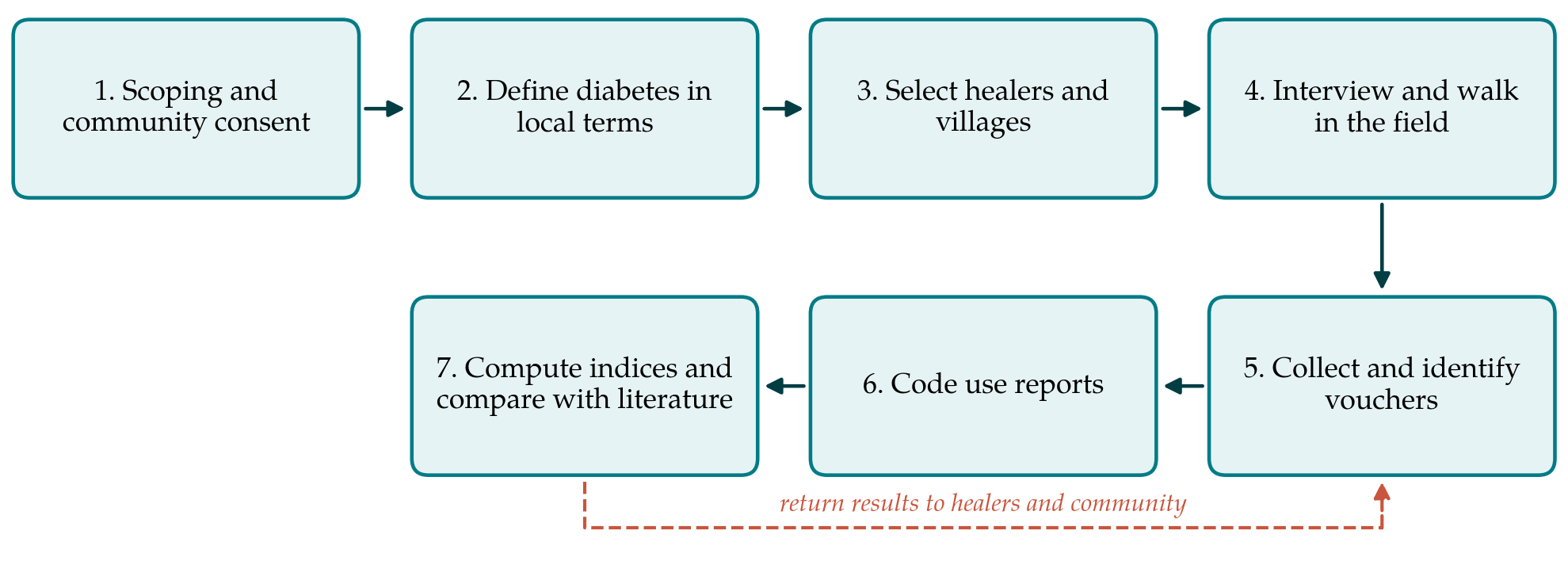
The protocol has seven steps. Table 1 sets out each step with its purpose and the record it should leave, and Figure 1 shows the sequence, including the return of results to the community.
| Step | Purpose | Record kept |
|---|---|---|
| 1. Scoping and consent | Agree aims, limits and benefit sharing with village bodies and authorities | Permissions, consent text, minutes of meetings |
| 2. Illness definition | Fix how diabetes is recognised and named locally | Glossary of terms and signs, screening questions |
| 3. Selection of healers | Reach specialists across communities and districts | Sampling frame, referral chain, refusals |
| 4. Interviews and field walks | Elicit remedies and see the plants in place | Interview guide, audio or notes, photographs |
| 5. Vouchers | Tie every vernacular name to a verifiable specimen | Numbered specimens, herbarium accession, determiner |
| 6. Coding | Turn narratives into comparable use reports | Codebook, use-report table |
| 7. Analysis and comparison | Measure agreement and set results against prior work | Index calculations, literature table |
3.1. Step 1: Scoping and consent
Work begins with visits to the village assembly, the Biodiversity Management Committee where one exists, and the forest and health offices of the district. The purpose of the survey, what will and will not be published, and what the community receives in return are discussed before any interview. Healers decide individually whether to take part and whether particular formulas are to remain unpublished. Consent is sought in the local language, orally where literacy is limited, and recorded. Review by an institutional ethics committee and any approval required under the Biological Diversity Act are obtained at this stage.
3.2. Step 2: Define diabetes in local terms
A short preliminary round of open conversations with a few healers and health workers establishes how the condition is named, which signs are taken to indicate it, and whether healers treat patients who have already been diagnosed at a clinic. From this a glossary and two or three screening questions are prepared. In the main interviews each remedy is then tagged by the basis on which the healer assigns it: a biomedical diagnosis reported by the patient, the healer's own recognition of signs, or a related complaint such as excessive urination or non-healing sores.
3.3. Step 3: Select healers and villages
Blocks are chosen to span the main tribal communities and forest types of the study area. Within each, healers are identified by asking village leaders, health workers and other healers, and the chain of referral is written down. This is purposive sampling and is reported as such; it supports statements about what specialists know, not estimates for the population. Recruitment continues in each block until further referrals lead mainly to people already interviewed. Sex, age, community, years of practice and the way the healer learned are recorded for every participant.
3.4. Step 4: Interview and walk in the field
Each healer is interviewed alone with a semi-structured guide: plants used, local names, part, preparation, quantity as the healer measures it, duration, accompanying dietary advice, perceived effects and unwanted effects, and where and when the plant is gathered. Free listing at the start gives an unprompted inventory. The interview is followed by a walk to the places where the healer collects, which removes much of the ambiguity of names given indoors and allows plant material to be gathered in the healer's presence (Alexiades, 1996). Mixtures are recorded as mixtures, with every ingredient, since many remedies are polyherbal.
3.5. Step 5: Collect and identify vouchers
Every plant named is collected, where abundance permits, as a fertile specimen with a collection number that links it to the interview. Specimens are pressed, dried and mounted by standard herbarium practice (Bridson and Forman, 1998), identified against regional floras and reference collections, and deposited in a recognised public herbarium, with duplicates at a local institution. Scientific names are given with author citation and family and checked against a current global checklist. Unverifiable names are the single commonest reason why field data cannot be reused (Rivera et al., 2014). Material sold in markets or bought as dried drug is vouchered separately and labelled as such.
3.6. Step 6: Code use reports
The unit of analysis is the use report: one healer citing one species for one purpose. Interview notes are converted to a table with one row per use report and columns for species, voucher, part, preparation, route, the basis of assignment from Step 2, and whether the plant is used alone or in a mixture. A written codebook defines each category. Two people code a portion of the interviews independently and settle differences before the remainder is coded, so that the table can be audited against the notes.
3.7. Step 7: Compute indices and compare with the literature
Agreement is summarised with a small number of indices whose formulas are stated. The informant consensus factor, (Nur − Nt)/(Nur − 1), relates the number of use reports in a category to the number of taxa cited (Heinrich et al., 1998). The fidelity level expresses the share of a species' citing informants who name it for the category of interest (Friedman et al., 1986). Relative frequency of citation shows how widely a species is known (Tardío and Pardo-de-Santayana, 2008). The underlying use-report table is published with the indices. Each species is then set against the pharmacological and clinical literature, noting whether the reported use is already documented and whether any toxicity is known.
4. Fitting the Protocol to Central Indian Conditions
Several features of the region call for adjustment. Fieldwork is constrained by the monsoon, when many herbs flower but villages are hard to reach, and by the dry season, when trees such as Pterocarpus marsupium and Syzygium cumini are accessible but annuals have vanished. Two visits in different seasons are therefore planned for each block. Interviews pass through Hindi or a regional language into Gondi, Korku or Bhili, and local assistants from the communities concerned should be trained and credited. Some species that healers use are under collection pressure, so vouchers are limited to what a population can bear and harvest practices are recorded, a point stressed in applied ethnobotany (Cunningham, 2001).
Results are returned in forms the community has asked for, for example an illustrated booklet in the local language or entries for the People's Biodiversity Register. Advice to patients forms no part of the survey. Where healers or patients ask, the team makes clear that the listing of a plant says nothing about its efficacy or safety and that people with diabetes should continue any treatment prescribed by health services.
5. Limitations and What Remains to Be Shown
The protocol has not been tested, and its practicality in the field remains to be shown. Asking healers to distinguish clinic-diagnosed patients from those they diagnose themselves may prove awkward in conversation. Referral sampling may miss healers who are isolated or in rivalry with those already interviewed. Voucher collection doubles the time spent with each participant. A pilot in one block would show whether the interview guide and coding scheme hold up and how long each step takes.
Some limits are inherent. Consensus measures agreement, not efficacy; a plant can be widely cited because it is common, bitter or promoted on television. Indices are sensitive to how use categories are drawn and to the number of informants, and they should be compared across studies only with care. Finally, a survey records what healers say they do. Whether a preparation lowers blood glucose, at what dose and at what risk, are questions for phytochemical, pharmacological and clinical research that a field survey can prompt but cannot answer.
6. Conclusion
Surveys of antidiabetic plants among tribal healers are worth doing well, because their outputs are reused by laboratories, conservation planners and the communities themselves. The seven-step protocol proposed here ties each plant name to a specimen, each index to a table of use reports, and the whole exercise to consent and benefit sharing under Indian law. It asks for more time per healer than a conventional inventory. A pilot study would show whether that cost is repaid by data that others can verify and build on.
Conflict of interest
To be declared by the author(s) before publication.
Funding
To be declared by the author(s) before publication.