1. Introduction
Chloride-induced corrosion of reinforcement is the most common cause of premature deterioration in concrete structures exposed to seawater or de-icing salts (Neville, 1995). The usual way of describing it follows Tuutti (1982): an initiation period, during which chloride moves through the cover until its concentration at the steel exceeds a threshold, and a propagation period, during which the steel corrodes. Most of the design effort goes into lengthening the first period, and the most effective single measure is the choice of binder (Bertolini et al., 2013).
Limestone calcined clay cement, usually written LC3, is a ternary binder in which clinker is partly replaced by calcined kaolinitic clay and limestone. In the common formulation known as LC3-50 the clinker content is about half of the binder, with roughly 30 per cent calcined clay, 15 per cent limestone and the remainder gypsum (Scrivener et al., 2018). The idea of combining metakaolin and limestone so that the two react together was established by Antoni et al. (2012), and the binder has since attracted attention because suitable clays are abundant where fly ash and slag are not (Sharma et al., 2021).
Laboratory work on saturated specimens has consistently reported low chloride diffusion and migration coefficients for LC3 concretes. The exposure classes in which chloride attack is most severe are not saturated ones, though. The European concrete standard reserves its highest chloride classes for tidal, splash and spray zones and for surfaces subject to cyclic wet and dry conditions (CEN, 2013). This review asks what the published evidence allows one to say about LC3 concrete under that kind of exposure, and where the evidence stops.
2. Scope and Approach
The article is a narrative review of the published literature. It does not report new measurements, and it makes no claim to have searched the literature exhaustively. Sources were chosen to cover three bodies of work: the established understanding of chloride transport in partially saturated concrete, the studies that characterise hydration, pore structure and chloride behaviour of LC3 and closely related metakaolin and limestone blends, and the test standards on which reported coefficients depend. Where the literature on LC3 itself is thin, as it is for long cyclic exposure, the review says so and reasons from the properties that are documented instead of filling the gap with conjecture.
3. Chloride Transport When Concrete Is Wetted and Dried
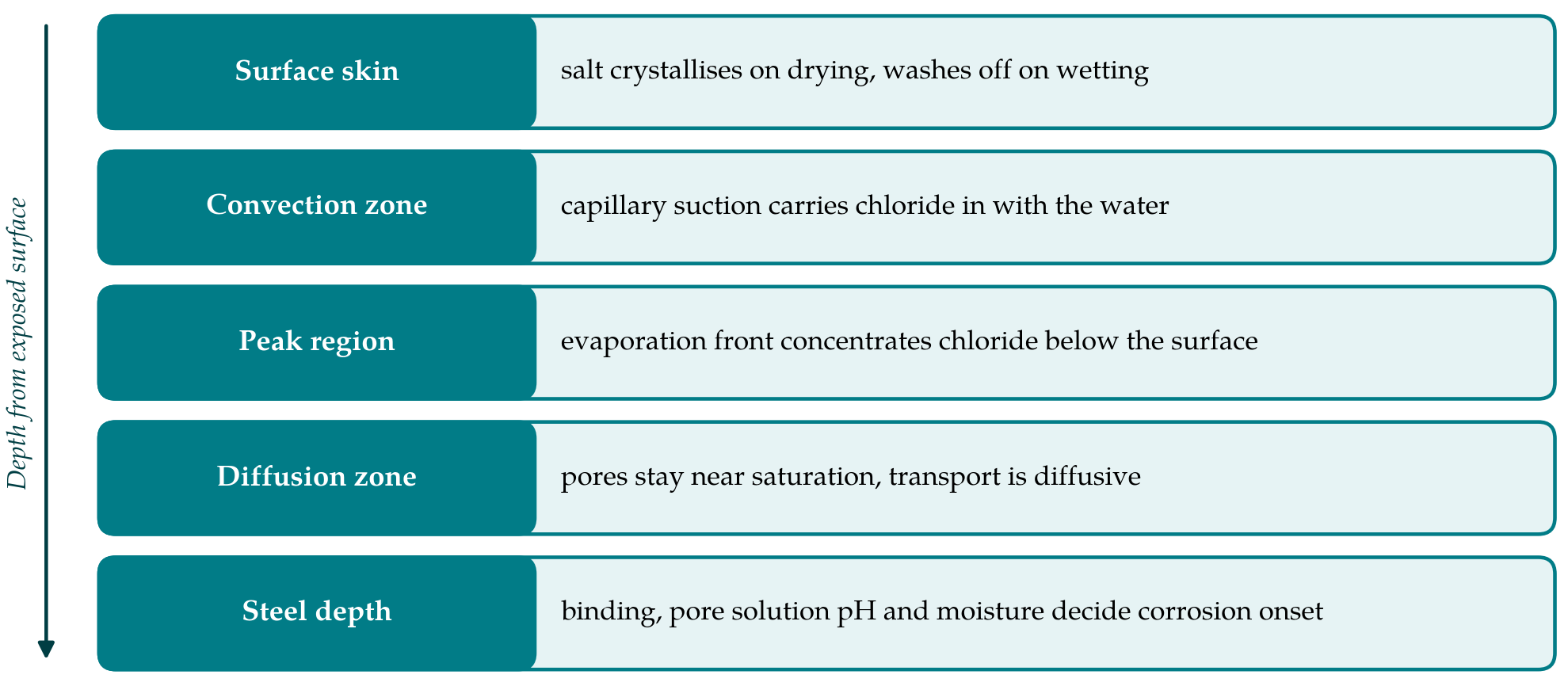
In permanently submerged concrete the pores are full and chloride moves by diffusion down its concentration gradient, a process first treated with Fick's second law by Collepardi et al. (1972). When the surface dries, the outer pores empty. On the next wetting, salt water is drawn in by capillary suction, which is far faster than diffusion, and carries chloride with it to the depth the water front reaches. During the following dry period water evaporates and the salt stays behind. Repetition raises the chloride concentration in the outer layer well above that of the wetting solution, and the profile often shows a maximum some millimetres below the surface instead of at it.
Figure 1 sets out the zones that result. The outer layer in which moisture content fluctuates is generally called the convection zone. Behind it the concrete stays close to saturation and transport is again diffusive, but it is driven by the elevated concentration at the inner edge of the convection zone. Saetta et al. (1993) gave an early numerical treatment of coupled moisture and chloride movement in partially saturated concrete, and the fib service life model handles splash-zone exposure by applying the diffusion solution from the inner boundary of a convection zone of specified depth (fib, 2006).
The balance between wetting and drying matters a great deal. In the cyclic ponding experiments of Hong and Hooton (1999), longer drying periods led to deeper chloride penetration, because a drier surface layer absorbs more solution on rewetting, and penetration grew with the number of cycles. Polder and Peelen (2002) followed concretes with different binders through salt wetting and drying using electrical resistivity, and found that blended cements with high resistivity showed both less chloride penetration and lower corrosion activity. Two material properties therefore govern cyclic performance in addition to the diffusion coefficient: the rate of capillary absorption, and the depth to which the concrete dries in the time available.
4. Properties of the Binder That Bear on Cyclic Exposure
Four properties of LC3 are relevant: how fine and how connected its pores are, how much chloride its hydrates can bind, what its pore solution contains, and how it responds to carbon dioxide. The first three are taken in turn here and the fourth in the next section.
4.1. Pore structure and absorption
Calcined clay reacts with portlandite to form additional calcium aluminosilicate hydrate, and the alumina it supplies reacts with limestone to form hemicarboaluminate and monocarboaluminate (Antoni et al., 2012). These products fill space efficiently. Avet and Scrivener (2018) showed that the critical pore entry size falls sharply within the first days for clays of moderate to high kaolinite content, and Zunino and Scrivener (2021) related the refinement to the metakaolin and limestone reaction itself. Concrete-scale work by Dhandapani et al. (2018) reported lower sorptivity, higher resistivity and lower chloride migration for LC3 than for Portland cement and fly ash concretes of similar grade.
For wetting and drying this is the central advantage. A finer and less connected pore network absorbs salt solution more slowly and to a shallower depth in a wetting period of given length, so the convection zone should be thinner. Fine pores also hold water at lower relative humidity, which keeps the interior closer to saturation during the dry phase. The same feature has a cost that is easily overlooked: a binder that depends on continued pozzolanic reaction for its pore structure is sensitive to early drying, and a poorly cured surface layer is exactly the layer that cyclic exposure attacks.
4.2. Chloride binding
Part of the chloride that enters concrete is removed from the pore solution, either chemically as Friedel's salt formed from aluminate phases or physically on the surface of the silicate hydrate (Yuan et al., 2009). Binders rich in reactive alumina bind more, and Thomas et al. (2012) found metakaolin to be the most effective of the supplementary materials they compared. In LC3 the carboaluminate phases can convert to Friedel's salt on contact with chloride. Shi et al. (2017) showed for Portland cement, metakaolin and limestone blends that binding depends strongly on the calcium available and on the pH of the pore solution, so binding measured in one solution cannot be transferred uncritically to another.
How much the binding contributes to the low apparent diffusion of LC3 has been examined directly. Maraghechi et al. (2018) compared ponded mortars made with clays of different kaolinite content and found that chloride resistance improved with kaolinite content up to an intermediate level, in step with pore refinement. Sui et al. (2019) concluded for a range of binary and ternary binders that pore structure, and not binding capacity, is the dominant factor in chloride transport. This matters for cyclic exposure because bound chloride is not permanently fixed. It is in equilibrium with the pore solution and can be released when that solution changes.
4.3. Pore solution and the chloride threshold
The pozzolanic reaction consumes portlandite and lowers the alkalinity of the pore solution compared with plain Portland cement. Since the onset of corrosion depends on the competition between chloride and hydroxyl ions at the steel surface, a lower chloride threshold is to be expected in such binders. The review by Angst et al. (2009) makes clear how widely reported thresholds scatter and how much they depend on the test method and on the condition of the steel and concrete interface, so single values should be read with care. Pillai et al. (2019) nevertheless estimated a lower threshold for LC3 than for Portland cement systems, and showed that the much lower diffusion coefficient more than compensated for it in the calculated service life.
5. Carbonation During the Dry Phase
Drying opens the outer pores to carbon dioxide, and carbonation proceeds fastest at intermediate humidity. Binders with little portlandite have less buffer against it, and the lower carbonation resistance of high-replacement blends, LC3 included, is acknowledged in the literature on the binder (Sharma et al., 2021). Under purely atmospheric exposure this is a matter of cover depth and curing. Under salt wetting and drying it interacts with chloride. Friedel's salt is not stable in carbonated paste, so carbonation of the outer cover releases chloride that had been bound, and the fall in pH lowers the amount the silicate hydrate can hold (Yuan et al., 2009). The released chloride is then free to be carried inward on the next wetting.
Whether this combined action is significant in practice depends on how deep the carbonation front travels between wettings. In a splash zone that is wetted daily the surface seldom dries far enough for much carbonation, and the fine pore structure of LC3 works in its favour. On a bridge deck or parking structure that receives de-icing salt in winter and dries for months in summer, the conditions for combined attack are much better met. The published evidence on LC3 does not yet settle the question, and it is the point at which extrapolation from saturated tests is least safe.
6. What the Test Methods Do and Do Not Capture
Almost all published chloride data for LC3 come from a small group of standard tests, which are summarised in Table 1. None of them reproduces cyclic exposure. The rapid chloride permeability test measures charge passed and is sensitive to the conductivity of the pore solution, so it tends to flatter binders with low alkalinity. Migration testing after NT BUILD 492 gives a coefficient from the penetration depth under an applied voltage, with no contribution from absorption. Bulk diffusion tests are closest to natural transport but are run on saturated specimens.
| Method | What is measured | Moisture state | Limit for cyclic exposure |
|---|---|---|---|
| Rapid chloride permeability ASTM, 2019 | Charge passed in six hours | Saturated | Reflects pore solution conductivity as much as transport |
| Non-steady-state migration Nordtest, 1999 | Migration coefficient from penetration depth | Saturated | No absorption, no binding equilibrium |
| Bulk diffusion ASTM, 2022 | Apparent diffusion coefficient from a profile | Saturated | Diffusion only; constant surface concentration |
| Capillary absorption (sorptivity) | Rate of water uptake by a dried specimen | Dried, then wetted | Depends strongly on the conditioning used |
| Electrical resistivity | Bulk or surface resistivity | Any, if known | Indirect; varies with moisture and temperature |
| Cyclic ponding or spray | Chloride profile after a set number of cycles | Cyclic | No agreed regime; results not comparable |
Cyclic regimes in the literature differ in the length of the wet and dry periods, the drying temperature and humidity, the salt concentration and the age at first exposure. Each of these changes the result, as Hong and Hooton (1999) demonstrated for the drying period alone. Drying at elevated temperature shortens a test but can alter the hydrate assemblage of a binder that contains carboaluminates, and it accelerates carbonation unless carbon dioxide is excluded. A comparison between LC3 and a reference concrete under one regime therefore says little about their ranking under another, and still less about a real structure.
7. Gaps and Directions for Future Work
Three gaps stand out. The first is the absence of an agreed cyclic test. A regime that fixes the wet and dry durations, the drying climate and the atmosphere, and that reports absorption depth and carbonation depth alongside the chloride profile, would let results from different laboratories be compared. The second is field data. LC3 has been produced at industrial scale only recently, and exposure-site results over periods comparable with a design life do not yet exist. Service life estimates rest on short-term coefficients and on assumptions about how those coefficients age.
The third gap concerns the threshold. Service life models multiply the uncertainty in the diffusion coefficient by the uncertainty in the critical chloride content, and for low-alkalinity binders the second is the larger. Threshold measurements on LC3 under partially carbonated and cyclically wetted conditions would be of more practical value than further migration coefficients. Models that couple moisture, chloride and carbonation in the manner begun by Saetta et al. (1993) exist, but they need binder-specific sorption and binding data that have not been published for LC3 in any systematic form.
8. Conclusion
The published evidence supports a qualified confidence in LC3 concrete under cyclic chloride exposure. Its fine pore structure reduces capillary absorption and diffusion, the two transport processes that operate under wetting and drying, and the reduction is large enough to outweigh a lower chloride threshold in the service life calculations published so far. The reservations concern chemistry. The binder carbonates more readily than Portland cement, carbonation releases bound chloride, and exposures with long dry periods bring the two together. Until an agreed cyclic test and long-term exposure data are available, designers would be prudent to pair LC3 with thorough curing and unreduced cover in the most severe chloride classes.
Conflict of interest
To be declared by the author(s) before publication.
Funding
To be declared by the author(s) before publication.