1. Introduction
Between the sunlit surface layer and the dark deep sea lies the mesopelagic zone, where light is too weak for photosynthesis but sufficient for vision. Its fish fauna is dominated in numbers by lanternfishes (Myctophidae) and bristlemouths (Gonostomatidae), most of them a few centimetres long. Many rise towards the surface at dusk to feed and descend again before dawn, forming the deep scattering layers that echosounders record across every ocean (Sutton, 2013). A review prepared for the Food and Agriculture Organization put the world resource at around one billion tonnes (Gjøsæter and Kawaguchi, 1980), and later acoustic work suggested that the true figure might be several times higher (Irigoien et al., 2014).
Numbers of that size attract attention when wild-capture fisheries have little room to grow and aquaculture needs marine ingredients for feed. Mesopelagic fishes have been taken commercially before, in the Southern Ocean, off southern Africa and in the Gulf of Oman, though never for long or on a large scale (Catul et al., 2011). Renewed trials are under way, and the scientific community has begun to ask what knowledge would be needed to manage such a fishery (Hidalgo and Browman, 2019).
The position taken here is that the order of events matters. Baseline surveys of biomass, species composition and ecological role should come first, and commercial harvest should wait for them. The sections that follow give the reasons, respond to the objections, and outline what a baseline should contain.
2. The Argument for Surveying First
Four considerations support the position. Each concerns something that is not yet known well enough to set a catch limit with confidence, and Table 1 gathers them with the sources relied upon.
| Uncertainty | Why it matters for harvest | Sources |
|---|---|---|
| Total biomass | Estimates span an order of magnitude; no basis for a catch limit | Irigoien et al., 2014; Proud et al., 2019 |
| Net avoidance and acoustic identity | Trawls undercount fish; echoes include other animals | Kaartvedt et al., 2012 |
| Carbon transport | Removal of migrators may weaken export to depth | Davison et al., 2013; Saba et al., 2021 |
| Role as prey | Predator dependence unmeasured in most regions | Drazen and Sutton, 2017 |
| Life history | Growth, age and spawning known for few species | Catul et al., 2011 |
| Stock structure | Management units undefined on the high seas | St. John et al., 2016 |
2.1. The biomass is not known to within a factor of ten
The long-standing estimate of about one billion tonnes was built from net catches, and small fishes with good eyesight evade nets. Acoustic observations from a research vessel showed mesopelagic fish avoiding a trawl so effectively that catches greatly underestimated what the echosounder recorded (Kaartvedt et al., 2012). Acoustic data from a circumnavigation of the subtropical and tropical oceans then led to the suggestion that biomass could be an order of magnitude above the earlier figure (Irigoien et al., 2014).
Acoustic estimates carry their own difficulties. The echo from a scattering layer depends on which organisms are present and on the state of their gas-filled swimbladders, and gas-bearing siphonophores can return strong echoes that are easily taken for fish. Proud et al. (2019) worked through these assumptions and arrived at a plausible range for global biomass whose upper bound is several times its lower bound. A manager asked to set a sustainable catch from a stock known only to that precision has nothing to work with. The composition of the scattering layers also differs between ocean regions, so a figure obtained in one basin cannot simply be carried to another.
2.2. The fish move carbon
Animals that feed near the surface at night and respire, excrete and die at depth by day transfer carbon downwards faster than sinking particles would carry it. For the north-east Pacific, Davison et al. (2013) estimated that mesopelagic fishes account for a substantial share of the carbon exported from the surface layer. A later synthesis concluded that fishes as a whole contribute appreciably to the ocean's carbon flux but that the estimates are spread widely and rest on few measurements (Saba et al., 2021). The service is thus real in kind and uncertain in size. A fishery that removed a large part of the migrating biomass would alter it by an amount that cannot at present be predicted, and the cost would fall on everyone and not on the fishery.
2.3. The fish feed much of the open ocean
Mesopelagic fishes link zooplankton to larger animals. They are eaten by tunas, billfishes, squids, seabirds, seals and toothed whales, and the feeding relationships of the deep pelagic are complex and only partly described (Drazen and Sutton, 2017). Where a fishery targets forage species near the base of a food web, the effects travel upwards to predators, some of them already the object of valuable fisheries or of conservation measures. The warning that fisheries tend to move down food webs as larger species are depleted was given a generation ago (Pauly et al., 1998), and a mesopelagic fishery would be a further step in that direction.
2.4. Deep-water fisheries have a poor record
Fisheries on the continental slope and seamounts expanded in the late twentieth century ahead of the science. Orange roughy is the best-known case: the species proved to be far longer lived and less productive than assumed when fishing began, and stocks were reduced within a few years (Clark, 2001; Koslow et al., 2000). The lesson is not that mesopelagic fishes share the biology of orange roughy, which they do not. It is that assumptions about productivity made before the data exist have been wrong in the past, and that the error was discovered only after the damage was done.
3. Objections Considered
A position of this kind should be tested against the strongest replies to it. Three deserve an answer.
3.1. Lanternfishes are small, fast-growing and resilient
Many myctophids mature within a year or two and are highly fecund, traits that normally allow a population to sustain a high rate of exploitation (Catul et al., 2011). This is a fair point, and it distinguishes them from slope species. It does not remove the need for surveys. The group contains hundreds of species, life histories have been described for a small minority, and those of cold and deep waters appear to live longer than tropical ones. A trawl in a scattering layer takes a mixture, and the productivity of the mixture is that of its least productive members if they are not to be depleted. Resilience is a hypothesis to be confirmed for each fished assemblage.
3.2. The world needs the protein and the oil
The demand for marine ingredients in aquaculture feed is real. Yet a fishery that turns lanternfish into meal and oil for farmed fish is an indirect route to human nutrition, and its contribution has to be weighed against what the same fish provide when left in the water as prey for wild-caught species and as carriers of carbon. Neither side of that comparison can be quantified without the baseline information this article asks for. Advocates of urgent study of the twilight zone have made the same point: the knowledge should be gathered now, before industrial pressure sets the terms (Martin et al., 2020; St. John et al., 2016).
3.3. Exploratory fishing is how data are obtained
It is sometimes said that only a fishery will pay for the ship time needed to study a remote resource. Commercial vessels can indeed collect acoustic and biological data. But data gathered by a fleet that has already invested in gear and processing plant arrive together with pressure to continue, and catch rates from schooling fish are a notoriously poor guide to abundance. Scientific surveys with public or shared funding, using commercial vessels as platforms where convenient, obtain the same information without creating a constituency for expansion before the results are in.
4. What a Baseline Should Contain
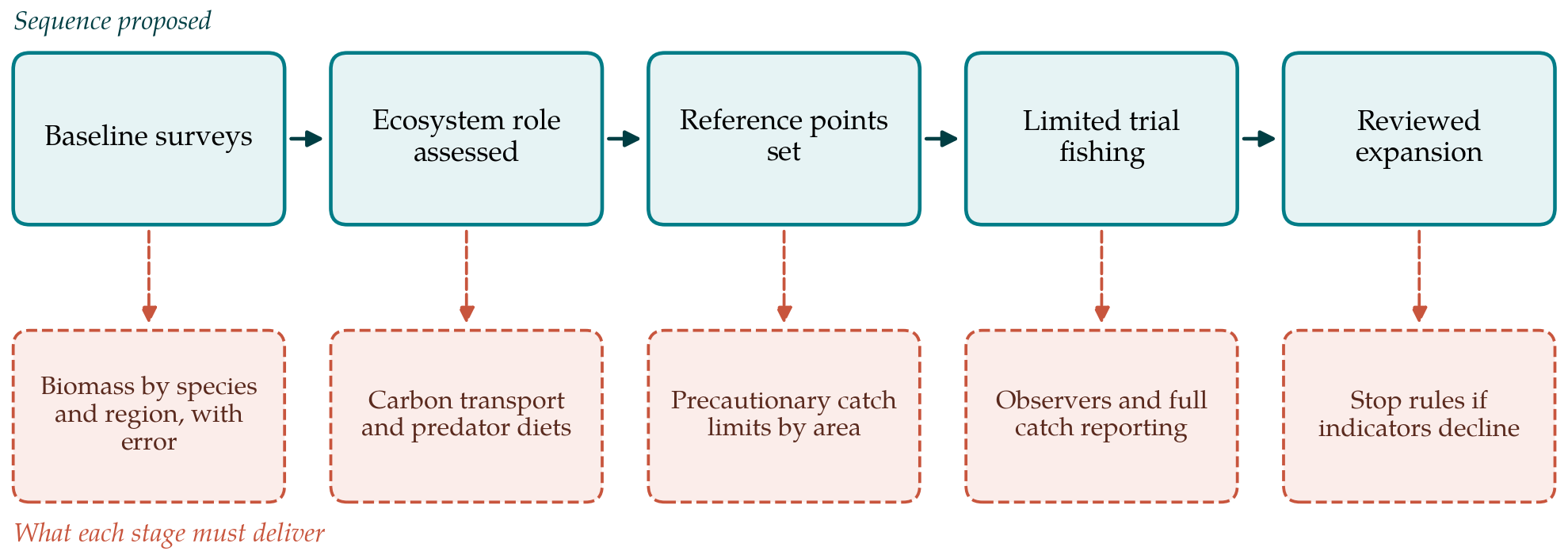
Figure 1 sets out the sequence proposed and what each stage should deliver before the next begins. The baseline itself has four elements. The first is a biomass estimate for the region and assemblage in question, obtained with multi-frequency acoustics and verified by nets and optical tools, with its uncertainty stated. The second is basic life history for the dominant species: age, growth, maturity and spawning season. The third is an account of ecological role, namely diet, predators and an estimate of the carbon moved by migration. The fourth is a description of natural variability over several years, without which a later decline could not be told apart from a fluctuation.
None of this is exotic. It is the information routinely demanded for established stocks, and it is achievable for a defined region within a few years of coordinated work. What it requires is that the surveys be funded and completed before commercial licences are issued and not alongside them.
5. Implications for Regulators
The legal basis for proceeding in this order already exists. The Code of Conduct for Responsible Fisheries calls on states to apply the precautionary approach widely and states that the absence of adequate scientific information should not be used as a reason for postponing or failing to take conservation measures (FAO, 1995). The United Nations Fish Stocks Agreement goes further for new or exploratory fisheries, requiring cautious conservation and management measures, including catch and effort limits, that remain in force until there are sufficient data to assess the effect of the fishery on the long-term sustainability of the stocks (United Nations, 1995).
Practice in the Southern Ocean shows that such rules can be made to work. The krill fishery there is managed with precautionary catch limits set well below the estimated biomass and subdivided by area, with explicit regard for the needs of dependent predators (Nicol et al., 2012). A comparable regime for mesopelagic fishes would treat any fishery as exploratory by default, restrict it to a small number of vessels with observers and full reporting, set limits as a small fraction of the lower bound of surveyed biomass, and define in advance the indicators whose decline would halt fishing. Where the fish occur beyond national jurisdiction, regional fisheries bodies would need to adopt such measures before, and not after, vessels arrive.
6. Conclusion
Mesopelagic fishes may one day support a fishery that is both useful and sustainable. That cannot be judged at present, because their biomass is uncertain by a wide margin, their contribution to carbon transport and to the diets of other animals has been measured in few places, and the life histories of most species are unknown. The reasonable course is to survey first and decide afterwards. The instruments of international fisheries law provide for exactly this, and the cost of waiting a few years for the information is small beside the cost of repeating in the twilight zone the mistakes already made on the continental slope.
Conflict of interest
To be declared by the author(s) before publication.
Funding
To be declared by the author(s) before publication.