1. Introduction
Coastal erosion is a slow emergency. A beach narrows over several monsoons, a row of houses is undermined, the place where boats were hauled out disappears, and the families affected rebuild further back if there is land to rebuild on. Small-scale fishers are tied to the shore by their work, by access rights that depend on residence and by debts to local traders, so leaving is costly. The usual compromise is partial: some members of a household go away to work and send money back, while others stay and keep the claim to place.
Policy writing has described this pattern as migration serving adaptation (McLeman and Smit, 2006; Black et al., 2011). The phrase is useful but says little about how the money moves. Remittances are requested, expected, delayed, earmarked and sometimes withheld, and all of this happens between people who stand in defined relations to one another. A married daughter, a mother's brother and a crew mate are not interchangeable sources of help.
This article sets out a research design for studying those relations in one eroding fishing village. It is addressed to ethnographers and to mixed-method teams, and it is a proposal only. No fieldwork is reported, no village is described, and the design has not been tested. The aim is to show how established instruments can be combined so that the economic and the moral sides of remittance are recorded together.
2. Conceptual Background
Two literatures frame the design, and a third supplies the setting.
2.1. Remittances as household strategy
The new economics of labour migration treats the decision to migrate as one taken by a household that spreads its members across places to spread its risks (Stark and Bloom, 1985). In the best-known statement of motives, Lucas and Stark (1985) distinguished altruism, self-interest and a middle position in which migrant and family are bound by an implicit contract of mutual insurance and repayment. Later reviews found that these motives are hard to separate in survey data, because the same transfer is compatible with several of them (Carling, 2008). Work in coastal Vietnam linked remittances to the resilience of households and also to widening inequality between them (Adger et al., 2002).
2.2. Remittances as obligation
Anthropology starts from the gift. Mauss (1990) argued that a gift carries duties to give, to receive and to return, and Sahlins (1972) showed that the terms of reciprocity tighten as kinship distance grows, from open-ended giving among close kin to calculated exchange with strangers. Studies of relatedness add that kinship is made through feeding, housing and care as much as through descent, which means that sending money can itself create or confirm a tie. Zelizer (1994) demonstrated that people mark money for particular uses and relations, and Carling (2014) proposed that each remittance follows a recognisable script, such as allowance, gift, repayment or investment, that tells both parties what is owed. A design that records amounts without scripts misses what the money means to those who handle it.
2.3. The fishing setting
Fishing economies have features that shape transfers. Catches are uncertain from day to day, earnings are divided by share and not by wage, crews are often recruited among kin, and credit from fish buyers ties households to particular landing sites (Acheson, 1981). Livelihood research has shown that fishing households nearly always combine fishing with other work, and that mobility is a normal part of that portfolio (Allison and Ellis, 2001). Erosion therefore acts on households that already move and already share. The research question is how an existing system of obligation is stretched by a new and permanent loss.
3. Research Questions and Case Selection
The design addresses three questions. The first is structural: along which kin ties do remittances travel, and which ties carry none? The second is normative: what do senders and receivers say is owed, by whom, and what happens when expectations are not met? The third concerns adaptation: is remitted money used to hold on to the eroding site, to establish a foothold elsewhere, or for needs unrelated to erosion?
A single village is studied in depth because obligations can only be understood where the whole web of kin is visible. The logic is that of the case study, which seeks analytic and not statistical generalisation. A suitable village is one of a few hundred households, small enough for a complete census, where erosion has been under way for some years, where some houses have already been lost and where out-migration for work is established. A village that has been wholly relocated by government is a different case and would need a different design.
4. The Proposed Design
The design has five phases spread over roughly fourteen months, so that one full cycle of fishing seasons and monsoon is observed. Figure 1 shows the phases and what each produces, and Table 1 lists the components with their instruments. The phases overlap in practice.
| Component | Instrument | What it records | Question served |
|---|---|---|---|
| Participant observation | Field notes | Daily work, talk about money and kin | All three |
| Household census | Structured schedule | Members, absentees, assets, house position | Structural |
| Genealogies | Kin charts | Descent, marriage and whereabouts of kin | Structural |
| Transfer diaries | Fortnightly visits | Each transfer, its sender, script and use | All three |
| Transfer map | Name-based network questions | Who gives to and asks from whom | Structural |
| Paired interviews | Open-ended guide | What senders and receivers say is owed | Normative |
| Loss mapping | Walks and sketch maps with residents | Houses, land and landing space lost | Adaptation |
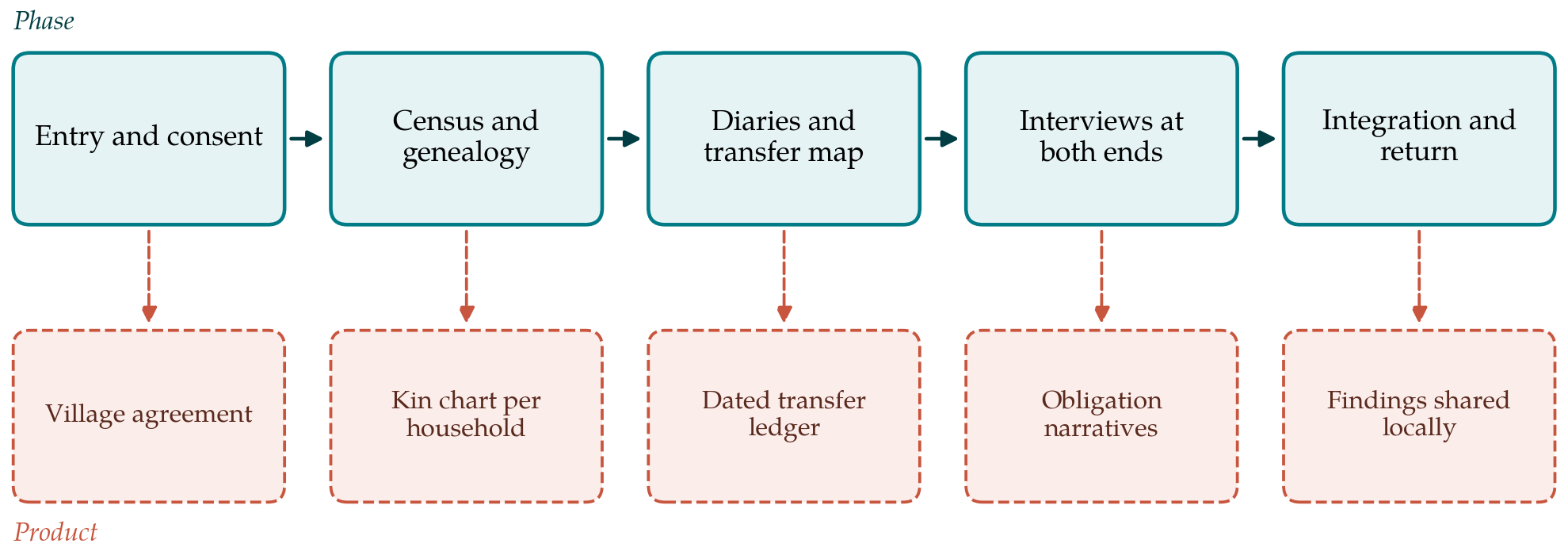
4.1. Phase 1: Entry, consent and a shared vocabulary
Fieldwork begins with residence in the village and with the ordinary work of participant observation: attending landings, net mending, auctions and household ceremonies (Bernard, 2011). Permission is sought from whatever body speaks for the village and then from each household individually. Early weeks are used to learn the local terms for kin, for kinds of help and for kinds of money, since the later instruments must use categories that people recognise. Questions about money are sensitive, and the ethical standards of the discipline require that people understand what will be recorded and can decline without consequence (American Anthropological Association, 2012).
4.2. Phase 2: Household census and genealogies
A census records every household, its members present and absent, their work, the boats and gear they own or crew, and the condition and position of the house in relation to the shore. Genealogies are then collected by the method that Rivers (1910) set out more than a century ago, extended to include affines and absent members and their present whereabouts. The product is a kin chart for each household that links to the charts of others. This chart is the frame on which transfers will later be placed, and it identifies migrants to be traced in the fourth phase.
4.3. Phase 3: Transfer diaries and the transfer map
One-off questions about remittances invite rounded and selective answers. The design instead uses diaries, adapted from the financial diary method developed for studying the money management of poor households (Collins et al., 2009). A purposive selection of households, chosen to span those that have lost a house, those at risk and those further inland, is visited every two weeks. At each visit the researcher records every transfer received or sent since the last one: who sent it, the relation, the channel, the amount in broad bands, what was said about its purpose and how it was used. Requests made and refused are recorded as carefully as money that arrived.
Towards the end of the diary period every household in the census is asked a short set of name-based questions: from whom it received help in the past year, to whom it gave, and whom it could ask in an emergency. The answers are assembled into a network in which households and absent migrants are points and transfers are directed ties, following standard practice in network research (Wasserman and Faust, 1994). Laid over the genealogies, the map shows which categories of kin carry support and where non-kin, such as boat owners and fish traders, stand in.
4.4. Phase 4: Interviews at both ends
Remittance is a relationship with two parties, and the village holds only one of them. Following the argument for multi-sited ethnography (Marcus, 1995), the researcher traces a number of migrants from diary households to the towns, harbours or foreign worksites where they live, and interviews them there or, where travel is impossible, by telephone. Sender and receiver are asked about the same transfers: how the request was made, what was felt to be owed, what was sent, and what each thinks the other did with it. Differences between the two accounts are the main material for the second research question. Life-history interviews with older residents record how obligations were met before migration became common.
4.5. Phase 5: Loss mapping, integration and return
Residents are asked to walk the shore with the researcher and to mark on a sketch map where houses, wells, shrines, net-drying ground and landing places stood, and when each was lost. The map dates erosion from the village's own memory and ties each loss to a household in the census. Analysis then brings the strands together for each diary household: its position on the kin chart, its transfers through the year, the scripts attached to them, and the use of the money in relation to its losses. Findings are presented back to the village in an accessible form before anything is published, and corrections are invited.
5. Analysis
Analysis proceeds by comparison within the case. Households are grouped by exposure to erosion and by the presence of a migrant, and the composition of their transfers is compared in words and simple counts. Network measures are used descriptively, to identify households that are sources of support for many others and households with no one to ask. Interview material is coded for the scripts that Carling (2014) describes and for local categories that do not fit them. The third question is answered by classifying recorded uses of money as spending on the present site, such as sea defences or house repair, spending on a move, such as an inland plot or schooling elsewhere, and spending on consumption, debt and ceremony.
6. Limitations and What Remains to Be Shown
The design is untested, and several of its weaknesses can be foreseen. Diaries are demanding for households and for the researcher, and people may tire of them or adjust what they report. Amounts are likely to be understated where neighbours might overhear or where money is hidden from other kin, which is itself a finding but limits any totals. Tracing migrants is expensive, and those who can be found are probably those on good terms with home. One village cannot show how common its arrangements are, and a single year may be unusual for catches or storms.
There is also a conceptual risk. Framing remittances as adaptation can make a household's private sacrifice look like a solution, and the design should record what migration costs those who leave and those who are left with the work of care. Whether the combination of diaries, genealogies and paired interviews yields a coherent account, or simply three partial ones, can only be established by using it. A pilot in a few households over one season would show whether the fortnightly visit is tolerable and whether the local vocabulary of obligation has been understood.
7. Conclusion
Remittances to an eroding fishing village are payments within kinship, and they should be studied with instruments that keep the kinship in view. The design proposed here places every recorded transfer on a genealogy, attaches to it the meaning that sender and receiver give it, and relates its use to dated losses of land and housing. It draws only on established methods. Its contribution is their combination around three linked questions, and its usefulness remains to be demonstrated in the field.
Conflict of interest
To be declared by the author(s) before publication.
Funding
To be declared by the author(s) before publication.