1. Introduction
The proposition that collisions between objects in orbit could become self-sustaining was put in quantitative form by Kessler and Cour-Palais (1978). Later modelling indicated that the population of fragments in the most crowded altitude bands of low Earth orbit would continue to grow through collisions even if launches ceased (Liou and Johnson, 2006). The policy response has centred on a simple idea: remove spacecraft and rocket stages from the protected region soon after they stop being useful, so that they cannot become targets.
For most objects in low orbit removal means re-entry, and re-entry means atmospheric drag, whether it acts alone on a satellite left to decay or completes a manoeuvre that lowered the perigee. Any rule expressed as a time limit therefore rests on a prediction of how fast drag will bring an object down. That prediction comes from a physical model of the upper atmosphere and of the body moving through it.
The question in the title can be read two ways. Read narrowly, it asks whether licensing should rely on such models at all, and the answer is plainly that it must. Read more carefully, it asks how a regulator should use a prediction whose error can be as large as the quantity predicted. This article takes the second reading. Its position is that decay models should guide licensing as sources of probabilistic evidence, and that current practice gives their output a precision it does not have.
2. How Lifetime Rules Work at Present
The guideline that a spacecraft should leave low Earth orbit within twenty-five years of the end of its mission originated in the work of the space agencies and was set down by the Inter-Agency Space Debris Coordination Committee (IADC, 2007). The United Nations guidelines adopt the principle of limiting long-term presence without fixing a number (UNOOSA, 2010). The international standard on debris mitigation requirements (ISO, 2019) and the standard that NASA applies to its own missions (NASA, 2019) translate the principle into requirements that a project must verify. In 2022 the United States Federal Communications Commission shortened the period to five years for satellites it licenses (FCC, 2022).
These instruments bind through national law. Under the Outer Space Treaty a state must authorise and continually supervise the space activities of its nationals (United Nations, 1967), and licensing is how it does so. In a typical application the operator supplies the mass, dimensions and intended orbit of the spacecraft and a calculated lifetime that falls within the limit. The calculation is done with accepted software and an accepted forecast of solar activity. What the regulator receives is a number.
3. What the Physics Predicts and What It Cannot
The deceleration of a satellite by drag is proportional to the density of the air, the square of the speed, and the ratio of the product of drag coefficient and cross-sectional area to the mass. The theory of how an orbit contracts under this force was worked out in the first decades of the space age (King-Hele, 1987) and is not in question. The difficulty lies in the inputs. Table 1 sets out the principal sources of uncertainty and says which of them better physics could reduce.
| Source | Why it matters | Reducible by better modelling? |
|---|---|---|
| Solar activity years ahead | Thermospheric density at a fixed height varies about tenfold over the solar cycle | Hardly; the cycle is poorly predictable |
| Geomagnetic storms | Heating raises density sharply for a day or two | No, beyond statistics |
| Density model error | Empirical models differ and carry systematic bias (Emmert, 2015) | Yes, gradually |
| Drag coefficient | Depends on shape, surface and gas composition | Partly |
| Attitude after failure | A tumbling body presents a different area from a controlled one | Only as a range |
| Long-term thermospheric cooling | Rising carbon dioxide lowers density and lengthens lifetimes (Brown et al., 2021) | Yes, as a scenario |
Density is the dominant term. The empirical models in general use, among them NRLMSISE-00 (Picone et al., 2002) and JB2008 (Bowman et al., 2008), describe the thermosphere as a function of indices of solar ultraviolet output and geomagnetic activity. Given the indices, they reproduce average conditions well and individual days less well. Projected years ahead, the indices themselves are the problem: the strength and timing of a solar cycle cannot be forecast with confidence before it begins. A critical assessment by Vallado and Finkleman (2014) concluded that the treatment of drag in operational practice is weaker than its routine use suggests, and that uncertainties in the inputs are often left unstated.
Two episodes illustrate the point without need of statistics. In February 2022 a batch of newly launched satellites was lost when a minor geomagnetic storm raised the density at their low insertion altitude enough to prevent orbit raising (Fang et al., 2022). There the error ran in the direction of faster decay. The slow contraction of the thermosphere as carbon dioxide accumulates runs the other way, lengthening the lifetime of everything in orbit relative to estimates made with models fitted to past decades.
4. The Case for Physics-Based Licensing
None of this argues for abandoning models. The alternatives are worse. A rule based on altitude alone, permitting anything below a fixed height, ignores the fact that a dense, compact satellite and a light one with large solar arrays decay at very different rates from the same orbit. A rule based on the operator's promise ignores physics altogether. Only a drag calculation connects the properties of a particular spacecraft to the outcome the rule exists to secure.
Physics-based evidence has a second virtue: it can be audited. The inputs are few, the equations are public, and an independent analyst can repeat the calculation. A regulator can ask what solar activity was assumed, what drag coefficient, what attitude, and can test the sensitivity of the answer. That transparency is worth preserving, and it is the reason for wanting the models used properly instead of replaced by cruder proxies.
5. Objections
The first objection is that a prediction so uncertain cannot support a bright-line rule, and that regulators need bright lines. This has force. A firm limit of five years means little if the calculated figure of four could equally have been seven under a quiet Sun. But the objection tells against the single figure and not against the model. A requirement that the lifetime fall within the limit with a stated probability, under a prescribed set of solar scenarios, is just as bright a line and is honest about what is known.
The second objection concerns burden. Probabilistic analysis is more work than a single run, and small operators and universities have little capacity to spare. The answer is proportionality. A three-unit CubeSat at an altitude from which it will certainly decay within a few years in any solar conditions needs no elaborate analysis. A large constellation at an altitude where natural decay takes decades presents a different case, and the public interest in rigorous evidence is correspondingly greater (Boley and Byers, 2021).
The third objection is that stricter national rules displace operators to more permissive jurisdictions. That risk attaches to every national measure on debris and is an argument for common standards, which bodies such as ISO and the IADC exist to provide. A further line of criticism holds that lifetime rules of any kind miss the point, since the underlying problem is unpriced use of a shared resource, and that a charge on orbital use would do more (Rao et al., 2020). The two approaches are compatible. A fee, too, would have to be scaled by expected time in orbit, and that again requires a decay model.
6. What a Sound Rule Would Require
If models are to guide licensing well, four practices follow. Lifetime should be reported as a distribution obtained by sampling solar activity scenarios, drag coefficient and attitude state, with the assumptions fixed by the regulator so that applications are comparable. The reference atmosphere and the allowance for long-term density decline should be specified and revised on a published schedule as the science develops. The probability that the disposal manoeuvre is actually carried out should be assessed separately, because a perfect drag model says nothing about a satellite that fails before it can lower its orbit (Klinkrad, 2006). And the depth of scrutiny should depend on the stakes.
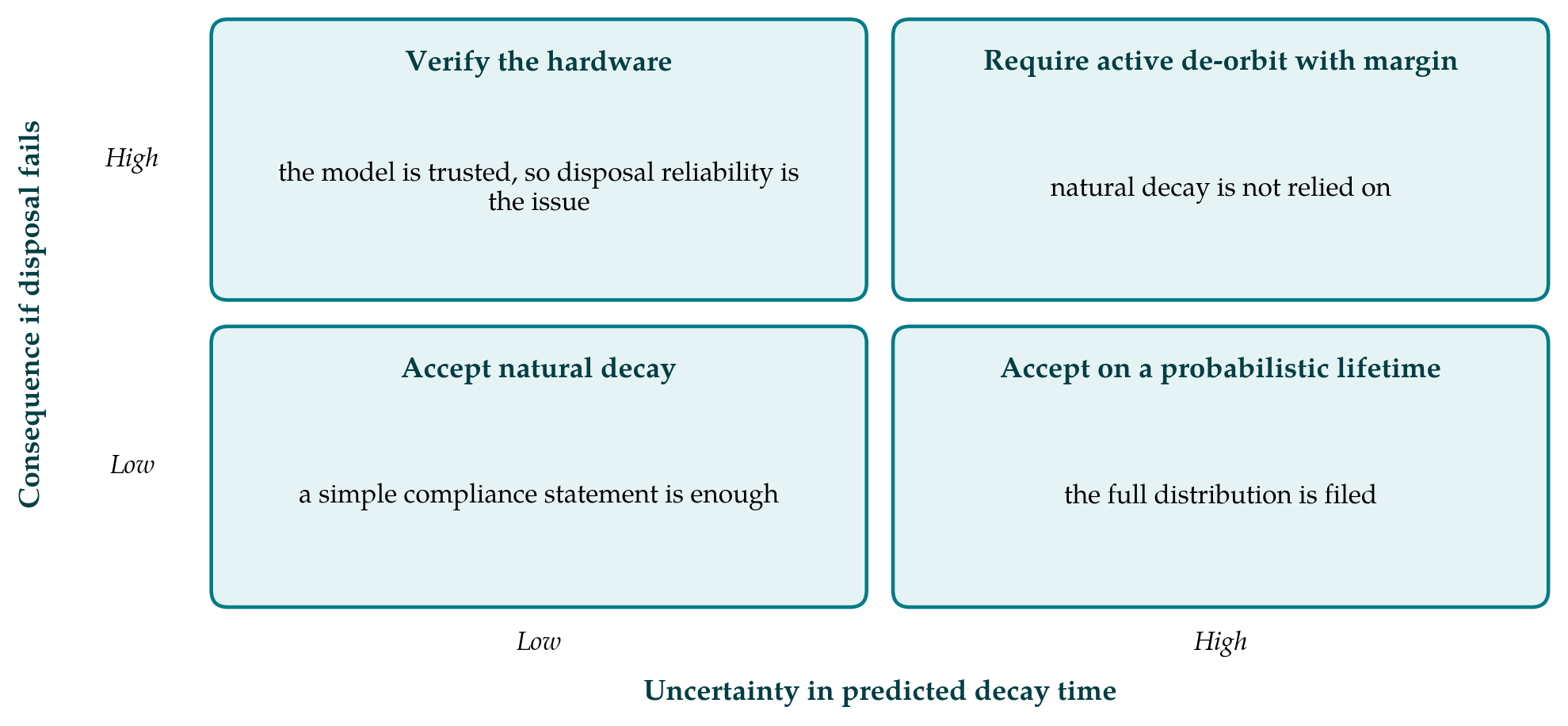
Figure 1 expresses the last point as a matrix. Where the predicted decay is robust and the consequence of failure small, a simple statement suffices. Where the prediction is uncertain but the object is small and low, a probabilistic lifetime can be accepted. Where consequence is high, the regulator should either look to the reliability of the hardware or, if the decay prediction is also uncertain, decline to rely on natural decay at all and require a controlled de-orbit with margin.
Such a scheme asks regulators to hold technical competence in astrodynamics and upper-atmosphere physics, or to obtain it from agencies that have it. It also implies that a licence may need conditions that respond to events, such as a duty to re-evaluate the disposal plan if solar activity proves much lower than assumed.
7. Conclusion
Physics-based decay models should guide launch licensing, because nothing else links a specific spacecraft to the time it will spend in orbit, and because their workings can be examined. They should do so as evidence with error bars. The present habit of reducing a deeply uncertain forecast to one figure and comparing it with a limit invites false assurance in some cases and needless refusal in others. Reporting lifetimes as distributions under common assumptions, scaling scrutiny to consequence, and treating disposal reliability as a separate question would let the physics inform policy to the extent that it legitimately can. The models will improve, but the Sun will remain unpredictable on the time scales that matter, and rules should be written with that in mind.
Conflict of interest
To be declared by the author(s) before publication.
Funding
To be declared by the author(s) before publication.