1. Introduction
In 1992 a judge of the Territorial Court of Yukon rearranged his courtroom in the village of Mayo, seated the accused, his family, community members, counsel and police in a circle, and asked them together to consider what sentence would serve everyone affected. The reasons in that case (Territorial Court of Yukon, 1992) and the judge's later writing (Stuart, 1996) became the reference point for what is now called circle sentencing. In 1996 a provision came into force in the Criminal Code directing sentencing judges to consider all reasonable alternatives to imprisonment, with particular attention to the circumstances of Aboriginal offenders. The Supreme Court of Canada interpreted that provision in R. v. Gladue (1999) and reaffirmed it in R. v. Ipeelee (2012), in both decisions linking it to the over-representation of Indigenous people in custody.
Circles are now one of several practices through which northern and rural courts bring community knowledge into sentencing. Their forms differ from place to place, as do the Indigenous legal traditions on which they draw (Ross, 1996). Research has not kept pace with practice. A court that flies into a community a few times a year, sits in a hall and works with a volunteer committee does not lend itself to surveys or to comparison groups, and the communities concerned have good reasons to be wary of outside researchers.
This article proposes a way of studying one such court in depth. It sets out a case study design that could be taken to a community for discussion and revised with it. Nothing here reports a completed study: no site has been chosen, no data have been gathered, and the procedure has not been tested in the field.
2. Background
Three matters shape the design: the unsettled state of knowledge about circles, the standing of case study as a method, and the rules that govern research with Indigenous peoples in Canada.
2.1. What is contested about circles
Advocates present circles as a return of conflict to the people it belongs to and as a route to healing for all concerned. Critics have asked harder questions. Dickson-Gilmore and La Prairie (2005) argue that restorative programmes assume a cohesive, well-resourced community that many small settlements, living with the consequences of colonial policy, do not have, and that power differences within a community can silence victims, especially women. Daly (2002) warns more generally that restorative justice is often described through origin stories and contrasts with a caricatured court system, in place of evidence about what happens in practice. The Royal Commission on Aboriginal Peoples supported Indigenous control over justice while acknowledging these risks (Royal Commission on Aboriginal Peoples, 1996). A sound study must be able to register both the strengths that communities describe and the problems that critics anticipate.
2.2. Why a single case study
Case study is the appropriate strategy when the question is how or why something works, when the researcher has no control over events and when the boundary between the phenomenon and its context is not clear (Yin, 2018). All three conditions hold. A circle cannot be separated from the families, history and institutions of the place where it sits. Stake (1995) distinguishes intrinsic cases, studied for their own sake, from instrumental ones studied for what they reveal about a wider issue; the proposed study is both. The common objection that one case teaches nothing general is answered by Flyvbjerg (2006), who shows that carefully chosen single cases have repeatedly tested and refined theory. What a single case cannot give is a statistical estimate, and the design does not seek one.
2.3. Research with Indigenous communities
Research in Indigenous communities has a history of extraction, in which outsiders took knowledge and returned little (Smith, 1999). Canadian policy now sets conditions intended to prevent this. Chapter 9 of the Tri-Council Policy Statement requires community engagement in research that affects First Nations, Inuit or Métis communities, commonly formalised in a research agreement (Canadian Institutes of Health Research et al., 2018). The First Nations principles of ownership, control, access and possession assert community authority over data about the community (First Nations Information Governance Centre, 2014), and Inuit organisations have published their own research strategy (Inuit Tapiriit Kanatami, 2018). Territorial research licences and the permission of the court itself may also be required. Indigenous scholars add that method is not neutral: relationship, reciprocity and conversation are ways of knowing as well as courtesies (Kovach, 2009).
3. The Proposed Design
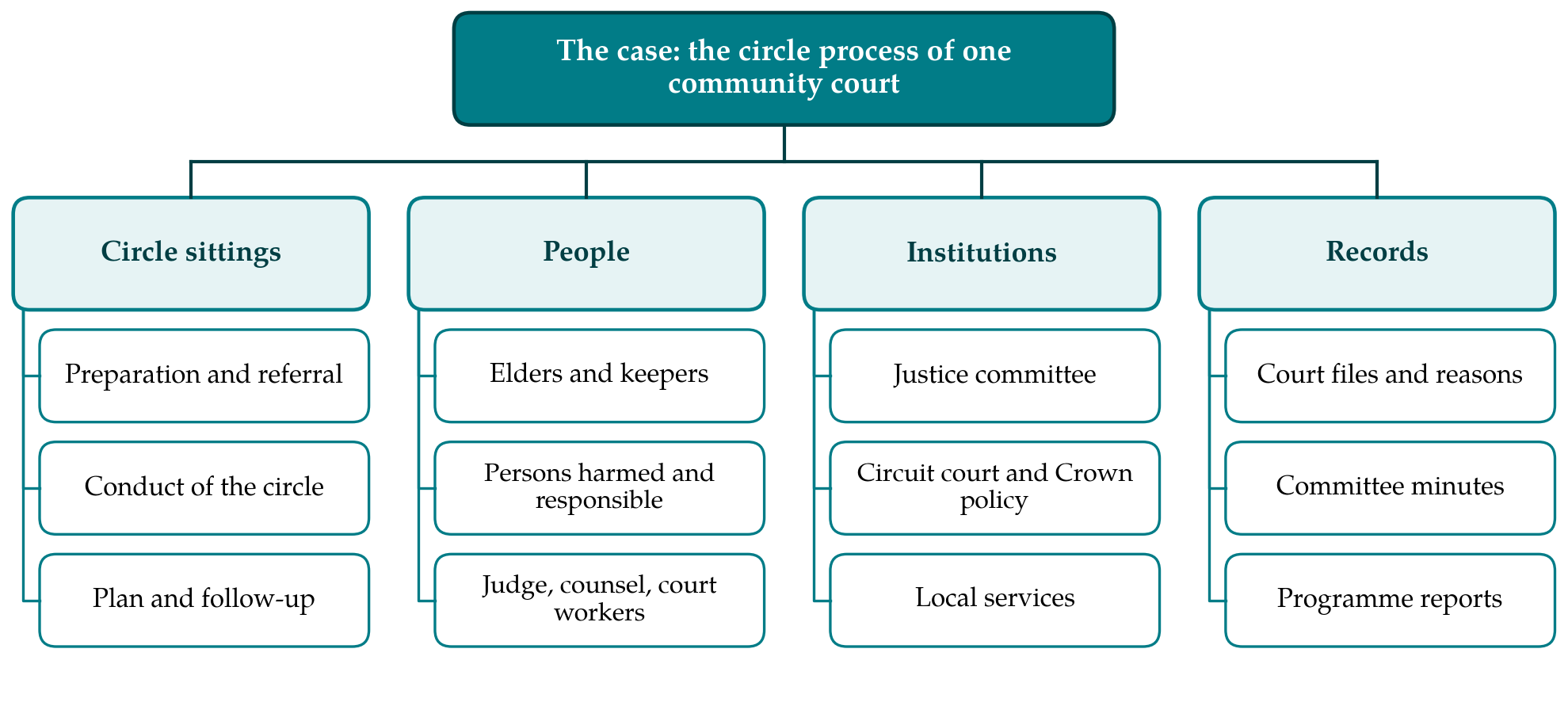
The study is conceived as a single-case embedded design. The case is the circle process of one rural court serving a predominantly Indigenous community reached by circuit. Within it, four units of analysis are distinguished: the circle sittings themselves, the people who take part, the institutions that sustain or constrain the process, and the written records it leaves. Figure 1 sets out this structure. The work is planned in six phases over roughly two years, a period long enough to cover several court circuits.
3.1. Phase 1: Approach, permission and governance
The first approach is to the community's own government and its justice committee, before any funding application is final. The purpose is to ask whether such a study is wanted and on what terms. If it is, a written agreement records who owns the data, who may see it, how the community and individuals will be identified or anonymised, how disagreements about interpretation will be handled and what the community receives in return. A small advisory group, including Elders, is asked to guide the work throughout. Institutional ethics review, any territorial licence and the consent of the presiding judiciary follow this agreement and do not precede it.
3.2. Phase 2: Agreeing the questions
The researcher arrives with provisional questions drawn from the literature: how cases come to a circle and which do not; who speaks and with what authority; how the person harmed is prepared, supported and heard; how the circle's plan relates to the sentence the court imposes; and what happens afterwards. These are put to the advisory group and revised. The community may care more about matters the literature neglects, such as the burden on volunteers or the relation between circles and its own law, and the design treats their priorities as binding on the scope of the study.
3.3. Phase 3: Being present at circles
Observation is the core source. The researcher attends court circuits and, where each participant agrees, sits in on circles as a guest. Protocol is taken from the circle keeper. No audio or video recording is proposed; notes are written afterwards and record process, such as the order of speaking, the roles taken and the handling of disagreement, and not the personal disclosures of participants. Any participant may ask the researcher to leave, and a circle from which the researcher is excluded is simply noted as such.
3.4. Phase 4: Conversations
Interviews follow a conversational form in which the person spoken with shapes the direction (Kovach, 2009). Those invited include Elders, committee members, court workers, the judge, Crown and defence counsel, police and, with particular care, people who have been through a circle as the person responsible or the person harmed. For the last two groups, invitations go through someone they trust, a support person may attend, and no one is approached while a matter is before the court. Consent is sought again at each meeting and may be oral where that is the community's preference.
3.5. Phase 5: Documents
Written sources include published reasons for sentence, court dockets, the justice committee's minutes and programme reports, and the funding agreements under which the committee operates. They show the official account and its timing and allow what is said in conversation to be checked against what was recorded. Access to committee records depends on the agreement made in the first phase. Table 1 compares the sources of evidence across phases three to five.
| Source | What it can show | Weakness | Safeguard |
|---|---|---|---|
| Observation of circles | How the process is conducted and who holds authority | Presence of an outsider may alter conduct | Consent of all present; no recording; process notes only |
| Conversations with Elders and committee | Purposes, teachings and history of the circle | May present the ideal more than the practice | Repeated visits; accounts compared with observation |
| Conversations with persons harmed and responsible | Experience of preparation, voice and outcome | Few may agree; risk of distress | Trusted intermediary; support person; right to withdraw |
| Conversations with court professionals | Referral criteria, legal constraints, Crown policy | Institutional viewpoint | Set against community accounts |
| Court files and reasons | Offences, sentences and timing | Record only what the court needed | Court permission; no copying of identifying details |
| Committee minutes and reports | Workload, funding and continuity | Written for funders | Used under the research agreement |
3.6. Phase 6: Interpretation and return
Analysis proceeds alongside fieldwork. Notes and transcripts are coded thematically, following the flexible procedure described by Braun and Clarke (2006), and the themes are tested against rival explanations in the manner Yin (2018) recommends. One rival, taken from the critical literature, is that the circle changes the setting of sentencing while leaving its outcomes and its distribution of power untouched. Draft interpretations are taken back to the advisory group and to those who were interviewed. This is a form of the member checking that Lincoln and Guba (1985) regard as central to credibility, and here it is also an obligation under the research agreement. Where the community and the researcher disagree, both readings are reported. Findings are returned first to the community, in a form it chooses, before academic publication.
4. Fitting the Design to a Northern Setting
Practical conditions will bend the plan. Circuit courts sit infrequently and are cancelled for weather, so the number of circles observed cannot be fixed in advance. Communities are small enough that changing names does not guarantee anonymity; the agreement should therefore settle whether the community wishes to be named and how composite or generalised description will be used for individuals. People who sit on the justice committee are often the same people who run other services and care for relatives, and the study must not add to their load without recompense. Fieldwork is costly, and funders should expect a budget in which travel, interpretation and payments to community members outweigh the researcher's own time. The researcher also needs to be clear about position: an outsider, particularly a non-Indigenous one, will be told some things and not others, and the report should say so.
5. Limitations and What Remains to Be Shown
The design has not been tried. Its feasibility depends on a community being willing to host it, which cannot be assumed, and its questions will change in the second phase. Three limits are inherent. The study cannot show whether circles reduce reoffending or imprisonment, since it has no comparison and too few cases; those questions need other designs and other data. It will hear least from those with most reason to stay silent, including people harmed who felt pressed to take part, and their absence would have to be reported as a finding about access and not passed over. And one community's practice is not a template for others, given the diversity of Indigenous legal orders.
What would need to be demonstrated in a first application is modest: that agreement on governance can be reached within a workable time, that observation without recording yields notes detailed enough to analyse, and that joint interpretation changes the analysis in ways that can be documented. A report on those points would itself be a contribution to method.
6. Conclusion
Circle practice in northern community courts is long established and little studied on its own terms. The design proposed here joins the discipline of embedded case study research to the governance that Indigenous communities are entitled to exercise over research about them. Its distinguishing features are the order of its steps, with community agreement first and ethics paperwork second, its reliance on presence and conversation over recording, and its treatment of disagreement as something to be reported. Whether it works is for a community and a research team to find out together.
Conflict of interest
To be declared by the author(s) before publication.
Funding
To be declared by the author(s) before publication.