1. Introduction
Literary scholars have always wanted to know how books were read and have rarely been able to find out. Darnton (1982), mapping the circuit through which a book passes from author to reader, identified reading as the stage most difficult to study, and the history of reading has since been built from scattered and hard-won sources: marginalia, commonplace books, library registers, letters, and the memoirs of exceptional individuals (Rose, 2001). Against that background the present situation is remarkable. Large numbers of readers now write down, voluntarily and at length, what they make of the narratives they care about, and they do it by writing more narrative. The results are kept in public archives, dated, classified by their authors and accompanied by other readers' responses.
That material is fan fiction. Media and cultural studies have taken it seriously since the early 1990s, when Jenkins (1992) and Bacon-Smith (1992) published the first book-length accounts of fan communities, and a specialised field with its own journals and anthologies has grown up since (Hellekson and Busse, 2006). Within English departments its standing is lower. It appears in creative writing exercises and in the occasional module on popular culture, but it is seldom admitted as a source in arguments about what a novel means, how a genre works or why a canon holds.
The position taken here is that this is a mistake of method. The claim is not that fan fiction is as good as the works it responds to, nor that it should displace them on the syllabus. It is that fan fiction is evidence, in the plain sense of material from which claims about literature can be supported or tested, and that a discipline committed to evidence about reading has no good reason to set it aside.
2. What Fan Archives Contain
It helps to be specific about what fan archives hold. The Archive of Our Own, opened in 2009 by the non-profit Organization for Transformative Works, stores stories together with the tags their authors assign, authors' notes, publication dates, and the comments and marks of approval left by readers. Older sites such as FanFiction.net, founded in 1998, hold similar records in a different arrangement. De Kosnik (2016) has described such collections as archives in the full sense, built and maintained by volunteers who understood that no institution would preserve this writing for them. Table 1 sets out the main kinds of evidence these archives contain, what each can show, the established scholarly source it most resembles, and the caution each requires.
| Kind of evidence | What it can show | Comparable source | Caution |
|---|---|---|---|
| Stories that fill gaps | Where readers find a source incomplete or unjust | Published sequels and rewritings | Writers are not a cross-section of readers |
| Tags and summaries | How readers classify character, relationship and genre | Catalogues and publishers' genre labels | Tagging habits differ between archives |
| Comments | Response recorded close to the time of reading | Letters, marginalia, reading diaries | Public praise follows community etiquette |
| Volume of writing per source | Which texts continue to provoke response | Reprint and adaptation histories | Reflects who uses the platform |
| Recurrent tropes | Conventions forming and changing over short periods | Genre history drawn from print | Easy to describe, hard to date exactly |
| Authors' notes | Stated aims and acknowledged influences | Prefaces and correspondence | Self-presentation, not transparent testimony |
Two features of the table deserve emphasis. Each kind of evidence has a recognised analogue that literary historians already use, so no new theory of evidence is needed. And each comes with a limitation of the familiar kind, to do with who produced the record and under what conventions. Fan fiction is neither transparent nor uniquely treacherous as a source. It is a source.
3. The Case for Fan Fiction as Evidence
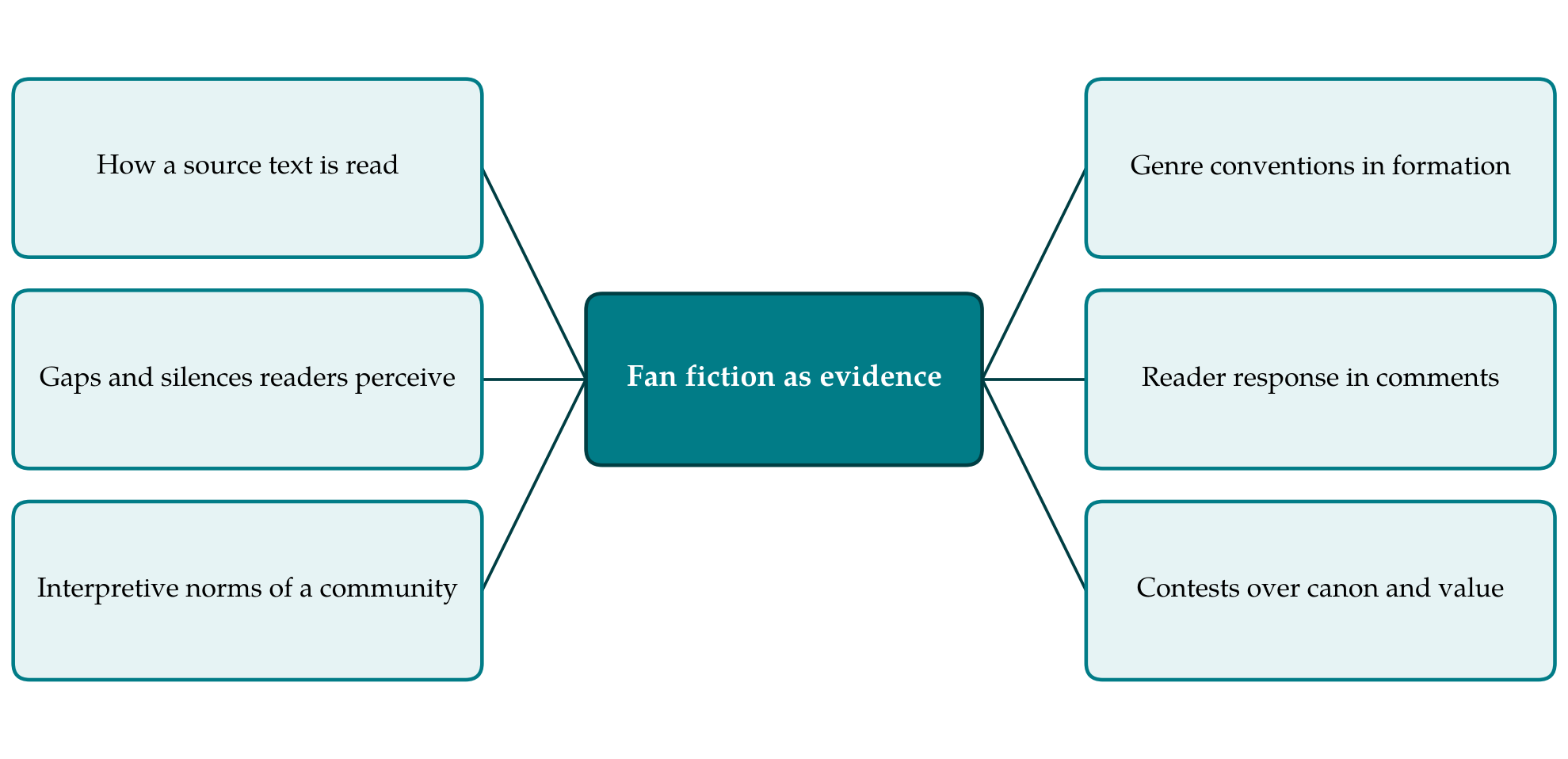
Four considerations support the claim, and Figure 1 summarises the questions to which fan fiction can be brought as evidence.
3.1. A record of reading
Reception study has a theory richer than its data. Jauss (1982) proposed that a work is understood against a horizon of expectations formed by earlier reading, and that literary history should be written as the history of such horizons. The proposal is difficult to carry out because horizons leave few traces. When scholars have gone to living readers, as Radway (1984) did in her study of women who read romances, the gain in understanding has been considerable, but such studies are laborious and small. Fan fiction offers reception evidence that is unsolicited. Nobody asked these readers a question. A story that gives a minor character an inner life, extends a narrative beyond its ending, or retells an episode from the antagonist's side is an interpretation carried out in practice, and it shows what its writer took the source to have left unsaid. Pugh (2005) distinguishes writers who want more of a source from those who want more from it, and the second group in particular is engaged in something that looks very like criticism.
3.2. Interpretation made visible
Literary theory has long held that meaning is produced within communities of readers who share assumptions and procedures. In most settings those procedures have to be inferred. In fan communities they are written down. Stories are discussed in comment threads, disputed readings of a character are argued over with citation of the source, and terms of art distinguish what the source establishes from what a community has come to agree. Busse (2017) shows that fan stories are composed for, and in conversation with, a particular community, and cannot be fully understood apart from that conversation. For a scholar interested in how interpretive norms arise, are enforced and change, this is an unusually well-documented case. It is also a corrective: readers in these communities attend closely to consistency of character and to textual detail, which complicates any easy contrast between professional and lay reading.
3.3. Derivative writing as a literary norm
The suspicion that writing about another author's characters is inherently minor does not survive acquaintance with literary history. Virgil continued Homer. Medieval romance is a web of continuations. Cervantes wrote the second part of Don Quixote partly in answer to an unauthorised sequel. Jean Rhys's Wide Sargasso Sea gives a history to the first Mrs Rochester of Jane Eyre, and it is taught as a classic. Genette (1997) devoted a treatise to the relations by which one text is grafted onto another, and Derecho (2006) has argued that fan fiction belongs to this long tradition of what she calls archontic literature, in which a source is treated as an archive to which new entries can always be added. To study Rhys and ignore the same operation performed by great numbers of contemporary writers is to let the mode of publication decide what counts as literature.
3.4. Genre in formation
Genre history is normally reconstructed after the fact from surviving print. In fan archives conventions can be observed as they form. Tropes are named by their users, attached to stories as tags, combined, parodied and abandoned within a few years, and the record of each stage remains. Coppa (2017) presents fan fiction as a set of genres with their own forms and histories, and computational studies have begun to compare fan writing with its sources at scale, examining which characters receive attention and how readers respond (Milli and Bamman, 2016). Work on particular communities has shown how such writing lets young writers explore matters of sexuality and identity outside the limits of the published books (Tosenberger, 2008). For the theory of genre, which has always had to work with incomplete series, a corpus in which the series is nearly complete and the classifying terms are supplied by participants is a considerable resource.
4. Objections
Four objections are commonly raised. Each has some force, and none defeats the proposal.
4.1. The quality objection
Much fan fiction is clumsy, formulaic or unfinished. The same is true of most surviving writing from any period, and literary historians do not on that account ignore the minor verse of the eighteenth century or the three-volume novels of the circulating libraries. The objection confuses two questions. Whether a text rewards aesthetic attention is one; whether it is evidence about reading, genre or reception is another. Guillory (1993) argued that canons are made by institutions, above all by the school and its syllabus, and that judgements of value cannot be separated from that history. A department can continue to teach judgement while accepting that the material on which claims about readers rest need not itself be distinguished. Some fan fiction is, in any case, accomplished by any standard, and the judgement is better made after reading than before.
4.2. The disciplinary objection
It may be said that fan fiction is already studied, in media studies and sociology, and that English has no need to duplicate the effort. But the questions differ. Fan studies has been concerned chiefly with communities, identities and media industries. Thomas (2011), surveying the field, observed that the stories themselves had received less analysis than the practices around them and called for closer attention to them as narratives. That is work for which literary scholars are trained: attention to form, to intertextual relation, to voice and to the history of genres. A division of labour in which other disciplines study the people and nobody studies the texts serves no one.
4.3. The ethical objection
The most serious objection is ethical. Fan writers publish under pseudonyms for audiences of fellow enthusiasts, often about intimate subjects, and some are young. Material that is technically public may have been written with a reasonable expectation that it would not be quoted in a lecture or a journal. This is a real constraint, and it is one that internet researchers have thought about carefully. The guidelines of the Association of Internet Researchers recommend judging each case by the expectations of the people concerned and the potential for harm, not by a simple test of public availability (Franzke et al., 2020). In practice this means seeking permission before quoting where it is feasible, avoiding links that expose individuals, taking special care with material by or about minors, and reporting patterns in aggregate where particular stories are not needed. Historians of reading face a version of the same problem with private diaries and letters. The difficulty calls for good practice, not for abstention.
4.4. Scale and instability
Finally, the archives are enormous, and works can be revised or deleted by their authors at any time. No scholar can read more than a sliver, and a citation may point to something that no longer exists. Both problems are familiar from other fields. Sampling has to be principled and declared, as in any study of a large corpus, and conclusions should be scoped to what was read. Instability is a condition of all born-digital sources, and the remedy is the same: record the date of access, keep a private copy for verification where the archive's terms and the author's wishes allow, and describe as well as cite.
5. Implications for Departments
If the argument is accepted, three changes follow. In teaching, fan fiction can be set beside its sources as reception evidence in modules on the novel, on Shakespeare or on children's literature, with students asked what a given body of stories reveals about how the source is read. This is different from assigning fan fiction as a creative exercise, useful as that may be. In research training, graduate students who work on reception or genre should learn how fan archives are organised, how tagging systems function and what their biases are, as they would learn to use a library catalogue or a periodicals index.
The third change concerns ethics and citation. Departments should adopt explicit guidance, drawing on existing internet-research ethics, so that students neither avoid the material from anxiety nor quote it carelessly. None of this requires that fan fiction be celebrated. Early fan studies was sometimes criticised for presenting fans as heroic resisters of commercial culture, and a literary approach should be free to find fan writing conservative, repetitive or cruel where it is so. Treating a body of writing as evidence means precisely that one does not decide in advance what it will show.
6. Conclusion
English as a discipline has spent decades theorising the reader and searching for records of reading. It now has, in fan fiction, an extensive and continuing record made by readers themselves: interpretations in narrative form, classified by their authors, answered by their audiences and preserved in archives built for the purpose. The record is partial and self-selected, and it raises questions of ethics that must be handled with care. Those are conditions of working with a source, and the discipline meets comparable ones wherever it relies on evidence. What the argument asks is modest: that scholars who make claims about how literature is received, how genres change and how canons are contested should look at the place where a great deal of that activity is written down.
Conflict of interest
To be declared by the author(s) before publication.
Funding
To be declared by the author(s) before publication.