1. Introduction
Song is the main channel through which male songbirds hold territories and attract mates, and it works only if it reaches a listener in a form that can be recognised. Natural habitats have always been noisy in places. Streams, wind, insects and other birds all compete for acoustic space, and the idea that habitats select for the signals that carry best in them is an old one in the study of bird song (Morton, 1975). What is new about cities is the character of the background. Road traffic, construction and ventilation plant produce sound that is loud, nearly continuous through the day and concentrated below about two kilohertz, with energy tailing off toward higher frequencies.
Interest in the subject grew rapidly after Slabbekoorn and Peet (2003) reported that male great tits (Parus major) holding noisier territories in a Dutch city sang with a higher minimum frequency than their neighbours in quieter ones. The finding was simple, it could be tested on other species with a microphone and a sound level meter, and it suggested that an animal might adjust to a human disturbance through its own behaviour. Many studies followed, and several reviews have organised them (Patricelli and Blickley, 2006; Barber et al., 2010; Shannon et al., 2016).
This article reviews what is known about the effects of urban noise on acoustic communication in songbirds. Its particular concern is the distance between two kinds of result: demonstrations that songs differ in noise, which are numerous, and demonstrations that communication or reproduction is impaired or rescued, which are not.
2. Approach of This Review
The article is a narrative review of the published, peer-reviewed literature on oscine passerines, with occasional reference to laboratory work on other birds where it supplies a mechanism. It is organised by the stages of a communication event and not by species or city. The studies discussed were chosen because they introduced a result, tested it experimentally or challenged its interpretation. No systematic search was made and no effect sizes are pooled. Work on noise from energy infrastructure outside cities is included because it provides the cleanest comparisons of noisy and quiet sites that are otherwise alike.
3. Masking and Active Space
A song is detected when its level at the listener's ear exceeds the background within the frequency band the ear is analysing. Sound from a singing bird weakens with distance through spreading and through absorption and scattering by air, ground and vegetation, and its temporal pattern is smeared by reverberation (Wiley and Richards, 1978). The area within which a receiver can still detect the signal is its active space. Raising the background in the band occupied by the song shrinks that area, and because received level falls with distance on a logarithmic scale, a modest increase in noise can remove a large part of it.
Laboratory psychoacoustics adds two refinements. Detection and discrimination are different thresholds: Lohr et al. (2003) showed with trained birds that a call must stand further above the noise to be told apart from a similar call than merely to be heard, so the distance over which a female can assess a song is shorter than the distance over which she can notice it. And masking depends on spectral overlap, so that low-pitched notes are lost in traffic noise before high-pitched ones. Brumm and Slabbekoorn (2005) set out the options open to a signaller in these circumstances, and the field studies reviewed below map closely onto their list.
4. Adjustments by Singing Birds
Four kinds of adjustment have been described. Table 1 lists them with the proposed mechanism and representative sources.
| Adjustment | How it could help | Representative sources |
|---|---|---|
| Higher minimum frequency | Moves song energy above the band where traffic noise is strongest | Slabbekoorn and Peet, 2003; Wood and Yezerinac, 2006 |
| Greater amplitude | Raises the signal above the background at all frequencies | Brumm, 2004 |
| Switching song types | Favours the less masked songs in an existing repertoire | Halfwerk and Slabbekoorn, 2009 |
| Real-time pitch shift | Alters a given song as noise rises | Bermúdez-Cuamatzin et al., 2011 |
| Singing at quieter hours | Avoids the daily peak of traffic | Fuller et al., 2007 |
| Change across generations | Learned dialects drift toward less masked forms | Luther and Baptista, 2010 |
4.1. Frequency
The association between noise and higher minimum song frequency is the most replicated result in the field. Beyond the original great tit study it was found in song sparrows (Melospiza melodia) in a North American city, where songs in noisier places also carried less of their energy in the low notes (Wood and Yezerinac, 2006). A comparison of great tits in ten European cities with paired forest sites found that urban songs were consistently higher, shorter and delivered faster (Slabbekoorn and den Boer-Visser, 2006). The pattern is clearest in species whose songs reach down into the traffic band. Species that already sing well above it have less to gain and show weaker or no shifts.
4.2. Amplitude
Humans and many other vertebrates raise their voices involuntarily in noise, a response known as the Lombard effect. Brumm (2004) demonstrated it in free-living common nightingales (Luscinia megarhynchos) in Berlin: males on noisier territories sang louder, and the same males sang louder on weekday mornings, when traffic was heavier, than at weekends. Amplitude is harder to measure in the field than frequency, since it requires a calibrated recording at a known distance and orientation, and it has been studied far less. This imbalance is unfortunate, because amplitude may be the more effective lever.
4.3. Timing and structure
Birds can also avoid noise in time. European robins (Erithacus rubecula) in an English city sang at night mainly in places that were noisy by day, and daytime noise predicted night singing better than artificial light did (Fuller et al., 2007). Within a bout, great tits exposed to experimental low-frequency noise switched toward song types from their repertoire that were less masked and persisted longer with those types (Halfwerk and Slabbekoorn, 2009). House finches (Haemorhous mexicanus) raised the minimum frequency of their songs within minutes of noise playback (Bermúdez-Cuamatzin et al., 2011). These experiments show that at least part of the urban pattern arises from immediate behavioural flexibility.
5. Flexibility, Learning or Side Effect
Three explanations for higher urban songs have been proposed, and they are not exclusive. The first is the flexibility just described. The second is cultural change. Oscine songbirds learn their songs, and a young bird in a noisy place may hear, and therefore copy, the higher variants best. Luther and Baptista (2010) compared recordings of white-crowned sparrows (Zonotrichia leucophrys) in San Francisco made decades apart and found that minimum frequency had risen as the city grew louder, with one dialect replacing others. Genetic change is a third possibility in principle, though for learned song it is the hardest to demonstrate and the least supported.
A more fundamental challenge concerns whether the frequency shift is an adaptation at all. Nemeth and Brumm (2010) calculated the gain in communication distance from the observed rise in pitch and compared it with the gain from the observed rise in amplitude. The amplitude effect was much the larger. They suggested that higher pitch might be a by-product of singing louder, and later work on common blackbirds (Turdus merula) supported the link: birds produced their higher-frequency elements at greater amplitude, so that choosing those elements is a way of being loud (Nemeth et al., 2013). On this reading the many reports of raised minimum frequency document a correlate of the response that matters and not the response itself.
An unplanned test came in 2020, when restrictions during the COVID-19 pandemic cut traffic in the San Francisco Bay area. Derryberry et al. (2020) recorded white-crowned sparrows on the same territories studied in earlier years and reported that the birds sang more softly and at lower minimum frequencies, yet their songs carried further in the quieter air. The result confirms that the urban song is a response to current conditions and is reversed quickly when they change.
6. Receivers and Consequences
What happens to the listener has received far less attention than what the singer does. Figure 1 places the known effects along the path from signaller to outcome. The receiver stage is where the argument for harm must be made, because a song that is altered but still detected and correctly assessed costs the singer little.
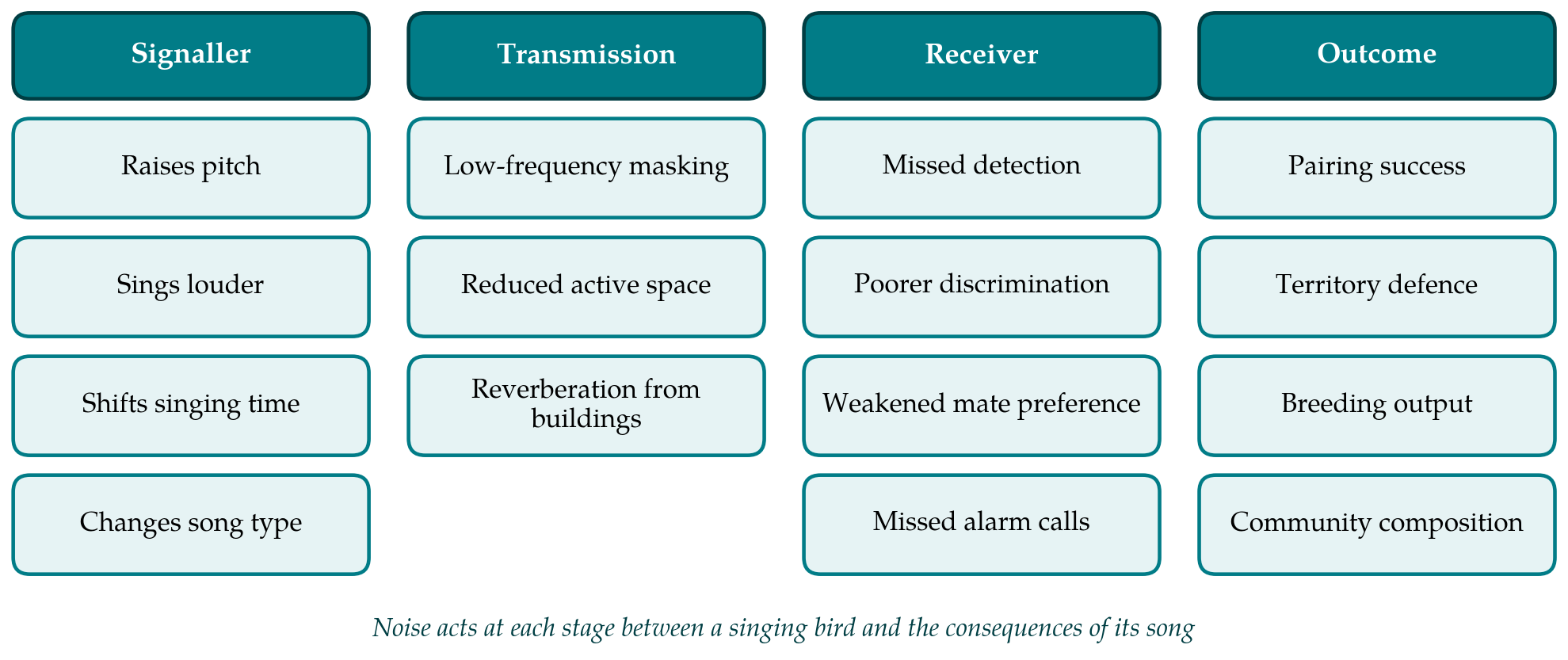
The strongest evidence comes from great tits. Low-frequency songs appear to carry weight with females, and males sing their lowest songs close to the time of laying. In a nest-box experiment, Halfwerk et al. (2011a) showed that females responded less to low songs when traffic-like noise was played, while high songs kept their effect. Males that raise their pitch may therefore be heard at the price of sounding less attractive. In captive zebra finches (Taeniopygia guttata), high levels of noise weakened the preference of females for their own mate (Swaddle and Page, 2007). Noise also interferes with signals other than song: great tit alarm calls were masked by traffic noise at levels common beside roads, leaving listeners less likely to respond (Templeton et al., 2016).
Evidence for reproductive costs is correlational in the main. Male ovenbirds (Seiurus aurocapilla) near noisy compressor stations in the Canadian boreal forest were less often paired than males at quiet facilities of similar appearance, and more of them were young birds (Habib et al., 2007). Great tits breeding in noisier parts of a Dutch woodland beside a motorway laid smaller clutches and fledged fewer young (Halfwerk et al., 2011b). Neither study can say whether failed communication, stress, altered food supply or the settlement of poorer birds in poorer places produced the effect, and reviews of the wider literature note the same limitation (Shannon et al., 2016).
7. Effects on Communities
If species differ in how well their signals survive noise, noise should filter communities. Around natural gas wells in New Mexico, where noisy and quiet sites share the same vegetation, fewer species nested at noisy sites; yet nests there were more successful, apparently because a major nest predator avoided the noise (Francis et al., 2009). The indirect effect ran opposite to the direct one. The most direct experimental test broadcast recorded traffic noise along a roadless ridge in Idaho and so created a road in sound only. Migrant songbirds became scarcer during broadcasts and those that stayed were in poorer body condition (Ware et al., 2015). That experiment isolates noise from collisions, edges, lights and pollution, and designs of its kind are what the urban literature most lacks.
8. Gaps and Future Work
Several weaknesses run through the literature. Minimum frequency is often read from spectrograms by eye, and in a noisy recording the faint low notes disappear into the background, which biases the measurement in the direction of the hypothesis. Measuring from power spectra at a fixed threshold below the peak avoids the problem and should be standard. Amplitude needs to be measured alongside frequency wherever possible. Most studies come from a few common species in European and North American cities, while the fastest urban growth, and many of the most diverse songbird faunas, are in the tropics.
The larger need is for work on receivers and on fitness. Playback experiments in which the same songs are presented with and without noise, to territorial males and to females, can show whether adjusted songs restore the response. Long-term studies of marked populations can relate noise on a territory to pairing date, extra-pair paternity and recruitment. Noise seldom arrives alone in a city: artificial light, altered food and predator communities, and chemical pollution accompany it, and experiments that add or remove noise while holding these constant are the only secure route to causation. Mitigation measures such as quieter road surfaces and barriers offer opportunities for such experiments at realistic scale.
9. Conclusion
Two decades of research have established that songbirds in noisy urban places sing at higher minimum frequencies, often more loudly and sometimes at different hours, and that much of this change is immediate and reversible. Whether the change is sufficient is a separate question. The best available evidence suggests that amplitude counts for more than pitch, that higher songs may carry a cost in attractiveness, and that noise can lower pairing and breeding success and reshape communities. The field now needs fewer descriptions of songs and more experiments on listeners and on reproduction.
Conflict of interest
To be declared by the author(s) before publication.
Funding
To be declared by the author(s) before publication.