1. Introduction
The toxicity of lead to children is not in dispute. Exposure in early life is associated with lasting deficits in cognition and behaviour (Needleman, 2004), the association extends to blood lead concentrations once thought harmless (Canfield et al., 2003; Lanphear et al., 2005), and the World Health Organization recognises no level of exposure as safe (WHO, 2010). Young children are at particular risk because they mouth objects and absorb a larger fraction of ingested lead than adults do.
Paint is a principal source. Lead chromate yellows, lead molybdate oranges and lead-based driers were long used in solvent-borne enamels, and Clark et al. (2009) found high lead concentrations in new household enamel paints bought in several countries of Asia, Africa and South America. Toys coated with such paints, or moulded from plastics stabilised or coloured with lead compounds, have been documented repeatedly (Kumar and Pastore, 2007; Greenway and Gerstenberger, 2010). Regulatory limits exist in many jurisdictions and are reviewed by Guney and Zagury (2012), but they bite at the point of import or formal retail. Goods sold from stalls, pavements and itinerant traders are seldom tested.
This article proposes a protocol for surveying that segment of the market using handheld X-ray fluorescence (XRF) and for mapping what is found. It describes a design; it does not report a survey. No toys were purchased or measured in its preparation.
2. Background
The protocol depends on two sets of facts: what the regulations limit, and what a handheld instrument can and cannot measure on a painted object.
2.1. Regulatory limits
Limits on lead in toys are of two kinds. Total-content limits restrict the mass fraction of lead in the coating or the substrate. In the United States the Consumer Product Safety Improvement Act set the limit for paint and similar surface coatings at 90 parts per million and that for accessible substrate materials of children's products at 100 parts per million (United States Congress, 2008), and the model law promoted by the United Nations Environment Programme recommends the same 90 parts per million for paints generally (UNEP, 2018). Migration limits, by contrast, restrict the amount of an element released into dilute acid simulating gastric fluid. This is the approach of the European standard EN 71-3 (CEN, 2019) and of the soluble-element requirements in ASTM F963 (ASTM International, 2017). XRF measures total lead. It can therefore be compared directly with a total-content limit, and only indirectly with a migration limit.
2.2. What handheld XRF measures
In energy-dispersive XRF a miniature X-ray tube excites the sample and a detector records the characteristic radiation emitted by its elements (Beckhoff et al., 2006). Lead is normally quantified from its L lines, Lα at about 10.55 keV and Lβ at about 12.61 keV. The method is fast and non-destructive, and field instruments have a long record in environmental work (Kalnicky and Singhvi, 2001). Three limitations bear on painted toys. Arsenic Kα coincides with lead Lα, so the Lβ line must be used where arsenic may be present, and bromine from flame retardants gives lines in the same region. A paint film is thinner than the depth from which the signal arises, so the instrument sees coating and substrate together, and a result expressed as a mass fraction is diluted by whatever lies beneath. The substrate may itself contain lead. Finally, small, curved or irregular parts do not fill the measurement window, which lowers the count rate and the reliability of the reading. For these reasons the screening result is treated throughout as an indication to be confirmed.
3. The Proposed Protocol
The protocol is set out in seven steps. Table 1 lists them with the record each should produce.
| Step | What is done | Record produced |
|---|---|---|
| 1. Set the action level | Choose the limit against which readings are judged and the margin around it | Written decision rule |
| 2. Select markets | List selling points by district and type; draw a stratified selection | Market list and selection log |
| 3. Select items | Buy painted toys by category and colour according to a quota | Purchase log with photographs |
| 4. Measure | Take replicate readings on each distinct colour with fixed settings | Spectra and readings per colour |
| 5. Control quality | Run reference materials, blanks and duplicates each session | Control charts |
| 6. Classify and confirm | Apply the decision rule; send positives and a negative subset for analysis | Classification and laboratory reports |
| 7. Map and report | Aggregate results by market or district and publish with uncertainty | Maps, tables and data file |
3.1. Step 1: Set the action level
The survey needs a single criterion fixed in advance. Where national law sets a total-lead limit for coatings, that limit is used; where it does not, the 90 parts per million of the model law is the natural reference. Because a reading on an intact coating is biased low by the substrate, the rule should also define a lower band within which a reading counts as inconclusive, the width of the band being set from the instrument's stated precision and from the pilot work described below.
3.2. Step 2: Select markets
Informal markets have no register from which to sample. The proposed approach is to build a frame at the level of the selling location: periodic markets, permanent stall clusters, streets known for toy vendors, and stalls near schools and transport hubs, enumerated by district with the help of local authorities and a walk-through. Locations are then stratified by district and type and selected at random within strata, following ordinary survey practice (Cochran, 1977). Visits are spread across days and seasons, since the goods on sale change around festivals. The result supports statements about the locations sampled, and, with caution, about the districts; it does not yield a national prevalence.
3.3. Step 3: Select and document items
Within each location, items are purchased, not measured on the stall. Purchase avoids confrontation, allows repeat and confirmatory analysis, and keeps the instrument away from bystanders. A quota ensures coverage of categories, such as painted wooden toys, metal vehicles and coated plastic figures, and of colours, with deliberate inclusion of yellow, orange, red and green coatings, in which lead chromate pigments are most likely. Each item is photographed and given a code; the price, any labelling and any stated origin are recorded. The vendor's identity is not.
3.4. Step 4: Measure
Each visually distinct colour on an item is measured separately, on the flattest area available, with the window in contact with the surface and a fixed counting time. At least two readings are taken per colour at different positions. The operator notes whether the part filled the window and whether the coating appeared thick, thin or worn. Where the instrument offers both a coatings mode reporting mass per unit area and a bulk mode reporting mass fraction, the mode is fixed for the whole survey and stated. Readings for chromium are kept alongside those for lead, because the two together point to a chromate pigment, and readings for arsenic and bromine are kept as indicators of possible interference. Spectra are saved. The instrument emits ionising radiation, and it is operated only by trained staff under the applicable local licensing rules, in a stand or shielded enclosure wherever practicable.
3.5. Step 5: Control quality
Quality control follows the pattern of the United States Environmental Protection Agency's field XRF method (US EPA, 2007). Each session begins and ends with an energy calibration check, a blank, and certified reference paint films or plastics spanning the action level; results are plotted on control charts and a session is rejected if they drift outside preset bounds. A proportion of items is re-measured by a second operator. Detection limits are established for the counting time used and for each class of substrate.
3.6. Step 6: Classify and confirm
Readings are classified by a rule that considers both the value and the conditions under which it was obtained, as shown in Figure 1. Every item classed as positive, presumptive positive or inconclusive goes forward for confirmation, together with a random subset of the negatives so that false negatives can be detected. Confirmation means removing the coating without the substrate, digesting it in acid and determining lead by atomic spectrometry, as in the standard operating procedure of the United States Consumer Product Safety Commission (CPSC, 2011). Laboratory results, not screening readings, decide whether an item exceeds the limit.
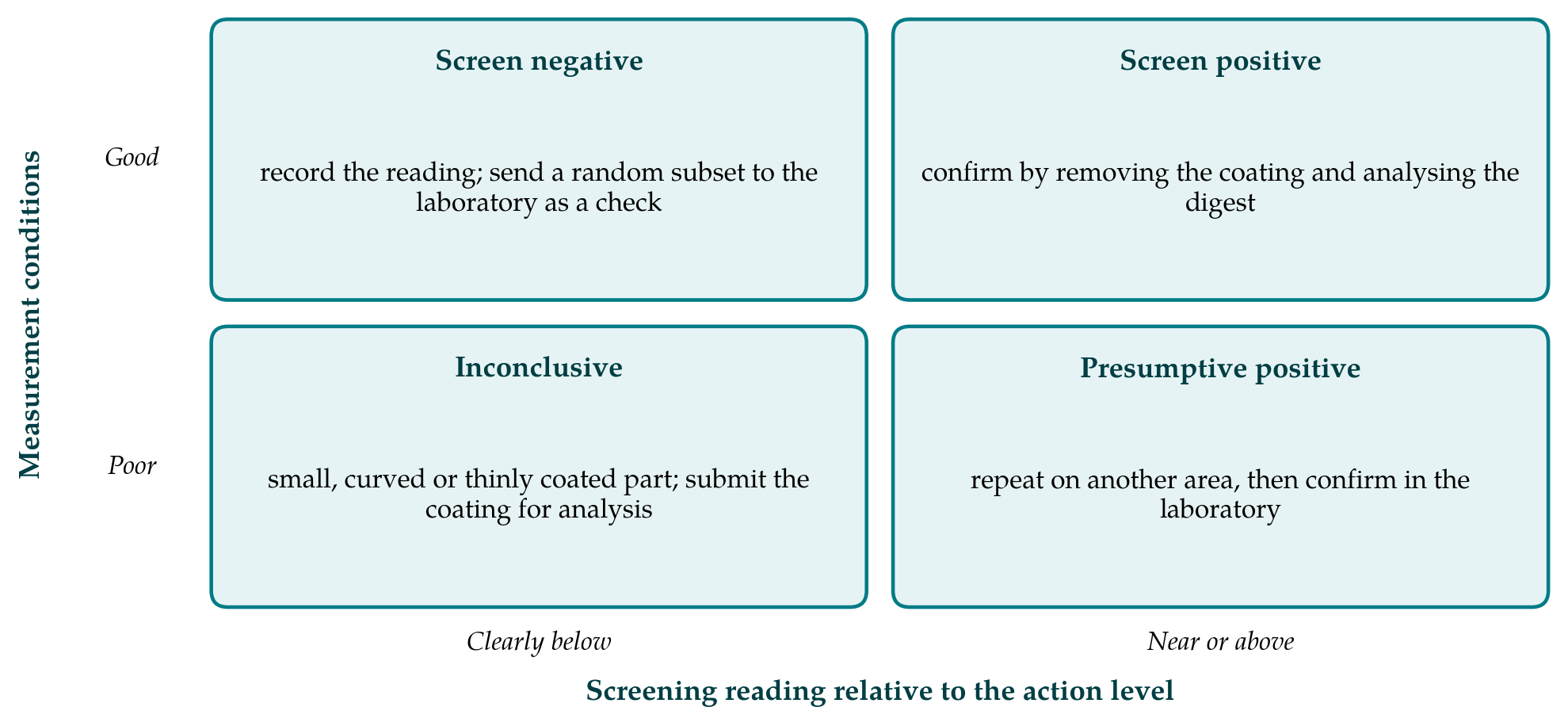
The paired screening and laboratory results also show how well the instrument performs on this kind of sample. Agreement is examined by plotting differences against means in the manner of Bland and Altman (1986), separately for each substrate class, and by tabulating how often the screening classification matched the laboratory outcome.
3.7. Step 7: Map and report
For mapping, each item carries the coordinates of the market where it was bought, never those of a stall. The mapped quantity is the proportion of confirmed exceedances among items tested at a location or in a district, shown with the number tested, since a proportion based on a handful of items is uninformative. Symbols scaled to sample size, or a simple table beside the map, prevent small samples from dominating the picture. A second map can show the categories or colours involved. The full item-level data, stripped of anything that identifies a seller, are published with the report so that others can reanalyse them.
4. Fitting the Protocol to Practice
The design assumes a small team, one instrument and access to an accredited laboratory for the confirmatory work. The largest cost after the instrument is the laboratory analysis, and the size of the confirmed subset is the main point at which budget and rigour are traded. Ethical review should be sought even though no human participants are studied, because publication can affect the livelihoods of traders who have no means of knowing what their goods contain. Findings should be passed to the competent authority before publication, framed around products and supply chains and not around individual sellers. Purchased items that exceed the limit are retained as evidence or disposed of as hazardous waste, and are not returned to circulation.
5. Limitations and What Remains to Be Shown
The protocol is a proposal and has not been tested. Before it is used for a full survey, a pilot should establish several things: the precision of readings on real toys of each substrate class; the relation between screening readings and laboratory results, and hence the proper width of the inconclusive band; the rate of false negatives among items classed as clear; and whether the location frame can in practice be enumerated. The dilution of the coating signal by the substrate is the most serious technical weakness, and it may prove that reliable screening of thin films requires either a coatings calibration or routine removal of the paint.
Other limits are inherent. Total lead is not bioavailable lead, and a coating above a total-content limit may or may not fail a migration test. A market-based sample describes what was on sale at the places and times visited and cannot be generalised without care. And the protocol addresses lead alone, although the same spectra contain information on cadmium, chromium and other elements that a fuller study might use.
6. Conclusion
Handheld XRF makes it practical to screen large numbers of painted toys from markets that formal surveillance does not reach. Used with a pre-set action level, a defensible way of choosing markets and items, session-by-session quality control, a classification rule that admits uncertainty and laboratory confirmation of every positive, it can yield maps that are useful to regulators and fair to traders. Whether the protocol performs as intended is a question for a pilot study, which is the necessary next step.
Conflict of interest
To be declared by the author(s) before publication.
Funding
To be declared by the author(s) before publication.