1. Introduction
The exhausted founder is a familiar figure in startup communities. The person who slept in the office before a funding round, who has not taken a holiday in three years, who quietly steps down for unstated reasons: these stories circulate in every city with a venture scene. They are usually told as stories about individuals. The founder pushed too hard, neglected self-care or lacked the temperament for the job. The remedies offered follow from that framing and are directed at the person: meditation applications, executive coaching, resilience workshops.
This article takes a different position. It holds that burnout among founders is produced mainly by features of the entrepreneurial ecosystem, meaning the investors, support organisations, norms and policies that surround new ventures, and that it should be addressed there. The claim is not that individual differences are irrelevant or that founders bear no responsibility for how they work. It is that the conditions which make burnout likely are set by parties other than the founder, are broadly similar across ventures, and can be changed.
The argument proceeds in four parts: what burnout is according to the research that defined it, why the individual framing dominates in entrepreneurship, how each layer of the ecosystem contributes, and what the strongest objections are. Throughout, the article separates what is well established from what is plausible but not yet shown.
2. What Burnout Is and Is Not
Burnout has a specific meaning. In the formulation that has guided most research it is a syndrome of overwhelming exhaustion, cynicism or detachment from the job, and a sense of ineffectiveness, arising as a prolonged response to chronic stressors at work (Maslach et al., 2001). The eleventh revision of the International Classification of Diseases lists burn-out as an occupational phenomenon resulting from chronic workplace stress that has not been successfully managed, and states that it is not classified as a medical condition (World Health Organization, 2019). It is distinct from depression and from ordinary tiredness, although it may accompany either, and a person who is seriously unwell needs clinical care and not an organisational analysis.
The research tradition is consistent on causes. Maslach and colleagues identified six areas in which a mismatch between person and job predicts burnout: workload, control, reward, community, fairness and values (Maslach et al., 2001). The job demands-resources model proposes that high demands lead to exhaustion while a lack of resources leads to disengagement (Demerouti et al., 2001). Conservation of resources theory holds that stress follows when valued resources are threatened or lost, and that those with few reserves are most exposed to further loss (Hobfoll, 1989). None of these accounts treats burnout chiefly as a weakness of the individual, and Maslach and Leiter (2016) have argued for years that interventions should change the workplace and not only the worker.
3. Why the Individual Framing Persists
Entrepreneurship is unusual among occupations in that the founder appears to have no employer. There is no manager who sets the hours and no human resources department to hold to account. The founder designs the job, so the reasoning goes, and must therefore own its consequences. Research on entrepreneurs has often reinforced this view by concentrating on traits. Passion is the clearest example. Entrepreneurial passion is treated as a driver of effort and persistence (Cardon et al., 2009), and the dualistic model distinguishes a harmonious form from an obsessive one in which the activity controls the person (Vallerand et al., 2003). A study of entrepreneurs found obsessive passion associated with higher burnout and harmonious passion with lower (de Mol et al., 2018).
Such findings are valuable, but they are easily read as saying that burnout is a matter of having the wrong kind of passion. That reading overlooks where obsessive involvement comes from. A founder who has signed personal guarantees, who has promised investors a milestone by a fixed date and whose peers praise round-the-clock work is being pushed toward an obsessive relationship with the venture by forces outside herself. The autonomy of the founder is real in law and limited in practice.
4. Where the Pressure Comes From
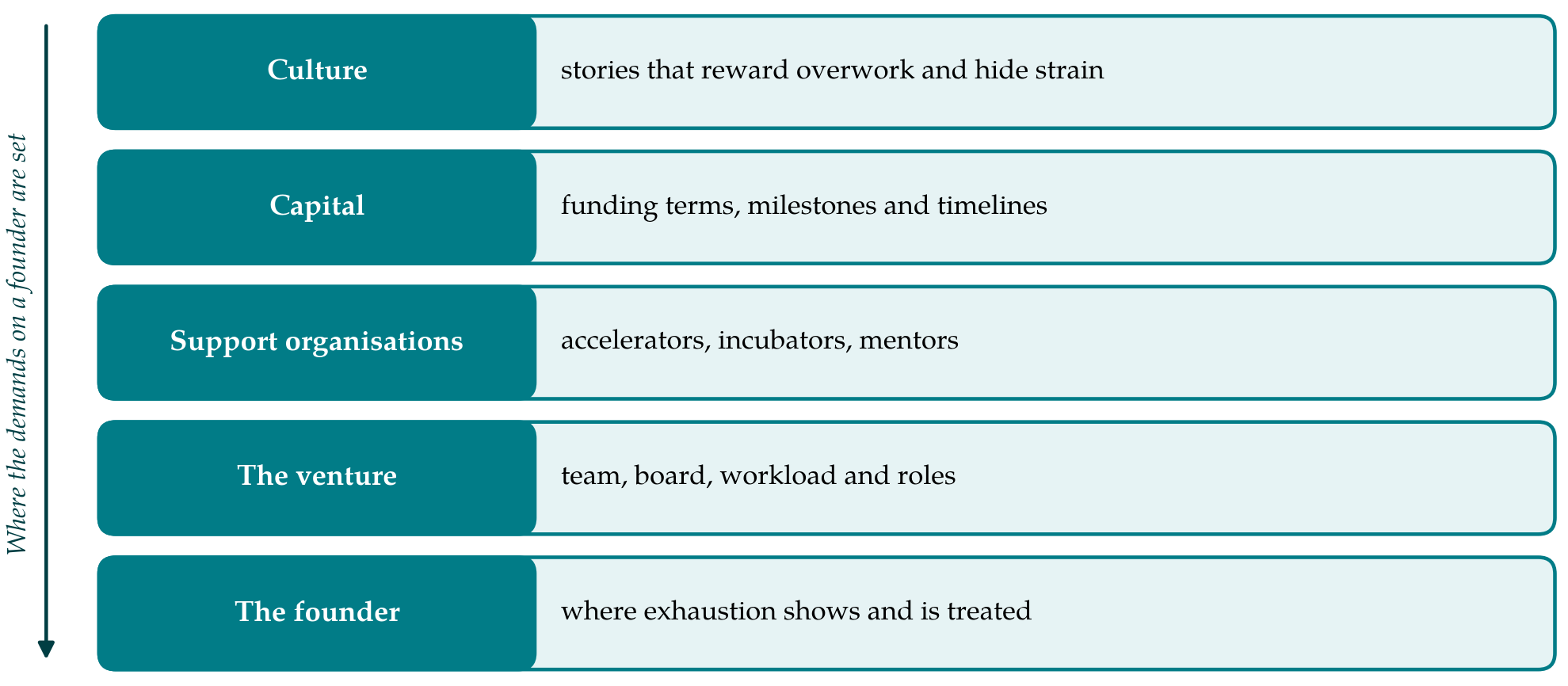
An entrepreneurial ecosystem is commonly described as the set of interdependent actors and factors that enable entrepreneurship in a place (Stam, 2015). Spigel (2017) groups its attributes as cultural, social and material. The same attributes that enable ventures also set the demands on the people who run them. Figure 1 arranges the sources of demand in layers, from the wider culture down to the individual founder, where the effects appear and where remedies are usually applied.
4.1. Capital
Equity investors in early-stage firms earn their returns from a small number of very large successes, and funds have a limited life. Both facts favour rapid growth over steady growth and make time the scarcest resource. Funding released in stages against milestones turns every few months into a deadline on which the survival of the firm depends. Founders who raise outside capital also give up control, and replacement of the founder as chief executive is a common outcome of later rounds (Wasserman, 2012). In the vocabulary of the burnout literature, staged venture finance raises workload, reduces control and puts job security permanently in question, three of the classic mismatches at once.
4.2. Support organisations
Accelerators and incubators exist to help founders, and many do. Their formats can nonetheless add to the strain. A cohort programme that ends in a public demonstration day concentrates effort into a short period and ranks participants against one another in front of investors. Mentoring is generous but often contradictory, and a founder who receives conflicting advice from many advisers carries the full weight of reconciling it. Few programmes include any structured attention to workload or recovery, and those that offer well-being sessions usually present them as optional extras beside the real work.
4.3. Culture and community
The cultural layer supplies the stories by which founders judge themselves. Where overwork is admired and doubt is concealed, a founder under strain has reason to hide it from investors, staff and peers alike, which removes the social support that the research identifies as a principal resource. Failure adds to the load. The closure of a business brings financial, social and psychological costs (Ucbasaran et al., 2013), and Shepherd (2003) described the response of the self-employed to losing a business as grief. An ecosystem that stigmatises failure raises the stakes of every setback. Table 1 summarises how each actor contributes and what each could do differently.
| Actor | Practice that adds to strain | Mismatch created | Change within its power |
|---|---|---|---|
| Investors | Tight milestone-based funding tranches | Workload, control | Realistic timelines; fund a second senior hire early |
| Boards | Reviewing only financial metrics | Reward, fairness | Ask about workload and succession as routine |
| Accelerators | Compressed cohorts ending in a ranked pitch | Workload, community | Pace the programme; build peer support in |
| Mentors | Abundant, conflicting advice | Control | One lead mentor to help weigh advice |
| Media and events | Celebrating overwork and overnight success | Values | Report ordinary paths and honest exits |
| Policy makers | Harsh personal consequences of insolvency | Security | Insolvency rules that allow a fresh start |
5. Three Objections
The first objection is that founders choose this life. Nobody is compelled to start a company or to take venture capital, and those who do know the terms. The reply is that consent to a risk does not make the risk well designed. Workers in many demanding occupations choose them freely, and that has never been accepted as a reason to ignore the conditions of the work. Many founders, moreover, do not choose the terms in any detailed sense: they accept the standard arrangements of the ecosystem they happen to be in.
The second objection is empirical and deserves weight. Some research finds that entrepreneurs report low, not high, levels of stress, which the authors attribute to self-selection and to psychological capital (Baron et al., 2016). Reviews of the evidence on entrepreneurs' mental health describe a mixed picture, with high autonomy and meaning set against long hours, uncertainty and loneliness (Stephan, 2018; Wiklund et al., 2019). Stress can also energise, and its effects depend on recovery (Rauch et al., 2018). Survey evidence that entrepreneurs report more mental health conditions than comparison groups exists (Freeman et al., 2019) but rests on self-report and should be read with care. The honest summary is that the prevalence of burnout among founders is not well measured.
That uncertainty does not rescue the individual framing. Studies of those who are founders at a given moment miss those who have already left, so resilience among survivors is partly an artefact of who remains. And if selection explains why many founders cope, the ecosystem is relying on an unusual psychological profile as a condition of entry, which narrows who can found a company and wastes the talent of everyone else.
The third objection is that intense pressure is the price of high growth and that easing it would cost performance. This is an empirical claim for which there is little direct evidence either way. What the general burnout literature does show is that exhaustion and detachment are associated with poorer work and with leaving the job (Maslach and Leiter, 2016). A founder who departs or disengages at a critical stage is a loss to investors as well. The burden of proof lies with those who assert that the present level of pressure is optimal.
6. Implications
If the argument holds, responsibility shifts. Investors could treat the sustainability of the founding team as a matter for due diligence and board oversight in the same way as cash runway, and could finance the early hiring that spreads the load. Accelerators could redesign schedules and measure what happens to participants' well-being during and after the programme. Ecosystem builders who publish rankings of startup communities could include indicators of founder health beside counts of deals. Governments influence the cost of failure directly through insolvency law and the treatment of personal guarantees.
Researchers have a part as well. Burnout among founders should be measured with established instruments in samples that include people who have left their ventures, and compared across ecosystems that differ in funding structures and norms. Until such comparisons exist, the ecosystem account offered here remains a well-grounded argument and not a demonstrated fact. None of this removes the need for individual care. A founder who is exhausted now should seek support now, including professional help where symptoms are severe, and should not wait for the system to reform.
7. Conclusion
Burnout was defined from the start as a response to the conditions of work. Founders' conditions of work are shaped by funding terms, programme formats and shared beliefs that no single founder controls. To keep describing founder burnout as a personal failing is to hold individuals answerable for the design of a system and to leave that design untouched. The actors who build and finance entrepreneurial ecosystems are in a position to lower the demands they impose and to supply the resources that protect against exhaustion. Doing so is consistent with their own interest in ventures that last.
Conflict of interest
To be declared by the author(s) before publication.
Funding
To be declared by the author(s) before publication.