1. Introduction
Every system of medicine has to deal with the fact that people differ. Two patients with the same complaint respond differently to the same food, climate or drug, and a physician who ignores this will often be wrong. Unani medicine meets the problem with the doctrine of mizaj, usually translated as temperament. A person's mizaj is a standing disposition, present from birth and modified by age, place, season and habit, and health is understood as the preservation of the temperament proper to that person (Rezaeizadeh et al., 2009).
The idea that individuals fall into a small number of constitutional types is far from unique to the Greco-Arabic tradition. Ayurveda, Chinese medicine and Korean medicine each have one. European psychiatry and psychology produced several in the twentieth century, some of them explicitly descended from the four humours. The recent interest in personalised medicine has prompted attempts to map these schemes onto one another and onto genomic or physiological data. This review asks what such mappings can legitimately claim in the case of Unani temperament.
2. Approach of the Review
The article is a narrative review. It reads the classical account of temperament through standard translations and historical scholarship, and sets it beside the primary sources and principal reviews of the other typologies. Studies that have tried to measure mizaj or to relate constitutional types to biological variables are discussed for what they show about method. The review does not pool results, and it does not claim to have covered every publication on the subject.
3. The Formation of the Concept
The roots lie in Greek natural philosophy. The Hippocratic treatise On the Nature of Man named four humours, blood, phlegm, yellow bile and black bile, and tied each to a pair of qualities and to a season (Jouanna, 2012). Galen systematised the scheme. In his work on mixtures he argued that every body is a blend, a krasis, of hot, cold, dry and moist, that the best blend is a balanced one, and that eight departures from balance are possible: four in which a single quality predominates and four in which a pair does (Siegel, 1968; Nutton, 2004). Galen's concern was chiefly physiological. The familiar personality portraits of the sanguine, choleric, melancholic and phlegmatic person were elaborated later, in late antique and medieval writing.
Physicians writing in Arabic received this material through the translation movement of the ninth century and reworked it into a teaching system (Pormann and Savage-Smith, 2007). In the Canon, Ibn Sina defines temperament as the quality that results when the opposing qualities of the elements act on one another and reach a state of equilibrium. He lists the equable temperament and the eight inequable ones, assigns temperaments to organs, ages, sexes and the inhabitants of different climates, and insists that the equable state is relative to the individual and not a single point (Gruner, 1930). Unani teaching places mizaj second among the seven natural factors, after the elements and before the humours, organs, pneuma, faculties and functions.
4. Temperament in Unani Practice
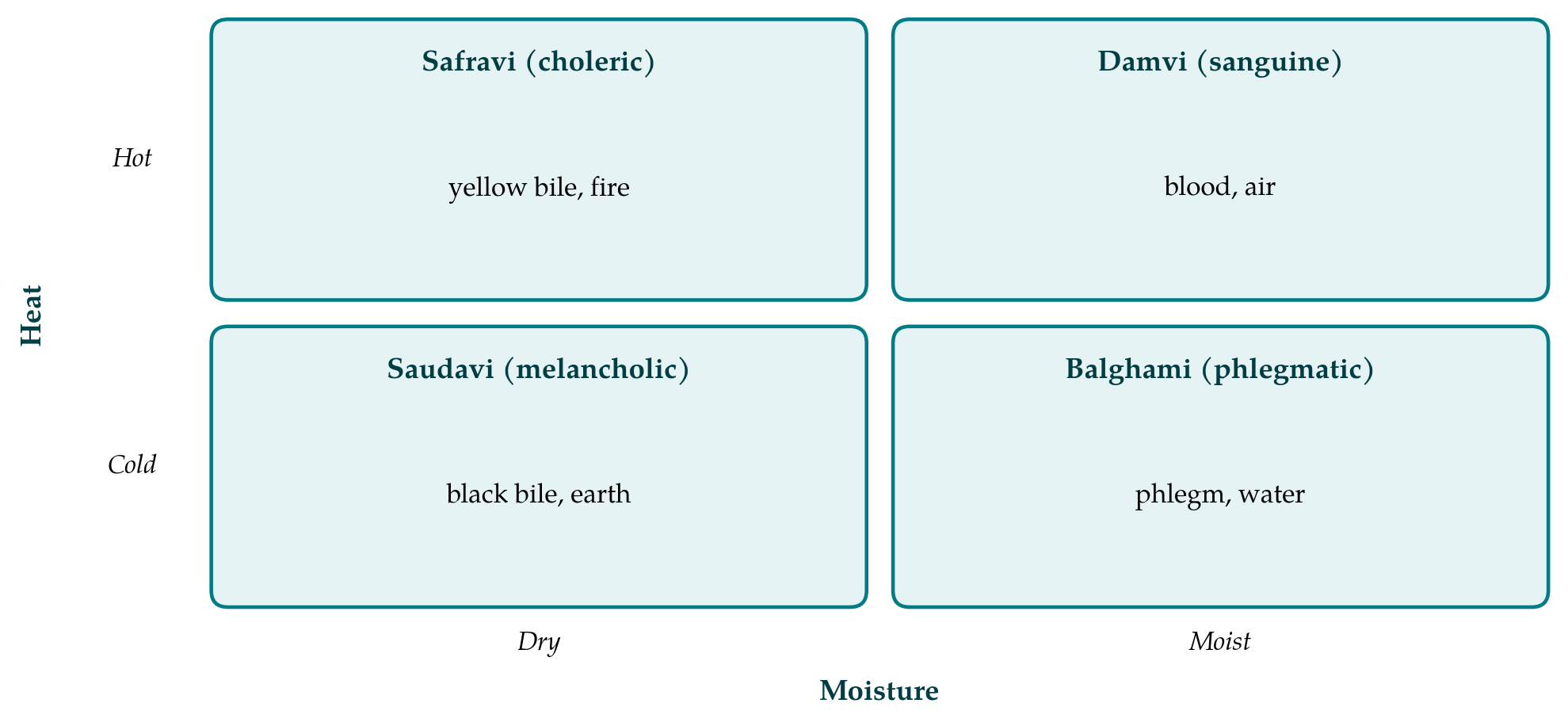
In practice the eight inequable temperaments are usually reduced to the four compound ones, each linked to a dominant humour, as Figure 1 shows. The sanguine or damvi temperament is hot and moist, the choleric or safravi hot and dry, the phlegmatic or balghami cold and moist, and the melancholic or saudavi cold and dry. Drugs and foods are graded by the same qualities, and treatment follows the principle of opposition: a condition judged cold and moist is met with a regimen and with medicines that are warming and drying.
Assessment rests on ten classes of sign, the ajnas-e-ashra: the feel of the skin, the amount of flesh and fat, the hair, the colour of the body, the build, the speed with which the body is affected by heat or cold, sleep and wakefulness, the state of the bodily functions, the excretions, and the emotional reactions. The physician forms a judgement from all ten. The list mixes anatomy, physiology and psychology, and that mixture is the point: mizaj is a property of the whole person. It also means that the assessment is a clinical judgement, and its agreement between physicians cannot be taken for granted.
5. Correspondence With Other Traditional Typologies
The closest relative of mizaj is the prakriti of Ayurveda, the constitution fixed at conception by the relative strength of the three doshas, vata, pitta and kapha. The descriptions overlap visibly. The pitta type, warm, sharp-tempered and of medium build, resembles the choleric; the kapha type, heavy, cool and slow, resembles the phlegmatic; the vata type, thin, dry and changeable, shares features with the melancholic. The fit is imperfect, because a three-term scheme cannot be laid exactly over a four-term one, and the sanguine temperament has no single counterpart. Table 1 sets out the main typologies side by side.
| Typology | Categories | What is classified | Key source |
|---|---|---|---|
| Unani mizaj | Sanguine, choleric, phlegmatic, melancholic | Whole person: body, function and psyche | Gruner, 1930 |
| Ayurvedic prakriti | Vata, pitta, kapha and their combinations | Whole person, fixed at conception | Patwardhan et al., 2005 |
| Sasang medicine | Taeyang, Soyang, Taeeum, Soeum | Organ strength, build and disposition | Kim and Pham, 2009 |
| Chinese constitutions | One balanced and eight biased types | Bodily tendencies and susceptibility | Wang et al., 2011 |
| Kretschmer; Sheldon | Pyknic, athletic, asthenic; three somatotype components | Body build, linked to character | Kretschmer, 1925; Sheldon et al., 1940 |
| Eysenck | Extraversion and neuroticism as dimensions | Personality | Eysenck, 1967 |
| Cloninger | Four temperament and three character dimensions | Personality | Cloninger et al., 1993 |
Sasang constitutional medicine, set out by Lee Je-ma in Korea at the end of the nineteenth century, divides people into four types according to the relative strength of paired organ systems, with characteristic builds and dispositions for each (Kim and Pham, 2009). Its fourfold form invites comparison with the Unani scheme, and studies of Sasang types have described psychological and physical profiles for them (Chae et al., 2003), but the reasoning behind it is Confucian and visceral and has nothing to do with hot, cold, dry and moist. Contemporary Chinese medicine uses a classification of nine constitutions, one balanced and eight biased, developed by Wang Qi and colleagues (Wang et al., 2011). Several of its types, such as the yang-deficient person who feels the cold and the phlegm-damp person who is heavy and sluggish, echo the cold and moist temperaments. Hot and cold also serve as organising qualities in Chinese medicine, which gives the comparison some substance.
6. Correspondence With Modern Biomedical and Psychological Typologies
The body-build typologies of the early twentieth century are the nearest biomedical analogue. Kretschmer (1925) described pyknic, athletic and asthenic physiques and associated them with dispositions to particular mental illnesses. Sheldon et al. (1940) rated every physique on three components, endomorphy, mesomorphy and ectomorphy, and later claimed that each went with a temperament. The rounded, sociable endomorph and the lean, restrained ectomorph recall the moist and dry temperaments. The link Sheldon claimed between physique and character has not survived scrutiny, although the description of physique was refined into the anthropometric somatotype still used in sports science (Carter and Heath, 1990).
In psychology the descent from the humours is explicit. Eysenck (1967) proposed that the four classical temperaments are the quadrants formed by two independent dimensions: the choleric is the unstable extravert, the sanguine the stable extravert, the melancholic the unstable introvert and the phlegmatic the stable introvert. Extraversion and neuroticism remain among the five broad factors recovered in studies of personality description (McCrae and Costa, 1987). Developmental research has returned to temperament as an early-appearing, biologically based disposition. Thomas and Chess (1977) described nine dimensions of infant behaviour and three broad patterns; Kagan (1994) studied inhibited and uninhibited children and took his title from Galen; and later work has organised child temperament around reactivity and self-regulation (Rothbart, 2011). Cloninger et al. (1993) distinguished four heritable temperament dimensions from three dimensions of character shaped by experience.
These models correspond to mizaj only in part. They share the claims that dispositions are stable, appear early and have a bodily basis, and the fourfold arrangement of two crossed axes is common to Eysenck's scheme and to the Unani one. They differ in scope. Modern temperament is a psychological construct, measured by questionnaires or observation of behaviour, and its dimensions are continuous. Unani temperament includes skin, hair, build, digestion and sleep, and it assigns a person to a type. A choleric person in Eysenck's sense need not be hot and dry in the Unani sense.
7. Attempts at Measurement and Biological Correlation
If mizaj is to be studied empirically it has to be measured in a repeatable way. Work in Iran, where the same tradition is practised as Persian medicine, has produced a self-report questionnaire for the hot-cold and dry-moist axes and has reported on its reliability and validity (Mojahedi et al., 2014). Such instruments are a necessary beginning. They also raise the question of what they are validated against, since the only available standard is the judgement of expert physicians, and the classic requirements of construct validity ask for more than agreement with the opinion from which the instrument was derived (Cronbach and Meehl, 1955).
Biological correlates have been sought mainly for prakriti. Studies in India have reported associations of prakriti types with HLA alleles (Patwardhan et al., 2005), with patterns of gene expression and biochemical measures (Prasher et al., 2008), and with single-nucleotide variants in a genome-wide analysis (Govindaraj et al., 2015). For hot and cold natures, a preliminary study reported differences in some neuroendocrine and immune measures (Shahabi et al., 2008). These findings are of interest and remain to be replicated in independent populations. The studies typically compare people chosen as extreme examples of each type, which makes differences easier to find and says little about the mixed constitutions that most people have.
8. Limits of the Correspondence and Directions for Research
Three cautions follow from the comparison. Similar labels do not imply a common referent: the systems were built on different theories, and resemblance between a kapha, a phlegmatic and an endomorph may reflect nothing more than the fact that body mass and activity level are conspicuous to any observer. Types are also convenient summaries of what are probably continuous traits, and forcing people into four boxes discards information. And historical descent, as from Galen to Eysenck, shows that an idea was inherited, which is different from showing that it is true.
The questions worth pursuing are empirical. Agreement between Unani physicians assessing the same people independently has to be established before anything else. The stability of an individual's assessed temperament over time needs testing, given that the doctrine itself says it shifts with age and season. Only then is it sensible to ask whether temperament predicts anything, such as susceptibility to particular disorders or response to treatment, beyond what age, sex and body mass index already predict. That last test is the one that would give mizaj a place in the personalised medicine now being pursued with genomic tools (Hood and Friend, 2011).
9. Conclusion
Mizaj is a coherent and historically deep way of describing human individuality, and it has recognisable counterparts in other medical traditions and in modern accounts of physique and personality. The correspondences are strongest at the level of broad contrasts and weaken on close inspection, because each scheme classifies different things for different reasons. Treating temperament as a hypothesis about stable individual differences, measuring it reliably and testing what it predicts would do more for the concept than further tables of equivalence.
Conflict of interest
To be declared by the author(s) before publication.
Funding
To be declared by the author(s) before publication.