1. Introduction
Few constitutions written before the 1990s mention personal data. Where the right to control information about oneself has acquired constitutional rank, it has usually done so through judicial interpretation of older guarantees of dignity, liberty, personality or private life. The German Federal Constitutional Court's census decision of 1983, which derived a right to informational self-determination from the general right of personality, is the best known instance. The Supreme Court of India's nine-judge decision in Justice K.S. Puttaswamy v Union of India in 2017, holding privacy to be a fundamental right under the Constitution, is the most discussed recent one.
Judgments of this kind attract a large secondary literature, much of it produced quickly. A typical contribution summarises the ruling, praises or criticises its reasoning and predicts its consequences. Such work has value, but it rarely explains why this court was studied, which other decisions were read alongside the headline case, or what would count as evidence against the author's reading. Hirschl (2005) made the same complaint about comparative constitutional law in general: cases are often selected because they are familiar or convenient, and conclusions are then stated more broadly than the selection can support.
This article proposes a framework for a more disciplined kind of study. It is addressed to a researcher who wants to examine how one constitutional or apex court has constructed data privacy as a fundamental right, and who wants the result to be usable by others for comparison. The framework is assembled from established writing on doctrinal method, case study design and privacy theory. It is put forward as a proposal. No application to a particular court is reported, and no claim is made that the framework has been tested.
2. Background
Three bodies of literature inform the design: writing on what doctrinal research is and how it can be made transparent, writing on case selection, and the conceptual literature on privacy and data protection.
2.1. Doctrinal method and its critics
Doctrinal research locates the sources of law on a question and then interprets and synthesises them. Hutchinson and Duncan (2012) describe it as a two-part process of that kind and observe that lawyers seldom articulate the second part, which is where most of the intellectual work lies. Epstein and King (2002) criticised legal scholarship more sharply for drawing inferences without stating the rules by which they were drawn. A partial answer is offered by Hall and Wright (2008), who set out how judicial opinions can be read systematically: define the population of decisions, record the same features of each, and report the scheme so that another reader could repeat it. The framework below borrows that discipline without turning the study into a counting exercise.
2.2. Case study design and case selection
A study of one court is a single case study in the social science sense. Gerring (2004) defines a case study as the intensive study of a single unit for the purpose of understanding a larger class of similar units, which makes the relation between the case and the class the central design question. Yin (2018) distinguishes cases chosen because they are critical, unusual, typical or revelatory. In comparative constitutional law, Hirschl (2014) lists parallel principles, among them the most similar cases, most different cases, prototypical cases and most difficult cases. A court may qualify under more than one heading, but the researcher should say which rationale is relied on, because it determines what the study can claim.
2.3. Concepts of privacy and data protection
The researcher also needs a vocabulary that does not presuppose the court's own. Warren and Brandeis (1890) framed privacy as a right to be let alone. Westin (1967) recast it as the claim of individuals to determine when, how and to what extent information about them is communicated to others, the idea closest to informational self-determination. Solove (2006) replaced the search for a single definition with a taxonomy of harmful activities, and Nissenbaum (2010) located the wrong in information flows that breach the norms of the context in which the information was shared. Whitman (2004) contrasted a continental tradition centred on dignity with an American one centred on liberty from the state. European law adds a structural point: the Charter of Fundamental Rights protects private life and personal data in separate articles, and the two are not coextensive (Kokott and Sobotta, 2013; Lynskey, 2015). These distinctions supply the categories against which a court's reasoning can be described.
3. The Proposed Framework
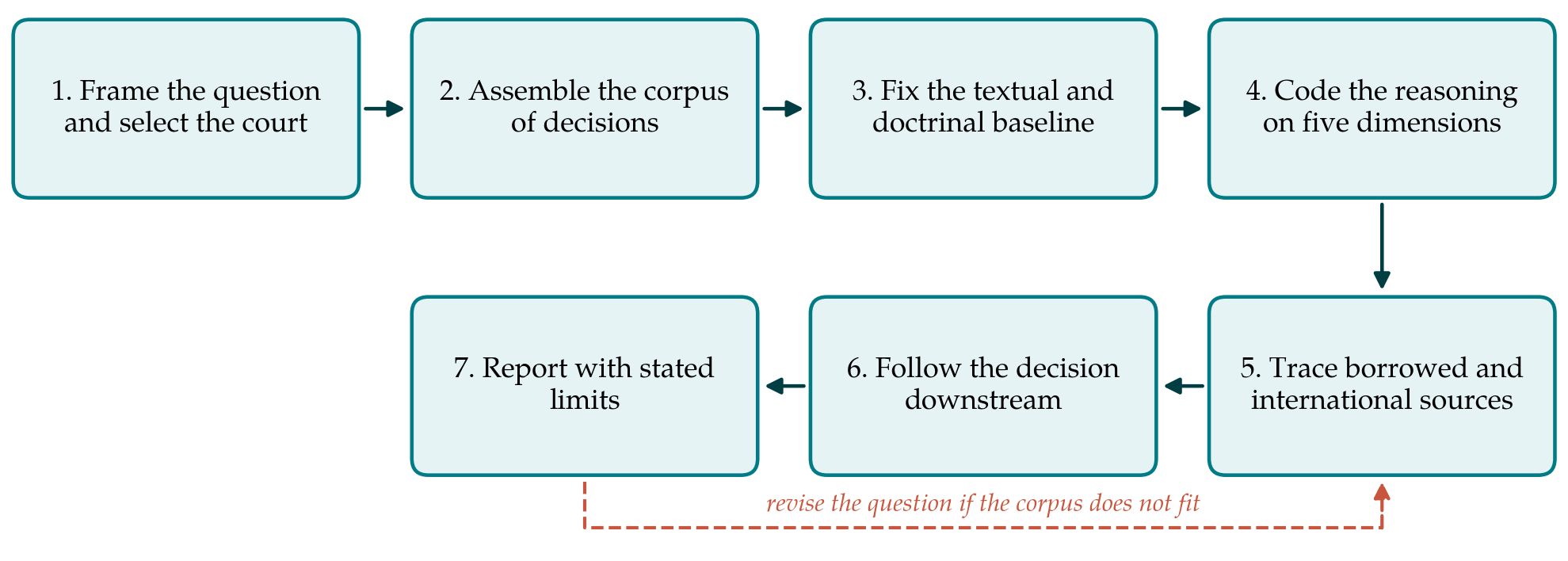
The framework has seven steps, shown in sequence in Figure 1. They are set out below in the order in which they would normally be carried out, although in practice the first three are revisited as reading proceeds.
3.1. Step 1: Frame the question and justify the court
The study should begin with a question narrower than what the court said about privacy. Useful questions concern the source from which the right was derived, the standard applied to limitations, or the treatment of a particular state practice such as biometric identification or the retention of communications data. The choice of court is then justified against the selection principles described above. A court that was the first in its region to recognise the right may be studied as a prototype; a court operating without an express privacy clause may be studied as a difficult case. The justification is recorded in a paragraph that also names the class of courts to which the findings might be relevant.
3.2. Step 2: Assemble the corpus
A landmark judgment is the centre of the corpus, never the whole of it. The researcher identifies the earlier decisions on which it relies or which it overrules, the later decisions that apply it, and any decisions of the same court that reach a different result on similar facts. The inclusion rule is written down: for example, every reported decision of the court in a stated period in which the right was a ground of decision and state processing of personal data was in issue. Official reports and the court's own database are the primary sources; where judgments are read in translation, that fact and the translation used are noted. Separate and dissenting opinions are included and marked as such, since they often state the alternatives the majority rejected.
3.3. Step 3: Fix the textual and doctrinal baseline
Before the reasoning is assessed, the legal materials the court had to work with are set out: the constitutional text, including any limitation clause; the state of precedent before the first decision in the corpus; relevant treaties binding on the state; and any data protection statute in force. The purpose is to separate what the court inherited from what it added. A reader comparing the Indian and German decisions, for instance, needs to know that neither constitution names privacy, while a reader of the judgment of the Court of Justice of the European Union in Digital Rights Ireland (2014) needs to know that the Charter does so expressly and twice.
3.4. Step 4: Code the reasoning on five dimensions
Each decision in the corpus is then read against a common set of questions. Five dimensions are proposed, listed in Table 1 with the question each poses and the features of a judgment that answer it. They concern the source of the right, its scope, the standard of review, the persons bound by it, and the remedy. A sixth row of the table records the authorities cited, which Step 5 takes up. The dimensions are deliberately few. They are intended to capture the choices that distinguish one court's doctrine from another's and to keep the record short enough to be published as an appendix.
| Dimension | Guiding question | What to record from the judgment |
|---|---|---|
| Source | From which provision or value is the right derived? | Text relied on; dignity, liberty or personality rationale Whitman, 2004 |
| Scope | What interests and what data does the right cover? | Definition adopted; whether control over data is distinct from seclusion Westin, 1967 |
| Standard of review | How are limitations tested? | Legality, legitimate aim, suitability, necessity, balancing Barak, 2012 |
| Addressees | Does the right bind private actors as well as the state? | Direct or indirect horizontal effect; duties to legislate |
| Remedy | What did the court order and when? | Invalidation, reading down, suspended declaration, directions to the legislature |
| Authorities | Whose reasoning did the court adopt? | Foreign, international and academic sources and the use made of each |
On the standard of review, the proportionality literature provides the reference points. The structured test of suitability, necessity and balancing in the strict sense is set out by Alexy (2002) and, with close attention to comparative practice, by Barak (2012). A court may announce the test and apply only part of it, or may apply a categorical rule instead, as the Supreme Court of the United States did in requiring a warrant for historical mobile phone location records in Carpenter v United States (2018). Recording which limbs did the work in each decision is more informative than recording the label the court used.
3.5. Step 5: Trace borrowed and international sources
The sixth row of Table 1 is treated as a step of its own because constitutional reasoning on privacy is unusually transnational. Courts cite one another, the European Court of Human Rights and academic writing from other systems. Tushnet (1999) distinguished several ways in which foreign material may be used, from treating it as evidence of a shared functional problem to drawing on it more loosely as a source of ideas. The researcher lists each external source cited, classifies the use made of it, and notes sources that were pressed in argument and not adopted. The result shows whether the court's doctrine is home-grown, borrowed or assembled from several places, which bears directly on claims about convergence.
3.6. Step 6: Follow the decision downstream
A fundamental right is partly defined by what happens after it is declared. The study therefore follows each principal decision into three places: later judgments of the same court, where the right is applied to concrete measures; legislation enacted or amended in response; and decisions of lower courts and regulators. The census decision was followed by a revision of German data protection legislation, and the recognition of privacy in India was followed by a ruling on the national biometric identity scheme and, some years later, by a data protection statute. Such sequences are matters of public record and can be documented without speculation about cause. Where the link between judgment and reform is uncertain, the study says so.
3.7. Step 7: Report with stated limits
The report should allow a reader to check the work. It states the question, the selection rationale and the inclusion rule; lists the corpus; reproduces the coding record; and separates description of what the court held from the author's evaluation. Evaluation is tied to a declared standard, whether internal coherence, fidelity to the constitutional text or fit with one of the theories of privacy described earlier. Rival readings of ambiguous passages are acknowledged. The class of courts to which the conclusions may extend is restated in light of what was found.
4. Fitting the Framework to Practice
The framework scales with the corpus. For a court with a single leading judgment and a handful of sequels the whole exercise can be completed by one researcher and reported within an article. For a court with decades of case law, such as the German court, the inclusion rule will need to be narrowed by period or by subject, and a second reader for a portion of the decisions is advisable so that disagreements about coding can be surfaced and resolved. Courts that deliver several separate opinions in a single case, as apex courts in the common law world often do, call for the opinion and not the case to be the unit of record, with a note of which propositions commanded a majority.
Language is a practical constraint. A researcher working from translations should prefer official ones, check key terms against the original with help where possible, and avoid resting an argument on the nuance of a translated phrase. The framework can also be extended to a paired study of two courts by completing the first four steps separately for each and then comparing the records, which is the point at which the selection principles of Hirschl (2014) become decisive.
5. Limitations and What Remains to Be Shown
The framework is proposed and has not been validated in this article. Whether two researchers applying it independently to the same court would produce substantially the same record is unknown, and that is the first thing a trial should establish. The five dimensions reflect the rights jurisprudence of courts that use some form of proportionality analysis, a model that is widespread but not universal (Möller, 2012), and they may fit poorly where privacy is protected mainly through procedural rules on search and seizure. A doctrinal study also has inherent limits: it describes what courts say and order, and it cannot show how officials and firms behave in response. Finally, the framework treats the court as a single author, which understates the role of litigants, interveners and individual judges in shaping doctrine.
6. Conclusion
Judicial recognition of data privacy as a fundamental right is one of the more striking developments in recent constitutional law, and it deserves study that others can rely on. The seven steps proposed here ask the researcher to justify the choice of court, define the corpus, separate the inherited law from the court's contribution, record the reasoning on a small number of common dimensions, and follow the right into its later life. None of this replaces interpretive judgement. It makes the judgement visible, and it produces records that can be laid side by side when the next court is studied. Whether the framework achieves that in practice is for those who apply it to determine.
Conflict of interest
To be declared by the author(s) before publication.
Funding
To be declared by the author(s) before publication.