1. Introduction
The vaccine cold chain is the system of stores, refrigerators, insulated containers, vehicles and people that keeps vaccine within its approved temperature range between manufacture and administration. Its present form dates from the Expanded Programme on Immunization, established by the World Health Organization in 1974, which had to carry heat-labile products into tropical countries with little refrigeration outside the cities (Lloyd and Cheyne, 2017). The engineering answers found then, chiefly the ice-lined refrigerator and the insulated carrier packed with frozen water, still define practice in much of the world.
Since then the task has grown. National schedules now include many more antigens than the original six, the newer vaccines are bulkier per dose and far more expensive, and several of them are damaged by freezing. Zaffran et al. (2013) argued that supply and logistics systems designed for the early programme were being asked to carry a load they had not been built for. The strain is felt most at the periphery: island communities, mountain and desert districts, river settlements reachable only by boat, and areas where conflict or seasonal flooding cuts road access. These are also the places where immunisation coverage tends to be lowest, so that cold chain reach is tied to the equity aims of current global strategy (WHO, 2020).
This article reviews what is known about operating a cold chain in such places. It is written from a logistics standpoint. Clinical questions about schedules and indications lie outside its scope, and nothing in it replaces the storage instructions on a product's label or national programme guidance.
2. Approach
The review is a narrative synthesis of published literature and of normative documents from the World Health Organization. It relies in particular on two literature reviews of freezing in the cold chain, on a group of papers on immunisation supply chains published together in the journal Vaccine in 2017, and on WHO guidance on vaccine handling and equipment. Sources were selected for relevance to low-resource and hard-to-reach settings. No formal search protocol was applied, and no quantitative pooling is attempted. Where the literature supports a firm statement the text says so, and where it does not, the uncertainty is stated.
3. How Vaccines Are Damaged
Two distinct hazards have to be managed, and the measures that guard against one can cause the other.
3.1. Heat
All vaccines degrade with cumulative exposure to heat, at rates that differ widely between products. The stability of each vaccine at a range of temperatures has been tabulated by WHO (Galazka et al., 1998; WHO, 2006). Oral polio vaccine is the most heat-sensitive of the traditional vaccines and is held frozen at the higher levels of the chain. Freeze-dried vaccines such as measles and BCG are fairly robust in the dry state and become fragile once reconstituted. For most products the standard storage range at health facility level is +2 °C to +8 °C (WHO, 2015). Heat damage is cumulative and irreversible, and it cannot be seen. The vaccine vial monitor, a heat-sensitive label that darkens with cumulative exposure, was introduced to give health workers a visible indication at the level of the single vial (Kartoglu and Milstien, 2014).
3.2. Freezing
Vaccines that contain an aluminium salt adjuvant, a group that includes the diphtheria, tetanus and pertussis combinations, hepatitis B and several newer products, are damaged when they freeze. Ice crystals disrupt the adjuvant gel and the particles clump, which lowers potency and may increase local reactions. A frozen vial can thaw and look normal. The shake test, which compares the sedimentation of a suspect vial with that of a deliberately frozen control, has been validated as a field method for detecting the damage (Kartoglu et al., 2010).
The literature is unambiguous that accidental freezing is widespread. Matthias et al. (2007) reviewed studies of cold chain temperatures and found exposure to freezing reported at every level, in storage and in transport, in high-income as well as low-income countries. A later review reached the same conclusion for the following decade (Hanson et al., 2017). The causes are mundane: vaccine placed against the evaporator plate, thermostats set too cold, and above all carriers packed with ice packs taken straight from the freezer. Programmes long trained staff to fear heat, and the equipment and habits that resulted have tended to overcool.
4. The Structure of the Chain and Where It Thins
Most national systems are arranged in tiers, shown in Figure 1. Vaccine arrives by air at a central store, moves to regional and district stores on a fixed schedule, and is collected by or delivered to health facilities, from which staff carry it to outreach sessions in surrounding communities. Each transfer adds handling and each tier adds holding time. Stock-outs at district level are frequent in many countries and are more often a failure of forecasting, funding and distribution than of global supply (Lydon et al., 2017). The lower two tiers are where grid power ends, where vehicles are fewest and where a single refrigerator failure leaves no alternative within reach.
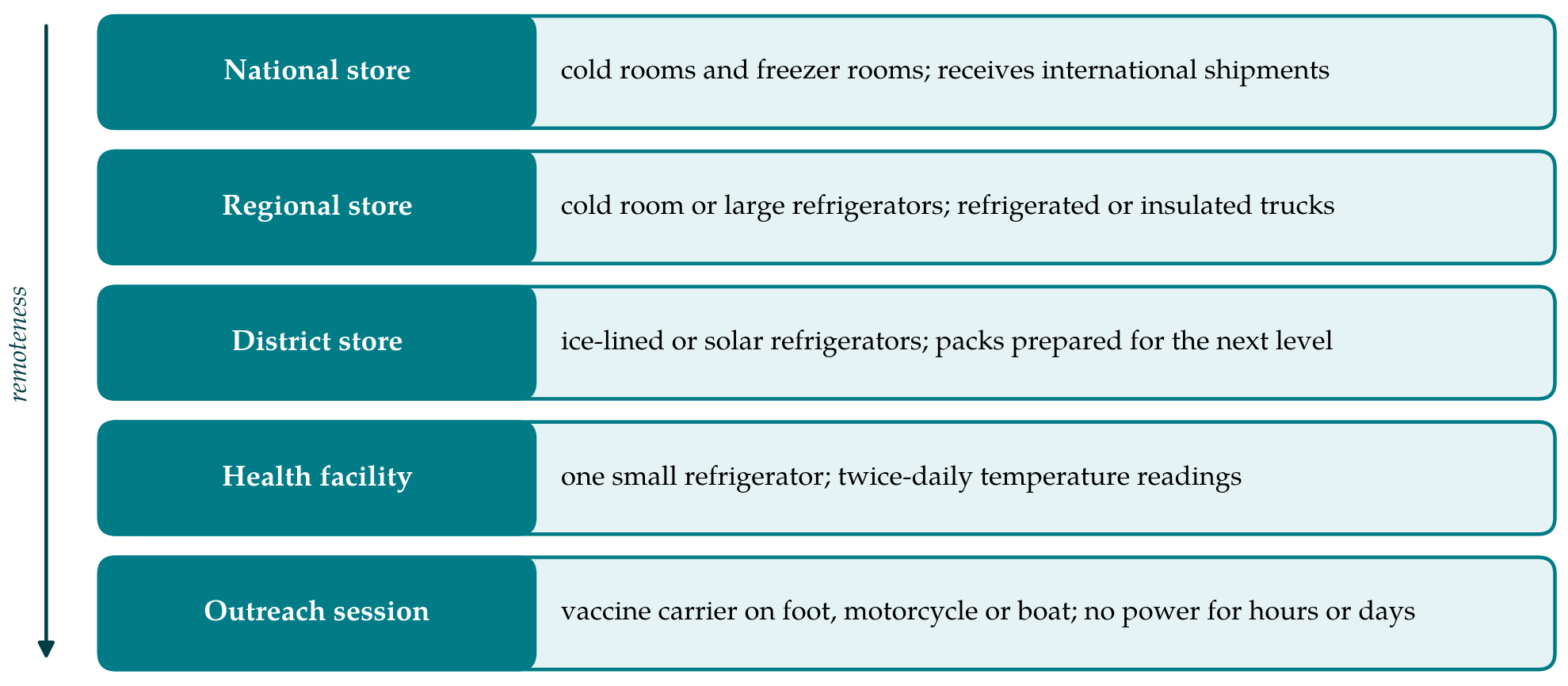
Tiered structures were inherited more than designed, and several authors have questioned them. Computational models of national supply chains have been used to compare the existing arrangement with alternatives that remove a level or replace collection by scheduled delivery loops, and these studies generally suggest that simpler structures can raise vaccine availability at similar or lower cost (Lee and Haidari, 2017). Such results are model outputs and depend on local road networks, volumes and staffing. They are best read as a reason to examine the structure and not as a design to copy.
5. Storage Where Power Is Absent or Unreliable
Table 1 compares the main equipment options for facilities at the end of the chain. Where the grid delivers at least several hours of electricity a day, the ice-lined refrigerator remains the standard choice: a lining of ice or other phase-change material holds the temperature through long power cuts. Older designs relied on the user to keep vaccine away from the cold lining, and newer models that pass the WHO performance specifications are built so that the vaccine compartment cannot fall below zero (Robertson et al., 2017).
| Equipment | Energy source | Strengths | Limitations |
|---|---|---|---|
| Ice-lined refrigerator | Intermittent mains electricity | Long holdover; mature and widely serviced | Needs some grid power; older models can freeze vaccine |
| Absorption refrigerator | Kerosene or bottled gas | Works with no electricity at all | Poor temperature control; recurrent fuel supply and cost |
| Solar refrigerator with battery | Photovoltaic panels | Independent of grid and fuel | Batteries and charge controllers fail and are costly to replace |
| Solar direct-drive refrigerator | Photovoltaic panels | No battery; energy stored as ice or cold | Higher purchase price; needs sound installation and sunlight |
| Long-term passive container | Ice replenished periodically | No power on site; few parts to fail | Small capacity; depends on an ice supply route |
| Vaccine carrier with ice packs | Frozen packs | Cheap, light, universal | Freezing risk if packs are not conditioned |
| Freeze-preventive carrier | Frozen packs | Barrier keeps vaccine above zero | Newer product; heavier and dearer |
Off the grid, the choice for decades lay between absorption refrigerators burning kerosene or gas and solar refrigerators with batteries. Both disappointed. Absorption units hold temperature poorly and depend on a fuel supply that is itself a logistics problem. Battery-based solar systems worked well when new and then failed as batteries aged, and replacement was seldom budgeted. McCarney et al. (2013) describe this history and the case for solar direct-drive refrigerators, which run a compressor straight from the panels and store cooling in ice or another thermal mass instead of storing electricity. Removing the battery removes the component that failed most often. The same authors stress that direct-drive units still depend on correct siting of panels, competent installation and a plan for repair.
Energy choices also bear on cost and emissions across the whole chain, a point developed by Lloyd et al. (2015). The broader lesson of equipment programmes is managerial. Ashok et al. (2017) list the recurring weaknesses of national cold chains as insufficient capacity, obsolete or broken equipment, and inadequate temperature monitoring and maintenance, and they argue that purchasing better refrigerators addresses only the first two. A refrigerator in a remote post is useful for as long as someone is responsible for it, trained to read it, and able to summon a technician.
6. Transport and Outreach
Between stores, vaccine travels in cold boxes; between the facility and the outreach site it travels in a vaccine carrier holding a day's supply. The coolant is the critical variable. Frozen packs placed directly beside freeze-sensitive vaccine can take it below zero within a short time, so guidance requires packs to be conditioned, that is, left at room temperature until the ice begins to move inside them, before loading (WHO, 2015). In practice conditioning is often skipped. Chilled water packs avoid the freezing risk at the price of a much shorter cold life, and carriers with a built-in barrier between pack and vaccine have been developed to make the safe practice the default.
Remote outreach stretches these tools. A team walking for two days to a mountain village, or travelling by boat between river settlements, needs a container that holds temperature well beyond a working day. Long-term passive containers, which keep vaccine cold for weeks on a single load of ice, extend that reach and can serve as the only storage at posts with no power, provided ice can be brought in on a regular run. Unmanned aircraft have attracted attention for the same problem. A modelling study by Haidari et al. (2016) found that drone delivery could raise availability and lower cost per dose under certain conditions of demand and distance. Evidence from routine operation at scale is still limited, and payload, weather, regulation and return logistics constrain what such services can carry.
7. Knowing the Temperature
A cold chain that is not monitored is assumed to work. The stem thermometer read twice a day records two moments and misses the night. Continuous electronic recorders that log for thirty days and display alarms for high and low excursions are now the recommended minimum for facility refrigerators, and electronic freeze indicators travel with freeze-sensitive shipments (Kartoglu and Milstien, 2014). WHO guidance on time- and temperature-sensitive pharmaceutical products sets out the expectations for mapping, monitoring and documenting storage conditions (WHO, 2011).
Remote monitoring devices that transmit readings over mobile networks allow a district officer to see a failing refrigerator before the vaccine is lost. Their value depends on network coverage, which is weakest exactly where they would help most, and on someone acting on the alarm. The literature offers more descriptions of such systems than evaluations of their effect on vaccine loss, and this is an area where claims have run ahead of evidence.
8. Relaxing the Chain
A different line of attack is to need less cold. Many vaccines are more stable than their labelled storage conditions imply, and the controlled temperature chain approach allows a specific product, on the strength of stability data reviewed by regulators, to be kept at ambient temperature for a single defined period just before use. The first product so licensed was a meningococcal A conjugate vaccine, and its use in a mass campaign in Benin showed that removing ice from the last days of distribution was feasible and was welcomed by vaccinators (Zipursky et al., 2014). Kahn et al. (2017) argue that the approach could extend reach and equity for other campaign and special-strategy vaccines. It applies only to products licensed for it, and only within the stated limits.
The longer-term hope is formulation: vaccines that tolerate both heat and freezing. The technical routes, including dry formulations and stabilising excipients, are reviewed by Chen and Kristensen (2009), and Kristensen et al. (2011) observe that the obstacles are as much commercial and regulatory as scientific, since reformulating a licensed product is costly and buyers have not consistently paid for stability. Movement in the opposite direction has also occurred. The first messenger RNA vaccines required frozen or ultra-cold storage because of the instability of the RNA and its lipid carrier (Crommelin et al., 2021), a requirement beyond the equipment of most peripheral stores anywhere.
9. Gaps and Future Work
Several questions remain open. The contribution of temperature excursions to reduced protection in vaccinated populations is hard to measure and poorly quantified, so that the health benefit of cold chain investments is usually inferred from potency studies. Comparative field evidence on equipment over its working life in remote posts, including repair histories, is scarce relative to laboratory performance data. The redesign of distribution structures has been modelled far more often than it has been implemented and evaluated. And commentary on immunisation logistics has repeatedly pointed to the human side of the system, the supply chain managers and technicians, as underfunded and understudied (Humphreys, 2011).
10. Conclusion
Carrying vaccine to remote communities is a solved problem in principle and a difficult one in practice. The established points are that freezing deserves the same vigilance as heat, that solar direct-drive and freeze-protected equipment have closed long-standing technical gaps, that continuous monitoring is necessary to know whether the chain is working, and that maintenance and management determine whether equipment keeps working. Controlled temperature chain use and thermostable formulations can shorten the distance over which cold must be carried for particular products. What the literature does not yet provide is strong field evidence on newer delivery technologies and on the redesign of supply structures, and these are the places where careful evaluation would be most useful.
Conflict of interest
To be declared by the author(s) before publication.
Funding
To be declared by the author(s) before publication.