1. Introduction
Liquefaction of loose, saturated granular soil remains one of the main causes of damage to foundations, buried services and waterfront structures in earthquakes. The mechanism has been understood in outline since the cyclic triaxial experiments of Seed and Lee (1966): repeated shearing makes a loose soil skeleton try to contract, drainage cannot keep pace, pore water pressure rises and effective stress falls. Conventional countermeasures either densify the deposit, cement it, or provide drainage. All three are costly over large areas, and that cost has kept alive the search for cheaper materials that can be blended into or placed within liquefiable ground.
Granulated rubber recovered from scrap tyres is one such material. Tyre-derived aggregate has been used in embankments and behind retaining walls for three decades, and a standard practice now governs its civil engineering use, including limits intended to prevent self-heating in thick fills (ASTM, 2020). The suggestion that rubber inclusions might also suppress liquefaction arose from two observations: rubber particles deform under load in a way that quartz grains do not, and layers of rubber-soil mixture attenuate the shaking transmitted to whatever lies above them (Tsang, 2008).
This article reviews the published evidence on that suggestion as it applies to silty sands. The qualification matters. Natural liquefiable deposits, hydraulic fills and tailings rarely consist of the clean uniform sands favoured in laboratories, and the presence of non-plastic silt changes both the behaviour of the soil and the vocabulary needed to describe it. The review is a narrative one. It draws on journal papers, conference volumes, standards and monographs known to the field, groups them by theme and weighs what they can and cannot support. No new test results are reported.
2. Scope and Approach
Terminology in this literature is loose, and a short clarification avoids confusion later. Tyre shreds and chips are pieces from roughly a centimetre to several tens of centimetres across, often with exposed steel wire. Granulated or crumb rubber is finer, generally of sand size, and free of wire. The distinction is mechanical as well as commercial, because the ratio of rubber particle size to sand particle size decides whether rubber grains sit in the voids of the sand skeleton, form part of it, or enclose it. This review concentrates on crumb and small-chip inclusions mixed with the soil, and refers to pure rubber layers only where they clarify a mechanism.
The material is organised in four parts: the behaviour of silty sand without rubber, which sets the baseline; the mechanics of mixtures of stiff and soft particles; the direct evidence on cyclic resistance of sand-rubber mixtures from element tests and model tests; and the consequences for stiffness, damping, settlement and the environment. A final section identifies what is missing.
3. Silty Sands as the Baseline
Field-based triggering procedures have long treated fines as beneficial. In the simplified procedure that grew out of the work of Seed and Idriss (1971), and in its later consensus form (Youd et al., 2001), penetration resistance is adjusted upward for fines content before it is entered into the triggering chart. Current versions retain a fines adjustment (Boulanger and Idriss, 2014). The adjustment is empirical. It reflects the fact that a silty sand and a clean sand with the same cyclic resistance give different penetration resistance, and it says little about how fines alter element behaviour.
Laboratory studies give a less comfortable picture. Lade and Yamamuro (1997) showed that adding non-plastic fines to loose sand can make it more prone to static liquefaction, because silt particles lodged near grain contacts create a compressible, metastable fabric. Polito and Martin (2001) found that cyclic resistance is controlled by relative density while the fines remain below a limiting content at which they fill the sand voids, and by the silt matrix above it. Thevanayagam (1998) and Thevanayagam et al. (2002) formalised this with the intergranular and interfine void ratios, which count only the particles that carry load. The apparent conflict in the earlier literature largely disappears once specimens are compared on the basis of the active skeleton and not global void ratio.
Two points from this body of work carry over directly to rubber. The first is that an inclusion may be mechanically inactive, sitting in voids, or active, sharing in force transmission, and that the transition depends on proportion and size. The second is that the density measure chosen for comparison can reverse a conclusion. Where the fines are plastic, susceptibility itself has to be judged on other criteria, and what follows concerns non-plastic and low-plasticity silty sands only. The broader framework of liquefaction and flow behaviour is set out by Ishihara (1993) and Idriss and Boulanger (2008).
4. Mechanics of Rigid-Soft Particle Mixtures
Tyre rubber has a specific gravity only a little above that of water and a stiffness several orders of magnitude below that of quartz. Early geotechnical work treated it as lightweight fill and measured compressibility and strength for that purpose (Edil and Bosscher, 1994). Mixtures with sand were found to be less compressible than rubber alone and, with elongated shreds, to gain strength through a reinforcing action (Zornberg et al., 2004).
The particle-scale picture was sharpened by Lee et al. (2007) and Kim and Santamarina (2008), who described a transition from sand-like to rubber-like behaviour as the rubber fraction rises. At low rubber content the sand grains form the load-bearing chains and rubber particles occupy or buttress the spaces between them. At high content the rubber carries the load and the response becomes soft and highly recoverable. Between the two lies a transitional mixture in which the skeleton is shared, and whose position on the content scale shifts with the size ratio and with confining stress, because rubber grains flatten under load and close up the pore space. Mashiri et al. (2015) reported the corresponding change in dilatancy for sand mixed with tyre chips: the tendency of dense sand to dilate is progressively suppressed as rubber is added.
These observations suggest several distinct ways in which rubber could affect liquefaction, and they do not all act in the same direction. Table 1 summarises the mechanisms most often invoked, together with the sources that discuss them and the reservations attached to each.
| Proposed mechanism | Expected effect | Representative sources | Reservation |
|---|---|---|---|
| Deformable particles absorb volumetric strain | Slower pore pressure build-up | Hyodo et al., 2007 | Demonstrated mainly for chips coarser than the sand |
| Reduced dilatancy of the skeleton | Less abrupt loss and recovery of stiffness | Mashiri et al., 2015 | Also lowers drained strength of dense mixtures |
| Shared or rubber-borne skeleton | Sand grains shielded from cyclic stress | Kim and Santamarina, 2008 | Requires rubber contents that make fills compressible |
| Higher permeability with coarse chips | Partial drainage during shaking | Hazarika et al., 2008 | Unlikely where silt clogs the pore space |
| Lower stiffness, higher damping | Reduced motion transmitted upward | Tsang, 2008; Senetakis et al., 2012 | Larger shear strains within the layer itself |
| Lower unit weight | Smaller inertial and overburden loads | Edil and Bosscher, 1994 | Lower confinement also lowers resistance |
5. Evidence on Cyclic Resistance
Direct evidence comes from undrained cyclic element tests and from model tests on shaking tables. The two kinds of experiment answer different questions and are considered separately.
5.1. Element tests
Hyodo et al. (2007) carried out undrained cyclic shear tests on mixtures of sand and tyre chips across the full range of proportions and reported that pore pressure build-up was progressively restrained as the chip fraction increased, with mixtures rich in chips not reaching the condition of zero effective stress at all. Promputthangkoon and Hyde (2007), in the same volume, drew a more cautious conclusion for finer rubber: at small proportions the composite was more compressible and its cyclic resistance was not improved. Mashiri et al. (2016) examined sand-tyre chip mixtures in cyclic triaxial tests and reported that resistance rose with chip content up to an intermediate proportion and that the benefit did not continue to grow beyond it.
Read together, these studies are less contradictory than they first appear. Where rubber particles are much larger than the sand grains and present in quantity, they form or share the skeleton and the mixture behaves in the restrained manner described by Hyodo and co-workers. Where rubber is of similar size to the sand and present in small amounts, it behaves much as loose non-plastic fines do in the studies of Lade and Yamamuro (1997): it adds compressibility to the skeleton without contributing strength. The parallel with the fines literature is close, and it implies that an intergranular measure of density, counting rubber as void when it is inactive, would be the appropriate basis for comparison. Few rubber studies report their results in that way.
Specimen preparation adds a further difficulty. Rubber and sand differ in density by a factor of more than two and segregate readily during pluviation or vibration, so most investigators have used moist tamping, sometimes with the undercompaction procedure of Ladd (1978). Moist-tamped fabrics are known to give different cyclic resistance from water-sedimented ones in clean and silty sands alike (Ishihara, 1993), and a field deposit treated by deep mixing or by placement of pre-blended fill would have a fabric that no current laboratory method reproduces with confidence.
5.2. Shaking-table and model tests
Model tests show system behaviour that element tests cannot. Hazarika et al. (2008) placed a cushion of tyre chips behind a model caisson quay wall on an underwater shaking table and observed lower seismic thrust and smaller residual wall displacement than with sand backfill alone. In that arrangement the chips acted as a compressible buffer and as a drain; they were not mixed into the liquefiable soil. Kaneko et al. (2013) studied saturated sand deposits mixed with tyre chips, combining element tests with a numerical model of the layered ground, and concluded that a mixed layer could limit pore pressure rise within itself and reduce the motion transmitted to the surface.
Both studies used coarse chips and clean sand. Their relevance to crumb rubber in silty sand is therefore indirect. The drainage contribution in particular depends on the mixture being much more permeable than the surrounding ground, a condition that silt-sized particles migrating into the pores would be expected to erode with time.
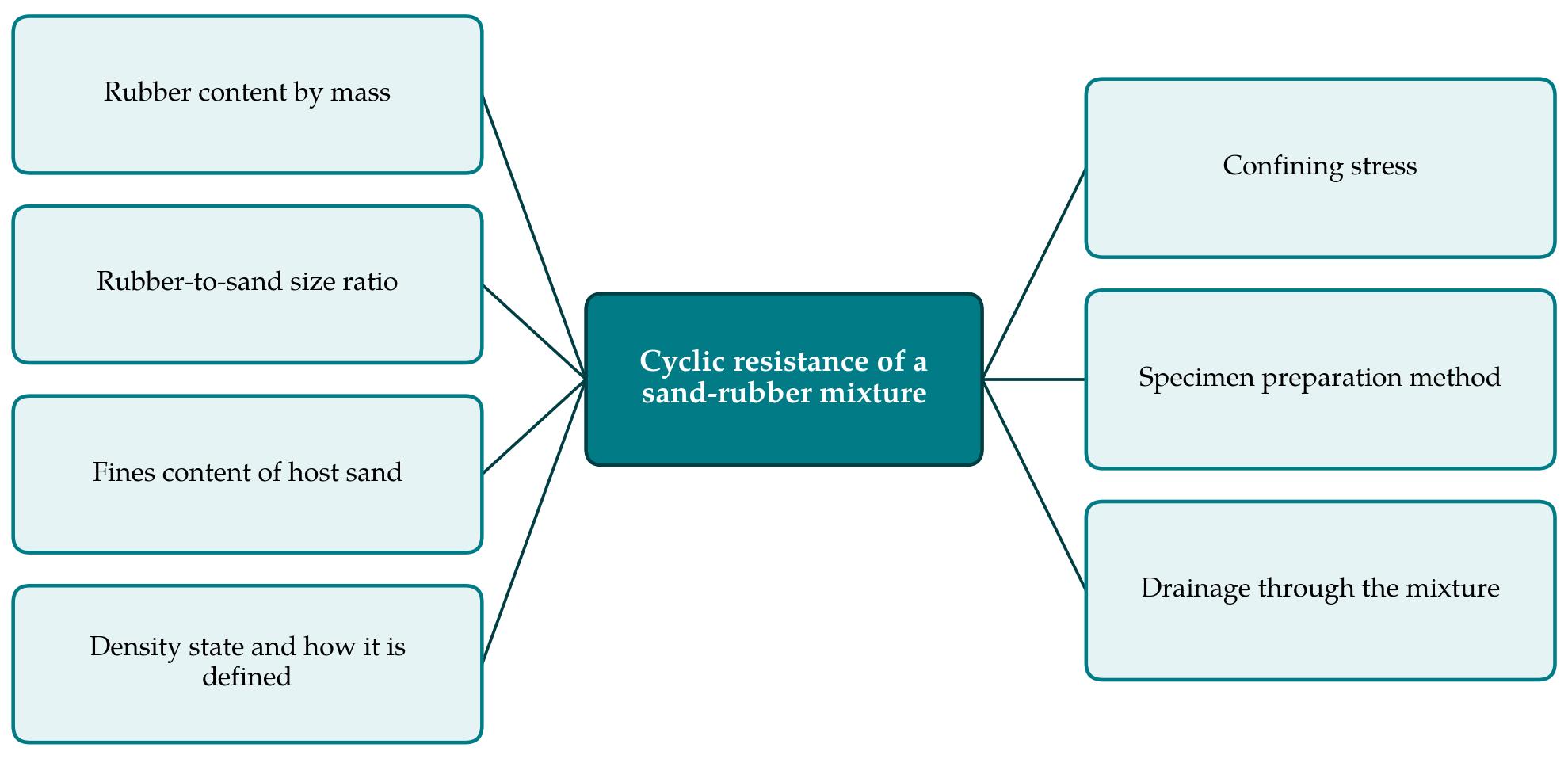
Figure 1 gathers the variables that the studies reviewed above identify as controlling the cyclic resistance of a sand-rubber mixture. The diagram is a reading aid. It does not rank the variables, because the published data do not allow a ranking that would hold across materials.
6. Stiffness, Damping and Settlement
A ground treatment is judged on more than triggering. Resonant column and torsional shear testing by Anastasiadis et al. (2012) and Senetakis et al. (2012) established that adding rubber to sand or gravel lowers the small-strain shear modulus markedly, raises damping at small strains and extends the range of strain over which the mixture behaves almost linearly. These properties underlie the proposal to use rubber-soil layers as a form of geotechnical seismic isolation (Tsang, 2008). They also mean that a treated zone will undergo larger shear strains than untreated sand under the same stress, and will settle more under static load. For a light structure on a raft this may be acceptable. For piled foundations, pipelines or pavements the loss of stiffness could be a more serious matter than the liquefaction it was meant to prevent.
Volumetric behaviour after shaking has received little attention. In ordinary sands, settlement following liquefaction is governed by the reconsolidation of the skeleton as excess pore pressure dissipates (Idriss and Boulanger, 2008). In a mixture, part of the volumetric strain imposed by cyclic loading is taken up elastically by the rubber and should in principle be recovered, but creep of rubber under sustained stress acts in the opposite sense. Which effect prevails over the service life of a fill is not established. Environmental questions are treated in the standard practice (ASTM, 2020), which addresses leachate and exothermic reaction, although mainly for chips and shreds above the water table and not for crumb placed permanently below it.
7. Gaps and Directions for Further Work
The most obvious gap is the one named in the title. Published cyclic tests on rubber mixtures have used clean, uniform sands almost without exception. Nothing in the literature reviewed here reports a programme in which fines content and rubber content were varied together, and so the interaction between the two kinds of inclusion is unknown. A three-phase mixture of sand, silt and rubber may be more compressible than either two-phase mixture, with silt and rubber both sitting loosely between sand grains, or the rubber may bridge and stabilise a metastable silty fabric. Either outcome is plausible on present knowledge.
A second gap concerns how results are expressed. Until rubber studies report an equivalent intergranular void ratio, or some comparable measure of the active skeleton, comparisons between laboratories will continue to mix the effect of rubber with the effect of density. A third is scale. Element tests assume uniform mixing, whereas field treatment would produce columns, panels or layers with untreated soil between them, and the behaviour of such a composite deposit has been explored only numerically and only for layers. Fourth, there is no field evidence. No treated site is known to have been shaken strongly, and none of the case-history databases that support triggering procedures contains rubber-treated ground.
Useful next steps follow from this list. Cyclic simple shear tests on silty sand with crumb rubber, prepared by slurry deposition to approach a natural fabric, would address the first gap directly. Centrifuge models with treated zones of realistic geometry would address the third. Long-term consolidation and permeability tests under saturated conditions would show whether the properties measured on fresh specimens persist.
8. Conclusion
The published evidence supports a narrower claim than is sometimes made for tyre rubber in liquefiable ground. Coarse chips mixed in substantial proportion with clean sand restrain pore pressure generation in undrained cyclic tests, and chip cushions reduce thrust on model waterfront structures. Fine crumb in small proportion has not been shown to raise cyclic resistance and may lower it. For silty sands there is no direct evidence at all, and the fines literature gives reason to expect that the outcome will depend on whether the rubber joins the load-bearing skeleton. Any benefit is accompanied by lower stiffness and greater compressibility. The technique should be regarded as promising for particular applications and unproven for silty deposits until the tests outlined above have been done.
Conflict of interest
To be declared by the author(s) before publication.
Funding
To be declared by the author(s) before publication.