1. Introduction
The rivers that drain the Himalaya hold a distinctive catfish fauna. The sisorid genera Glyptothorax, Pseudecheneis, Glyptosternon and Exostoma, with their relatives, live on the beds of fast, cold streams, and many have adhesive structures on the chest or flattened bodies and paired fins that let them hold position in the current (Thomson and Page, 2006). The regional faunal works list them and give their distributions (Talwar and Jhingran, 1991; Jayaram, 1999), but say little about how they reproduce. A regional assessment of freshwater biodiversity in the Eastern Himalaya classed a substantial proportion of the fishes it evaluated as Data Deficient (Allen et al., 2010).
Seasonal maturation of the gonads is usually the first piece of reproductive biology to be described for such a species, because it can be established from monthly samples with modest equipment. It is also easy to do badly. This note sets out, for a little-known Himalayan catfish, what a sound description requires. It is a commentary on method and expectation and presents no original observations.
2. What Is Likely to Time Reproduction
Fish in seasonal environments breed when the conditions that follow will favour the survival of eggs and young, and they use environmental signals to prepare in advance (Wootton, 1990). In temperate and subtropical freshwater fishes, lengthening days and rising temperature commonly drive the growth of the gonads, while a more immediate stimulus such as rainfall, flooding or a change in water chemistry triggers the final maturation of the eggs and spawning itself (Lam, 1983). The experimental work of Sundararaj and Vasal (1976) on the Indian catfish Heteropneustes fossilis is the classic demonstration that photoperiod and temperature together regulate ovarian development in a South Asian siluriform.
A Himalayan river adds complications. Discharge rises with snowmelt in spring and peaks with the summer monsoon, when the water is turbid and the bed unstable. Temperature varies steeply with altitude, so that one species may experience quite different thermal regimes along a single river. Many lowland catfishes of the region spawn with the monsoon floods, but a fish that attaches its eggs to stones in a torrent might equally be expected to spawn before the flood or after it, when the bed is stable. The season cannot be inferred from relatives in the plains and has to be observed.
3. Methods for Describing Maturation
The reproductive cycle of an adult fish passes through a repeating series of phases, shown in Figure 1 in the terminology proposed by Brown-Peterson et al. (2011). That scheme was devised to replace the many incompatible numbered scales in the older literature, and its phases are defined by histological and physiological criteria that apply to both sexes and to any teleost. Its use is recommended here, so that results for an obscure species can be compared directly with others.
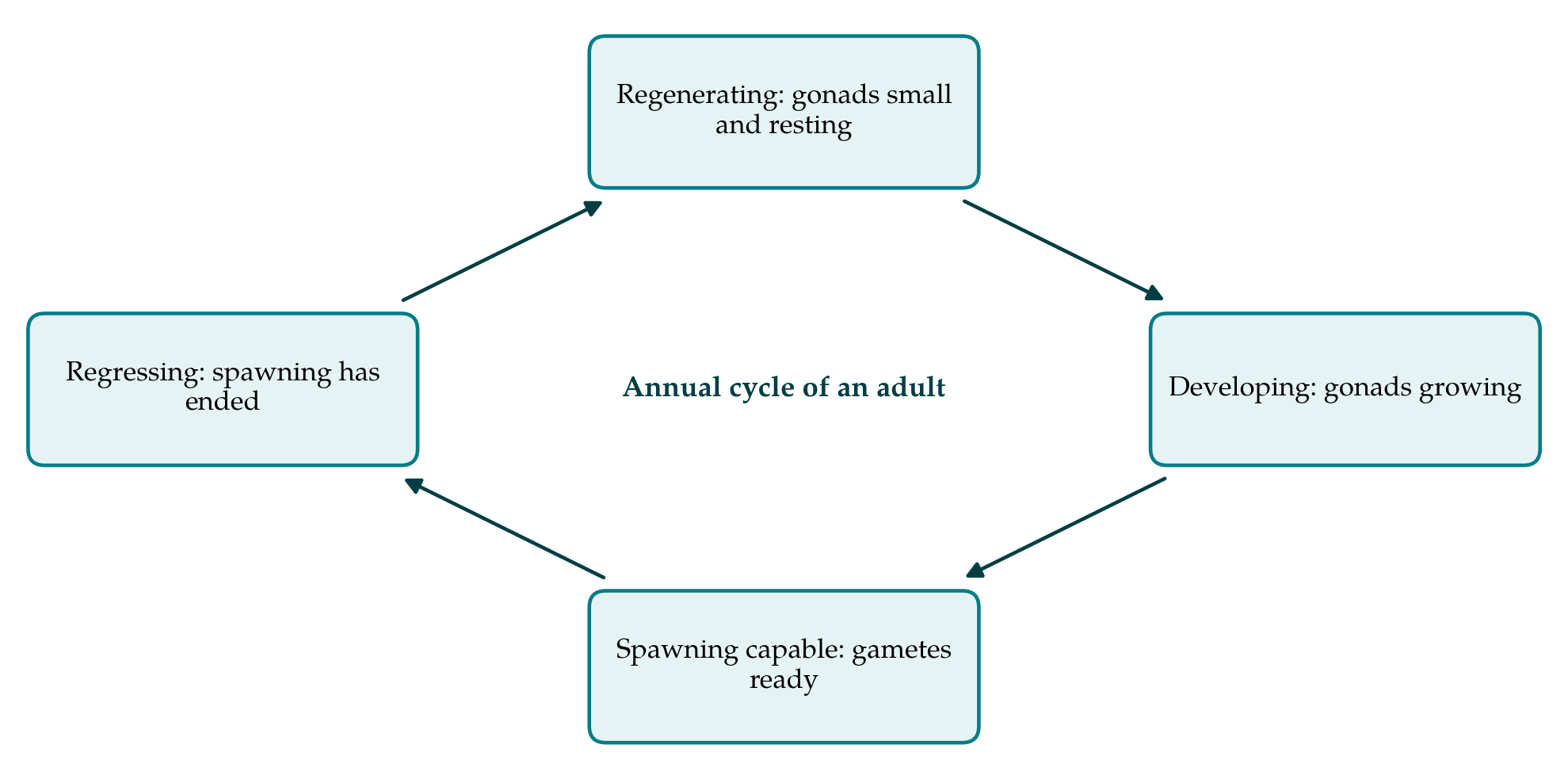
The methods by which a fish is assigned to a phase differ in cost and reliability, and they are compared in Table 1. Macroscopic staging, by the size, colour and texture of the gonad, is quick and can be done in the field, but it confuses immature fish with adults in the regenerating phase and is the least repeatable between observers (West, 1990). The gonadosomatic index, gonad weight as a percentage of body weight, gives a simple seasonal curve whose peak marks the approach of spawning. de Vlaming et al. (1982) showed, however, that the index is valid only if gonad weight scales with body weight in the same way at every stage of development, a condition that is frequently not met and seldom checked.
| Method | What it shows | Limits |
|---|---|---|
| Macroscopic staging | Approximate phase of each fish, in the field | Subjective; immature and regenerating fish are confused |
| Gonadosomatic index | Seasonal rise and fall of gonad mass | Assumes constant scaling with body size; weak for very small gonads |
| Oocyte diameter distribution | Whether eggs develop as one batch or several | Needs preserved ovaries and a consistent subsampling position |
| Histology | Definitive phase; evidence of recent or imminent spawning | Laboratory cost; usually feasible only for a subsample |
| Length at first maturity | Size at which half the fish are mature | Requires correct separation of immature from resting adults |
| Fecundity counts | Number of eggs per female in relation to size | Meaningful only when the spawning pattern is known |
Measurement of oocyte diameters shows whether the ovary holds a single advancing group of eggs or several, and so whether a female spawns once or repeatedly in a season (West, 1990). Histology is the reference method. It identifies the most advanced type of oocyte present, and it reveals postovulatory follicles, the remains of ovulated eggs, which are direct evidence of recent spawning and the basis of estimates of spawning frequency (Hunter and Macewicz, 1985). The size at which half of the fish are mature, and fecundity in relation to length, are then estimated by the standard methods of fishery biology (Bagenal, 1978).
4. Recommendations for a Little-Known Species
Four recommendations follow for a study of a Himalayan torrent catfish. Samples should be taken at least monthly through a complete year, and preferably two, since a cycle described from one year in a river with variable monsoon timing may not be typical. Water temperature, day length and river stage should be recorded alongside each sample, so that maturation can be related to the candidate cues. The gonadosomatic index should be reported, but only after its relation to body size has been examined, and every phase assignment should rest on histology of at least a subsample of each sex in each month. And fish should be classified in the standard phase terminology, with immature fish distinguished from regenerating adults on histological grounds.
Rarity imposes a further duty. Where a species is scarce or its status unknown, the number of fish killed should be the smallest that will answer the question, and every specimen should yield length, weight, gonads, and material for age and diet so that none is wasted. Voucher specimens should be lodged in a museum collection, because the taxonomy of sisorid catfishes is still being revised and a reproductive study is of little use if the identity of its subject later becomes uncertain (Thomson and Page, 2006).
5. Conclusion
The seasonal maturation of the gonads is basic information that is missing for many Himalayan catfishes. It can be supplied with simple means, provided that macroscopic stages and the gonadosomatic index are checked against histology, that a standard terminology is used, and that sampling covers the whole year alongside records of temperature and flow. Such descriptions are needed before closed seasons can be set on evidence or the effects of altered river flow on breeding can be judged.
Conflict of interest
To be declared by the author(s) before publication.
Funding
To be declared by the author(s) before publication.