1. Introduction
The compounds that give food its character are mostly plant secondary metabolites, and most of them are present in the source tissue in small amounts. Vanillin is extracted from cured pods of a vine grown in a few tropical regions; saffron apocarotenoids come from hand-picked stigmas; the ionones of violet and the lactones of peach are harvested on a scale that bears no relation to the demand for them. The result is a supply chain that is thin, geographically concentrated and exposed to weather, disease and the politics of the growing regions. Where the extracted compound cannot meet demand, the gap is filled by chemical synthesis from petrochemical or lignin feedstocks, which supplies the molecule but not the label.
Fermentation sits between the two. A microorganism engineered to carry the plant pathway makes the same molecule from sugar in a tank, on a schedule, near the point of use. The idea is old, and what has changed is the ability to execute it: long heterologous pathways can now be assembled, integrated and iterated quickly enough for the economics to be tested rather than argued about (Nielsen and Keasling, 2016).
2. Why Yeast Suits This Class of Molecule
Saccharomyces cerevisiae is not the fastest-growing or the most metabolically flexible host, and for simple compounds a bacterium is often the better choice. For plant natural products the balance tips. Plant pathways depend heavily on cytochrome P450 monooxygenases, which are membrane-anchored and require a compatible reductase and an endoplasmic reticulum to sit in; yeast provides both, while bacterial expression of these enzymes is frequently poor. Yeast also tolerates the low pH and high osmolarity of industrial fermentation, is genetically tractable, and has a long record of safe use in food manufacture.
The toolkit has matured alongside the biology. Multi-fragment assembly of pathway constructs is routine (Gibson et al., 2009), CRISPR methods allow several loci to be modified in one step (DiCarlo et al., 2013; Jakociunas et al., 2016), and the specific problems of expressing plant secondary metabolism in yeast have been reviewed in detail (Siddiqui et al., 2012). Strain construction that once took a graduate degree now takes weeks, which changes which projects are worth starting.
3. What the Demonstrations Establish
Three bodies of work define what is possible. The semisynthetic artemisinin programme reconstructed the plant route to artemisinic acid in yeast and carried it from a laboratory demonstration (Ro et al., 2006) to industrial titres through sustained strain and process engineering (Paddon et al., 2013). The lesson most relevant to flavour work is how much of the effort went into the last stages: the first functional strain was a small fraction of the programme.
The second is the complete biosynthesis of opioids in yeast from sugar, which required more than twenty enzymatic steps drawn from several organisms (Galanie et al., 2015), followed by comparable reconstructions of other alkaloid pathways (Li and Smolke, 2016) and of cannabinoids with their unnatural analogues (Luo et al., 2019). These established that pathway length is no longer the limiting factor; product titre is.
The third is closest to the flavour industry. De novo biosynthesis of vanillin was demonstrated in both baker s yeast and fission yeast by routing the shikimate pathway through heterologous enzymes and trapping the aldehyde as a glucoside to limit its toxicity (Hansen et al., 2009). That work is instructive because the central difficulty, a product that inhibits the organism making it, is shared by many aroma compounds. Table 1 sets out the recurring engineering problems and the responses that have been used.
| Obstacle | Why it arises | Usual response |
|---|---|---|
| Product toxicity | Aldehydes and phenolics damage membranes and proteins | Glycosylate in situ, or extract into a second phase Hansen et al., 2009 |
| Poor P450 activity | Plant enzymes need a membrane and a matched reductase | Tune reductase ratio and expand the endoplasmic reticulum |
| Precursor limitation | Acetyl-CoA and aromatic amino acid pools are tightly regulated | Relieve feedback inhibition and rebalance central carbon flux |
| Pathway imbalance | Intermediates accumulate at the slowest enzyme | Vary promoter strength and copy number across the pathway |
| Genetic instability | High expression is costly and selects for loss | Integrate into the genome rather than use plasmids |
| Scale-up losses | Volatile products are lost and gradients appear in large tanks | Closed fermentation with in-line recovery |
4. Where the Engineering Still Fails
Three difficulties recur, and none is solved in a general way. The first is that the plant pathway is often unknown. For many prized aroma compounds the enzymes have not been identified, and the project becomes one of gene discovery before it becomes one of engineering. The second is toxicity: short-chain aldehydes, phenolics and some terpenes are antimicrobial, which is part of why plants make them, so the host is working against its own product. The third is that titres adequate for a pharmaceutical are rarely adequate for a flavour, because flavour molecules sell for far less per kilogram and the process must therefore be much cheaper per unit.
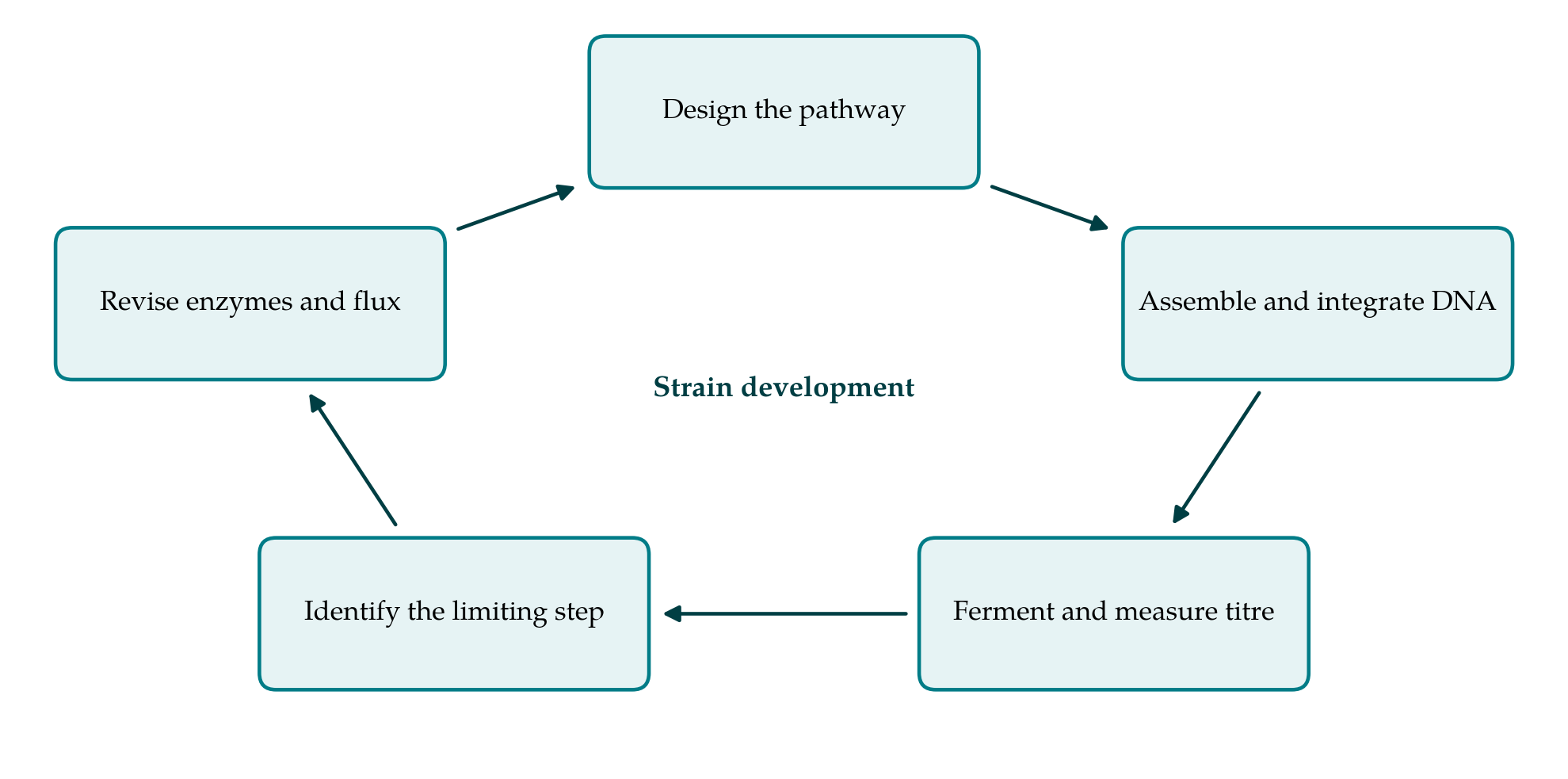
The way through all three is iteration rather than insight, and Figure 1 shows the loop that strain development actually follows: design, assembly, fermentation, identification of the limiting step, and revision. The number of turns of that loop, not the cleverness of the first design, generally determines whether a strain reaches a commercially useful titre.
5. Regulation and Acceptance
A commercial judgement sits alongside the technical one. In the European Union, flavouring substances and the conditions under which a preparation may be described as natural are governed by dedicated legislation (European Parliament and Council of the European Union, 2008), and whether a fermentation-derived molecule qualifies depends on the substrate and the process rather than on the identity of the product. The distinction is commercially decisive, since the premium attached to a natural label is often larger than the difference in production cost. Consumer response to fermentation-derived ingredients is a separate matter again, and the sector has learned that it is better to describe the process plainly than to leave it to be discovered.
6. Conclusion
Yeast is a credible route to plant flavour compounds whose supply is constrained, and the published reconstructions of long plant pathways show that the technical ceiling is higher than the flavour industry generally requires. What limits the field is not pathway length but product toxicity, unknown enzymes and the low price per kilogram of the target molecules. Progress will come from unglamorous work: discovering the missing enzymes, managing toxicity through compartmentalisation and in-process recovery, and reducing the cost of each turn of the design and test cycle. The compounds worth attacking first are those where the plant supply is thinnest and the molecule itself is comparatively stable.
Conflict of interest
To be declared by the author(s) before publication.
Funding
To be declared by the author(s) before publication.