1. Introduction
A burned vehicle reaches the investigator as a shell of oxidised steel with sagging glass, melted alloy and a floor covered in debris. The question put is usually simple: where did the fire start and why. The answer matters to insurers, to manufacturers facing a possible defect, and to criminal courts when the fire is thought to have been set or to conceal another offence. The standard texts devote chapters to the subject (DeHaan and Icove, 2012; Lentini, 2019), and the consensus guide of the National Fire Protection Association treats motor vehicle fires at length (NFPA, 2021).
Two sources of physical evidence dominate such inquiries. One is the pattern of damage on the vehicle, read as a record of where the fire burned longest and how it moved. The other is chemical: the laboratory search for residues of ignitable liquids in debris. Each has known weaknesses. Damage patterns are shaped by ventilation and fuel load as much as by the point of origin, and a vehicle carries its own petroleum products, so that a positive laboratory result may mean very little. Used separately, each invites over-reading. This article proposes a protocol for using them together, within the scientific method that the guide prescribes. It describes a procedure and reports no investigation of any actual fire.
2. Background: What the Evidence Can Bear
Full-scale burn experiments on passenger cars show a consistent course of events. A fire that starts in the engine compartment or the cabin grows slowly while the compartment is closed, accelerates sharply when glazing fails and air enters, and then involves the whole vehicle (Mangs and Keski-Rahkonen, 1994; Okamoto et al., 2009). Once the cabin has reached full involvement, damage in it is governed largely by ventilation. The same principle is well established for rooms, where patterns formed after flashover reflect air supply more than the first fuel (Drysdale, 2011), and the review of fire pattern research by Gorbett et al. (2015) documents how often investigators' readings of damage have outrun the experimental support for them.
The guide draws the practical conclusion. Indicators once treated as signs of a set fire, such as severe oxidation of body panels, loss of temper in seat springs or melted aluminium, are produced by ordinary vehicle fires given enough time and should not be read as evidence of an added fuel (NFPA, 2021). The wider critique of forensic science by the National Research Council (2009) singled out fire investigation as a field in which experience-based rules had run ahead of research. Pattern evidence remains useful, but mainly in vehicles where the fire was put out early and for comparing compartments with one another.
Laboratory analysis has its own interpretive problem. Ignitable liquid residues are isolated from debris, commonly by passive headspace concentration onto activated charcoal (ASTM International, 2019a), and identified by gas chromatography-mass spectrometry against the classification scheme of the standard test method (ASTM International, 2019b). The chemistry is mature and is described in detail by Stauffer et al. (2008). The difficulty lies in meaning. Many manufactured goods contain petroleum-derived solvents (Lentini et al., 2000), burning polymers yield pyrolysis products that overlap with the compounds sought (Almirall and Furton, 2004), and a vehicle legitimately holds petrol or diesel, engine oil, transmission and brake fluids and screen wash. A finding of petrol in a car is expected in some places and surprising in others, and only the sampling record can say which.
3. Overview of the Proposed Protocol
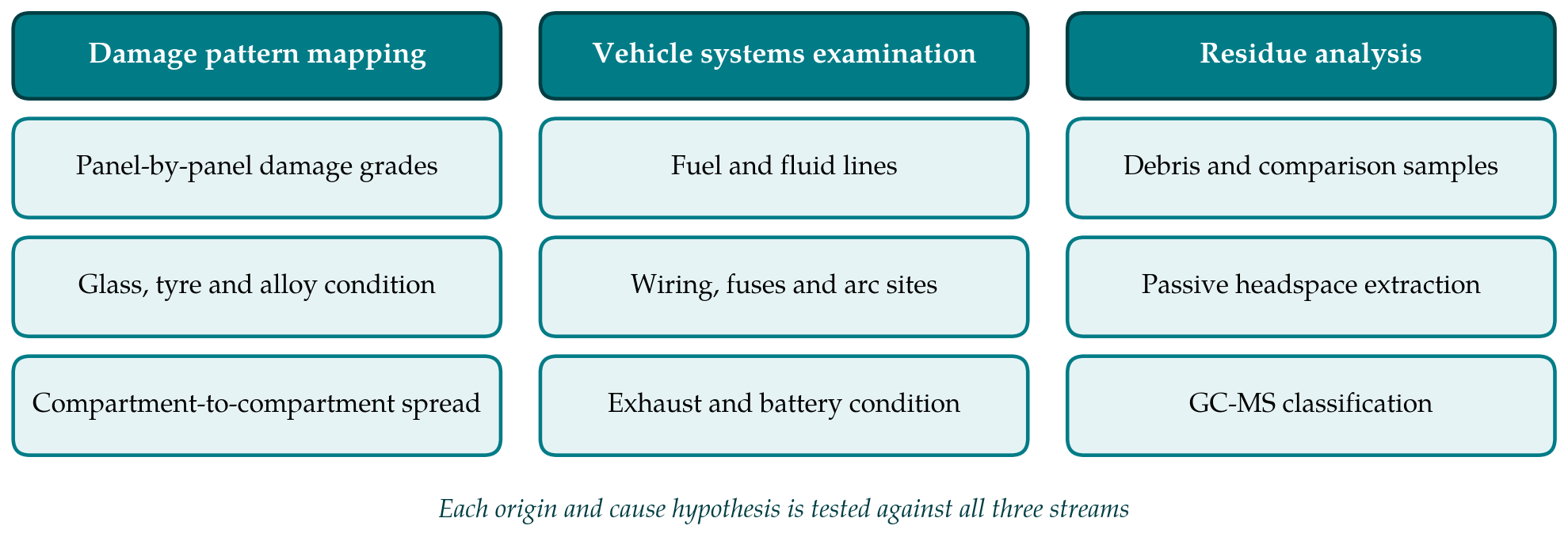
The protocol has eight phases, listed in Table 1 with the record each should produce. They follow the sequence of the scientific method as the guide sets it out: define the problem, collect data, analyse them, develop hypotheses and test each against all the data. Figure 1 shows the three streams of physical evidence that the phases generate and that the final phase brings together. The protocol assumes an investigator who meets the professional qualification standard for the role (NFPA, 2022) and a laboratory working to the ASTM methods.
| Phase | Main activity | Record produced |
|---|---|---|
| 1. Safety and preservation | Make the vehicle safe; protect it and its surroundings from disturbance | Scene log; as-found photographs |
| 2. Background data | Identify the vehicle; gather history, witness and fire service accounts | Vehicle data sheet; statements |
| 3. Exterior mapping | Grade and chart damage on every panel, window and wheel | Annotated damage maps |
| 4. Compartment examination | Remove debris in layers from cabin, engine bay and load space | Layer notes; position of controls and openings |
| 5. Systems examination | Inspect fuel, electrical, exhaust and battery systems | Systems checklist; retained components |
| 6. Sampling | Take debris and comparison samples on stated grounds | Sample register; chain of custody |
| 7. Laboratory analysis | Extract and classify residues by standard methods | Laboratory report with chromatographic data |
| 8. Hypothesis testing | Test each origin and cause hypothesis against all findings | Reasoned report; peer review record |
4. Phases 1 and 2: Preservation and Background
The first duty is safety. A burned vehicle may hold undeployed airbag inflators, pressurised struts, residual fuel and, in hybrid and electric models, a damaged high-voltage battery. Lithium-ion packs can enter thermal runaway and reignite long after a fire appears to be out (Sun et al., 2020), so the manufacturer's emergency response information should be consulted before the vehicle is touched. The vehicle is then recorded exactly as found, with its surroundings: ground staining, glass fragments and their distance from the body, detached parts, containers, tyre marks and vegetation damage. If the vehicle must be moved for examination, its position and the ground beneath it are documented and sampled first.
Background data are gathered before interpretation begins. They include the identification number, model, age, fuel type, service and repair history, any open safety recalls, recent faults reported by the driver, and where and how the vehicle was last used. Fire crews can say which compartment was burning on arrival, whether doors, windows and bonnet were open or shut, and what they opened or cut. Bystander video is often available. Stored electronic data from control modules may survive and should be preserved by someone qualified to recover them.
5. Phases 3 and 4: Mapping the Damage
The exterior is photographed from all sides and from above where possible, then examined panel by panel. On a plan and four elevations of the vehicle type, the investigator charts a small number of defined damage grades for painted metal, for example sooted, paint blistered, paint consumed, and bare oxidised metal, and notes the state of each window, tyre, wheel, lamp unit and trim piece. The value of a fixed scale is that the map can be checked by another person and compared between vehicles. The underside is charted in the same way once the vehicle is lifted.
The interior is cleared in layers. Roof lining, glass and upper trim fall first in a fire and lie over seat and floor debris, so their order records the sequence of collapse. Each layer is photographed and removed in turn, and the position of the ignition switch or start control, gear selector, handbrake, window regulators and door latches is noted as they are exposed. The engine bay and load space are treated likewise. The completed maps are then read with the ventilation history in mind: which openings existed before the fire, which failed during it, and which were made by firefighters.
What the maps can support depends on how far the fire progressed. Where one compartment is heavily damaged and its neighbours lightly, the direction of spread is usually clear. Where the whole vehicle has burned out, the maps may show only where ventilation was best, and the protocol requires the investigator to say so and not to nominate an origin from the area of deepest damage alone (Gorbett et al., 2015; Icove et al., 2013).
6. Phase 5: Examining the Vehicle Systems
Accidental vehicle fires arise mostly from a limited set of mechanisms: fuel or other combustible fluids released onto hot surfaces, electrical faults, overheated exhaust components and catalytic converters in contact with combustibles, and mechanical failures that generate frictional heat. Each leaves traces that can survive the fire. Fuel lines, rails, injectors and filler components are inspected for loose or missing fittings and for failures that preceded the fire. Fluid reservoirs and their caps are accounted for. Wiring is traced where it survives, fuses and relays are recorded, and sites of arcing on conductors are marked on the damage map, since their distribution can indicate where circuits were first attacked while still energised.
The ignition properties of the fluids matter here. Whether a leaked fluid will ignite on a hot manifold depends on the fluid, the surface temperature and the airflow, and published data show that hot-surface ignition requires temperatures well above the laboratory autoignition value (Babrauskas, 2003). A hypothesis of accidental ignition by a named fluid on a named surface should therefore be checked against such data and not assumed from proximity. Components that may bear on cause are photographed in place, removed and retained for examination by a specialist and by other interested parties.
7. Phases 6 and 7: Sampling and Residue Analysis
Samples for the laboratory are taken for stated reasons that are written down at the time. Useful locations are those where an ignitable liquid would not ordinarily be present and where a liquid would be protected from burning away: carpet and underlay beneath seats, seams of the floor pan, the foam of seat bases, and soil under the vehicle. For every questioned sample a comparison sample of the same material from an unburned or less damaged part of the vehicle is sought, so that the laboratory can separate the substrate's own contribution. Samples go into clean airtight containers suited to fire debris, are sealed and labelled at once, and are kept cool. The register records who took each sample, from where, with what tool, and whether fresh gloves were used.
In the laboratory the debris is extracted and analysed by the standard methods already named. The report should state the class of any ignitable liquid identified under the scheme of the test method, the result for each comparison sample, and the limits of the finding (ASTM International, 2019b). Weathered petrol in soil beneath a ruptured fuel tank is unremarkable. The same class of liquid in seat foam, with a clean comparison sample and an intact fuel system, calls for an explanation. A negative result does not show that no liquid was used, since volatile liquids can be consumed completely, and the laboratory should say this as plainly as it reports a positive.
8. Phase 8: Testing Hypotheses and Reporting
The investigator now lists every origin and cause that the data allow, not only the one that seems likeliest, and tests each against the damage maps, the systems findings, the laboratory results and the background data. A hypothesis survives only if it is consistent with all four. The guide warns against concluding that a fire was set merely because no accidental cause was found, a line of reasoning it calls negative corpus and rejects (NFPA, 2021). Where more than one hypothesis survives, the cause is reported as undetermined. Before issue, the report and its supporting record are reviewed by a second qualified investigator who has access to the maps and the sample register and not only to the conclusions.
9. Limitations and What Remains to Be Shown
This protocol is put forward as a proposal. It has not been applied to a vehicle fire for this article and no claim is made about its accuracy. Validation would call for test burns of vehicles with known origins and causes, examined by investigators who are not told the answer, with the rate of correct, incorrect and undetermined findings recorded. Such work would also show whether a fixed damage scale gives better agreement between investigators than free description, which is assumed here and not demonstrated.
Other limits are already apparent. The protocol demands time, lifting equipment and laboratory capacity that are not available for every burned vehicle, and some selection of cases is inevitable. Electric vehicles change the fuel load, the fire behaviour and the hazards, and experience with them is still accumulating (Sun et al., 2020). And in a vehicle that has burned completely, no procedure can recover information that the fire has destroyed. The protocol's contribution in such cases is to make the reasons for an undetermined finding explicit.
10. Conclusion
Damage patterns and residue analysis are the two kinds of physical evidence most often relied on after a vehicle fire, and each is easily asked to carry more than it can. The protocol described in this article ties them to one another and to a documented examination of the vehicle's own systems, so that a pattern is read against ventilation, a laboratory result against what the vehicle normally contains, and both against the alternatives. It is built from existing guidance and standards and adds structure more than novelty. Whether that structure improves the reliability of conclusions is a question for controlled testing.
Conflict of interest
To be declared by the author(s) before publication.
Funding
To be declared by the author(s) before publication.