1. Introduction
Seaweeds account for a large share of the world's aquaculture harvest by weight, and almost all of it is grown in Asia, with China and Indonesia the leading producers (FAO, 2022). The crop falls into two broad groups. Temperate kelps and red algae such as Saccharina, Undaria and Pyropia are grown mainly for food in East Asia. Tropical red algae of the genera Kappaphycus and Eucheuma are grown on lines in shallow lagoons for carrageenan, a gelling agent used by the food industry, and Gracilaria is grown for agar (Buschmann et al., 2017).
It is the tropical group that has been taken up most widely as a livelihood intervention. The method is simple: cuttings are tied to lines strung between stakes or floats, left to grow for several weeks, then harvested and sun-dried. Start-up costs are low, no feed is needed and the product keeps without refrigeration. Development agencies and conservation organisations have introduced farming in the Philippines, Indonesia, East Africa, India and the Pacific on the strength of these features (Valderrama et al., 2013). More recently, seaweed has been presented as a contribution to climate mitigation and to the restoration of coastal water quality (Duarte et al., 2017).
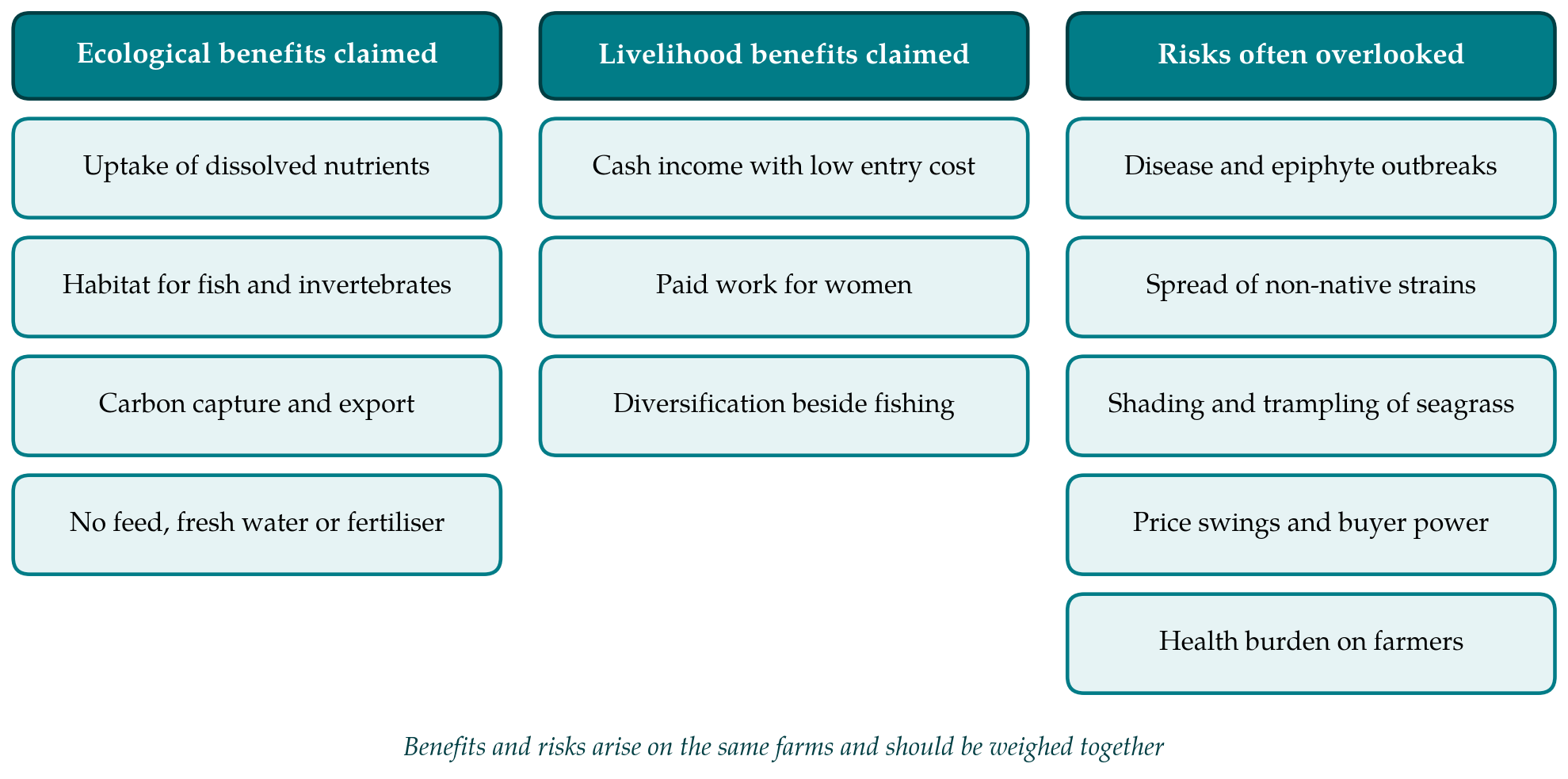
Enthusiasm of this kind invites scrutiny. This review sets out what is known about the ecological benefits claimed for seaweed farming and then examines risks that are less often discussed when farming is proposed to a coastal community. Figure 1, in a later section, arranges the main claims and risks side by side.
2. Approach
The article is a narrative review of the published literature: peer-reviewed studies, reports of the Food and Agriculture Organization and policy briefs from research institutions. Sources were chosen for their relevance to small-scale farming in coastal communities, and the emphasis is on tropical carrageenophytes because that is where the livelihood argument has been made most often. Work on temperate kelp farming is used where it bears on ecological effects. No systematic search was undertaken, and the review does not attempt to quantify effects across studies.
3. Ecological Benefits
Three kinds of environmental benefit are regularly attributed to seaweed farms. They rest on evidence of differing strength.
3.1. Nutrient uptake
Seaweeds take up dissolved nitrogen and phosphorus as they grow, and harvesting removes those nutrients from the water body. This is the best established of the benefits. It underlies integrated multi-trophic aquaculture, in which seaweeds are grown beside fed fish or shrimp so that the waste of one crop becomes the input of another (Chopin et al., 2001; Neori et al., 2004). At a regional scale, the very large seaweed harvest of China has been estimated to remove a meaningful fraction of the nutrients entering its coastal seas (Xiao et al., 2017). The same process has a less welcome side in nutrient-poor waters, where a dense farm competes with phytoplankton and natural vegetation for a limited supply (Campbell et al., 2019).
3.2. Habitat provision
Suspended lines of seaweed add three-dimensional structure to open water, and fish and mobile invertebrates gather around them. Whether this represents new production or the attraction of animals from nearby habitats is seldom resolved, and the structure is removed at every harvest. Reviews of the environmental effects of farming treat the habitat benefit as plausible but poorly quantified (Campbell et al., 2019).
3.3. Carbon
The carbon argument has two parts. Wild macroalgae export a share of their production to deep water and sediments, where some of it is stored for long periods (Krause-Jensen and Duarte, 2016), and farmed seaweed may do likewise through fragments shed before harvest. In addition, seaweed products may displace materials with a larger carbon footprint (Duarte et al., 2017). Modelling suggests that offsetting on a scale relevant to national emissions would require farming over very large areas (Froehlich et al., 2019).
The accounting has been challenged. Hurd et al. (2022) point out that carbon fixed by a seaweed is not the same as carbon dioxide removed from the atmosphere: the air-sea exchange that completes the removal is slow, calcifying organisms on the fronds release carbon dioxide, and most harvested biomass is consumed and returns to the atmosphere within a short time. On present evidence, a small farm should not be described to its owners as a carbon sink, and income from carbon credits is not a sound basis for a household's planning.
4. Livelihood Benefits
The economic case rests on accessibility. A comparative study of carrageenan seaweed farming in six countries found that it can give coastal households a regular cash income from a small outlay, with returns to labour that compare well with local alternatives when prices are favourable (Valderrama et al., 2013). In the Philippines, where commercial cultivation of Kappaphycus began in the early 1970s, farming has supported large numbers of families for several decades (Hurtado et al., 2015). Because the work is done in shallow water close to home and fits around other tasks, women have taken it up widely, and in Zanzibar they make up the majority of farmers (Fröcklin et al., 2012).
Seaweed farming also fits the logic of livelihood diversification, in which rural households spread risk across several activities instead of relying on one (Ellis, 2000). A crop harvested every few weeks smooths income between fishing seasons. The qualification is that diversification helps only if the risks of the new activity are not closely tied to those of the old, and a lagoon farm shares with reef fishing its exposure to storms, warming water and the condition of the lagoon itself.
5. Overlooked Risks
The risks discussed below are documented in the literature but are rarely given the same weight as the benefits when farming is promoted. Table 1 pairs each common claim with the main qualification and the sources on which this review relies.
| Claim | Main qualification | Representative sources |
|---|---|---|
| Cleans coastal water | True for nutrient-rich sites; competes with native vegetation where nutrients are scarce | Neori et al., 2004; Campbell et al., 2019 |
| Stores carbon | Fixation is not sequestration; most biomass is soon consumed | Hurd et al., 2022 |
| Harmless to the seabed | Shading and trampling alter seagrass beds under farms | Eklöf et al., 2005 |
| Reliable crop | Clonal stock is prone to ice-ice disease and epiphytes | Largo et al., 1995; Vairappan et al., 2008 |
| Safe to introduce | Farmed strains have spread onto reefs outside their native range | Conklin and Smith, 2005 |
| Steady income | Prices fluctuate and farmers have little bargaining power | Valderrama et al., 2013 |
| Reduces fishing pressure | Fisher numbers have not fallen where farming expanded | Hill et al., 2012 |
5.1. Disease, epiphytes and a narrow genetic base
Tropical carrageenophytes are propagated by cuttings, so a farming region may be planted with a very small number of clones. The crop has been domesticated at great speed with little of the breeding and health management that accompany land crops (Loureiro et al., 2015). Two problems recur. Ice-ice disease, a whitening and softening of the thallus that follows stress from high temperature, low salinity or low light and is aggravated by opportunistic bacteria, can destroy a crop within days (Largo et al., 1995). Infestation by filamentous red algal epiphytes lowers yield and carrageenan quality and has spread through the main producing countries (Vairappan et al., 2008). In Tanzania, repeated die-offs of the higher-value Kappaphycus have pushed farmers towards the hardier but cheaper Eucheuma denticulatum (Valderrama et al., 2013). A policy brief on the future of the industry identifies weak biosecurity, including the unregulated movement of seed stock between countries, as its principal vulnerability (Cottier-Cook et al., 2016).
5.2. Introduced species
Kappaphycus and Eucheuma are native to South-East Asia and have been carried to many other tropical coasts for farming. In some places they have left the farms. In Kane'ohe Bay, Hawai'i, Kappaphycus introduced for research and cultivation spread across reef habitat and overgrew coral, and proved difficult to remove (Conklin and Smith, 2005). Overgrowth of live coral by Kappaphycus alvarezii has also been reported from the Gulf of Mannar in southern India (Chandrasekaran et al., 2008). Establishment is not inevitable, and in many introductions no spread has been recorded, but the outcome is hard to predict in advance and expensive to reverse. For temperate kelps the parallel concern is genetic: cultivated strains may interbreed with wild populations nearby (Campbell et al., 2019).
5.3. Effects on seagrass and the lagoon floor
Off-bottom farms are usually sited on shallow sand flats, which in the tropics are often seagrass meadows. In Zanzibar, seagrass beds beneath farms had lower seagrass cover and different macrofaunal assemblages than comparable beds without farms, an effect attributed to shading, to the clearing of vegetation by farmers and to trampling during daily tending (Eklöf et al., 2005). Seagrass meadows are nursery grounds for the fish and invertebrates on which the same communities depend, so a loss here is set directly against the gain in farm income. European assessments list benthic shading, altered water flow and the deposition of organic matter among the effects that need study before farming is scaled up (Campbell et al., 2019).
5.4. Markets and bargaining power
Dried carrageenophyte is an industrial raw material sold into a chain that ends with a small number of processors. Farm-gate prices have risen and fallen sharply over the years, and farmers in remote villages commonly sell to a single buyer who also supplies their ropes and seed on credit. The six-country comparison found wide differences in the price farmers received and in their share of the export value (Valderrama et al., 2013). In Zanzibar, Fröcklin et al. (2012) concluded that the income earned by women farmers was low in relation to the hours worked and questioned whether the activity deserved its reputation as a development success.
5.5. Health and safety of farmers and consumers
The same Zanzibar study recorded that seaweed farmers reported poorer general health than women in other occupations, with complaints that included musculoskeletal pain, fatigue, eye and skin irritation and injuries from marine organisms, consistent with long hours bent over in salt water under strong sun (Fröcklin et al., 2012). These burdens seldom appear in appraisals of farming projects. For seaweeds grown as food there is a separate question of product safety: some species accumulate iodine, arsenic and other elements to levels that are subject to regulation in importing countries (Holdt and Kraan, 2011), and small producers are poorly placed to pay for testing.
5.6. The assumption that farming replaces fishing
Conservation programmes have often introduced seaweed farming as an alternative livelihood in the expectation that people who farm will fish less. Field studies in the Philippines and Indonesia found little support for this. Households tended to add farming to fishing instead of substituting one for the other, and income from seaweed was sometimes invested in fishing gear (Sievanen et al., 2005). In the central Philippines the number of fishers did not decline in villages where farming grew (Hill et al., 2012). Farming may still be worth supporting for the income it brings, but it should not be counted on as a fisheries management measure.
6. Weighing Benefits and Risks
Read together, these strands suggest that the outcome depends heavily on context. Nutrient removal is a benefit beside a fish farm or a polluted estuary and a potential cost on an oligotrophic reef flat. A native species farmed over bare sand carries little of the ecological risk attached to an introduced clone grown over seagrass. A household with other income can ride out a crop failure or a price fall that would ruin one dependent on seaweed alone. Scale matters as well: effects that are negligible for a few lines may become significant when a lagoon is covered.
Some of the risks can be reduced by measures that are already understood. They include siting farms away from dense seagrass and coral, quarantine and health checks on seed stock, the maintenance of several cultivars, and the organisation of farmers into groups able to negotiate with buyers (Cottier-Cook et al., 2016). Their adoption is uneven, in part because the costs fall on farmers and local authorities with few resources.
7. Gaps and Future Work
Several gaps stand out. Ecological effects of tropical off-bottom farms have been measured at few sites, and before-and-after comparisons are rare. Farm-level accounts that include unpaid family labour, crop losses and health costs are scarce, which makes claims about profitability hard to assess. The fate of carbon shed from farms is largely unmeasured. Little is known about how warming lagoons will affect disease, although farmers' reports of die-offs in hot seasons point to a growing problem. Research that follows the same farming households and the same lagoon habitats over a number of years would address several of these at once.
8. Conclusion
Seaweed farming offers coastal households real advantages: low entry cost, a short crop cycle and work that is open to women. Its capacity to take up nutrients is well founded. Its other ecological claims are less secure, and the published record documents disease, biological invasion, damage to seagrass, weak market position and ill health among farmers. None of these argues against farming as such. They argue for presenting it to communities with its risks stated, for choosing sites and species with care, and for treating it as one source of income among several.
Conflict of interest
To be declared by the author(s) before publication.
Funding
To be declared by the author(s) before publication.