1. Introduction
Kelps are large brown seaweeds of the order Laminariales, and on temperate rocky reefs they build the habitat on which much else depends. Their canopies shade the understorey, slow the water, export detritus to neighbouring systems and shelter fishes and invertebrates of commercial value. The classic accounts of kelp ecology stressed how variable these forests are, cleared by storms and grazers and regrowing within a few years (Dayton, 1985; Steneck et al., 2002). That capacity to recover is the background against which recent losses have to be judged, because a forest that fails to return after disturbance is a different matter from one that fluctuates.
The temperate coasts of the Southern Hemisphere hold some of the most extensive kelp systems on Earth. Across southern Australia a single interconnected system of rocky reefs dominated by the laminarian Ecklonia radiata runs along thousands of kilometres of coast, and Bennett et al. (2016) named it the Great Southern Reef to draw attention to its neglected social and economic value. Giant kelp, Macrocystis pyrifera, forms surface canopies in Tasmania, New Zealand, Chile and the sub-Antarctic islands, while Ecklonia maxima and Laminaria pallida dominate the Benguela coast of southern Africa. The large fucoid bull kelps of the genus Durvillaea, although not true kelps, fill a similar role on wave-exposed shores of New Zealand and Chile.
A global analysis of kelp time series found no single worldwide trend: some regions had lost canopy, some had gained, and many showed no clear change (Krumhansl et al., 2016). Within that mixed picture, several of the steepest declines came from southern temperate coasts, and the most abrupt of them coincided with periods of extreme ocean temperature. This article reviews what is known about that coincidence. It asks how far the increasing frequency of marine heatwaves, as distinct from the slow rise in mean temperature, accounts for kelp forest decline on these coasts, and where the evidence is thin.
2. Scope and Approach
This is a narrative review of the published literature. It draws on the papers that defined and catalogued marine heatwaves, on the field studies that documented kelp responses to particular events, and on the syntheses that placed those responses in a global setting. No formal search protocol was applied and no quantitative synthesis is attempted. The emphasis falls on Australia and New Zealand, where the record is deepest, with South Africa and Chile treated as comparisons that help to show which conclusions are general. Northern Hemisphere cases are mentioned only where they clarify a mechanism.
3. Defining and Counting Marine Heatwaves
Until a decade ago the term marine heatwave was used loosely. Hobday et al. (2016) proposed a definition that has since become standard: a discrete, prolonged, anomalously warm water event, identified in practice as a period of at least five days in which sea surface temperature exceeds the 90th percentile of a thirty-year local climatology for that time of year. The definition is relative and seasonal, so an event can occur in winter and in cold water. A later scheme grades events into four categories, from moderate to extreme, according to how many multiples of the threshold anomaly the peak temperature reaches (Hobday et al., 2018). Both conventions allow events in different oceans to be compared on one scale.
Applied to satellite and long in situ records, the definition shows a clear change through time. Oliver et al. (2018) reported that marine heatwaves became both more frequent and longer over the past century, so that the annual count of heatwave days rose substantially worldwide, and they attributed most of the change to the rise in mean ocean temperature and not to greater variability. Model projections indicate that the trend continues under further warming, with events that were rare in the pre-industrial climate becoming common (Frölicher et al., 2018). The drivers of individual events differ by region. Some are forced from the atmosphere through persistent high pressure and weak winds, others by ocean advection, and many are modulated by climate modes such as the El Niño Southern Oscillation (Holbrook et al., 2019).
Two points follow for ecology. A fixed-baseline definition means that, as the ocean warms, more of the year qualifies as heatwave, and the distinction between an event and a trend becomes partly a matter of bookkeeping. And the surface statistics describe the skin of the ocean, whereas kelp grows from the shallows to several tens of metres, where temperature may or may not follow the satellite record.
4. The Southern Hemisphere Record
The best documented cases come from four regions. They differ in the kelp species involved, in the oceanography behind the warming and in what replaced the canopy, and Table 1 summarises them before they are discussed in turn.
| Region | Canopy species | Reported change | Key sources |
|---|---|---|---|
| Western Australia | Ecklonia radiata | Range contraction after the 2011 heatwave; turf and subtropical species now dominate | Wernberg et al., 2013; Wernberg et al., 2016 |
| Eastern Tasmania | Macrocystis pyrifera | Long decline of surface canopy as warm, nutrient-poor water extended south | Johnson et al., 2011 |
| Eastern Tasmania | Ecklonia radiata and mixed algae | Urchin barrens formed by a range-extending sea urchin | Ling, 2008; Ling et al., 2009 |
| Southern New Zealand | Durvillaea spp. | Local extinction on some reefs after the 2017/18 summer | Thomsen et al., 2019 |
| South Africa | Ecklonia maxima | Eastward expansion along a cooling south coast | Bolton et al., 2012 |
4.1. Western Australia, 2011
In the austral summer of 2010/11 an unusually strong Leeuwin Current, driven by La Niña conditions, carried tropical water down the west coast of Australia while air-sea heat flux added to the warming. Temperatures along hundreds of kilometres of coast rose several degrees above the seasonal norm for weeks (Pearce and Feng, 2013). It was this event for which the phrase marine heatwave came into general use. Wernberg et al. (2013) documented the immediate effects on reefs near the warm limit of the kelp: the cover of habitat-forming seaweeds fell sharply, and the fish assemblage shifted toward tropical species within a single season.
What made the case influential was what happened next. Five years on, the kelp forests at the northern end of the range had not returned. Wernberg et al. (2016) described a contraction of the kelp's range of roughly one hundred kilometres and the replacement of forest by low turf, seaweeds and corals of subtropical affinity, maintained by increased grazing from tropical and subtropical fishes. The authors called it a regime shift, and the description has held. The event showed that a single extreme summer, superimposed on decades of gradual warming, could move a system past a point from which the ordinary processes of recovery no longer restored it.
4.2. Tasmania and south-eastern Australia
The Tasmanian story is slower and has more than one cause. The East Australian Current has extended further south over recent decades, bringing warmer, saltier and nutrient-poor water to the east coast of the island. Johnson et al. (2011) assembled the evidence that this change in oceanography coincided with a marked decline of giant kelp canopies, with shifts in the ranges of many species, and with the arrival of the long-spined sea urchin Centrostephanus rodgersii from the mainland. The urchin overgrazes seaweed beds and creates barrens of bare rock with much lower diversity than the reefs they replace (Ling, 2008). Fishing of large rock lobsters, the urchin's main predator, reduced the resilience of the kelp beds to that incursion (Ling et al., 2009).
Against this backdrop the Tasman Sea heatwave of 2015/16 was the longest and most intense then recorded in the region, and it was linked to an anomalous southward flow of the East Australian Current extension (Oliver et al., 2017). Its ecological effects fell on a system already altered. Tasmania therefore illustrates a general difficulty: where the trend is strong, the contribution of any one event to the loss of canopy is hard to isolate, and heat, nutrient supply and grazing act together.
4.3. New Zealand, 2017/18
The summer of 2017/18 brought record sea surface temperatures around the South Island of New Zealand. Thomsen et al. (2019) reported the loss of bull kelp from intertidal and shallow reefs, with local extinction of Durvillaea at some sites and its partial replacement by the introduced kelp Undaria pinnatifida. The case extends the pattern beyond Australia and beyond true kelps, and it draws attention to air temperature and desiccation at low tide as part of the stress on species that live at the water's edge.
4.4. South Africa and Chile
Not every southern temperate coast shows decline. Along the Benguela system, wind-driven upwelling keeps inshore water cold, and Ecklonia maxima has extended its range eastward along the south coast of South Africa in recent decades (Bolton et al., 2012). The Humboldt coast of Chile is similarly buffered by upwelling, and its kelp losses have been tied more often to El Niño warming and to direct harvesting than to a long-term trend. These coasts matter to the argument because they show that the response of kelp to a warming planet depends on local oceanography. Where upwelling strengthens, the regional signal can run against the global one.
5. Mechanisms Linking Heat to Canopy Loss
Heat affects kelp through several routes, and the persistence of a loss depends on which of them operate. Figure 1 groups the pathways that the literature identifies. The most direct is physiological. Kelps are cool-water organisms whose growth, photosynthesis and reproduction decline above a thermal optimum, and warm water in these regions usually carries little nitrate, so that thermal stress and nutrient limitation arrive together. Adult sporophytes bleach, erode and die, and the microscopic stages on which recruitment depends are often more sensitive still.
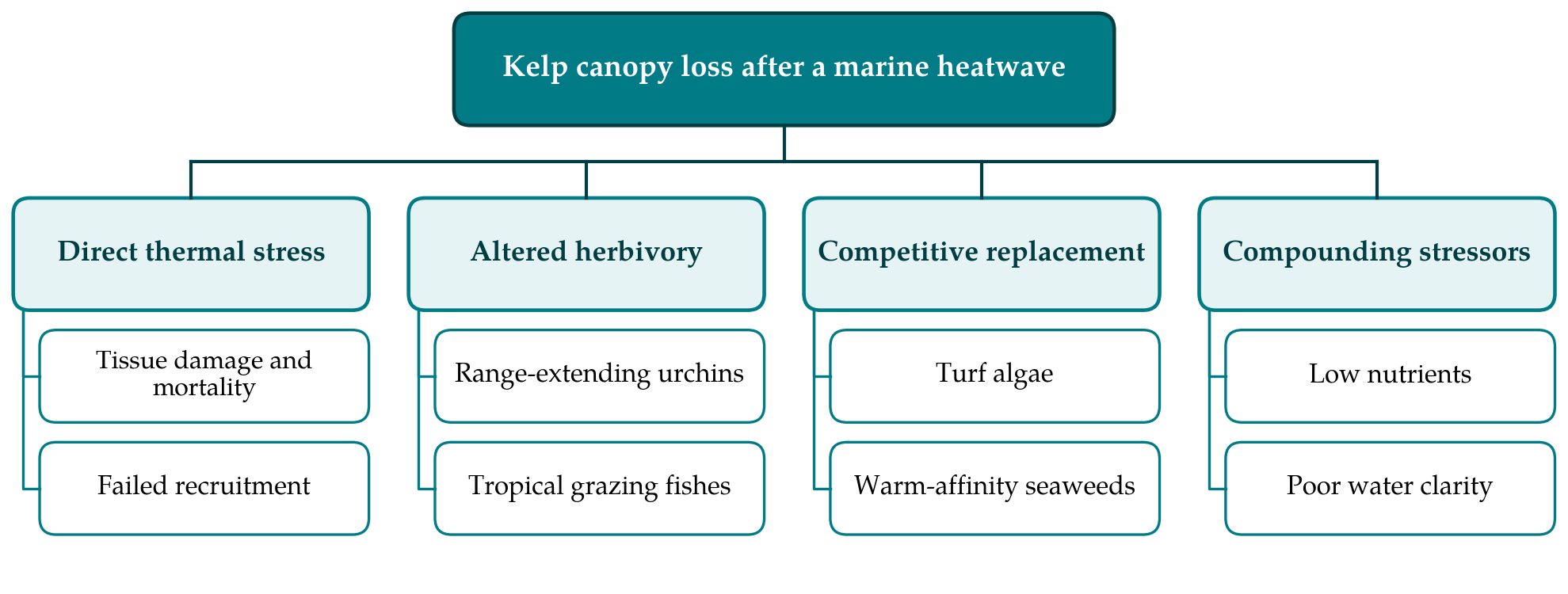
The second route runs through herbivores. Warming allows warm-water grazers to move poleward, a process described as the tropicalisation of temperate reefs. Vergés et al. (2014) reviewed cases from Japan, the Mediterranean and Australia in which range-extending fishes and urchins removed canopy seaweeds or prevented their return. In Western Australia it was fish grazing that held the reef in a turf state after the heatwave had passed; in Tasmania it is an urchin. Either way, the heat event opens space and the altered herbivore community keeps it open.
The third route is competitive. When canopy is lost, low mats of filamentous turf algae spread over the rock, trap sediment and inhibit the settlement of kelp spores. Filbee-Dexter and Wernberg (2018) argued that the replacement of kelp by turf is now as widespread a threat as the better known shift to urchin barrens, and that warming, eutrophication and reduced water clarity all favour it. Urchin barrens themselves behave as an alternative stable state: far fewer urchins sustain a barren than are needed to create one, so that recovery requires conditions well beyond those at which the collapse occurred (Filbee-Dexter and Scheibling, 2014). These feedbacks explain why a heatwave lasting weeks can have effects lasting years.
A global synthesis found that marine heatwaves have damaged foundation species of many kinds, among them corals, seagrasses and kelps, and that the damage is concentrated where populations live near their warm range edge and where other human pressures are strong (Smale et al., 2019). The kelp cases of the southern temperate coasts fit that pattern closely.
6. Gaps in the Evidence and Future Work
Several weaknesses limit what can be claimed. The first is the baseline. Long, consistent records of kelp cover exist for few southern reefs, and the global compilation of Krumhansl et al. (2016) was dominated by Northern Hemisphere and Australian sites. For much of southern Africa, South America and the sub-Antarctic there is little against which to measure change, and a later overview of the world's kelp forests repeated the point (Wernberg et al., 2019). Satellite detection of surface canopy helps for Macrocystis but not for subsurface Ecklonia.
The second is attribution. Most case studies are observational accounts of one event at a set of sites, and they cannot by themselves separate the pulse of a heatwave from the press of long-term warming, or either from fishing, sedimentation and nutrient change. Experimental work on thermal thresholds, and comparisons among populations with different thermal histories, are needed to turn correlation into mechanism. The third is the mismatch between surface temperature products and conditions at the depth where kelp grows, which calls for more in situ loggers on reefs.
A further gap concerns what happens between events. If heatwaves arrive more often, the interval available for regrowth shortens, and a forest that could absorb one warm summer in a decade may not absorb three. The published cases describe single events and their aftermath. Very few follow a reef through a sequence of heatwaves, and none of the southern records is long enough to say whether surviving populations become more tolerant through selection or acclimation, or weaker through the loss of reproductive adults. Frequency, the variable named in the title of this review, is thus the aspect of the problem on which direct ecological evidence is thinnest.
Finally, the literature on responses lags behind that on impacts. Restoration of kelp in Australia has a mixed record, and Layton et al. (2020) concluded that it succeeds only where the cause of the original loss has been removed or reduced. Where the cause is the temperature of the water, that condition is hard to meet, and attention has turned to controlling grazers, to protecting cool refuges and to the selection of heat-tolerant genotypes, all of which remain at an early stage.
7. Conclusion
The published evidence supports a qualified answer. Marine heatwaves have become more frequent and longer, and on the temperate coasts of Australia and New Zealand individual events have been followed by abrupt losses of kelp and bull kelp that did not reverse when the water cooled. The persistence of those losses owes as much to changed grazing and to turf feedbacks as to heat itself. Elsewhere, on upwelling coasts, kelp has held its ground or expanded. Decline is therefore not uniform, and frequency of heatwaves is one driver among several. Longer records, better attribution and tests of intervention are the clear priorities for the field.
Conflict of interest
To be declared by the author(s) before publication.
Funding
To be declared by the author(s) before publication.