1. Introduction
Prediabetes is common in adolescence. Analysis of national survey data from the United States suggests that roughly one in five adolescents meets at least one of the laboratory definitions (Andes et al., 2020), and youth-onset type 2 diabetes, once established, tends to follow a more aggressive course than the adult form, with early loss of glycaemic control on oral treatment (TODAY Study Group, 2012). Schools in large cities bring together many young people from communities that carry a high burden of obesity and diabetes, and they are a natural base for screening and for research.
Continuous glucose monitoring (CGM) has an obvious appeal in this setting. A sensor worn on the arm for up to two weeks records interstitial glucose every few minutes without fingersticks, and current devices need no user calibration. The data are rich, and it is tempting to assume that they are also informative. This communication is a commentary on that assumption. It presents no original data. It sets out what is known about interpreting CGM at near-normal glucose levels in young people, what the school context adds, and what studies in this population should report.
2. A Heterogeneous Group Defined by Adult Thresholds
The diagnostic categories applied to adolescents are those derived in adults: fasting plasma glucose of 100 to 125 mg/dL, two-hour glucose of 140 to 199 mg/dL after an oral glucose load, or glycated haemoglobin of 5.7 to 6.4 per cent (American Diabetes Association, 2024). These three tests identify overlapping but different groups, and their ability to predict progression in youth is less well established than in adults (Arslanian et al., 2018). Puberty adds a further complication. Insulin sensitivity falls during mid-puberty and recovers towards its end (Moran et al., 1999), so that some adolescents cross a threshold for a time and then return to normal without intervention. Young people with impaired glucose tolerance also differ physiologically from adults with the same label, showing greater insulin resistance and a more exaggerated insulin response (RISE Consortium, 2018). A group of adolescents with prediabetes is therefore a mixture of transient physiology and early disease, and CGM traces from such a group will reflect both.
3. Metrics Without Reference Values
The language of CGM reporting comes from diabetes care. International consensus statements define a standard set of metrics, including mean glucose, coefficient of variation, and the percentage of time within, above and below a target range of 70 to 180 mg/dL, and recommend about fourteen days of data with the sensor active for most of that time (Danne et al., 2017; Battelino et al., 2019). The targets attached to these metrics were set for people with type 1 and type 2 diabetes. They say nothing about what is desirable or abnormal in a person whose glucose rarely leaves the normal range, and no consensus targets exist for prediabetes at any age.
Reference data from people without diabetes help to frame the problem. In a multicentre study of healthy participants that included children, sensor glucose lay between 70 and 140 mg/dL for the great majority of the time, with brief excursions above that level after meals (Shah et al., 2019). Other work has shown that some adults with normal standard tests have frequent and large postprandial excursions (Hall et al., 2018). An occasional reading above 140 mg/dL is thus a normal event, and the question for prediabetes is one of degree and frequency for which thresholds have not been validated against outcomes. Derived indices should be used with similar care. The glucose management indicator, which converts mean sensor glucose into an estimate of glycated haemoglobin, was derived in people with diabetes (Bergenstal et al., 2018) and its behaviour at lower glucose levels in adolescents is uncertain. Classical measures of variability such as the mean amplitude of glycaemic excursions were likewise designed to describe unstable diabetes (Service et al., 1970).
Measurement error matters more near the normal range. Sensors measure interstitial fluid, which lags behind blood when glucose is changing, and readings can fall spuriously when the wearer lies on the sensor during sleep. Differences of the size that separate normal from mildly impaired glucose regulation are of the same order as the error of the device, so individual classification from a single wear period is unlikely to be reliable. Table 1 summarises these points for the commonly reported metrics.
| Metric | Origin | Caution in this population |
|---|---|---|
| Mean sensor glucose | Diabetes care (Danne et al., 2017) | Narrow spread; differences close to sensor error |
| Time in range 70 to 180 mg/dL | Consensus targets (Battelino et al., 2019) | Near ceiling in almost everyone; poorly discriminating |
| Time above 140 mg/dL | Studies of people without diabetes (Shah et al., 2019) | Plausible, but no validated cut-off |
| Coefficient of variation | Diabetes care | Strongly affected by meal content and activity |
| Glucose management indicator | Derived in diabetes (Bergenstal et al., 2018) | Not validated at near-normal glucose |
| Excursion amplitude | Unstable diabetes (Service et al., 1970) | Sensitive to how peaks are defined |
4. What the Urban School Setting Adds
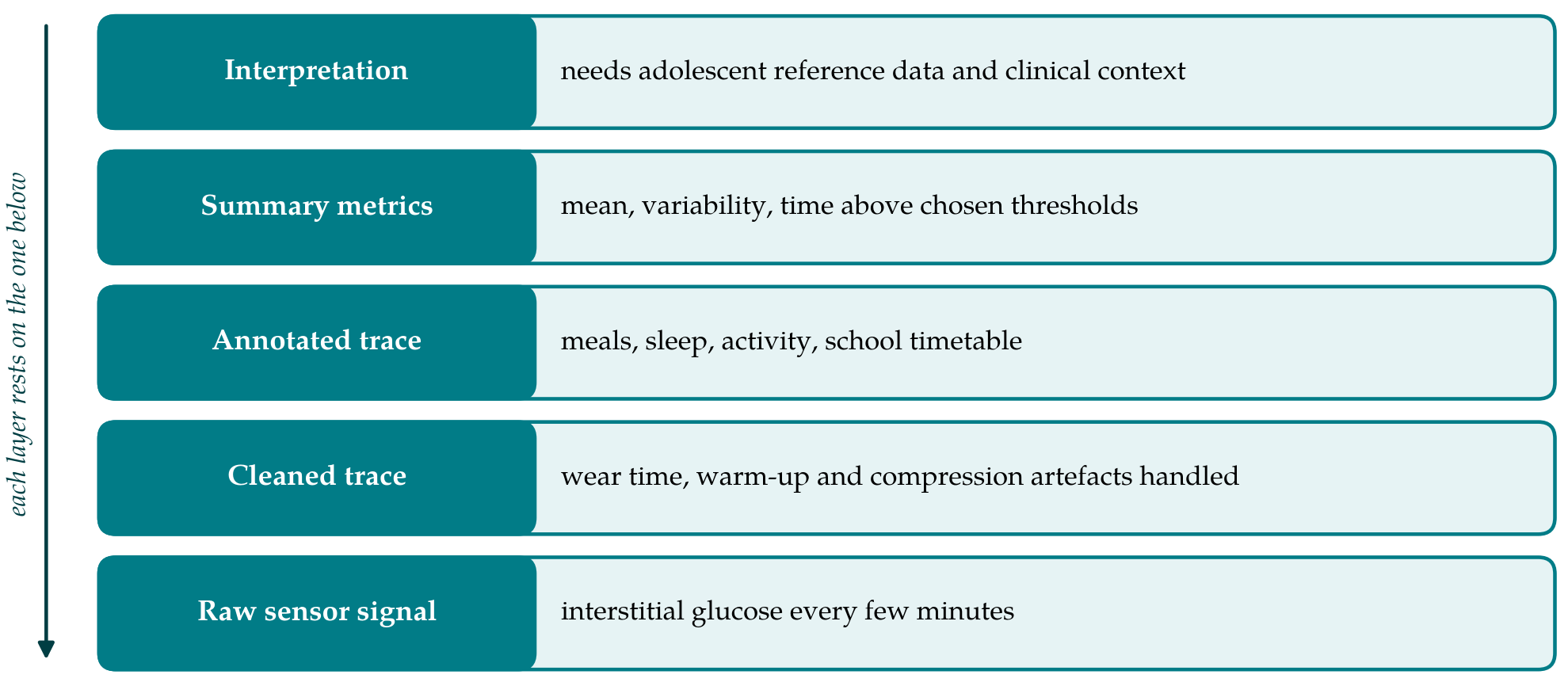
A glucose trace is a record of behaviour as much as of physiology. On school days adolescents eat at times fixed by the timetable, often from a limited menu, and their activity is concentrated in breaks, physical education lessons and the journey to and from school. Sleep is shortened on school nights and extended at weekends. A trace collected across a school fortnight will carry these patterns, and comparison between pupils, or between schools, is uninterpretable without them. At minimum, studies need the timing of meals, some record of what was eaten, activity, and sleep, and should analyse school days and other days separately. Figure 1 sets out the layers that lie between the raw signal and any statement about an individual adolescent.
The setting also raises questions that a clinic does not. A visible sensor identifies the wearer to peers, and adolescents selected because of weight or a screening result may experience this as stigmatising. Parental permission and the young person's own assent are both required, and the school should not have access to individual glucose data. Real-time display of readings can cause anxiety or prompt dietary restriction in adolescents who have no disease, and blinded recording avoids this. Recruitment through schools that agree to take part, and through families who return consent forms, will not produce a representative sample, and reports should describe who was approached and who declined.
A single wear period is also a snapshot. Glucose patterns in adolescents shift with examination periods, holidays and sports seasons and, in those still growing, with pubertal stage, so one fortnight cannot stand for a year. Repeated wear periods some months apart would show how stable an individual pattern is. Sensors detach more readily in active young people, and data lost in this way are unlikely to be missing at random with respect to activity; the extent of such loss should be reported and not silently excluded.
5. Suggested Reporting Items
Comparability between studies would be improved by a few consistent items. These are the criterion by which prediabetes was defined and whether it was confirmed on repeat testing; pubertal stage; the device, its wear period and the proportion of time with valid readings; whether the display was blinded; how the first day of wear and suspected compression artefacts were handled; the thresholds used for time above range, stated in advance; separate results for school days and other days; and the contextual data collected on meals, activity and sleep. Guidance on youth-onset type 2 diabetes does not list CGM among the tests recommended for screening or diagnosis (Arslanian et al., 2018), and reports should be clear that their purpose is descriptive.
6. Conclusion
Continuous glucose monitoring can describe the daily glucose patterns of adolescents with prediabetes in more detail than any single blood test, and urban schools are a practical place to gather such descriptions. The data are easy to collect and hard to interpret. The group is heterogeneous, the metrics lack reference values and validated thresholds for this age and glucose range, and the trace is shaped by the school day. Until longitudinal studies link sensor-derived measures in adolescence to later outcomes, CGM in this population is best treated as a research tool, reported with enough context to be compared, and kept apart from decisions about individual young people.
Conflict of interest
To be declared by the author(s) before publication.
Funding
To be declared by the author(s) before publication.