1. Introduction
The proposal to produce meat from cultured cells rests on tissue engineering methods developed for medicine. Post (2012) set out the steps: isolate stem cells from muscle, expand them in a bioreactor, induce them to fuse into myotubes, and assemble the result into something that can be cooked. Each step has since attracted research and investment, and each still presents technical and regulatory problems (Stephens et al., 2018; Post et al., 2020).
Muscle cells are anchorage-dependent. They proliferate and differentiate only when attached to a surface, and they form aligned, contractile fibres only when that surface gives them direction and resistance. In an animal the extracellular matrix, chiefly collagen, does this. In culture a scaffold has to. For ground products the scaffold may be a microcarrier bead that merely provides area; for structured products it is a three-dimensional porous body that determines the shape, and much of the texture, of the final piece (Ben-Arye and Levenberg, 2019).
Collagen and gelatin are the obvious scaffold materials, and fibrous gelatin has been shown to support muscle tissue with a texture approaching that of meat (MacQueen et al., 2019). They are also slaughter by-products, which defeats part of the purpose. Attention has therefore turned to materials from plants and fungi, which are produced at agricultural scale, have a history in food and carry no animal pathogens. This review surveys what has been reported for those materials and where the evidence stops.
2. Scope and Approach
The article is a narrative review of the published literature. It draws on primary studies in which plant or fungal materials were used as substrates for mammalian cell culture, whether for food or for biomedical purposes, and on earlier reviews of scaffolds for cultivated meat (Campuzano and Pelling, 2019; Ng and Kurisawa, 2021; Bomkamp et al., 2022; Seah et al., 2022). Materials from algae and bacteria, such as alginate and bacterial cellulose, are mentioned only for comparison. Company announcements that are not accompanied by published methods are left out.
3. What a Food Scaffold Has to Do
Four requirements recur in the literature. The first is attachment: cells must be able to bind the surface, which in animal matrix happens through integrins recognising short peptide sequences such as arginine-glycine-aspartate (RGD). The second is mechanics. Engler et al. (2006) showed that the stiffness of the substrate steers stem cells towards one lineage or another, and earlier work from the same group found that myotubes develop their striated structure best on gels of a stiffness close to that of muscle, and poorly on much softer or stiffer ones (Engler et al., 2004).
The third requirement is transport. Cells consume oxygen faster than it diffuses through dense tissue, and in the body few cells lie more than about 100 to 200 μm from a capillary (Carmeliet and Jain, 2000). A scaffold thicker than a fraction of a millimetre needs interconnected pores or channels through which medium can be perfused. The fourth requirement is peculiar to food. The scaffold is eaten, or else must be removed completely, so it has to be safe, digestible or at least harmless as fibre, neutral or pleasant in flavour, and able to survive cooking in a way that resembles meat (Bomkamp et al., 2022).
4. Plant-Derived Options
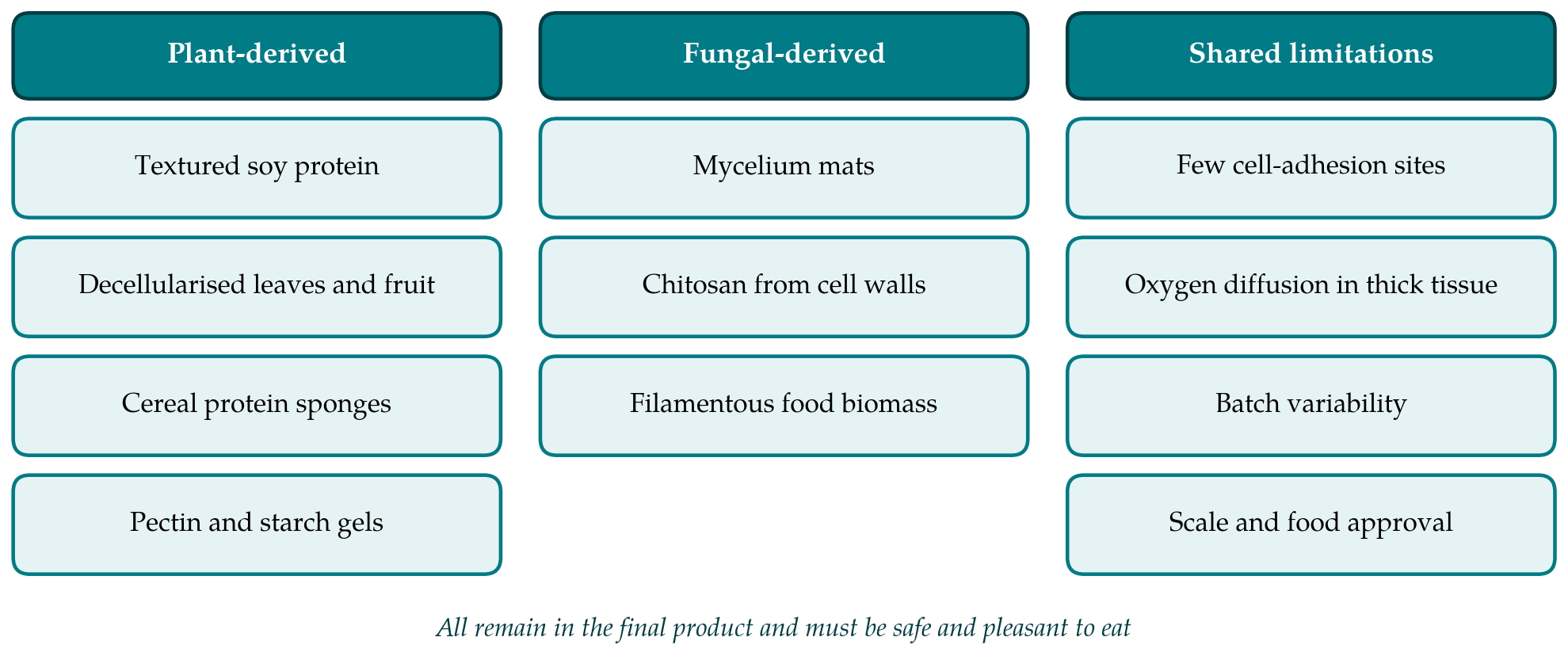
Plant materials reach the cell culturist in three forms: as protein ingredients already processed by the food industry, as intact tissues stripped of their cells, and as purified polymers formed into gels or sponges. Figure 1 groups these alongside the fungal options and the limitations that both share.
4.1. Textured soy protein
Textured vegetable protein is made by extruding defatted soy flour or concentrate under heat and shear, which yields a dry, porous, fibrous solid that is the base of many meat substitutes. Ben-Arye et al. (2020) seeded it with bovine satellite cells and reported that the cells attached, proliferated and formed myotubes within the pores, and that co-culture with smooth muscle and endothelial cells increased matrix deposition. The cooked product was assessed by a tasting panel. The attraction is plain: the material is cheap, food-grade, already accepted by consumers and itself contributes protein and bite. The fibres of extruded soy are, however, coarse and irregular compared with muscle fibres, so the alignment of cells follows the extrudate and cannot be precisely set.
4.2. Decellularised plant tissue
Removing the cells from plant tissue leaves a cellulose-rich framework that keeps the architecture of the original. Modulevsky et al. (2014) showed that slices of apple treated in this way supported the growth of mammalian cell lines, including myoblasts, in three dimensions. Gershlak et al. (2017) decellularised spinach leaves and perfused the remaining vein network, proposing it as a ready-made vascular tree, and Jones et al. (2021) cultured bovine satellite cells on decellularised spinach with cultivated meat specifically in mind. Plant tissues offer a library of structures, from the parallel bundles of celery and grasses to the open foam of fruit flesh.
Two reservations apply. Cellulose has no integrin-binding sequences, and attachment to untreated plant frameworks is often weak; Fontana et al. (2017) improved it by coating the material with adhesion peptides or by mineralising it, which adds cost and, for some coatings, raises food-safety questions. Decellularisation itself is commonly done with detergents such as sodium dodecyl sulfate followed by bleach, borrowed from biomedical protocols. Residues of such agents are not acceptable in food, and milder, food-compatible procedures are needed. Cellulose is also indigestible by humans, so the scaffold persists in the product as dietary fibre and changes its texture.
4.3. Protein sponges and polysaccharide gels
Purified plant proteins can be shaped more freely than whole tissues. Films and freeze-dried sponges of soy protein, zein from maize and glutenin from wheat have been tested as cell substrates, and Xiang et al. (2022) reported that porous glutenin scaffolds supported bovine satellite cells without added adhesion coatings. Plant polysaccharides such as pectin and starch form hydrogels that are soft, edible and inexpensive but offer cells little to hold on to unless blended with protein. These fabricated scaffolds allow pore size and stiffness to be tuned, at the price of extra processing and, for soy and wheat, the introduction of recognised food allergens.
5. Fungal-Derived Options
Filamentous fungi grow as networks of hyphae a few micrometres wide, a scale and geometry closer to muscle fibres than anything extrusion produces. Mycelium can be grown as a mat on liquid or solid substrates, and its density and mechanical properties vary with species and feed (Haneef et al., 2017). The biomass of Fusarium venenatum has been eaten as mycoprotein for decades, valued precisely because its filaments give a meat-like texture (Wiebe, 2002; Finnigan et al., 2019). Reviews of non-animal scaffolds accordingly list mycelium among the promising candidates (Campuzano and Pelling, 2019; Seah et al., 2022).
The fungal cell wall is built of chitin and glucans. Chitosan, obtained by deacetylating chitin, is a long-established biomaterial in tissue engineering, cationic and able to form sponges, fibres and gels (Croisier and Jérôme, 2013). Sourcing it from fungi instead of crustacean shell avoids both an animal input and a shellfish allergen. Published evidence that animal muscle cells grow and differentiate well on fungal scaffolds is nevertheless much thinner than for plant materials. Most of the case rests on analogy: fibrous structure, food history for a few species, and ease of cultivation.
6. Comparing the Options
Table 1 brings the materials together. No single candidate satisfies every requirement set out above, and the reviews cited agree that blends and composites are the likely outcome (Ng and Kurisawa, 2021; Bomkamp et al., 2022).
| Material | Form | Strengths | Limitations |
|---|---|---|---|
| Textured soy protein | Extruded porous solid | Cheap, food-grade, adds protein; myotubes shown Ben-Arye et al., 2020 | Coarse, irregular fibres; soy allergen |
| Decellularised leaf or fruit | Cellulose framework | Natural channels and varied architecture Gershlak et al., 2017 | Weak attachment; detergent residues; indigestible |
| Cereal protein sponge | Freeze-dried porous solid | Tunable pores; attachment without coating reported Xiang et al., 2022 | Extra processing; gluten |
| Pectin or starch gel | Hydrogel | Edible, inexpensive, mild gelation | Few adhesion sites; low strength |
| Fungal mycelium | Fibrous mat | Fine filaments; grown on simple feeds Haneef et al., 2017 | Little cell-culture evidence; species approval |
| Fungal chitosan | Sponge, fibre or gel | Established biomaterial; non-animal source Croisier and Jérôme, 2013 | Properties depend on source and deacetylation |
7. Limitations That Cut Across Materials
Several limitations are common to plant and fungal scaffolds alike. The lack of native adhesion motifs has been noted; the usual laboratory remedy, coating with gelatin, fibronectin or laminin, reintroduces animal products or expensive recombinant proteins. Mass transfer is unsolved for any scaffold of meat-like thickness, and the vein networks of leaves, attractive as they are, have been perfused only at laboratory scale. Mechanical data are usually reported for the dry or freshly hydrated material and seldom after weeks in culture medium, during which many plant proteins soften.
Most studies use small pieces in static culture, immortalised mouse cell lines or short time courses, and few follow bovine, porcine or avian primary cells through to mature tissue. Agricultural materials vary from batch to batch in ways that a pharmaceutical-grade polymer does not. Evidence on eating quality is sparse, and little is known about how residual scaffold affects flavour, colour and behaviour on cooking. Regulatory status differs by jurisdiction: in the European Union both the cells and any scaffold component without a history of consumption fall under the novel food regulation (European Union, 2015), and a fungal species new to the diet would need its own assessment.
8. Directions for Research
The gaps suggest an agenda. Food-compatible ways of improving attachment, such as plant-derived adhesion peptides or blending with proteins that cells bind unaided, deserve priority over coatings taken from medicine. Decellularisation needs protocols that use only food-grade reagents and that are verified for residues. Fungal scaffolds need the basic studies that plant scaffolds already have: attachment, proliferation and differentiation of livestock muscle and fat cells on mycelium and fungal chitosan under defined conditions. Reports should include the mechanical properties of the hydrated scaffold over the culture period and some measure of the cooked product, so that materials can be compared on the terms that matter for food.
Scale deserves separate attention. A scaffold that works as a square centimetre in a culture dish has to be produced by the tonne, sterilised without losing its structure, loaded into a bioreactor and seeded evenly through its depth. Extruded soy protein and fermented fungal biomass already come from industrial processes, which is an advantage that decellularised tissue and freeze-dried sponges do not share. Whether heat or irradiation sterilisation alters pore structure and cell attachment is rarely reported and would be simple to test. Comparative studies that run several materials through the same cells, medium and reactor would do more to guide the choice than further single-material demonstrations.
9. Conclusion
Plant and fungal materials are the most credible route to scaffolds that are edible, affordable and free of animal inputs. Textured soy protein and decellularised plant tissue have the fullest published record, protein sponges offer the most design freedom, and fungal mycelium and chitosan are attractive in structure but supported so far mostly by inference. Across all of them the unresolved issues are cell attachment without animal-derived coatings, nutrient supply in thick constructs, consistency of natural feedstocks and proof at scale. The scaffold is also an ingredient, and its contribution to texture and flavour should be studied as carefully as its biocompatibility.
Conflict of interest
To be declared by the author(s) before publication.
Funding
To be declared by the author(s) before publication.