1. Introduction
Adult-onset Still's disease was set apart as an entity when Bywaters (1971) described adults with the quotidian fever, evanescent rash and arthritis already familiar from the systemic form of juvenile arthritis. It remains uncommon, has no specific test, and is diagnosed only after infection, malignancy and other rheumatic diseases have been excluded (Gerfaud-Valentin et al., 2014). For that reason it reaches the rheumatologist late, often after weeks of investigation for fever of unknown origin under another specialty.
Macrophage activation syndrome is the form of secondary haemophagocytic lymphohistiocytosis that complicates rheumatic disease. It is driven by uncontrolled activation of T lymphocytes and macrophages (Crayne et al., 2019) and produces persistent fever, falling blood counts, liver dysfunction, coagulopathy and extreme hyperferritinaemia (Schulert and Grom, 2015). In Still's disease it may arise during a flare, after an infection, or at presentation, and it carries a substantial mortality in adults (Carter et al., 2019). Recent European recommendations treat systemic juvenile arthritis and the adult-onset form as one disease across ages and ask clinicians to look actively for this complication (Fautrel et al., 2024).
This article addresses the hardest version of the problem: an adult with prolonged fever in whom both conditions may be present and neither has yet been named. It proposes an ordered diagnostic pathway built from published criteria. It does not describe a patient or report the pathway in use, and it gives no treatment protocol. What it offers is a method, together with the reasoning for each step.
2. Background
Three sets of published tools supply the material for the pathway. Each was developed for a different purpose, and the differences explain why they cannot simply be applied side by side.
2.1. Prolonged fever as the entry point
The classical definition of fever of unknown origin required a temperature above 38.3 °C on several occasions, an illness lasting more than three weeks and no diagnosis after a week of inpatient investigation (Petersdorf and Beeson, 1961). A later revision shortened the required investigation and separated classical, nosocomial, neutropenic and HIV-associated categories (Durack and Street, 1991). Infection, malignancy and non-infectious inflammatory disease are the three large diagnostic groups, and Still's disease is among the more frequent inflammatory causes in adults.
2.2. Classification of adult-onset Still's disease
The criteria of Yamaguchi et al. (1992) are the most widely used. Their major items are fever of 39 °C or more lasting at least a week, arthralgia for at least two weeks, the typical rash, and leucocytosis of at least 10,000 per cubic millimetre with 80 per cent or more granulocytes. The minor items are sore throat, lymphadenopathy or splenomegaly, liver dysfunction, and negative rheumatoid factor and antinuclear antibody. Classification needs five items including two major ones, after exclusion of infection, malignancy and other rheumatic disease. The criteria of Fautrel et al. (2002) dispense with exclusions and add a glycosylated ferritin fraction of 20 per cent or less as a major item, following earlier work showing that a low glycosylated fraction combined with a high total ferritin is more specific than ferritin alone (Fautrel et al., 2001).
2.3. Recognising macrophage activation syndrome
Table 1 compares the instruments available. The HLH-2004 criteria were written for a paediatric treatment protocol and require five of eight findings, including a ferritin of at least 500 micrograms per litre, cytopenia in two lineages and tissue haemophagocytosis (Henter et al., 2007). They are specific but late: by the time five are met the syndrome is advanced. The HScore assigns weighted points to nine clinical, laboratory and cytological variables and returns a probability of reactive haemophagocytic syndrome (Fardet et al., 2014). The 2016 classification criteria were derived for systemic juvenile arthritis and require a ferritin above 684 nanograms per millilitre with two of four laboratory changes (Ravelli et al., 2016).
| Instrument | Developed for | Core content | Caveat in adult Still's disease |
|---|---|---|---|
| Yamaguchi criteria (1992) | Classifying adult Still's disease | Four major and four minor items, with exclusions | Leucocytosis may be absent once macrophage activation begins |
| Fautrel criteria (2002) | Classifying adult Still's disease | Six major, two minor items; glycosylated ferritin | Glycosylated ferritin assay not widely available |
| HLH-2004 (Henter et al., 2007) | Paediatric treatment protocol | Five of eight clinical and laboratory findings | Met late; some tests slow to return |
| HScore (Fardet et al., 2014) | Adults with suspected reactive syndrome | Nine weighted variables giving a probability | Not specific to rheumatic triggers |
| 2016 criteria (Ravelli et al., 2016) | Systemic juvenile arthritis | Ferritin threshold plus two of four laboratory changes | Derived in children; adult use is extrapolated |
A feature shared by both diseases complicates all three instruments. Active Still's disease raises the white cell count, the platelet count and fibrinogen. When macrophage activation supervenes, those values fall, and they may pass through the normal range on the way down. A platelet count that would be unremarkable in a healthy person can therefore be an alarm signal in someone whose count was high three days earlier, and the erythrocyte sedimentation rate may fall with fibrinogen while C-reactive protein keeps rising (Carter et al., 2019).
3. The Proposed Pathway
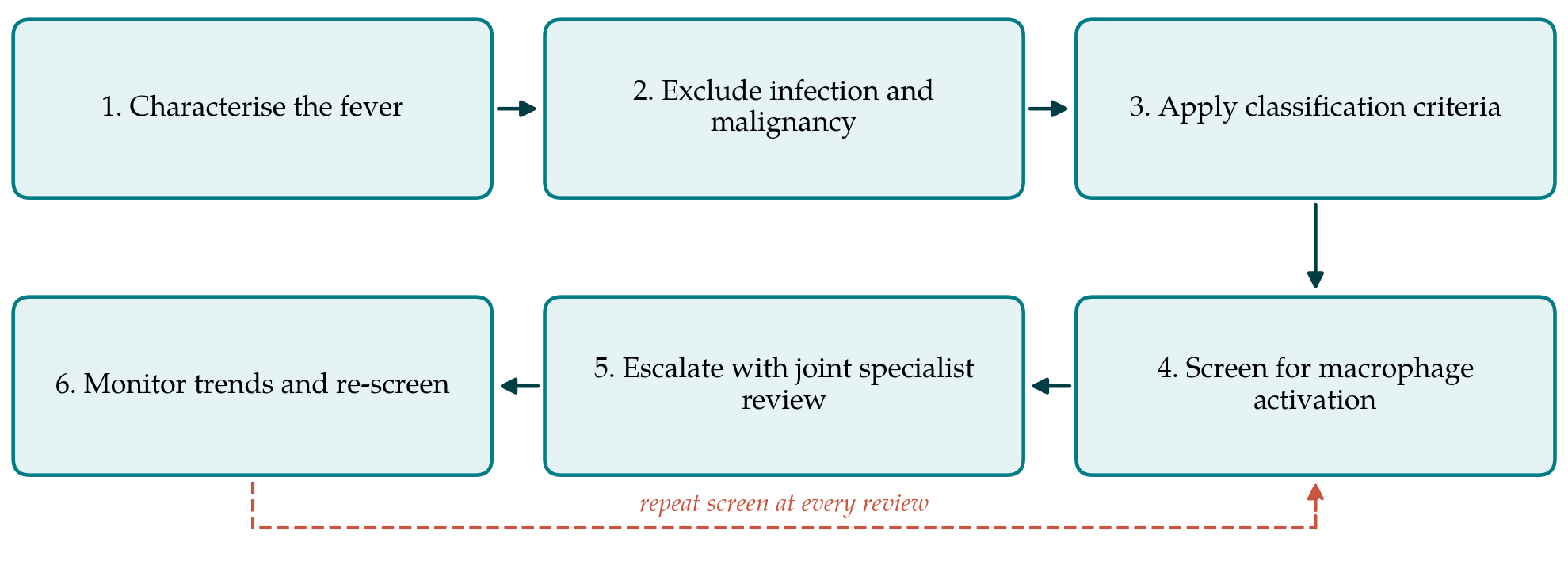
The pathway has six steps, shown in Figure 1. Steps one to three establish the underlying diagnosis; steps four to six deal with macrophage activation. In practice step four begins on the first day and runs in parallel with the others, since the complication cannot wait for the classification to be completed.
3.1. Step 1: Characterise the fever and its companions
The first step is descriptive. Temperature is charted at least four times daily so that a quotidian or double-quotidian pattern can be seen, and the skin is examined at the fever peak, when the salmon-coloured rash is most likely to be visible. Sore throat at onset, joint pain or swelling, lymph nodes, spleen and liver size, and serositis are recorded as present or absent. Baseline tests comprise a full blood count with differential, C-reactive protein, sedimentation rate, liver enzymes, lactate dehydrogenase, ferritin, triglycerides and fibrinogen. The record left by this step is a dated table of these values, which later steps depend on.
3.2. Step 2: Exclude infection and malignancy
Still's disease may be diagnosed only when the alternatives have been pursued. Blood cultures, serology and molecular tests directed by exposure and geography, cross-sectional imaging, and echocardiography where endocarditis is possible form the infectious part of the search. Lymphoma is the chief malignant mimic and is also the commonest malignant trigger of haemophagocytic syndrome in adults (Ramos-Casals et al., 2014), so enlarged nodes should be biopsied and not merely observed. Autoantibody testing covers lupus and vasculitis. The pathway asks the clinician to document which alternatives were considered and on what evidence each was set aside.
3.3. Step 3: Apply the classification criteria
With the exclusions documented, the Yamaguchi items are counted, and the Fautrel set is applied as well where glycosylated ferritin can be measured. Classification criteria were built to assemble comparable groups for research and were not intended as diagnostic rules (Giacomelli et al., 2018). A patient who falls one item short because leucocytosis is missing should not be dismissed if steps one and four suggest that macrophage activation has already lowered the count. The pathway therefore asks for the item count to be recorded twice: on the values observed, and on the highest values documented earlier in the illness.
3.4. Step 4: Screen for macrophage activation by trend
Screening is repeated at every review and uses change over time. The dated table from step one is extended daily during the acute phase. Features that should prompt concern are a ferritin that is rising steeply, a fall in platelets, neutrophils or haemoglobin from the previous measurement, rising liver enzymes and triglycerides, a falling fibrinogen or sedimentation rate in the face of persistent fever, and a change in the fever from spiking to continuous. The HScore is calculated at each review, and the 2016 criteria are checked as a second view. A bone marrow aspirate is requested when the screen is positive, both to look for haemophagocytosis and to exclude marrow infiltration, but its result is not a precondition for escalation, since haemophagocytosis may be absent early.
3.5. Step 5: Escalate with joint specialist review
A positive screen triggers same-day review by rheumatology and haematology together, with critical care informed. Published guidance for adults with haemophagocytic lymphohistiocytosis stresses that treatment should be directed at both the hyperinflammation and its trigger, and that it should not be delayed until every criterion is fulfilled (La Rosée et al., 2019). The choice of agents is outside the scope of this pathway and should follow those recommendations and the European guidance for Still's disease (Fautrel et al., 2024). What the pathway specifies is the handover: the dated table, the criteria counts, the HScore series and the list of excluded alternatives travel with the patient.
3.6. Step 6: Monitor and re-screen
After escalation the same variables are followed until fever has settled and ferritin, counts and fibrinogen are moving steadily in the right direction. Macrophage activation can recur, and it can be precipitated by intercurrent infection, so the screen in step four is resumed whenever fever returns. Markers such as interleukin-18 and soluble CD25 reflect the biology of the disease (Feist et al., 2018) and may be added where a laboratory offers them, but the pathway is designed to work without them.
4. Fitting the Pathway to Practice
The pathway was shaped by the settings in which prolonged fever is investigated. Most such patients are under general medicine or infectious diseases, and the tests in step one are available in any hospital laboratory, usually within hours. Ferritin is the exception in some centres, where it is batched; a unit adopting the pathway would need to arrange for it to be run urgently. Glycosylated ferritin, soluble CD25 and natural killer cell function are reference-laboratory tests in most places, and the design avoids depending on them.
The dated table is the element that costs least and matters most. Trend-based screening fails if values are scattered through an electronic record and nobody sets them side by side. A single flow sheet, on paper or in the record system, lets a clinician coming on duty see at a glance that the platelet count has halved. Where rheumatology is not on site, the same sheet supports a telephone consultation.
5. Limitations and What Remains to Be Shown
The pathway is a proposal. It has not been tested on patients, prospectively or retrospectively, and nothing in this article should be read as evidence that it improves outcomes. It also sets no numerical thresholds for the trends in step four, because none has been established for adults with Still's disease; the 2016 thresholds come from children with systemic juvenile arthritis, and the HScore cut-off was derived in a mixed adult population in which rheumatic triggers were a minority.
Validation would need to answer three questions. The first is whether trend-based screening identifies macrophage activation earlier than the application of HLH-2004 criteria at a single time point, which could be examined in existing case series with dated laboratory data. The second is how often the screen is positive in patients who turn out to have sepsis or lymphoma, since a pathway that triggers immunosuppression in undiagnosed infection would do harm. The third is whether counting classification items on peak values, as step three proposes, improves sensitivity without an unacceptable loss of specificity. Each of these is an empirical matter that the present article leaves open.
6. Conclusion
An adult with prolonged fever, very high ferritin and falling blood counts may have Still's disease and macrophage activation syndrome together, and the published criteria for each were not written with that combination in mind. The pathway proposed here orders the existing tools into six steps, replaces single thresholds with dated trends, and makes the record of each step explicit so that it can be handed between teams. Its components are established; their arrangement is new and untested. Careful evaluation against documented cases is the necessary next stage before any wider use.
Conflict of interest
To be declared by the author(s) before publication.
Funding
To be declared by the author(s) before publication.