1. Introduction
Fit approval has traditionally meant sewing a sample, putting it on a fit model and having a technician look, pinch and ask how it feels. Three-dimensional computer-aided design systems offer to replace part of that cycle. A two-dimensional pattern is stitched virtually around an avatar, the cloth is simulated under gravity, and the result is inspected on screen with maps of strain and pressure (Sayem et al., 2010). The attraction is fewer physical samples and faster decisions. The risk is that a decision taken on screen is wrong in a way nobody sees until bulk production.
That risk is not spread evenly. Plus-size customers already report more difficulty finding clothes that fit, and sizing systems serve them poorly because body proportions diverge as size increases (Alexander et al., 2012; Ashdown, 2007). If virtual fitting is less accurate for larger bodies, a company that adopts it across its range will make its worst fit decisions for the customers it already serves least well. The question deserves a direct test.
This article sets out a protocol for such a test. It describes how to compare virtual and live fit for the same garments on the same women, what to measure and how to analyse agreement. The protocol is proposed for use by companies, software users and researchers. It has not been run for this article, and no results are presented.
2. Background
The design of the protocol rests on what is known about how simulation works, what earlier comparisons found, and why larger bodies are a harder case.
2.1. How virtual fit is produced
Commercial systems represent cloth as a mesh of particles joined by elements that resist stretch, shear and bending, and they solve for the resting shape step by step. The implicit integration scheme of Baraff and Witkin (1998) made such simulation stable enough for practical use. Three inputs govern the outcome. The first is the avatar, which may be a parametric body adjusted by measurements or a mesh taken from a body scan. The second is the fabric, entered as tensile, shear and bending parameters and weight; these descend from the objective measurement tradition of Kawabata (1980), though each vendor uses its own test kit and units (Power, 2013). The third is the simulation setting itself: mesh density, collision thickness and friction.
2.2. What earlier comparisons found
Song and Ashdown (2015) compared virtual and real fit of trousers and found that the simulation was more accurate in some garment areas than in others, with overall fit judgements differing between the two. Lim and Istook (2011) showed that the drape of a simulated garment changes visibly with the fabric parameters supplied, and Power (2013) reported that converting laboratory fabric measurements into the values a simulator expects is far from straightforward. A review of sizing and fitting research concluded that validation has lagged behind adoption (Gill, 2015). None of these studies was designed around plus-size bodies.
2.3. Why plus-size bodies are a harder case
Several features of larger bodies strain the assumptions built into simulation. Most avatars are rigid: the garment deforms and the body does not. On a real body a waistband, bra band or fitted sleeve compresses soft tissue and displaces it, changing the silhouette above and below. Shape varies widely among women with the same girths, in the position of abdominal fullness, the prominence of the seat and the fullness of the upper arm (Alexander et al., 2012). Parametric avatars enlarged from a standard form tend to distribute volume evenly and miss that variety. Body surfaces also touch one another at the inner thigh, under the bust and at the underarm, where scans have gaps and collisions are difficult to resolve. Finally, garments for this market rely heavily on stretch fabrics, whose behaviour under sustained extension is among the harder properties to parameterise.
3. The Proposed Protocol
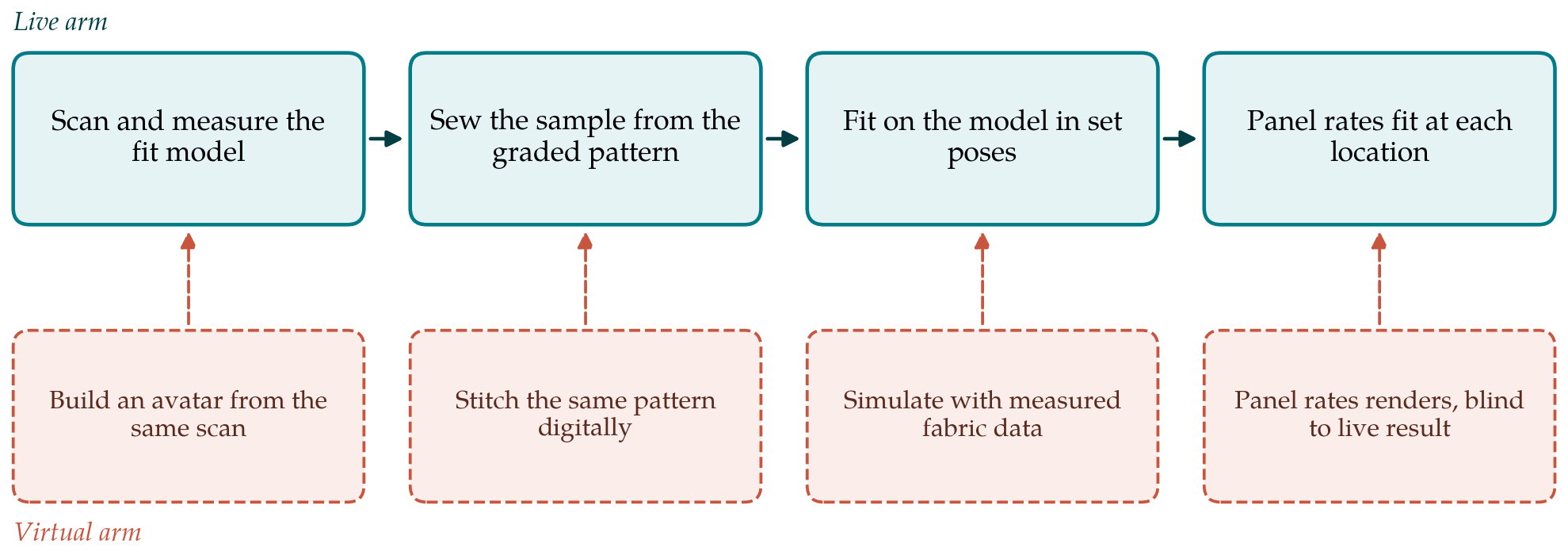
The protocol is a paired comparison. Every garment is assessed twice on the same woman, once sewn and worn and once simulated on an avatar built from her scan, as Figure 1 shows. Table 1 lists the stages, the main decisions at each and the output. The stages are then described in order.
| Stage | Main decisions | Output |
|---|---|---|
| 1. Garments and criteria | Choose garment types, fabrics, fit locations and rating scale | Written fit criteria and rating form |
| 2. Fit models and scanning | Select models across sizes and shapes; scan and measure each | Scans and manual measurements |
| 3. Avatars | Build a scan-based avatar; optionally a parametric one for comparison | Avatar files with measurement check |
| 4. Fabric characterisation | Test each fabric and enter parameters by a fixed method | Fabric parameter sheet |
| 5. Simulation | Fix software version and settings before any run | Renders, strain maps, virtual ease values |
| 6. Live fitting | Fit sewn samples in set poses; record ratings and ease | Rating forms, photographs, measured ease |
| 7. Agreement analysis | Apply pre-set statistics and thresholds by location | Agreement tables and conclusion |
3.1. Stage 1: Garments and fit criteria
The test set should span the cases that matter commercially: at least one woven and one knitted fabric, and garments for the upper and lower body, for example a fitted woven shirt, a woven trouser and a jersey dress. Fit is assessed at named locations, such as bust, upper arm, waist, high hip, seat, thigh and crotch, and against the classical criteria of ease, line, grain, balance and set (Fan et al., 2004). A short ordinal scale is used at each location, running from much too tight through acceptable to much too loose, together with a yes or no decision on whether the garment would be approved. Scale anchors are written out with photographs before assessment begins.
3.2. Stage 2: Fit models and scanning
Women are invited so that the group covers the size range of interest and, within each size, differing body shapes. Each is measured manually using landmark definitions from the international standard (ISO, 2017) and scanned in a standard posture in close-fitting undergarments, with scan-derived dimensions checked against the manual ones in the manner of the scanning methodology standard (ISO, 2018). The foundation garments worn for scanning are the ones worn for fitting, since a change of bra alters the bust point and contour. Participation requires informed consent and ethical review, and scans are stored as sensitive personal data.
3.3. Stage 3: Avatars
An avatar is prepared from each scan by closing holes and smoothing only as far as the software requires. Its key girths and lengths are checked against the manual measurements, and discrepancies beyond a stated tolerance are corrected or recorded. Where a company normally works with parametric avatars, a second avatar is produced by entering the woman's measurements into the software, so that the protocol can show how much accuracy depends on having the real body shape.
3.4. Stage 4: Fabric characterisation
Each fabric is tested with the kit or procedure that the software vendor specifies, on conditioned specimens, and the resulting parameters are entered without adjustment. Tuning fabric values by eye until the simulation looks right is common in practice and must be excluded here, because it would use knowledge of the physical garment to improve the virtual one.
3.5. Stage 5: Simulation
The graded production pattern for the woman's size is imported and stitched. Software version, mesh density, collision settings and the number of simulation steps are fixed in a written specification before the first run and held constant. The operator works without sight of the sewn garment on the body. Outputs are still images from set viewpoints, a turntable animation, strain and pressure maps, and the virtual ease at each fit location, taken as garment girth minus avatar girth.
3.6. Stage 6: Live fitting
The same pattern is cut and sewn in the same fabric. The model wears the sample standing, seated, and with arms raised and reaching forward. A panel of at least three experienced fit technicians rates every location independently on the prepared form. Ease is measured as the difference between garment and body girth, and where a clothed scan can be taken it is kept as a record for visual fit analysis of the kind described by Ashdown et al. (2004). The wearer's own comfort ratings are collected separately, since satisfaction with fit is partly a matter of how a person feels about her body (LaBat and DeLong, 1990) and should not be merged with the technicians' judgement.
The same panel rates the virtual garments from the simulation outputs. Order is randomised, a suitable interval separates the two sessions, and raters are not told which avatar corresponds to which woman.
3.7. Stage 7: Agreement analysis
Agreement, not correlation, is the quantity of interest: two methods can rise and fall together while one is consistently tighter than the other. For the ordinal ratings the protocol uses weighted kappa, which gives partial credit for near misses (Cohen, 1968), read against the conventional benchmarks of Landis and Koch (1977) and reported separately for each location and garment. For measured ease it uses the limits-of-agreement method of Bland and Altman (1986), which shows both the average bias of the virtual value and the range within which most differences fall. Consistency among raters within each mode is expressed as an intraclass correlation coefficient, chosen and reported as Koo and Li (2016) recommend. The approve or reject decisions are cross-tabulated. Before any data are seen, the team states the level of agreement that would justify relying on virtual approval, and the size of ease difference that a technician would regard as a different fit.
4. Fitting the Protocol to Practice
A full application is demanding, and a company may reasonably start with one garment type in which virtual approval is already being considered. The cost lies mostly in scanning and in sewn samples that the company would have made in any case. Two points should not be compromised. The women taking part are being scanned and assessed in minimal clothing, and the sessions must be run with privacy, respect and the right to withdraw. And the software settings must be frozen in advance, because a validation in which the simulation was adjusted after the live result became known is not a validation.
5. Limitations and What Remains to Be Shown
The protocol has not been tested, and several weaknesses are apparent on paper. Rating a render and rating a garment on a person are different tasks: a technician cannot tug a virtual hem or hear the wearer say that the armhole cuts. Some disagreement will therefore reflect the medium of assessment and not the simulation, and the design cannot fully separate the two. Results will hold only for the software version, fabrics and garment types examined. A static scan does not capture how soft tissue moves when a woman sits, so dynamic fit remains outside what the virtual arm can show. The number of women and garments needed for stable estimates at each location has to be worked out for each application and may be larger than a company finds convenient.
What remains to be shown is the main result itself: at which locations, and for which fabrics, virtual fit on scan-based avatars agrees with live fit closely enough to be trusted for plus-size garments, and how much is lost when a parametric avatar is used instead.
6. Conclusion
Virtual fitting is being adopted faster than it is being checked, and plus-size garments are the segment in which unchecked adoption carries most risk. The paired protocol proposed here holds the body, pattern and fabric constant, blinds the assessors, and analyses agreement location by location with methods chosen for the kind of data involved. Applied honestly, it would tell a company where a screen can stand in for a fitting room and where a sewn sample on a real woman is still required.
Conflict of interest
To be declared by the author(s) before publication.
Funding
To be declared by the author(s) before publication.