1. Introduction
Buy-now-pay-later (BNPL) products let a shopper take goods at once and pay in a small number of instalments, typically without interest when payments are made on time. The best-known form divides the price into four payments over about six weeks. The lender pays the merchant at the outset, less a fee, and bears the risk of non-payment. Merchants accept the fee because providers promise higher conversion and larger baskets, and an integration usually places the offer in three spots: a message beside the price on the product page, a reminder in the cart, and a button at checkout.
The claim about conversion is often expressed as a reduction in cart abandonment. It is a claim that a merchant can apparently check, since every storefront records carts created and orders completed. This note argues that the check is harder than it looks. It draws on published research and regulatory reports, presents no data of its own, and aims to help merchants and researchers read mobile storefront logs with appropriate caution.
2. Reasons to Expect an Effect
Behavioural research gives good grounds for thinking that the framing and timing of a payment change willingness to buy. Prelec and Loewenstein (1998) described a pain of paying that is felt most sharply when payment is closely coupled to consumption and is dulled when the two are separated. Willingness to pay has been found to be higher when people expect to use a credit card than when they expect to pay cash (Prelec and Simester, 2001), and payment methods that make outlays less salient and less memorable are associated with greater spending (Soman, 2001). Reframing a total as a series of small amounts makes it easier to accept, because small amounts invite comparison with trivial everyday expenses (Gourville, 1998).
A BNPL offer uses all of these levers. The instalment figure shown beside the price is a fraction of the total, most of the payment is postponed, and for returning users the checkout can be completed without typing a card number, which matters on a small screen. Analysis of transaction data has associated the adoption of BNPL with increased spending by its users (Di Maggio et al., 2022). An effect on the completion of mobile checkouts is therefore plausible. Its size is another matter.
3. Reasons to Expect a Smaller Effect
Abandoned carts are not all lost sales, and lost sales are not all lost to payment. Figure 1 groups the common reasons. Shoppers use the cart as a wish list, as a calculator for the total with shipping, and as a place to wait for a discount (Kukar-Kinney and Close, 2010). Others leave because of perceived risk, waiting time or the inconvenience of the transaction (Rajamma et al., 2009). Deferred payment can address a concern about cost today and some of the inconvenience. It does nothing for the shopper who was only browsing, and little for one deterred by a delivery charge.
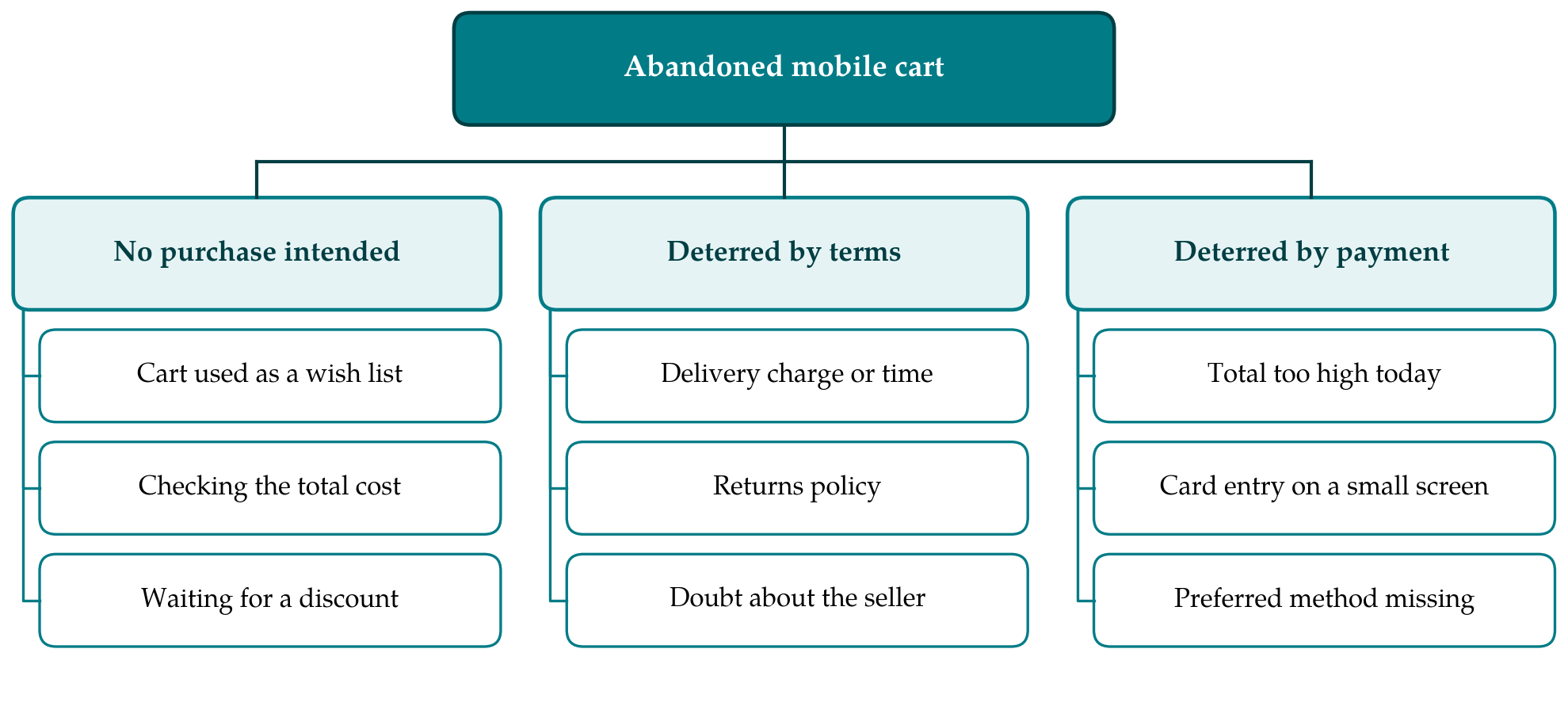
BNPL also adds exits of its own. The shopper may be redirected to the provider to register or log in, an eligibility check may decline the request, and a failure at either point ends a checkout that a card payment might have completed. Whether the option reduces abandonment on balance depends on the mix of reasons among a particular merchant's shoppers, which is exactly what the merchant does not know in advance.
4. Reading the Logs
Mobile storefront logs record a sequence of events for each session: product views, additions to cart, checkout started, payment method selected, payment submitted, order confirmed. Table 1 lists the signals relevant to BNPL and what each can support. The last column of the table is the important one.
| Log signal | What it shows | What it cannot show |
|---|---|---|
| Share of orders paid by BNPL | Uptake among buyers | Whether those orders would have been placed anyway |
| Completion rate before and after launch | Change over time | The effect of BNPL apart from season, promotions and app changes |
| Completion rate by method chosen | Difference between groups of shoppers | A causal effect, since shoppers select their own method |
| Drop-off at the provider redirect | Friction added by the BNPL flow | Why the shopper left |
| Declined eligibility checks | Sales lost to the provider screening | Whether a card payment would have succeeded |
| Returns and refunds by method | Reversal after purchase | Regret or difficulty with repayment |
Two comparisons tempt the analyst and both mislead. The first is before and after. A merchant who launches the option ahead of a sale season, alongside a redesign, or with a campaign by the provider will see completion change for reasons unrelated to the payment method. The second is between shoppers who choose BNPL and those who do not. A shopper selects a payment method only after deciding to proceed, so completion among those who selected any method is high by construction, and differences between methods reflect who chooses them. These are the standard problems of confounding and selection that make observational comparisons unreliable guides to causal effects (Angrist and Pischke, 2009).
The credible design is an experiment. Shoppers, or sessions, are assigned at random to see the BNPL messaging and button or not, and completion is compared across the whole of each arm from cart creation onward, including those who never reach payment (Kohavi et al., 2020). The unit of assignment should be the shopper where possible, since the product-page message may influence a purchase completed in a later session. Where an experiment is ruled out, a staggered launch across markets or product categories gives a weaker but usable comparison, provided the order of launch was not chosen on the basis of expected response.
5. Beyond Conversion
A higher completion rate is the merchant's measure of success, and it is an incomplete one. The United States Consumer Financial Protection Bureau has drawn attention to risks that include borrowers taking several loans at once across providers and becoming overextended, alongside uneven consumer protections (Consumer Financial Protection Bureau, 2022). In the United Kingdom a review for the Financial Conduct Authority recommended bringing interest-free BNPL within regulation (Woolard, 2021), and research on card transactions has documented BNPL instalments being paid with credit cards, which can turn an interest-free loan into interest-bearing debt (Guttman-Kenney et al., 2023). The psychological mechanisms that make the option effective at checkout are the same ones that make overspending easy.
Merchants cannot observe a customer's finances, but their logs hold some relevant signals: return rates, repeat purchase, and complaints by payment method. Researchers with access to storefront data should report these with conversion. A sale that is completed, regretted and returned is a cost to both sides, and an integration judged only by abandonment will look better than it is.
6. Conclusion
Adding a deferred-payment option to a mobile storefront may well reduce cart abandonment, and behavioural theory explains why it should. Storefront logs alone, read through before-and-after or between-method comparisons, cannot show that it does or by how much. Randomised exposure, measured from the cart onward, can. Evidence on this question should be read with attention to its design and to what happens to buyers after the order is placed.
Conflict of interest
To be declared by the author(s) before publication.
Funding
To be declared by the author(s) before publication.