1. Introduction
Holmium laser enucleation of the prostate (HoLEP) was developed in New Zealand in the 1990s, growing out of earlier work on holmium laser resection (Gilling et al., 1996). The step that made it practical was the transurethral morcellator, which allowed whole lobes to be dissected off the surgical capsule, pushed into the bladder and removed without an incision (Fraundorfer and Gilling, 1998). Randomised trials have since shown durable relief of obstruction compared with transurethral resection (Gilling et al., 2012) and results equivalent to open prostatectomy for very large glands, with less blood loss and a shorter stay (Kuntz et al., 2008). Current guidelines list it as an option that does not depend on prostate size (Lerner et al., 2021).
Day-case HoLEP was described early in the history of the operation (Larner et al., 2003) and has become routine in some high-volume units. Where surgical capacity is scarce, the appeal is obvious. The Lancet Commission on Global Surgery drew attention to the shortage of operating capacity and hospital beds across low- and middle-income countries (Meara et al., 2015), and in many such hospitals men with large prostates are still offered open surgery and several days in a ward. This note considers what would be needed to offer HoLEP as a day-case procedure under those constraints.
2. Why the Operation Suits Day-Case Care
Three properties of the technique matter. The holmium:YAG laser emits at a wavelength of about 2.1 micrometres, which is strongly absorbed by water, so that its energy is deposited within a fraction of a millimetre of the fibre tip. Vessels are sealed as the plane is developed, and haemostasis is generally good at the end of the procedure. The operation is performed in physiological saline, which removes the risk of dilutional hyponatraemia associated with glycine irrigation in monopolar resection. And because the adenoma is removed completely along the capsular plane, outcomes do not deteriorate with increasing gland size (Humphreys et al., 2008). A pooled analysis of transurethral procedures found that enucleation was associated with shorter catheterisation and hospital stay than resection (Cornu et al., 2015).
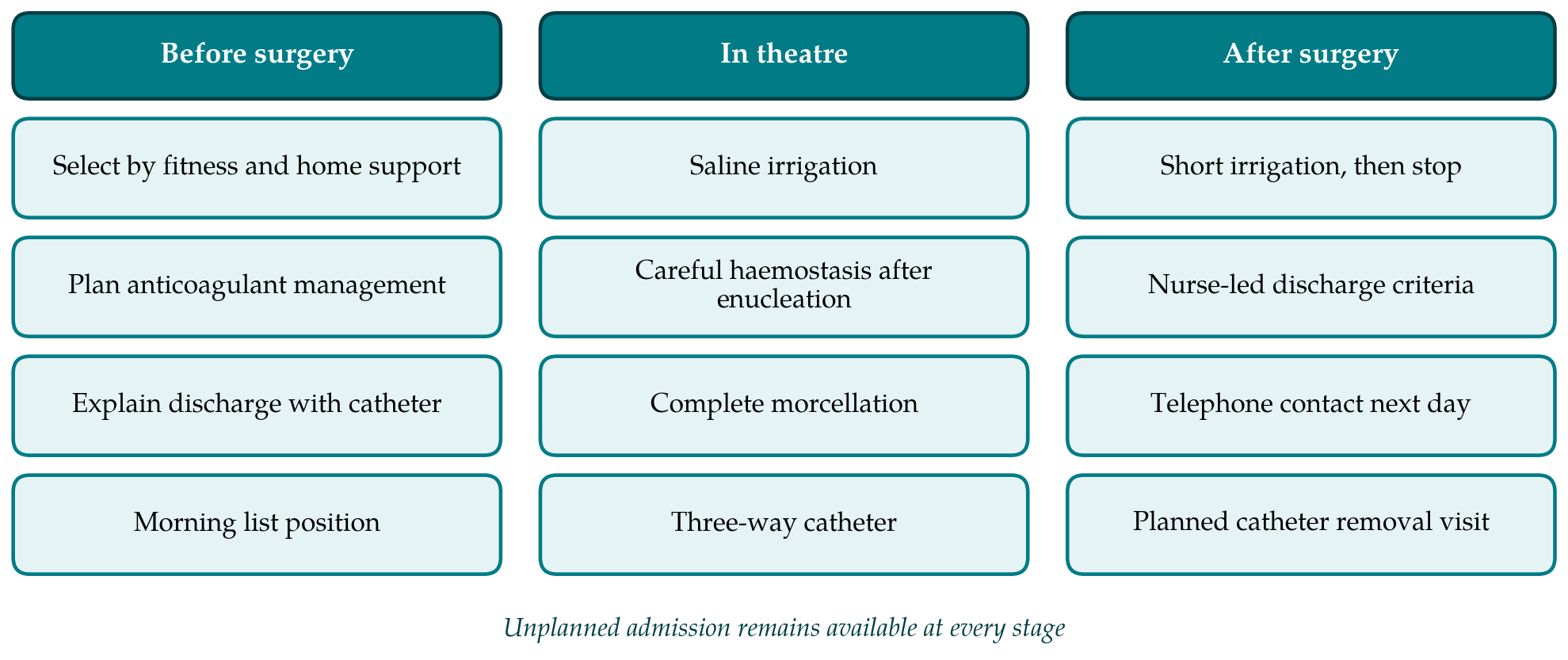
None of this makes same-day discharge automatic. Haematuria in the first hours is the usual reason a planned day-case patient is kept in hospital, and the pathway has to be built around preventing and detecting it. Figure 1 groups the elements of such a pathway by phase.
3. Requirements and Adaptations
Table 1 lists the components of a day-case service, the purpose of each and the considerations that apply when resources are limited. Three of them deserve fuller comment: equipment, training and the arrangements for discharge.
| Component | Purpose | Consideration where resources are limited |
|---|---|---|
| Holmium laser and reusable fibres | Enucleation and haemostasis | Share the laser with stone surgery; plan maintenance and fibre reprocessing |
| Morcellator and nephroscope | Removal of enucleated tissue | No workable substitute for large glands; budget for blades |
| Trained surgeon | Safe, efficient enucleation | Mentored learning; start with moderate glands and inpatient stay |
| Selection criteria | Avoid predictable failures of discharge | Weight given to travel distance and a capable adult at home |
| Saline irrigation supply | Clear vision; early postoperative washout | Reliable stock of sterile saline is a precondition |
| Discharge protocol | Consistent decisions by nursing staff | Written criteria; catheter left in with planned removal |
| Safety net | Early response to bleeding or retention | Contact telephone number and a defined route for return |
3.1. Equipment
The laser is the main capital cost. Its justification in a small hospital rests on shared use, since the same machine and fibres serve ureteroscopic and percutaneous stone surgery, which in many regions forms a large part of urological work. Reusable fibres reduce the cost per case provided that reprocessing is reliable. The morcellator is a separate purchase and cannot easily be dispensed with: removing a large enucleated lobe piecemeal with a resection loop is slow and defeats the purpose of a short operation. A stable electricity supply and a service contract, or at least access to an engineer, should be settled before the equipment is bought.
Whether a lower-powered and less expensive holmium generator would be sufficient is a practical question for such hospitals. Enucleation at reduced power settings has been described, and the choice of machine should rest on the unit's own mix of stone and prostate work, on the availability of local servicing and on the cost of consumables over several years, not on the purchase price alone. Pooling demand with neighbouring hospitals, so that one laser serves a regular visiting list, is another way of spreading the cost while a surgeon builds up the necessary volume of cases.
3.2. Training
HoLEP is harder to learn than resection. Prospective study of the learning curve suggests that several dozen cases are needed before operating time and complication rates stabilise (Shah et al., 2007), and long-term series note the same influence of experience on outcome (Elzayat and Elhilali, 2007). Modifications such as the en-bloc technique have been proposed in part to make the planes easier to find (Scoffone and Cracco, 2016). A new service should not begin with day-case discharge. A sensible sequence is to establish the operation with overnight stay, audit bleeding, catheter time and readmission, and move to same-day discharge only when those results are steady.
3.3. Selection and discharge
Selection for day-case surgery depends as much on circumstances as on the prostate. A man should be fit for anaesthesia, able to manage a catheter or have someone who can, and should not be alone on the first night. In hospitals that serve a wide rural area, the distance and the means of getting back if bleeding occurs weigh heavily, and some units may reasonably arrange for patients to stay nearby overnight. Anticoagulant and antiplatelet treatment needs an explicit plan agreed before the day of surgery; men in whom it cannot be interrupted are poor candidates for early discharge, although not for the operation itself.
On the day, an early place on the list leaves time for observation. Careful inspection of the fossa and bladder neck at low irrigation pressure before the catheter is placed is the most useful single precaution against later bleeding. A period of irrigation through a three-way catheter is then stopped, and discharge depends on the urine remaining clear enough without it. Sending the patient home with the catheter in place, to be removed at a planned visit, is more practical than same-day removal in most resource-limited settings, because it removes the risk of retention at home. Written instructions, a telephone number that will be answered and a call from the unit the next day complete the arrangement. Men should be warned about transient urgency and stress leakage, which are common in the early weeks and usually settle.
4. Limits of This Note
The suggestions made here are drawn from published experience in well-equipped centres and from general principles of ambulatory surgery. Whether they transfer to hospitals with different patients, distances and nursing resources has not been shown. Evidence on the cost of HoLEP in low-resource health systems is sparse, and the balance between capital outlay and bed-days saved will differ from one hospital to another. Any unit adopting day-case discharge should define in advance what it will count as failure, such as unplanned admission, return to theatre or readmission within thirty days, and should review those figures regularly.
5. Conclusion
The features that distinguish HoLEP, reliable haemostasis, saline irrigation and independence from gland size, also make it suitable for same-day discharge. For a hospital with few beds the potential gain is considerable, but it depends on a laser that earns its cost through shared use, on a surgeon who is past the learning curve, on selection that takes home circumstances seriously, and on a dependable route back to hospital. Introduced in stages and audited, day-case HoLEP is a realistic aim outside high-income centres.
Conflict of interest
To be declared by the author(s) before publication.
Funding
To be declared by the author(s) before publication.