1. Introduction
Fermentation is among the oldest food technologies, and for most of its history its purpose was preservation, palatability and the transformation of raw materials that were otherwise hard to use. The current interest is different. Fermented foods are now discussed as a way of influencing the gut microbiota and, through it, the immune system, and that framing has reached dietary guidance, clinical consultations and a large commercial market.
Some of the ground is solid. An international expert panel has defined fermented foods as foods made through desired microbial growth and enzymatic conversion of food components, a definition that deliberately separates the process from the presence of live organisms at the point of eating, since many fermented foods are heated, filtered or baked afterwards (Marco et al., 2021). The same panel reviewed the health evidence and was careful about what it claimed. The looser public conversation has been less careful.
This article asks a narrow question. Should fermented foods be part of everyday advice given on immune grounds, as distinct from advice given on grounds of general dietary quality? The question matters because the two justifications carry different obligations. Recommending a food because it belongs in a varied diet requires little more than safety and plausibility. Recommending it because it will help the immune system is a specific claim, and specific claims should be supported.
2. Three Claims Worth Separating
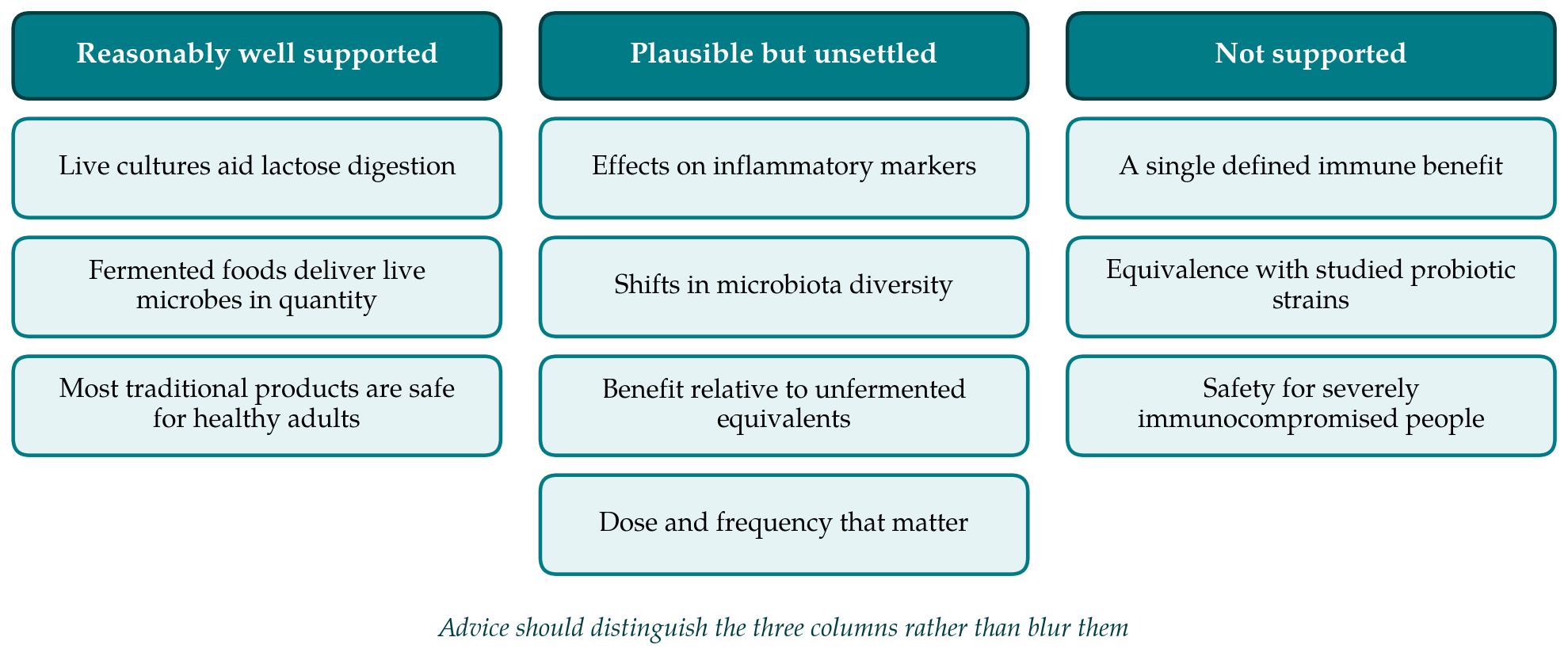
Advice about fermented foods typically bundles three propositions, which have different evidential standing. Table 1 sets them out with what supports each and where each becomes uncertain. Keeping them apart is the main analytical move of this article, because the first claim is often used to carry the third. Figure 1 arranges the same material by how well each proposition is supported, which is the distinction that advice most often loses. The sorting is a judgement about the weight of published work rather than a formal grading, and readers who weigh the dietary intervention literature differently will place one or two items in a neighbouring column.
| Claim | What supports it | Where it becomes uncertain |
|---|---|---|
| Fermented foods deliver live microbes | Direct enumeration across many products Rezac et al., 2018 | Varies widely by product and by processing |
| Live cultures aid lactose digestion | Accepted by regulators for yoghurt cultures EFSA, 2010 | Specific to lactose, not a general benefit |
| They shift the gut microbiota | Diet intervention work in adults Wastyk et al., 2021 | Durability after the diet ends is unclear |
| They are equivalent to probiotics | Shared organisms in some products | Probiotic benefit is strain and dose specific Hill et al., 2014 |
| They improve immune function | Markers of inflammation in dietary studies | Few clinical endpoints in healthy people |
| They are safe for everyone | Long history of consumption Hutkins, 2018 | Caution in severe immunosuppression Suez et al., 2019 |
The first claim is the most secure, because it is a matter of enumeration rather than inference. Surveys of commercial products have measured the live microbial content of yoghurts, fermented vegetables and fermented beverages and found that many deliver large numbers of viable organisms per serving, while others, particularly those pasteurised after fermentation or baked, deliver effectively none (Rezac et al., 2018). This is a useful finding precisely because it is discriminating: sauerkraut from the chilled section and sauerkraut from a shelf-stable jar are not the same exposure, and neither is sourdough bread, in which the organisms are killed in the oven.
The second claim, about microbiota composition, has support from a dietary intervention in adults that compared a high-fibre diet with a diet high in fermented foods and reported increased microbiota diversity and reduced markers of inflammation in the fermented-food arm (Wastyk et al., 2021). Observational work has separately associated habitual fermented food consumption with differences in the gut microbiome and metabolome (Taylor et al., 2020). The direction of these findings is consistent, and the mechanisms proposed, including delivery of live organisms, of fermentation metabolites, and of substrates that resident organisms use, are reasonable (Marco et al., 2017). What is not established is how large the effect is relative to other dietary changes, or how long it lasts once the diet reverts.
3. The Argument for Including Them
Several considerations favour including fermented foods in general advice. They are safe for the great majority of people, which is not a trivial point for a recommendation aimed at a whole population; the products concerned have been eaten for centuries, and the microbiology of their manufacture is well characterised (Hutkins, 2018). One specific benefit is accepted by regulators: live yoghurt cultures improve the digestion of lactose in the product for people with lactose maldigestion, and this has been evaluated and allowed as a health claim (EFSA, 2010). Reviews of yoghurt and cultured milk consumption support a favourable general position (Savaiano and Hutkins, 2021).
There is also an argument from substitution. Fermented vegetables, yoghurt and kefir generally displace less desirable foods, and they tend to belong to dietary patterns with other established benefits. A recommendation that increases their consumption is unlikely to do harm and may do good for reasons that have nothing to do with the immune system. Finally, there is the argument from the general case for feeding the gut microbial community, developed in the prebiotic and probiotic literature and summarised in consensus statements on both (Gibson et al., 2017; Sanders et al., 2019). Fermented foods sit near that literature even if they are not part of it.
4. The Argument for Restraint
Three counter-arguments deserve more weight than they usually receive. The first is a definitional problem. A probiotic is a live microorganism that, administered in adequate amounts, confers a health benefit on the host, and the definition is deliberately tied to specific strains at specific doses with specific demonstrated effects (Hill et al., 2014). Most fermented foods do not meet it: the organisms are often uncharacterised at strain level, the dose varies between batches, and no benefit has been demonstrated for that product. Evidence generated for a defined strain does not transfer to a food that happens to contain a related species, and the consensus statement on fermented foods says so explicitly (Marco et al., 2021).
The second is the weakness of the immune endpoint itself. Most human studies measure circulating inflammatory markers or cell-surface phenotypes rather than infections avoided or vaccine responses improved. Those markers are informative about mechanism and uninformative about whether anyone gets fewer colds. The gap between a changed cytokine concentration and a clinical benefit is the same gap that has frustrated probiotic research for three decades, and the critical literature on probiotics has documented how often it goes unacknowledged (Suez et al., 2019).
The third is heterogeneity. Fermented foods are not a category with shared properties. Kimchi, kombucha, tempeh, miso, kefir and yoghurt differ in their organisms, their metabolites, their salt and sugar content and whether they contain anything alive at all. Advice that treats them as interchangeable is advice about an idea rather than about food. The literature on definitions and characteristics makes the diversity plain (Dimidi et al., 2019), and the same diversity is why the field has moved towards more precisely specified products rather than broader claims (Veiga et al., 2020). The heterogeneity also defeats dose advice. Nobody can say how much kimchi corresponds to how much kefir, because the quantity that matters, if any quantity does, has never been identified for either.
5. What Honest Advice Would Say
A defensible position lies between enthusiasm and dismissal. Fermented foods belong in everyday dietary advice, recommended as part of a varied diet, on grounds of safety, palatability and the dietary patterns they accompany. Where an immune benefit is mentioned, it should be described as plausible and under investigation rather than established, and it should not be the reason given for the recommendation. Where a specific effect is well supported, as with live cultures and lactose digestion, it can be stated plainly, and it should be stated in its own narrow terms.
Three practical qualifications follow. Advice should direct people to products that actually contain live organisms, which means telling them that heat-treated and shelf-stable versions generally do not. It should set expectations about persistence: the organisms in a fermented food are transient passengers in an established community, and the effect of eating them lasts about as long as the habit does. And it should carry the standard caution that people who are severely immunocompromised, who have central venous access or who are critically ill should discuss live-culture foods with their clinician, which reflects the documented risk in those groups rather than any concern about healthy consumers.
For research, the useful next steps are reasonably clear. Trials with clinical rather than biomarker endpoints, comparisons against the unfermented version of the same food rather than against an unrelated control, and characterisation of what is actually in the product being tested would all narrow the gap between what is claimed and what is known. Until that work exists, advice should match the evidence in both direction and confidence.
6. Conclusion
Fermented foods deserve a place in everyday dietary advice, and they do not yet deserve the specifically immune framing they are often given. The case for them rests on safety, on a long record of consumption, on one well-evidenced digestive benefit and on a reasonable body of work showing that they can shift the composition of the gut microbiota. The case for recommending them as immune nutrition rests on markers rather than outcomes and on an analogy with probiotics that does not hold. Saying this plainly costs little, since the recommendation itself survives, and it keeps nutrition advice ahead of the claims made on packaging rather than behind them.
Conflict of interest
To be declared by the author(s) before publication.
Funding
To be declared by the author(s) before publication.