1. Introduction
Anyone who has stood near a jembe ensemble at a wedding in Bamako, or an Ewe drum ensemble at a funeral in the Volta Region, knows that the music is made to be danced to and that it succeeds. Scholars have long tried to say why. One influential answer locates the effect below the level that staff notation or a drum-machine grid can show, in differences of a few tens of milliseconds between where a stroke would fall on an even grid and where a skilled player puts it. The technical term is microtiming, and the feeling it is supposed to produce is groove, defined in the psychological literature as a pleasurable urge to move to music (Janata et al., 2012).
The best-known statement of the idea is Keil's theory of participatory discrepancies, which holds that music must be slightly "out of time" and "out of tune" to be socially engaging (Keil, 1987). Iyer gave it a cognitive form, arguing that expressive timing in African-American music carries information about the body that produces it (Iyer, 2002). Both authors drew on a lineage of writing about West African drumming, and both assumed a continuity between that drumming and the musics of the diaspora.
When psychologists began to test the claim with controlled stimuli, however, the results went the other way, and the tests used jazz, funk and rock. Meanwhile a separate research programme was measuring what West African drummers do in fact play. This review brings the two together and asks a narrow question: what does the published evidence say about microtiming and the perception of groove among listeners who know West African drum ensemble music from the inside?
2. Scope and Approach
This is a narrative review of the published literature. It was not conducted as a systematic search and makes no claim to completeness. Sources were chosen for their direct bearing on the question and fall into three groups: ethnographic and music-analytical accounts of ensemble drumming in West Africa; corpus studies that measure performed timing from multitrack recordings; and experimental studies of groove ratings, sensorimotor synchronisation and rhythm categories, including those conducted with participants in Mali. Work on jazz and funk is included where it supplies the methods and the comparison, since most of what is known about microtiming and groove was learned there.
"West African drum ensemble music" covers a great many traditions. The measured evidence is far narrower than the label, and most of it concerns jembe and dundun ensembles of the Mande area, especially urban Bamako. The review says so wherever a finding rests on that repertoire alone, and it does not extend conclusions from Mali to Ewe, Dagomba, Yoruba or Wolof drumming, for which comparable timing corpora and listener studies have yet to be published.
3. Ensemble Drumming and the Idea of Timing "Feel"
The classic descriptions of West African ensemble drumming concentrate on structure. Nketia described the time line, a short asymmetrical pattern on a bell or similar instrument that orients the other parts (Nketia, 1974). Locke analysed the offbeat placement and cross-rhythm of southern Ewe dance drumming in terms of a steady underlying beat that dancers embody (Locke, 1982). Arom, working in Central Africa, showed by re-recording each part separately that complex polyrhythm rests on a strict isochronous pulse and short repeating cycles (Arom, 1991). Chernoff's account of Dagomba and Ewe drumming added the social dimension: a good drummer is judged by how the rhythms make room for others, dancers included (Chernoff, 1979).
None of these authors measured timing at the millisecond level, and several had reason to be wary of the idea that African rhythm lies beyond notation. Agawu has argued at length that the notion of a uniquely elusive "African rhythm" is a construct of outside observers, and that Northern Ewe music can be described with the ordinary vocabulary of metre, grouping and periodicity (Agawu, 2003). His critique bears directly on microtiming research, which risks restating an old exoticism in the language of signal processing. The response that the measurement literature offers is that fine timing in this music is regular and learnable, which is the opposite of elusive.
4. What Corpus Studies of Jembe Music Show
The decisive measurements come from Polak's recordings of professional jembe ensembles in Bamako, made with a separate microphone on each drum so that every stroke could be timed. The first analysis showed that the fast pulses dividing each beat are not equal in length. In pieces with three subdivisions per beat, the three positions take consistently different shares of the beat, for example short, medium and long, and each piece has its own characteristic pattern. Polak argued that these patterns are not deviations from an even grid but belong to the metre itself, and called the phenomenon rhythmic feel as metre (Polak, 2010).
Two further studies tested that reading. If the unevenness were an expressive inflection, it should weaken as the tempo rises and the room for nuance shrinks, yet the patterns stayed stable through the marked acceleration that is normal in a jembe performance (Polak and London, 2014). If uneven subdivision made coordination harder, ensembles should synchronise less tightly in pieces that use it. A corpus analysis found the reverse of a penalty: players were as precisely synchronised in pieces with non-isochronous subdivision as in pieces with even subdivision (Polak et al., 2016). The implication for theories of metre is considerable, since standard accounts treat isochrony at some level as a requirement for entrainment (London, 2012).
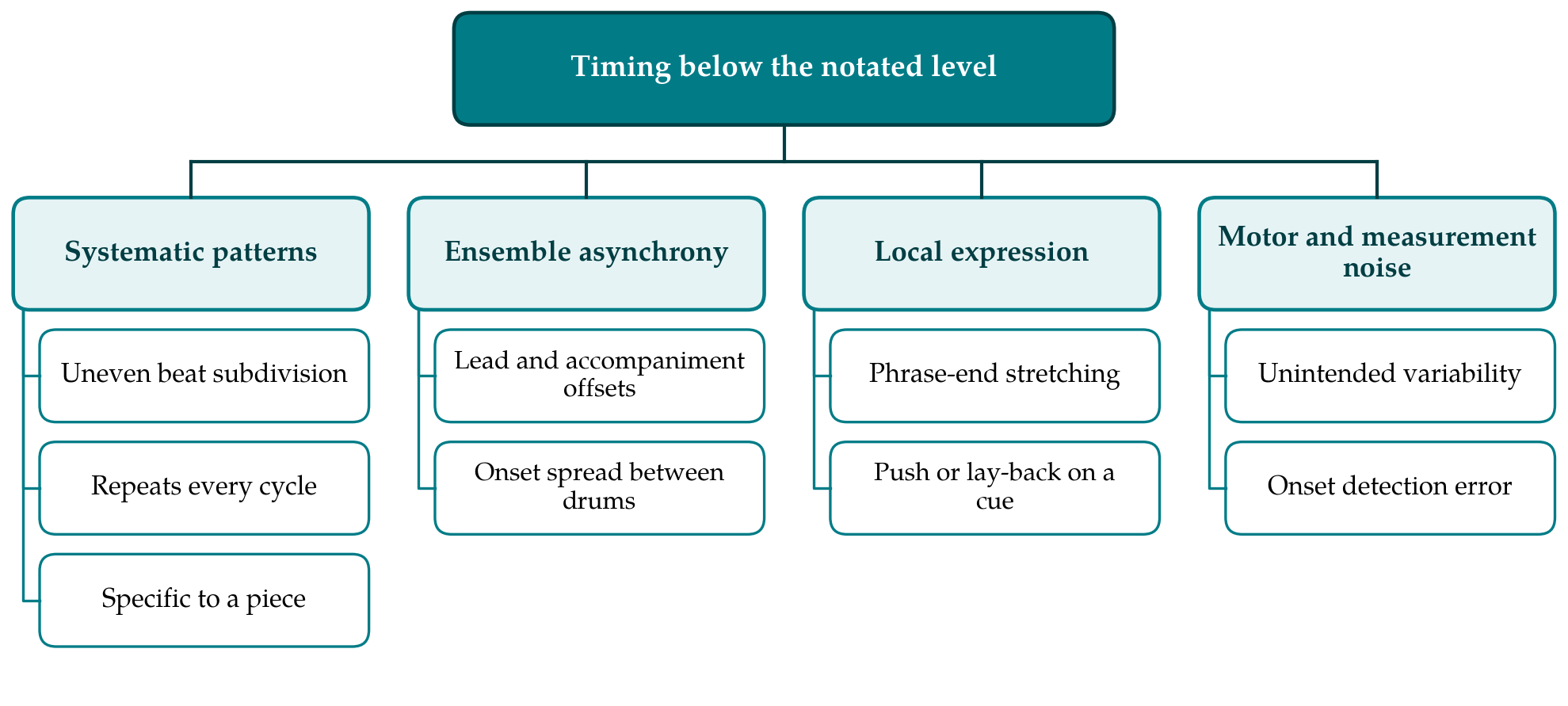
These findings change what "microtiming" can mean in this repertoire. Figure 1 separates four sources of sub-notational timing that are often lumped together: systematic subdivision patterns, asynchronies between ensemble parts, local expressive shaping, and unintended variability. The participatory discrepancy tradition speaks mainly of the second, and the laboratory groove studies have mostly manipulated the first or the second in idioms where an even grid is the reference. In jembe music the first is categorical. A listener who knows the piece does not hear the short first subdivision as early; an evened-out version would be the altered one.
Swing in jazz offers a partial parallel. The long-short division of the beat there is also systematic, varies with tempo in an orderly way, and differs between soloists and rhythm section (Friberg and Sundström, 2002). In both idioms the audible feel seems to lie more in stable ratios than in moment-to-moment discrepancy.
5. Experimental Evidence on Microtiming and Groove
Groove became a measurable construct when Madison showed that listeners agree with one another about how much a musical excerpt makes them want to move (Madison, 2006). Janata and colleagues then tied ratings to spontaneous movement and to ease of synchronisation (Janata et al., 2012), and Witek and colleagues found that both the wish to move and pleasure are highest for drum breaks of intermediate syncopation (Witek et al., 2014). These studies explain groove through features that notation does capture: beat salience, event density, and a moderate degree of metrical tension.
The studies that manipulated microtiming directly are summarised with the other strands of evidence in Table 1. Across a varied set of commercial recordings, measured microtiming did not predict groove ratings once other rhythmic descriptors were considered (Madison et al., 2011). Applying systematic timing displacements to short synthesised rhythms lowered ratings as the displacement grew (Davies et al., 2013), and a fully quantised drum pattern was rated above versions with shifted strokes (Frühauf et al., 2013). When the timing of expert swing and funk performances was scaled down, kept or exaggerated, the quantised and original versions were rated broadly alike and the exaggerated ones lower (Senn et al., 2016).
| Strand | Representative sources | What it supports | Main limit |
|---|---|---|---|
| Ethnography and analysis | Locke, 1982; Chernoff, 1979; Agawu, 2003 | Dance orientation, steady beat, cyclic structure | No timing measurement |
| Discrepancy theory | Keil, 1987; Iyer, 2002 | Timing nuance as a bodily, social signal | Largely untested when proposed |
| Jembe timing corpora | Polak, 2010; Polak et al., 2016 | Uneven subdivision is stable and metrical | One region and instrument family |
| Groove experiments | Davies et al., 2013; Senn et al., 2016 | Added deviations do not raise groove ratings | Western idioms and listeners |
| Malian listener ratings | Neuhoff et al., 2017 | Local listeners judge timing patterns of known pieces | Aesthetic rating, not groove as such |
| Cross-cultural rhythm tasks | Polak et al., 2018; Jacoby and McDermott, 2017 | Rhythm categories depend on musical exposure | Simple stimuli, not ensemble texture |
Taken at face value, this literature suggests that microtiming adds nothing to groove and that evenness is preferred. Three features of the experiments caution against carrying that conclusion over to West African drumming. The stimuli came from idioms whose reference structure is an even or swung grid. The listeners were mostly European or North American, often students. And the manipulations treated timing as a quantity to be added to or removed from an otherwise complete pattern. Danielsen's analyses of funk and of digitally produced rhythm argue that listeners hear beats as having shape and width, so that what counts as "on" the beat is itself a matter of style (Danielsen, 2006; Danielsen, 2010).
6. Listeners Who Know the Repertoire
Whether a timing pattern is heard as a deviation depends on the categories a listener brings. Hannon and Trehub showed that North American adults detect changes in metres with simple ratios more easily than in the non-isochronous metres of Balkan music, that adults raised with Balkan music show no such bias, and that young infants do not show it either (Hannon and Trehub, 2005). Jacoby and McDermott, using a method in which participants repeatedly reproduce a rhythm until it settles on a preferred form, found that listeners favour small-integer ratios, but that which ratios are favoured differs between a United States sample and Tsimane' participants in Bolivia (Jacoby and McDermott, 2017).
The same logic has been applied to Mali. In a tapping study with participants from Mali, Bulgaria and Germany, Malian participants synchronised accurately with a two-interval rhythm whose ratio is characteristic of local drumming and lies between the simple categories of Western theory, while the other groups tended to pull it towards a simpler ratio (Polak et al., 2018). The authors interpret this as evidence for a culturally learned rhythmic prototype. If so, the uneven subdivisions of jembe music are not fine detail for these listeners at all. They are the pattern.
The study closest to the question of this review asked musicians in Mali to evaluate phrases from a standard jembe piece whose subdivision timing had been digitally altered in several ways (Neuhoff et al., 2017). The design matters as much as the outcome: it used ensemble recordings of real repertoire, manipulated the piece-specific pattern itself, and recruited listeners for whom the piece was familiar. The ratings showed that such listeners discriminate among timing variants and do not treat them as equivalent. What the task measured, though, was aesthetic preference and judged correctness. It did not ask about the urge to move, and it did not involve dancers, who are the audience that the music addresses.
7. Gaps and Directions for Future Work
The evidence therefore leaves the central question open, and for identifiable reasons. Groove questionnaires were developed in English and validated with Western popular music; the word has no settled equivalent in Bamana or Ewe, and local vocabularies of praise for drumming may divide the experience differently. A sound test needs measures that do not depend on translation, such as movement recorded by motion capture or the judgements of dancers about whether a rendition can be danced. It also needs stimuli that keep ensemble texture, sound quality and tempo intact while timing alone is varied, which is only possible with multitrack recordings of the kind that currently exist for a single region.
Three extensions would be especially informative. Timing corpora for other traditions, Ewe and Dagomba ensembles above all, would show whether stable non-isochronous subdivision is a Mande speciality or a wider practice. Studies that separate the four sources in Figure 1 would establish which of them listeners attend to, since asynchrony between lead and accompaniment may matter even where subdivision is categorical. And comparisons between listeners with and without long exposure, using the same stimuli and movement measures, would indicate how much of the groove response is learned. Until such work is published, statements that microtiming creates groove in West African drumming, and statements that it does not, both go beyond the evidence.
8. Conclusion
The literature reviewed here supports two firm statements and one open one. Performed timing in Malian jembe ensembles departs from an even grid in ways that are systematic, stable across tempo and compatible with tight synchronisation, and listeners enculturated in that music hold rhythm categories that match it. Experiments in Western idioms give no support to the idea that small deviations from a grid increase groove. How enculturated listeners and dancers experience groove when the timing of their own repertoire is altered has scarcely been tested. The most useful next step is not another rating study with quantised funk but work designed with West African musicians, on their repertoire, with movement as the measure.
Conflict of interest
To be declared by the author(s) before publication.
Funding
To be declared by the author(s) before publication.