1. Introduction
A speech recogniser built in the conventional way needs hundreds or thousands of hours of transcribed audio, a pronunciation lexicon and a large body of text. Few of the world's languages have these. Besacier et al. (2014), surveying recognition for under-resourced languages, listed the usual obstacles: little transcribed speech, limited electronic text, no agreed lexicon, sometimes no stable orthography, and few trained specialists among speakers. That description still fits much of East Africa, where languages with large speaker populations are absent from commercial voice products.
The technical situation has shifted. Models pretrained on unlabelled audio learn representations of speech that transfer across languages, and fine-tuning them on a small transcribed set can produce a usable recogniser (Baevski et al., 2020; Conneau et al., 2021). A team at a university or a community organisation can now attempt what once required a national programme. What such a team lacks is an ordered account of the decisions involved, from the first conversation with speakers to the evaluation of the finished system.
This article proposes such an account as a framework in five stages. It is written for a single target language and a small team with modest computing resources. The framework is a proposal built from published methods. It is not a report of a project: no model was trained and no data were collected for this article, and nothing here should be read as a result.
2. Background
Two things must be understood before the stages are set out: what the available pretrained models are, and what is particular about the languages and data of the region.
2.1. Pretrained speech models
The models fall into two groups. The first is self-supervised. wav2vec 2.0 masks spans of a latent representation of the raw waveform and learns to identify the correct content among distractors; a linear output layer is then added and the network is fine-tuned with connectionist temporal classification (Baevski et al., 2020; Graves et al., 2006). Pretraining the same architecture on many languages at once improves results for languages with little labelled data (Conneau et al., 2021), and XLS-R extended the approach to 128 languages (Babu et al., 2022). The Massively Multilingual Speech project went further, using recordings of religious texts to cover more than a thousand languages and adding small language-specific adapter modules (Pratap et al., 2024).
The second group is trained with supervision on a very large scale. Whisper is an encoder-decoder Transformer trained on several hundred thousand hours of audio paired with transcripts gathered from the web, in many languages (Radford et al., 2023). Its authors report that accuracy in a given language tracks the amount of training audio in that language, so its starting point for an East African language may be weak even though the model is strong overall. Both kinds of model can be fine-tuned, and the choice between them is taken up in Stage 3.
2.2. Languages and data in East Africa
The region's languages belong to several families with different demands. Bantu languages such as Luganda and Kinyarwanda are agglutinative: a single written word may carry subject, tense, object and verb root, so vocabularies are very large and unseen word forms are common. Many Bantu and Nilotic languages use tone to distinguish words or grammatical forms, and the standard orthography often leaves tone unmarked. Amharic and Tigrinya are written in the Ethiopic script, in which each character stands for a syllable. Speakers routinely mix in Swahili, English or French, depending on the country.
Open data exist for some of these languages. Mozilla's Common Voice collects read sentences from volunteers under a public-domain dedication and validates each clip by listener vote (Ardila et al., 2020), and it includes collections for several East African languages. Earlier work built Swahili resources from broadcast and web sources (Gelas et al., 2012). Read speech recorded on telephones is nevertheless a narrow sample of how a language is spoken, a point that shapes the evaluation stage below.
3. The Proposed Framework
The framework has five stages. Table 1 gives the decisions and outputs of each, and Figure 1 pairs each stage with the risk most likely to undermine it. The stages are intended to be followed in order, though findings at evaluation will often send a team back to collect more data.
| Stage | Decisions to take | Output |
|---|---|---|
| 1. Profile and agree | Variety and dialects covered; orthography and normalisation rules; consent and licence | Language profile; written agreement |
| 2. Assemble data | Sources of speech and text; speaker balance; speaker-disjoint splits | Corpus with a data statement |
| 3. Select model | Self-supervised or supervised base; full or parameter-efficient tuning | Justified choice of checkpoint and method |
| 4. Fine-tune and decode | Output units; augmentation; stopping rule; language model for decoding | Trained model and configuration |
| 5. Evaluate and release | Metrics; out-of-domain test; subgroup breakdown; terms of release | Evaluation report; model card |
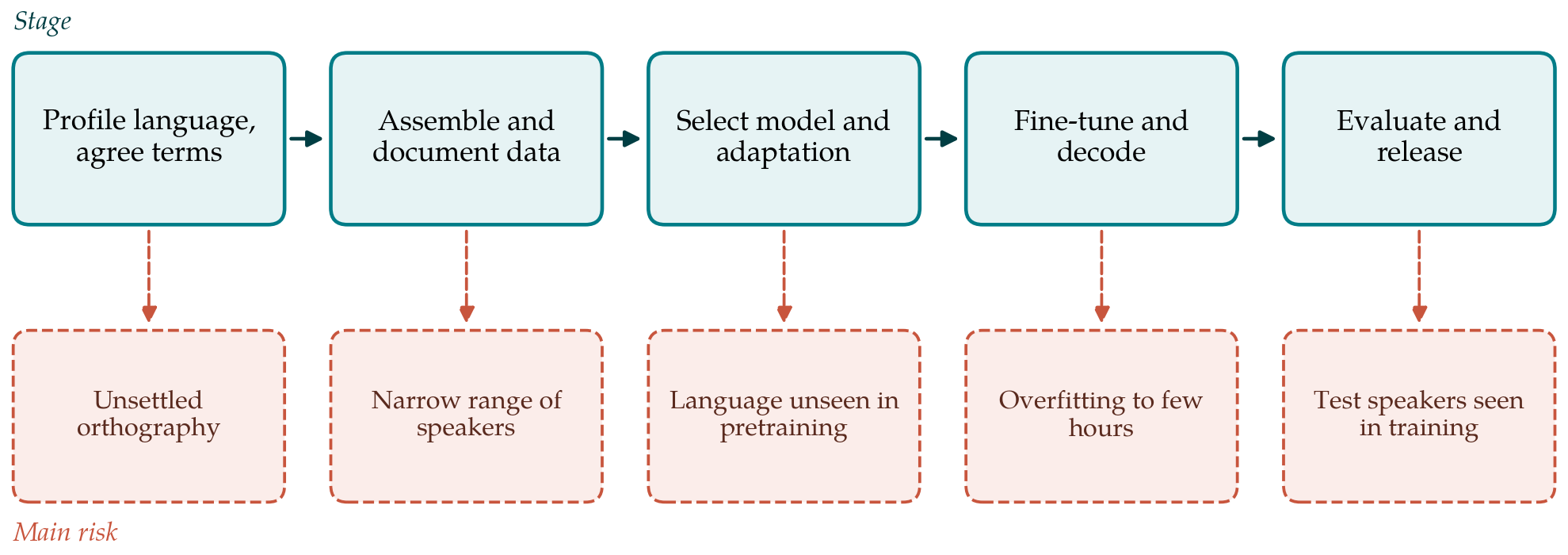
3.1. Stage 1: Profile the language and agree terms
Work begins with people, not audio. The team records which variety of the language is to be served, which dialects are in scope, and how the language is written in practice as well as officially. A normalisation document fixes the treatment of numerals, loanwords, punctuation, tone marks and code-switched passages; without it, two transcribers will write the same utterance differently and the model will be penalised for their disagreement. Speakers and community bodies should be partners in these choices. Nekoto et al. (2020) describe a participatory approach to machine translation for African languages in which speakers take part as creators and evaluators, and the same principle applies here. Consent, ownership and the licence of the eventual model are agreed in writing at this point.
3.2. Stage 2: Assemble and document the data
Three kinds of material are sought: transcribed speech for fine-tuning, a separate transcribed set for testing, and text for a language model. Existing open collections are used first, then supplemented by recording, with attention to the balance of sex, age, region and recording device. Test speakers must not appear in training, and if the system is meant for conversation or radio then some test material should come from those settings and not only from read prompts. The corpus is released with documentation of who the speakers are and how the data were gathered, following the data statements of Bender and Friedman (2018) or the datasheets of Gebru et al. (2021).
3.3. Stage 3: Select a base model and adaptation method
The first question is whether the target language, or a close relative, was present in a candidate model's pretraining data, which the model's documentation normally states. A self-supervised multilingual encoder with a new output layer is a sound default when the language was unseen, because nothing in the model is tied to a fixed vocabulary. A supervised encoder-decoder may be preferable when it already produces rough transcripts in the language. The second question is how much of the model to update. Full fine-tuning needs the most memory. Adapter modules inserted between frozen layers (Houlsby et al., 2019) and low-rank updates to existing weight matrices (Hu et al., 2022) train a small fraction of the parameters and suit a single graphics card.
3.4. Stage 4: Fine-tune and decode
Output units are chosen to match the script: characters for alphabetic orthographies, syllable characters for Ethiopic. With only a few hours of speech the chief danger is overfitting, and augmentation is the standard defence. SpecAugment masks bands of time and frequency in the input features (Park et al., 2019), and perturbing the speed of recordings creates additional training variants (Ko et al., 2015). Training stops on the error rate of a validation set and not after a fixed number of steps.
For models with a classification output layer, decoding with an external language model usually helps, since the acoustic model has seen little text in the language. An n-gram model estimated with a toolkit such as KenLM is cheap to build and query (Heafield, 2011). For agglutinative languages the model is better estimated over sub-word units than whole words, a strategy examined for Swahili by Gelas et al. (2012), and the text must pass through the same normalisation as the transcripts.
3.5. Stage 5: Evaluate and release
Word error rate is reported because it is the common currency, and character error rate is reported beside it. In a language where one long word encodes a clause, a single wrong morpheme makes the whole word an error, so word error rate overstates the difficulty relative to English and the two measures should be read together. Results are given separately for the in-domain and out-of-domain test sets and broken down by sex, age band and region. Koenecke et al. (2020) found large differences in the error rates of commercial recognisers between groups of speakers of one language, and a new system for a small language is not exempt. The model is released with a statement of its training data, measured performance, known weaknesses and the terms agreed at Stage 1.
4. Fitting the Framework to Local Conditions
The framework assumes little. Fine-tuning with parameter-efficient methods can be run on one consumer graphics card or on rented time, and all of the tools named are openly available. The scarcer resources are human. Transcription by trained native speakers is slow, and a realistic plan budgets more time for Stages 1 and 2 than for the modelling stages. Intermittent connectivity argues for keeping data and checkpoints on local storage, and for a final model small enough to run without a network connection where it will be used.
Tone deserves a deliberate decision. If the orthography does not mark it, the recogniser will not output it, and for dictation that may be acceptable to readers who are used to resolving it from context. For applications that feed a downstream system, such as translation, the team should decide with speakers whether unmarked output is adequate before data are transcribed, since adding tone marks afterwards means transcribing again.
5. Limitations and What Remains to Be Shown
The framework has not been applied. Its stages are drawn from methods that have each been published and used, but their combination in this order for an East African language has not been tested here, and it cannot be claimed that following it yields a recogniser of any particular accuracy. Three questions would need answers from actual projects: how much transcribed speech is required before the output is useful to speakers, how the choice between a self-supervised and a supervised base model plays out for languages of different families, and whether the participatory first stage changes the quality or uptake of the result.
The framework is also silent on matters that a full deployment must face. It treats one language at a time and does not address joint training across related languages, which may help where neighbours share vocabulary and sound systems. It does not cover languages with no written form. And it takes existing pretrained models as given, although their training data, drawn heavily from read religious texts or from the web, carry biases of speaker and style that fine-tuning may not remove.
6. Conclusion
Pretrained multilingual models have lowered the cost of building speech recognition for languages that were long left out, and the remaining difficulty lies less in modelling than in the choices that surround it. The five-stage framework proposed here places agreement with speakers and careful documentation ahead of training, matches the adaptation method to modest hardware, and insists on evaluation with unseen speakers and realistic speech. It remains a proposal, and its worth can be judged only when teams working on East African languages try it and report what they find.
Conflict of interest
To be declared by the author(s) before publication.
Funding
To be declared by the author(s) before publication.